Section Modulus calculation and optimization
- Use the Section from your Hood design and calculate the section modulus using the formula
S = I/y,
Come up with a new section that has improved the section modulus of the previous section and mention what change you made that has increased the strength.
About Section Modulus -
Section modulus is a geometric property for a given cross section used in design of beams or flexural members.
For general design elastic section modulus is used, applying up to the yield point of most metals and other common metals.
The elastic section modulus is defined by S = I/y
Where I = second moment of area (or moment of inertia)
y = neutral axis to any given fibre.
The second moment of area, also known as moment of inertia of plane area, area moment of inertia, or second area moment, is a geometrical property of an area which reflects how its points are distributed with regard to an arbitrary axis.
The axis that determines the centroid is also known as the neutral axis (N/A). The second moment of area is a measure of the 'efficiency' of a shape to resist bending caused by loading. A beam tends to change its shape when loaded. The second moment of area is a measure of a shape's resistance to change. More the I, more the section modulus and hence stronger the beam to support greater loads.
Example,
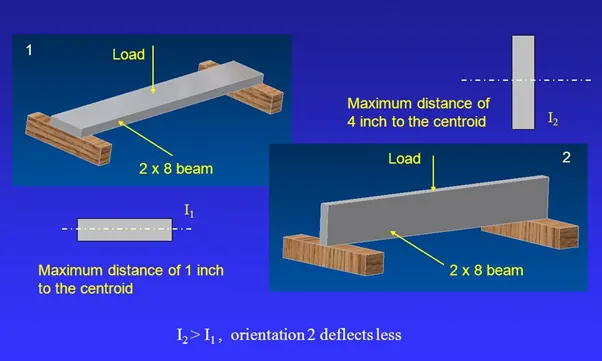
In direct measure of strength of beam, larger the section modulus greater the load bearing capacity and higher the resistance to bending.
Steps Involved –
- A plane is created in the centre of the sheet metal outer and inner panel.
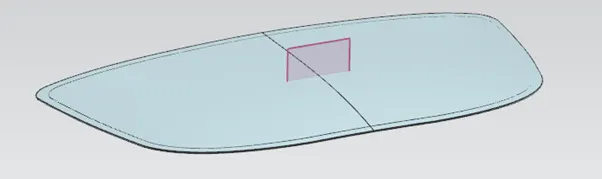
2. On the same plane a intersection curve is obtained.
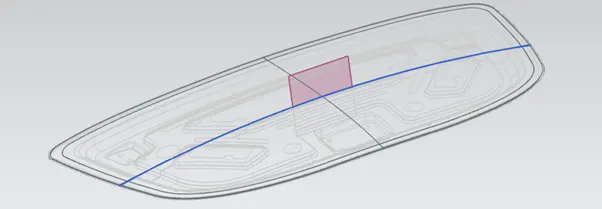
3. Cut section view

4. Hiding the outer and inner panel the intersection curve is taken as sketch on the same reference plane and the open / un-connected sections are connected with splines in sketch.

Case 1 –
Considering the thickness of hood outer panel and inner panel as 0.75mm and taking the intersection curve of that section.
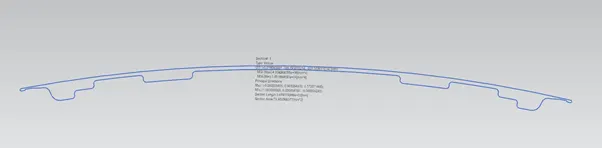
Sectional inertia value obtained,
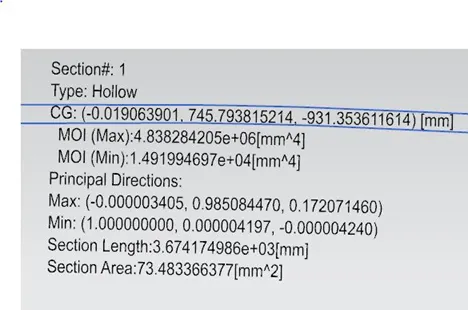
Moment of inertia –
S = I/y
Imax = 4.8382 x 10^6 mm^4
Imin – 1.4919 x 10^4 mm^4
y = 871.7106/2 = 435.85 mm (neutral axis to extreme end of the section)
Smax = 4838284/435.85 = 11,100.8 mm^3
Smin = 14919/435.85 = 34.23 mm^3
Case 2 –
When the hood inner panel curve is offset to 1mm downward so increasing the cross-sectional area, the A Surface provided by styling team its geometrical dimension is fixed and changes cannot be made on that.
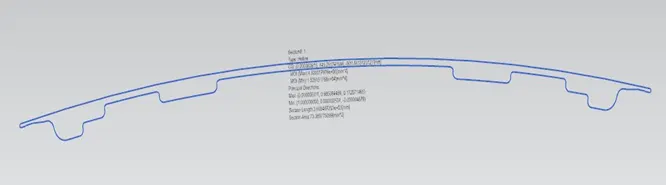
Sectional inertia value obtained
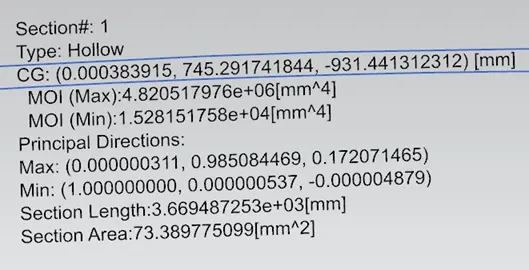
Imax = 4.8205 x 10^6 mm^4
Imin = 1.5281 x 10^4 mm^4
y = 435.85 mm
Smax = 4820517 / 435.85 = 11,060.03mm^3
Smin = 15281 / 435.85 = 35.06 mm^3
Conclusion –
From the above we can conclude that the A surface (outer surface) provided from the styling team is has no geometrical changes & is having nearly same value of the section modulus (Smax). In inner panel distance changes are done so there is increase in section modulus(Smin) from 34.23 mm^3 to 35.06 mm^3 , so increase in moment of inertia ,which adds to strength of the hood part.