Section Modulus calculation and optimization
SECTION MODULUS:
Section modulus is a geometric property for a given cross-section used in the design of beam and flexural members. by finding the section modulus we can find the resistance to remain unchanged when the force is applying to the object or substances.
S= I / Y
S - section modulus (Unit: mm^3)
I - the moment of inertia (Unit: mm^4)
y - the distance between the neutral axis and the end of the object. (Unit: mm)
Types of section modules:
- Elastic Section Modulus:The elastic section modulus is applicable up to the yield point of material.
-
Plastic section modulus:The plastic section modulus is generally used for material in which plastic behavior is observed.The plastic section modulus is the sum of the area of cross section on each side of the plastic natural axis multiplied by the distance from the local centriod of the two ares of the plastic natural axis.
Moment of inertia:
Moment of inertia is defined as the quantity expressed by the body resisting angular acceleration which is the sum of the product of the mass of every particle with its square of a distance from the axis of rotation
Section Modulus Calculation:
For studying the section modulus we need the cross section of hood. For that I created a cross section using intersection curve.
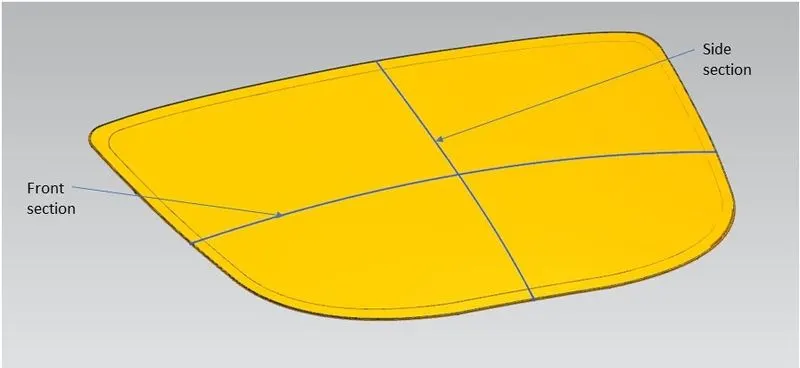
Side section modulus of the hood:
Case 1: Before Optimization
The hood which was already created is imported and the section inertia analysis is done.We have to make sure that the curve obtained is a single/closed curve.
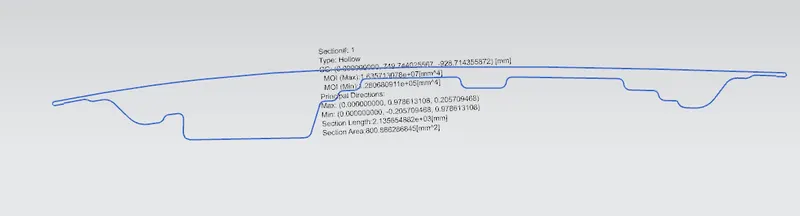
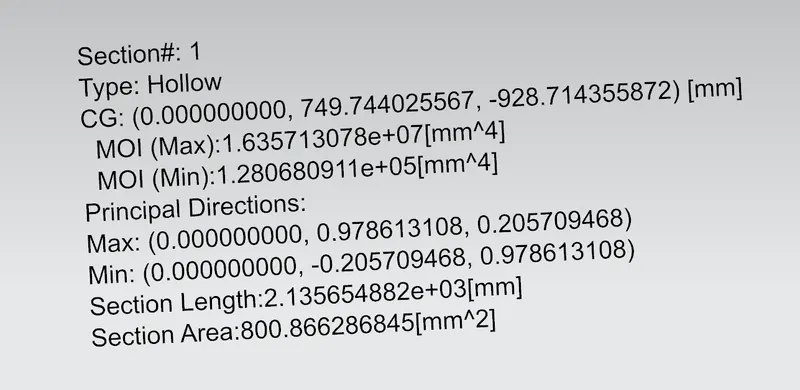
Calculation:
S=I/Y
Here the moment of inertia,(I) =1.2806890911e5 [mm^4]
The distance between neutral axis and extreme end of the object,(Y) = 245.3205 [mm]
S1= 1.2806890911e5/ 245.3205
S1=522.0473181 mm^3
we have to consider the minimum value because from the point only the substance starts to change from its original shape.
Case 2: After Optimization
The outer line of the inner panel is offset to 0.5mm downwards. In other words the depth of the inner panel is increased to notice the changes in the section modulus.
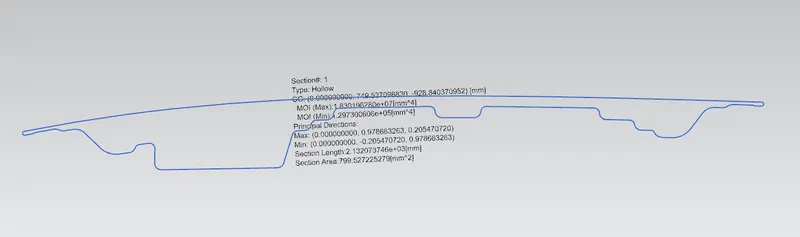
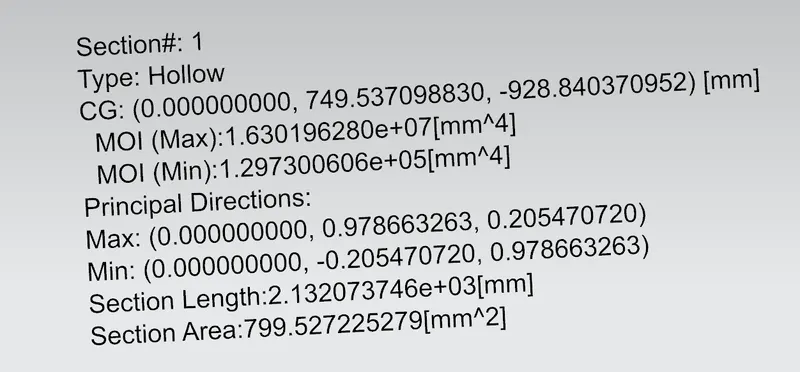
Calculation:
S=I/Y
I=1.297300606e5 [mm^4]
Y=245.3205 [mm]
S2=1.297300606e5/245.3205
S2=528.8186703mm^3
Difference (S1-S2 )=528.8186703-522.0473181=6.77135217mm^3
% of difference =(528.8186703-522.0473181/ 522.0473181)*100=1.297076331%
Front section modulus of the hood:
Case 1: Before Optimization
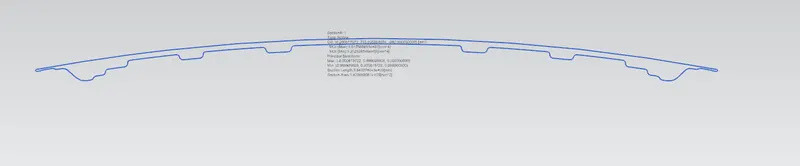
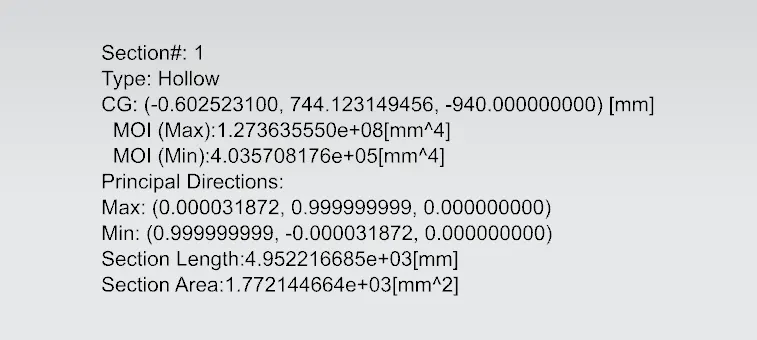
Calculation:
S=I/Y
Here the moment of inertia,(I) = 4.035708176e5 [mm^4]
The distance between neutral axis and extreme end of the object,(Y) = 442.80405 [mm]
S= 4.035708176e5 / 442.80405
S1=911.3982 mm^3
we have to consider the minimum value because from the point only the substance starts to change from its original shape.
Case 2: After Optimization

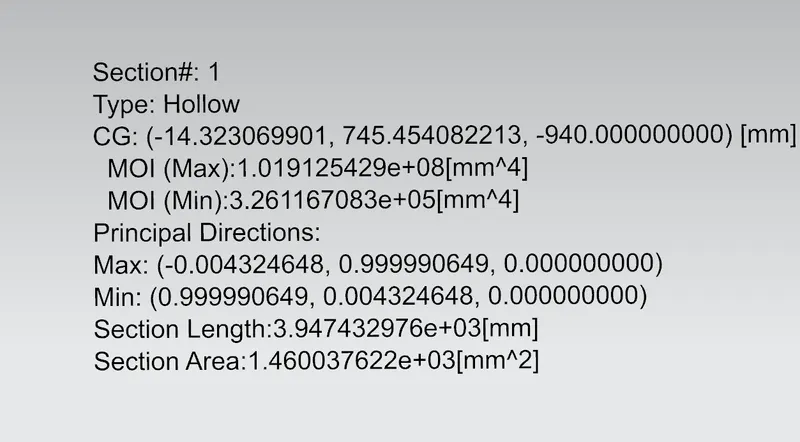
Calculation:
S=I/Y
I=1.297300606e5 [mm^4]
Y=245.3205 [mm]
S2=3.261167083e5/442.80405
S2=736.4808617mm^3
Difference (S2-S1 )=736.4808617-911.3982 =-174.9173383mm^3
% of difference =(736.4808617-911.3982 / 911.3982)*100=-19.19219704%
Conclusion:-
After the modification side section modulus has increased,this clearly shows that strength of the material is directly propertional to the moment of inertia if the area increases the section modulus is also increase.