Fender Design
FENDER: A car fender is a part of a vehicle's body that is located around the wheel well and helps to protect the car from mud, debris, and other elements. It also helps to improve the aerodynamics of the vehicle and can contribute to the overall aesthetic design of the car. Car fenders are typically made of metal or plastic and are easily replaceable in the event of damage.The front fenders are separate components whereas the rear fenders are integrated with the body sides.
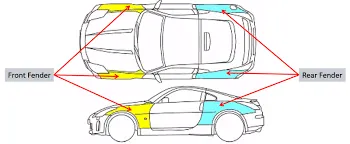
TYPES OF FENDERS:
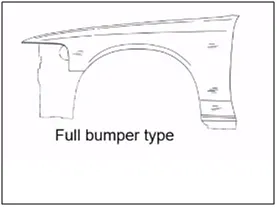
- Full bumper type fender
- Half bumper type fender
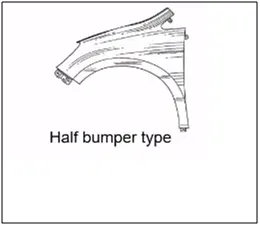
A fender is different than a bumper because it's a metal structure that frames the wheel well in car, instead of the front or back. The fender extends between the front door to the front bumper covering the front wheels of the vehicle.
Manufacturing process
The manufacturing of the fender majorly involves these operations.
1.Embossing
2.Bending
3.Cutting and Blanking
Embossing:
Embossing is a process that creates a raised or recessed design on a flat surface by pressing a shaped die into the material. This process can be applied to a variety of materials, including paper, leather, plastic, and metal. The die used in embossing can have a positive or negative image, with the positive image being raised and the negative image being recessed.
Bending
Bending is a manufacturing process that involves the use of a machine or tool to apply force to a piece of material and cause it to bend into a desired shape. Bending is commonly used in the production of metal, plastic, and wood products, such as pipes, tubes, sheets, and profiles.
Cutting and Blanking:
Cutting is the process of separating a piece of metal into two or more parts using a cutting tool, such as a saw, laser, or water jet. Cutting can be performed on a variety of metal materials and thicknesses and is used in the production of parts for a wide range of industries, including automotive, aerospace, and construction.
Blanking is a type of cutting process in which a piece of metal is cut from a larger piece to create a separate, finished part. Blanking is typically performed on a punch press, where a punch and die set is used to shear the metal along a desired line. The resulting part is known as a blank, and it can be used as-is or further processed to create the final product.
MOUNTING REGIONS ON FENDER:
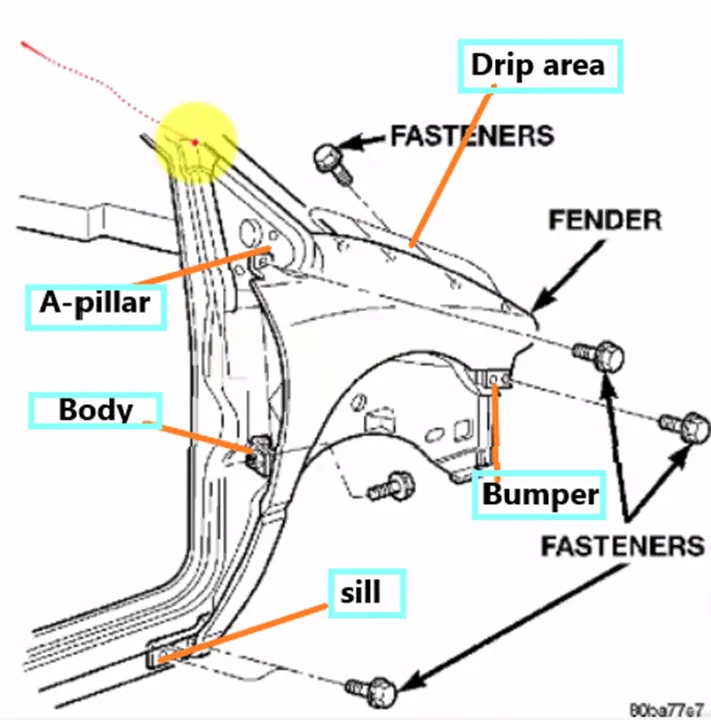
There are five mounting region on a fender
- A-Pillar mounting
- Body mounting
- Sill mounting
- Bumper mounting
- Drip area mounting
Master Section:
Fender skin:
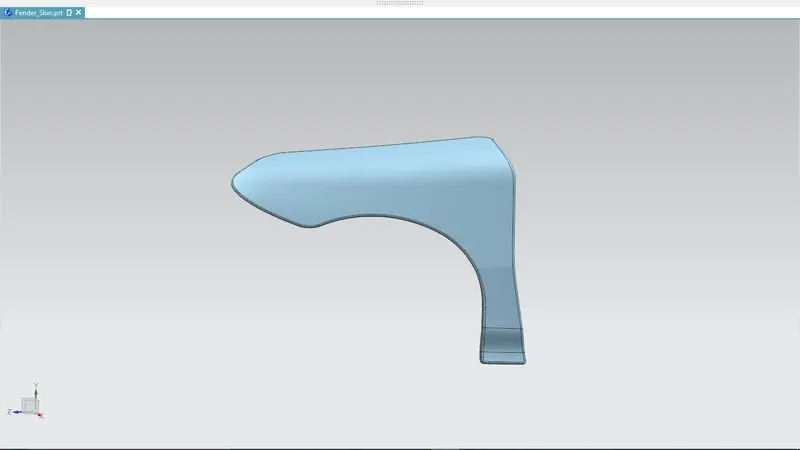
Bumper Mounting:
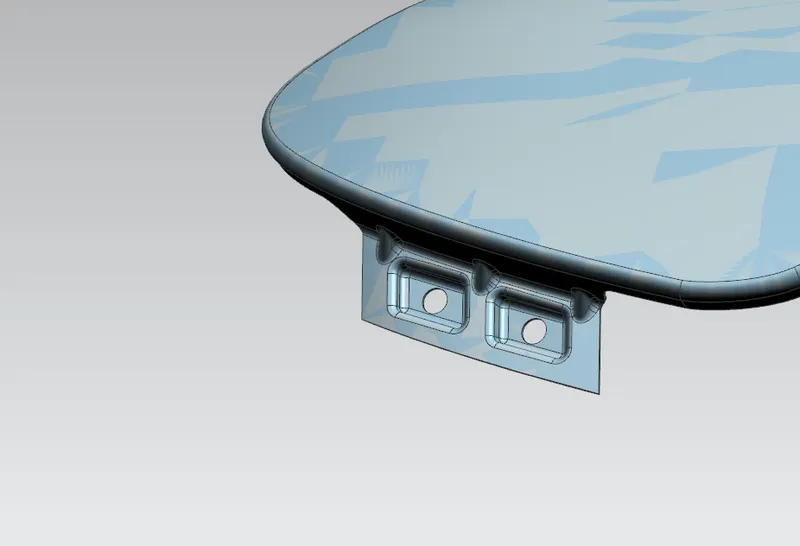
The bumper mounting area is used to fix the plastic bumper to the fender with the help of the fasteners
Drip area Mounting:
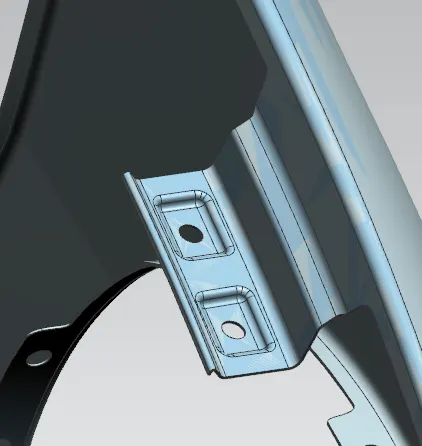
- It is the important mounting unit of the fender . it is connected with the engine compartment , therefore the lot of design constraints are to be followed while designing the fender
- While designing the drip area we have to initially leave 200-300 mm for cowl top
- For placing the headlamp we have to leave at least 150 mm at the front while designing the fender
- Cowl top part consists pf wiper motor and its instruments
- Two darts are added on the longer side of the drip area in order to provide the stiffness and adds strength to the part . This helps the fender to not to vibrate and impact the forces outside of the fender during motion of the vehicle.
- Embossing are provided on the mounting to strengthen them during fastening.
Sill Mounting:
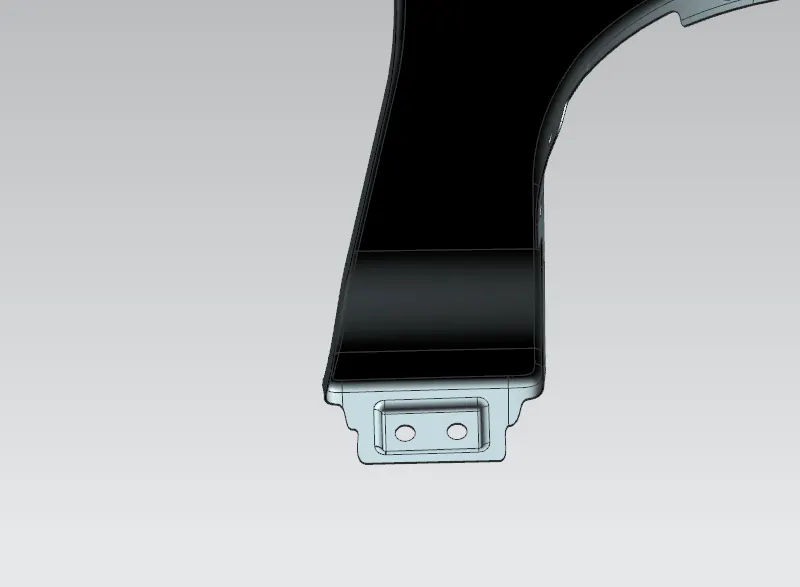
The sill is a structural component of the vehicle that runs along the bottom edge of the door opening. The fenders are attached to the sill using screws, bolts, or other types of fasteners. This method provides a strong and secure attachment and helps to distribute the weight of the fender evenly across the sill. Sill mounting is commonly used for both plastic and metal fenders, and is a common method of attaching fenders to cars and other types of vehicles
A-Pillar mounting:
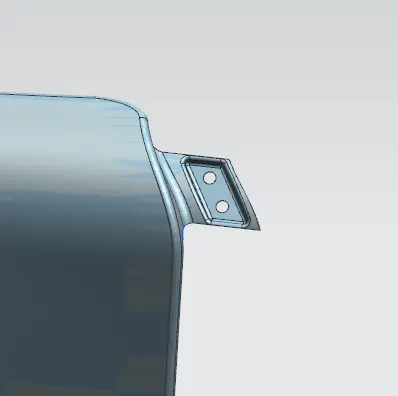
A-pillar mounting in a fender refers to the process of attaching the A-pillar (the vertical structural member at the front of a vehicle that runs from the roof to the floor) to the fender. The A-pillar is a crucial component of a vehicle's structure and provides support for the roof and windshield. In some vehicles, the A-pillar may also be used to mount the fender in place. The process of A-pillar mounting typically involves securing the A-pillar to the fender using bolts, screws, or other hardware. This helps to ensure that the fender remains securely in place and provides the necessary support to the rest of the vehicle's structure.
Baffle Mounting:
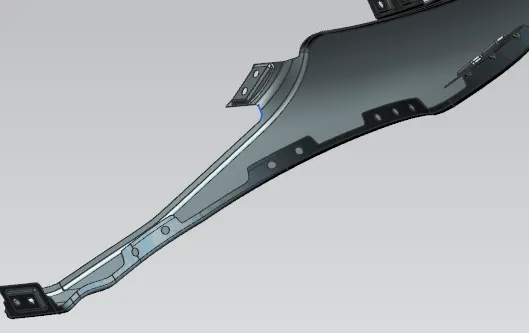
- It is located at the wheel arch area that is the inward area of the fender.
- It is used to protect the fvehicle from dust particles
- It is also used to protect the pederstians from causing from the chips out debris of the car when in motion.
- It is fixed using fasteners and clips.
APPLYING OF THICKNESS TO THE SURFACE
The thickness of 0.75 mm inward on the final sewed surface of the fender to the sheet metal parameters
Purpose of Fender :
Cleanliness : Protect the car, occupants and passers by from items, water, mud, snow, ice, thrown off the tires as you drive.
Safety : Protects pedestrain from the wheel, e.g. its better to be it by a laterally moving fender than a rolling tire, keeps loose, streaming items from being wrapped up in a rolling wheel.
Aerodynamics : Smooths the car profile so you don't get a lot of drag off the uncovered wheels. Some fenders are enclosed on the side for this.
General Appearance : Looks better with fender, gives a finished look, looks more streamlined.
CONCLUSION : Thus, all mounting areas for the fender designed from skin data and master section is done by following all design rules .