Section Modulus calculation and optimization
Section Modulus calculation and optimization
Use the Section from your Hood design and calculate the section modulus using the formula S = I/y
S = Section Modulus
I = Moment of Inertia
y = distance between the neutral axis and the extreme end of the object
Come up with a new section that has improved the section modulus of the previous section and mention what change you made that has increased the strength.
Aim: Calculation and Optimization of Section Modulus for Hood (i.e to increase strength of hood)
Section Modulus:
- The section modulus of the cross-sectional shape is of significant importance in designing beams or flexural members.
- It is a geometric property which is of direct measure of the strength of the beam.
- A beam that has a larger section modulus than another will be stronger (i.e more resistive to bending) and capable of supporting greater loads.
- The ratio of total moment resisted by the section to the stress in the extreme fiber.
- It gives us an idea about how much load the given structure can take.
- If the section modulus increases the moment of resistance increases and hence its load-bearing capacity.
The elastic section modulus (S) is defined as the ratio of the overal moment of area (I) (or area moment of inertia) to the most extreme fiber distance (y) from the overall bending neutral axis of a part or beam system.
S=I/y
Its unit is mm^3
There are two types of section modulus:
- Elastic section modulus(S).
- Plastic section modulus(Z).
Section Modulus is also referred to as the Polar Modulus (J) or the Torsional Sectional Modulus for circular sections.
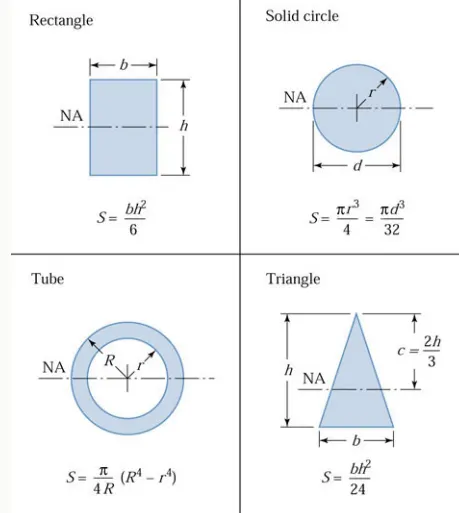
Image above shown section modulus are commonly used cross-sections.
Significance of Section Modulus:
- Section modulus is an important factor for designing beams and flexural members. The higher the section modulus, the higher will be the resistance to bending.
- Easier to calculate strength and stresses in beams.
- If two beams are made of the same material and the section modulus of two beams are being compared and vice versa, the beam with a larger section modulus will be tougher and more capable to withstand larger loads.
SECTION MODULUS CALCULATION AND OPTIMIZATION
To calculate section modulus the below section was considered which has be to parallel to x-coordinate. We Create an intersection Curve with the help of the plane consider both the Outer & Inner panels of the hood.
Image below shows middle section of hood taken for consideration
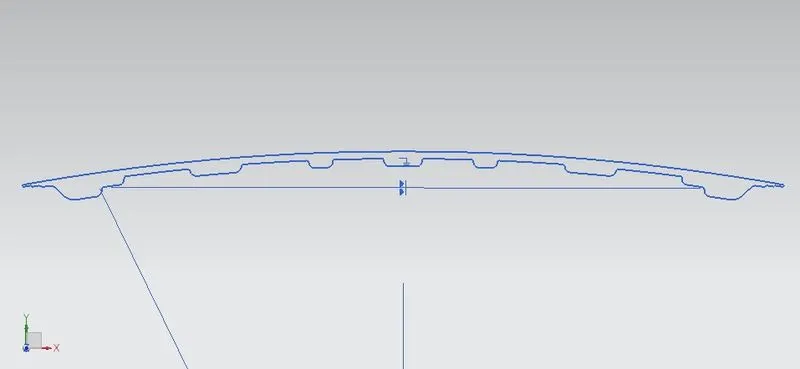
Case 1 : Intial hood design study
- Section of the hood design is studied.
- Section inertia analysis tool is used to find area moment of inertia for the section considered.
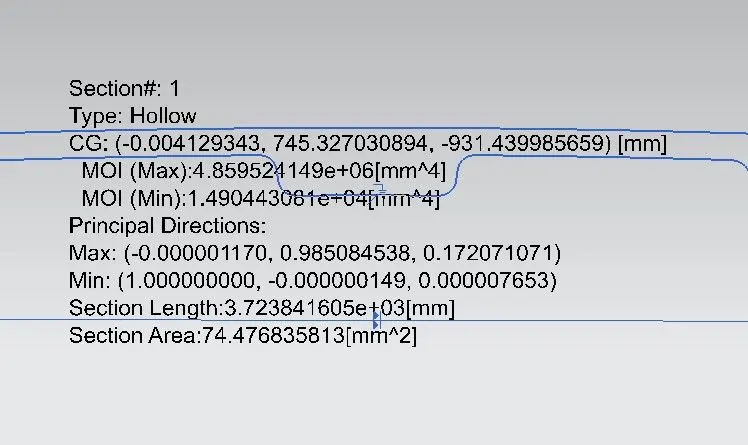
Moment of Inertia (MOI), Imax = 4.859524149 x 10^6 [mm^4]
= 4859524.149 [mm^4]
Moment of Inertia (MOI), Imin = 1.49044308 x 10^4 [mm^4]
= 14904.4308 [mm^4]
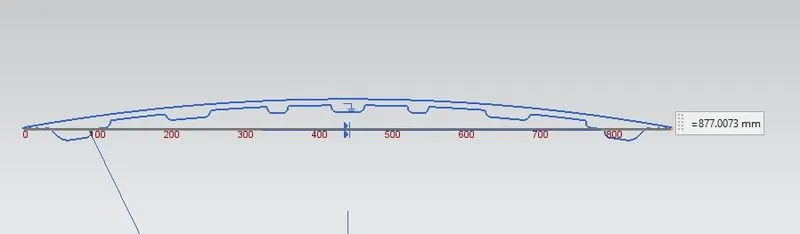
Distance between the neutral axis and the extreme end of the object, y = 877.007 mm / 2 = 438.50 mm
Section Modulus, S = Moment of Inertia (MOI), I/ Distance between the neutral axis and the extreme end of the object (y)
S = I/y
We go with the minimum moment of inertia to find minimum strength of the hood in order to satisfy the requirement.
Moment of inertia, S=(14904.4308)/(438.50)
S= 33.989 mm^3
Case 2: Optimized Hood design study
- The motive here is to increase the strenth of the hood (i.e Section Modulus) that can be achieved by various means like changing the geometry, increasing the thickness etc.
- Here the depth of the inner panel is increased by 2.5mm
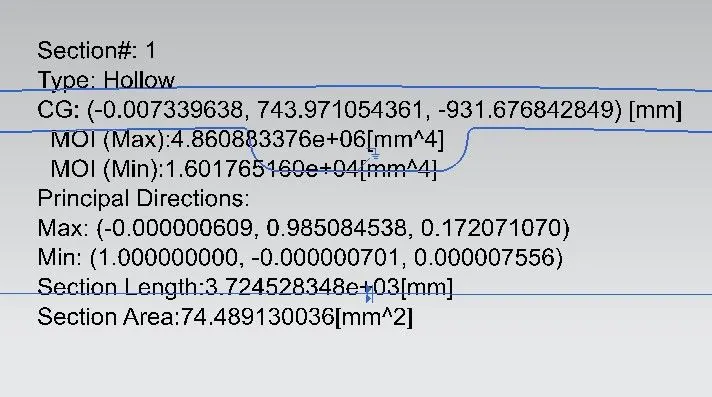
Moment of Inertia (MOI), Imax = 4.8608833 x 10^6 [mm^4]
= 4860883.3 [mm^4]
Moment of Inertia (MOI), Imin = 1.6017651 x 10^4 [mm^4]
= 16017.651 [mm^4]
Distance between the neutral axis and the extreme end of the object, y = 877.007 mm / 2 = 438.50 mm
Section Modulus, S = Moment of Inertia (MOI), I/ Distance between the neutral axis and the extreme end of the object (y)
S = I/y
We go with the minimum moment of inertia to find minimum strength of the hood in order to satisfy the requirement.
Moment of inertia, S=(16017.651)/(438.50)
S= 36.528 mm^3
From above observations, it can be infered that strength of the hood is directly propotional to the Area moment of Inertia(I). When I increases hoods strength increases.
Conclusion:
Thus the section modulus of the Front Hood of a car was calculated and compared with the optimized hood and found the better result. Hence we can conclude that when the sectional area of the hood increases the stiffness and resistance of the hood strength will also be increased.