Project - Analysis of a practical automotive wiring circuit
Aim: Analysis of a practical automotive wiring circuit.
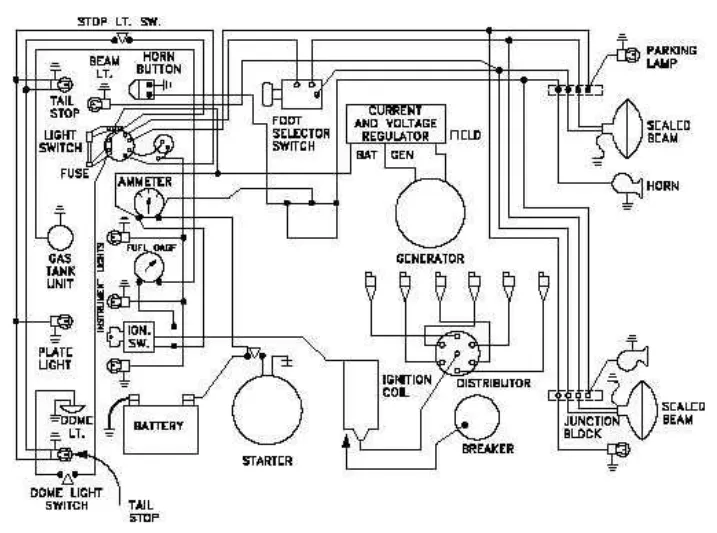
- Identify each of the major elements in the above automotive wiring diagram.
- Explain the purpose and working of any three elements briefly.
- If the total load is 10A from battery, what should be the fuse rating?
- If 500W is the load, what is the voltage and capacity of battery you recommend?
- Identify any two elements which are connected parallel to each other. Why they are connected in parallel?
- Identify any two elements which are connected in series. Why they are connected in series?
Battery voltage =12V
Description:
I.Major elements in the above automotive wiring diagram:
- Battery
- Starter
- Ignition Switch
- Ammeter
- Fuse
- Foot selector switch
- Current and voltage regulator
- Parking lamp
- Sealed beam
- Horn
- Generator
- Distributor
- Breaker
II.Purpose and working of Elements in the circuit:
- Starter:
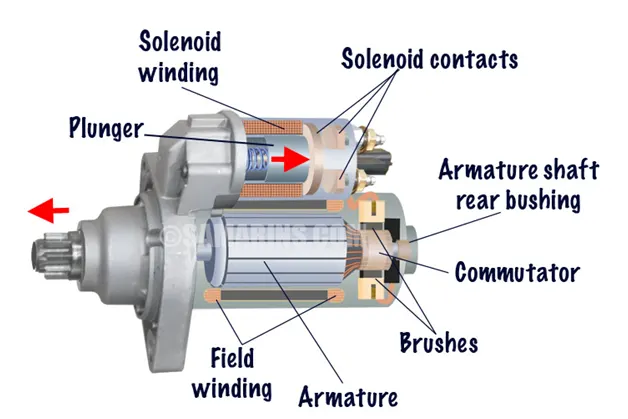
Starter is a device used to crank an Internal Combustion engine so as to initiate the engine power under its own power.
When we turn on the key in car’s ignition, the engine cranks. For cranking it requires a flow of air into the engine, which can only be achieved by creating suction (the engine does this when it turns over). If engine isn’t turning ON, there’s no air. No air means that fuel can’t combust. The starter motor is responsible for turning the engine over during ignition and allowing everything else to happen. When you turn the ignition on, the starter motor engages and turns the engine over allowing it to suck in air. On the engine, a flywheel, with a ring gear attached around the edge, is fitted to the end of the crankshaft. On the starter, the pinion is designed to fit into the grooves of the ring gear. When you turn the ignition switch, the electromagnet inside the body engages & pushes out a rod to which the pinion is attached. The pinion meets the flywheel and the starter motor turns. This spins the engine over, sucking in air (as well as fuel). As the engine turns over, the starter motor disengages, and the electromagnet stops. The rod retracts into the starter motor once more, taking the pinion out of contact with the flywheel and preventing potential damage.
- Generator:
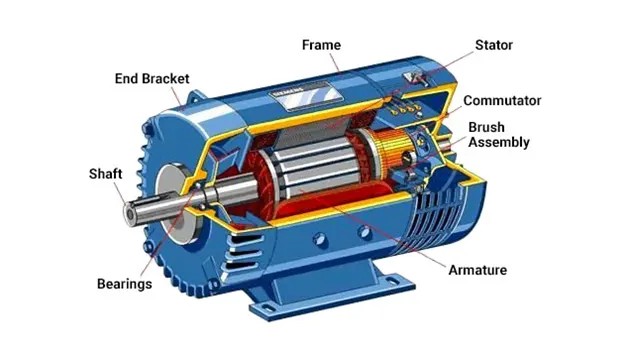
AC generator is a machine that converts mechanical energy into electrical energy. The AC Generator’s input supply is mechanical energy supplied by steam turbines, gas turbines and combustion engines. The output is alternating electrical power in the form of alternating voltage and current.
AC generators work on the principle of Faraday’s law of electromagnetic induction, which states that electromotive force – EMF or voltage – is generated in a current-carrying conductor that cuts a uniform magnetic field. This can either be achieved by rotating a conducting coil in a static magnetic field or rotating the magnetic field containing the stationary conductor. The preferred arrangement is to keep the coil stationary because it is easier to draw induced alternating current from a stationary armature coil than from a rotating coil.
The generated EMF depends on the number of armature coil turns, magnetic field strength, and the speed of the rotating field.
The various parts of an AC generator are:
- Field
- Armature
- Prime Mover
- Rotor
- Stator
- Slip Rings
- Distributor
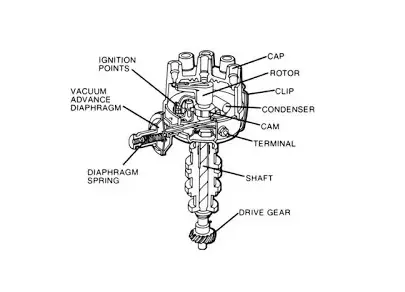
A distributor is an electric and mechanical device used in the ignition system of older spark ignition engines. The distributor's main function is to route electricity from the ignition coil to each spark plug at the correct time.
As the ignition distributor shaft rotates, it rotates the cam and rotor. When the cam pushes the cam follower of the contact breaker, the contact factors of the contact breaker opens and collapses the primary current through the primary winding. This produces a excessive voltage current in the secondary winding. The excessive voltage current produced is transfer to the distributor’s relevant terminal.The current from the relevant terminal reaches to the outer edges of the rotor thru the carbon bush. As the rotor is available in the front of the internal terminal of the spark plug in the distributor cap, the high voltage electric pulses (or surge) pass to the spark plug and it produces a spark within the cylinder head.
The distributor produces spark in every of the spark plug in in correct sequence and in correct amount of time.
III. If the total load is 10A from battery, what should be the fuse rating?
Load = 10A
Fuse rating = 10A*135% = 13.5A
For this 15A standard fuse can be selected.
IV. If 500W is the load, what is the voltage and capacity of battery you recommend?
Given: Load = 500W Voltage of battery = 12V
Considering for 1hour,
Energy = 500W * 1hour = 500Wh
We know that Capacity, Ah = Wh/V
Capacity = 500Wh/12 = 41.7 Ah
V. Identify any two elements which are connected parallel to each other. Why they are connected in parallel?
Horn is connected in parallel with Parking lamp. This is done because we need to turn on both at different times. If we connect both in series both Horn and Parking lamp will turn ON at the same time.
VI. Identify any two elements which are connected in series. Why they are connected in series?
Battery is connected in series with Ammeter. This is done because all the current measuring will happen in series.