Project-1: Powertrain for aircraft in runways
Part A:
- Search and list out the total weight of various types of aircrafts.
Ans.
- In the aircrafts many types of weight is consideration like gross weight, maximum landing weight, Maximum take-off weight etc.
- Manufacture empty’s weight :- It is the weight of aircraft as built and including weight of structure, power plant and other integral part which is necessary to built.
- Max fuel weight :- It is weight of total usable fuel in aircraft.
- Max cargo weight :- It is carrying capacity of passenger people, cargo, extra fuel. This weight is also known as payload capacity.
- Maximum take-off weight :- This is weight which the pilot of aircraft is allowed to attempt to take off.
- Maximum landing weight :- This is weight which an aircraft is permitted to land.
- Maximum ramp weight :- This is weight which authorized for maneuvering an aircraft to ground.
- Operating empty weight :- It is the basic weight of an aircraft including the crew, all fluids necessary for operation such as engine oil, engine coolant, water, unusable fuel and all operator items and equipment required for flight but excluding usable fuel and the payload.
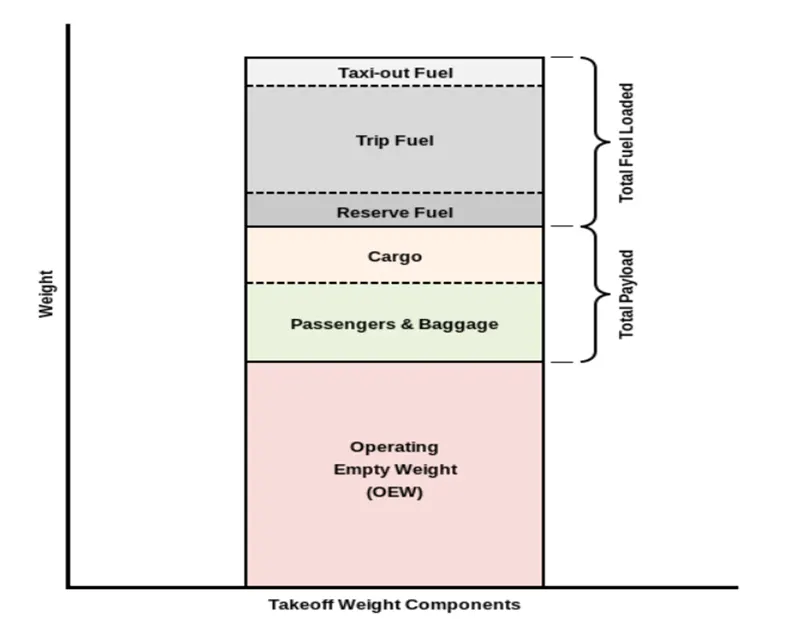
Typical airplane weight is below shows.
|
Aircraft |
Empty Weight |
Max Fuel Weight |
Max Cargo Weight |
Max Gross Takeoff Weight |
|
628,000 lbs |
661,400 lbs |
417,000 lbs |
1,411,000 lbs |
|
|
611,000 lbs |
560,000 lbs |
185,000 lbs |
1,268,000 lbs |
|
|
485,300 lbs |
427,400 lbs |
295,000 lbs |
987,000 lbs |
|
|
370,000 lbs |
386,300 lbs |
119,000 lbs |
820,000 lbs |
|
|
370,000 lbs 168,000 kg |
320,800 lbs 145,500 kg |
148,000 lbs |
776,000 lbs |
|
|
299,000 lbs 135,500 kg |
223,500 lbs |
126,300 lbs 57,300 kg |
560,000 lbs |
|
|
98,500 lbs |
53,100 lbs |
44,600 lbs |
187,000 lbs |
|
|
93,900 lbs |
48,700 lbs |
44,000 lbs |
150,000 lbs |
|
|
63,500 lbs |
28,600 lbs |
28,800 lbs |
106,000 lbs |
|
|
54,000 lbs 24,500 kg |
48,200 lbs 21,900 kg |
6,500 lbs |
100,000 lbs |
|
|
48,160 lbs 21,850 kg |
19,600 lbs 8,900 kg |
6,075 lbs 2,760 kg |
80,500 lbs |
|
|
39,300 lbs |
11,700 lbs |
18,700 lbs |
62,000 lbs |
|
|
13,900 lbs 6,300 kg |
6,060 lbs |
2,900 lbs |
21,500 lbs |
|
|
10,300 lbs 4,700 kg |
5,800 lbs |
2,200 lbs 1,000 kg |
17,200 lbs |
|
|
7,100 lbs 3,200 kg |
3,200 lbs |
4,150 lbs |
12,000 lbs |
|
|
3,200 lbs |
340 lbs |
1,250 lbs |
4,400 lbs |
|
|
2,500 lbs 1,150 kg |
450 lbs |
850 lbs |
3,660 lbs |
|
|
2,200 lbs |
520 lbs |
1,150 lbs |
3,600 lbs |
|
|
2,250 lbs 1,000 kg |
485 lbs |
950 lbs |
3,600 lbs |
|
|
1,700 lbs |
380 lbs |
560 lbs |
2,425 lbs |
- Is there any difference between ground speed and air speed?
Ans.
- There is difference between ground speed and air speed which understand by relative velocity concept.
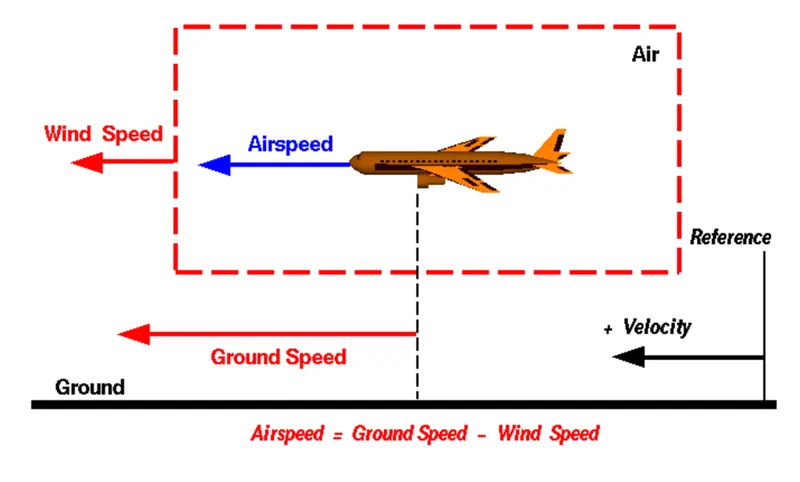
- Aerodynamic forces are generated by an object moving through a fluid (liquid or gas). A fixed object in a static fluid does not generate aerodynamic forces.]
- It is important to understand the relationships of wind speed to ground speed and airspeed.
- Wind speed is vector quantity and it has both magnitude and direction. A positive velocity is defined to be in the direction of the aircraft's motion.
Ground speed :-
- Ground speed is simply the sum of airspeed and wind speed.
- Ground speed = airspeed + wind speed
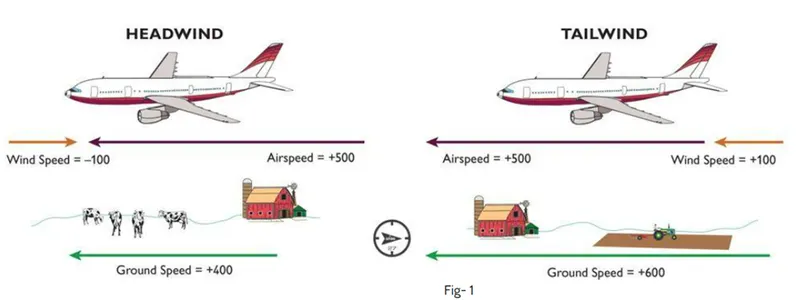
- If the aircraft is flying in the same direction as the wind is blowing, the aircraft experiences tailwind, and its ground speed is higher than its airspeed. On the other hand, if the wind is blowing against the direction the aircraft is traveling in, the aircraft experiences headwind, and its ground speed is lower than its airspeed.
Air speed :-
- The important quantity in the generation of lift is the relative velocitybetween the object and the air, which is called the
- Airspeed cannot be directly measured from a ground position, but must be computed from the ground speed and the wind speed. Airspeed is the vector difference between the ground speed and the wind speed.
- Why is it not recommended to use aircraft engine power to move it on the ground at Airport?
Ans.
It is not recommended to use aircraft engine power to move it on ground at airport here are some reason behind that is discuss below.
Most of aircraft can’t move in reverse direction.
- Unfortunately some aircraft can’t reverse so we do not taxing aircraft we always need towing for this type of aircraft.
Engine thrust hazards in environmental of airport.
- commercial airplanes are equipped with engines rated from 18,000 to nearly 100,000 lb of thrust. Such thrust levels provide for safe takeoff, flight, and landing over a wide range of temperatures, altitudes, gross weights, and payload conditions. However, the exhaust wake from these engines can pose hazards in commercial airport environments. Operators and airport authorities must carefully consider these hazards and the resulting potential for injury to people and damage to or caused by baggage carts, service vehicles, airport infrastructure, and other airplanes.
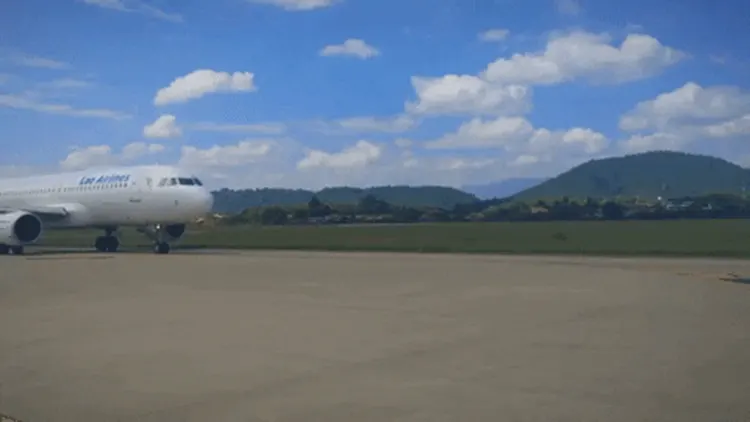 Taxing the aircraft
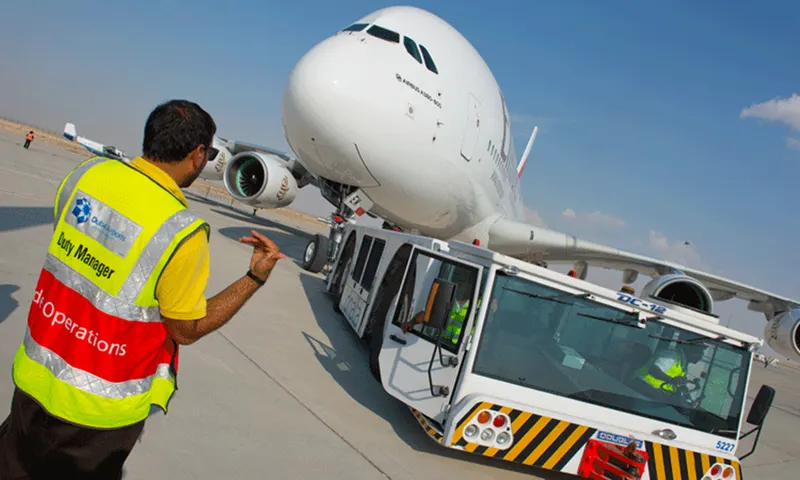
Towing the aircraft
There are some reason which is conclude that it is not recommended to use aircraft rngine power to move it on the ground at airport.
- There is risk to damage near by the aircraft ground support person or equipment.
- It is also take more fuel in taxing compare to towing.
- The aircraft engine is more louder these makes uncomfortable to passenger and near by airport area.
- In taxing the aircraft loss of control makes big accident in specially high power engine running.
- How an aircraft is pushed to runway when its ready to take off?
Ans.
- When aircraft is in parking lot there are mainly two ways first is taxing the aircraft and second is towing the aircraft.
- Taxing is refers to movement on the ground in which aircraft is use it’s own power. In this aircraft is move by it’s own wheels. In the parking area taxing is not safe or practical.
- In this aircraft is always move in yellow line to avoid the collision with surrounding building and it’s speed is limited. The image of taxing is above shows in question 3.
- Towing is performed by ground vehicle attached to nose leading gear. This is traditional method to move aircraft by nose leading or means of towbar.
- This is very safe compare to taxing because in taxing pilot can’t see the behind the aircraft. This towing image is shows in above question 3.
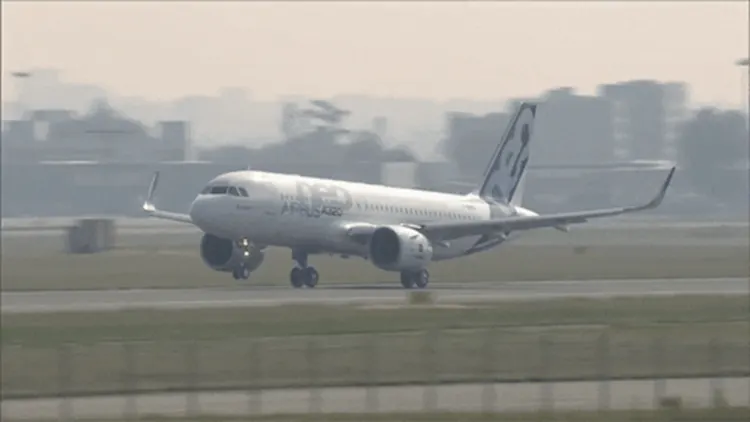
Take off aircraft
- Above the ways aircraft is reach to runways for flying.
- Take off is phase of flight in which aircraft goes through transition from moving along the ground to flying in the air, usually starting on runway.
- Before the take off first engine check routinely run up to high power to check for engine related problems. This make considerable noise.
- When the pilot release the brake aircraft starts accelerating rapidly until necessary speed for take off is achieved.
- Take off speed is achieved by v-speeds, v1 and v2.
- This speed is depend not only by above factor but it’s depend also on runways slope, length.
- if below v1 in case of critical failure and take off should be abort and above v1 continue to take off process and v2 is safe speed for take off.
- Learn about take off power, tyre design, rolling resistance, tyre pressure, brake forces when landing.
Ans.
Take off power :-
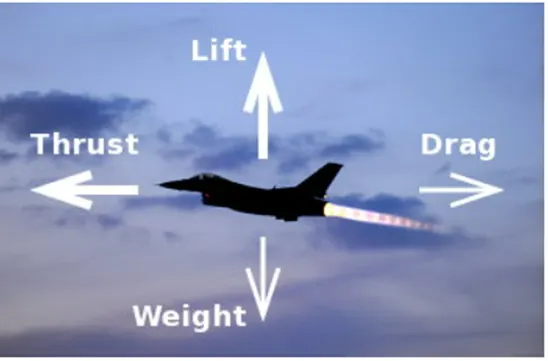
- Take off power usually is full power of aircraft. In the large aircraft take off power is lesser than full power for take off because of long life spam of engine, require less maintenance and noise is less produce.
- In some case power produce is increase to increase the aircraft’s performance.as we know usually before take off aircraft runs at full power to check engine related problems.
- For take off pilot release the brake and push the throttle for maximum power for take off which is take off power.
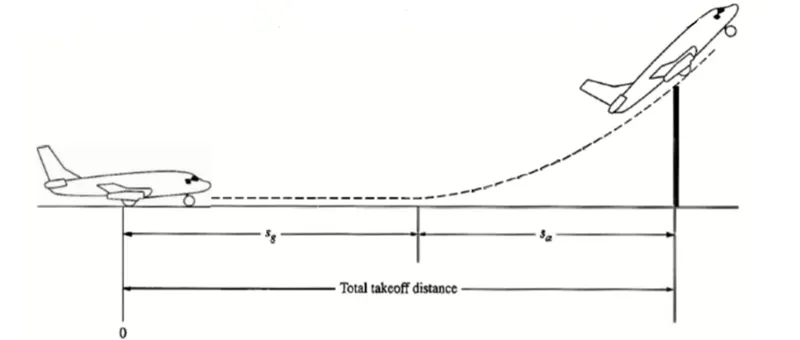
- Aircraft is accelerate the down the runway.
- At some distance aircraft is lift in air and distance of starting the runway to aircraft lift up in air covered distance is know as ground roll. This is mentioned in above image as sg.
- The distance is to aircraft is in airborne but before it clears the obstacle of 50ft for military aircraft and 35ft for commercial aircraft this covered distance is airborne roll. This mentioned in above image as sa.
- The total of sg and sa is known as take off distance.
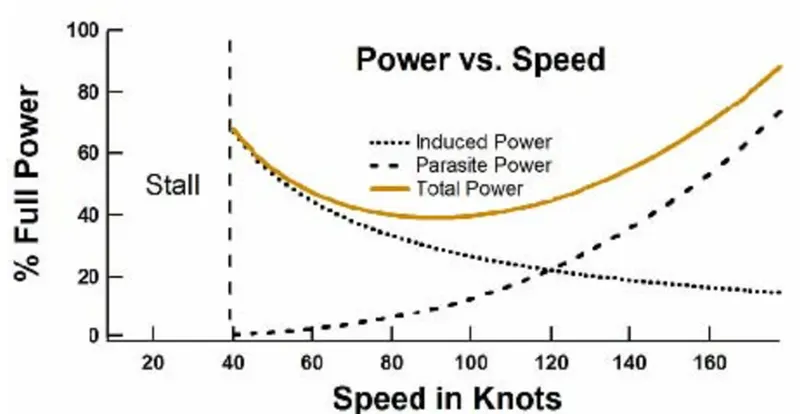 ++++
++++
- In above figure we can see that total power is sum of induced power and parasite power.
Tyre design :-
- For aircraft tire designed the main on to withstand the extremely heavy load for short duration and high temperature resist.
- Aircraft tires also include fusible plugs , designed to melt at a certain temperature .
- Tires often overheat if maximum braking is applied during an aborted take off or emergency landing.
- Designing tire is very intense undertaking. Carcass plies are used to form tire. They are sometimes called casing plies.
- Aircraft tyre is constructed for the purpose it serves.
- They support weight of aircraft while it is on ground.
- It also provides necessary traction for braking and stopping of an aircraft.
- Tyre also helps to absorb shock of landing and provide cushioning roughness of takeoff , roll-out, taxi operations.
- For aircraft tire two types of tires are used in aircraft. First is bias plies and second is radial plies.
- This both types pf tire have share some similarities in design. The different between these two tyre is lay of plies within carcass.
Lets go for some technical aspect of tire.
- Retreading :- retreading is methods of restoring a worn tyre by renewing tread area or by renewing the tread area plus one or both sidewalls. Repair are include in the tyre retreading process.
- Load rating :- load rating is the maximum permissible load at a specified inflation pressure.
- Ply rating :- ply rating is used to identify the maximum recommened load rating inflation for a specified tire. It is an index of tyre strength.
- Speed rating :- the speed rating is the maximum take off speed to which tyre has been tested.
- Skid depth :- skid depth is distance between tread surface and deepest groove as measured in mould.
- Aircraft tyres must have an approved speed and load rating and have sufficient clearance when retracted through landing gear to allow for type growth.
- Tyre growth is increase in size of tyre due to centrifugal forces at high speed.
Rolling resistance :-
- There is rolling resistance occur by friction between tire and ground.
- When the aircraft is moving in ground by taxing or towing at that time rolling resistance force is act against the traction force of aircraft.
- This rolling resistance force is depending upon the surface of road, roughness of road, dry or wet of road, tire pressure, tire material etc, which is determine by rolling resistance.
- Equation of rolling resistance Frr = Urr*m*g
Tyre pressure :-
- The tire pressure of aircraft is very high ti minimize the rolling resistance and withstand the weight.
- Usually tire pressure is 190 to 320 psi based on aircraft types it’s varies.
- Aircraft tire is inflated with nitrogen gas to minimize the expansion and contraction from extreme changes ambient temperature and pressure experience during flight.
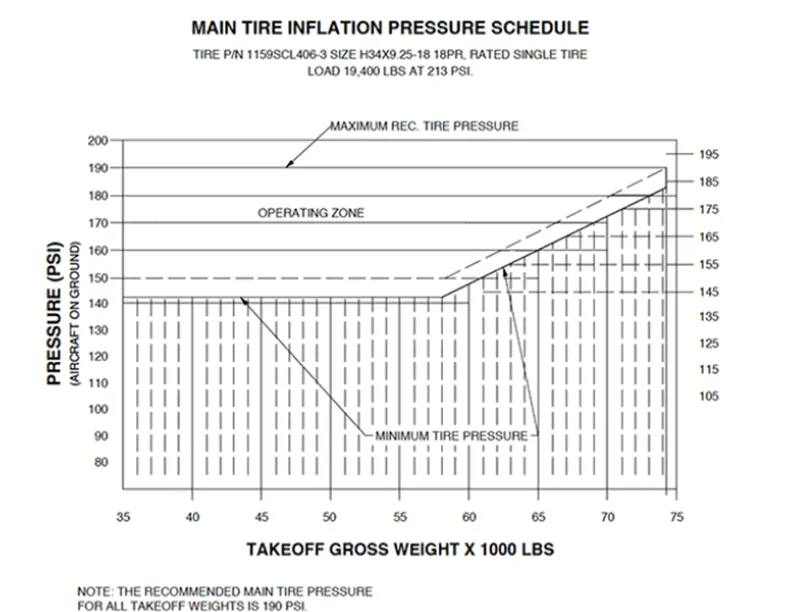
- The maximum allowable tire pressure loss is 5% per day. This according to u.s. federal aviation administration.
Brake force when landing :-
- Stopping the aircraft landing at 180-200 mph required lot of braking force.
- To do this aircraft has brake unit on each of the wheels on the main gear assembly.
- On landing time pilot should use aerodynamic braking by applying extra back-pressure on quickly approaching.
- Applying brakes at too high speed could burn tires, wear out brakes, or result in a ground loop or swerve.
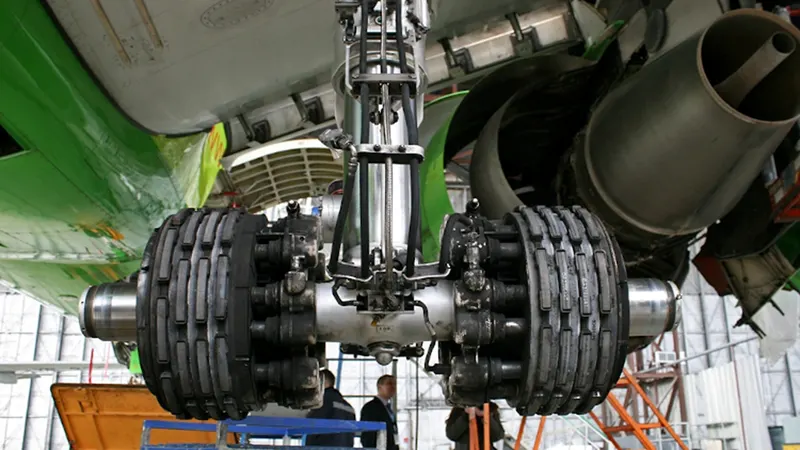
- This mechanics is provided on each wheel for brake.
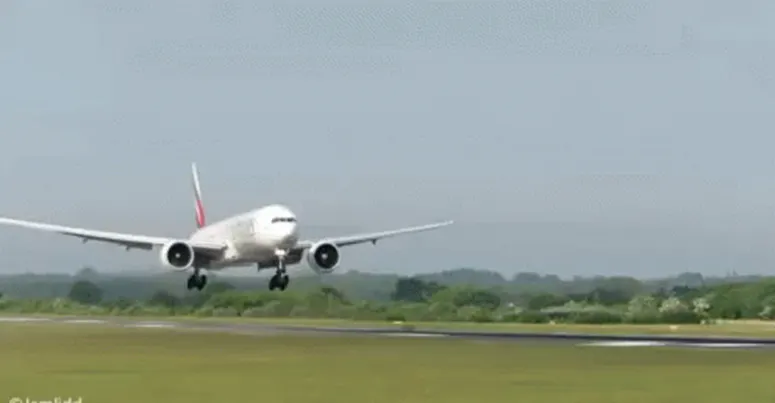
- There is other way also work to brake the aircraft to more aerodynamic drag force generated by means of change at landing time to provided brake.
Part B:
6A. With necessary assumptions, calculate the force and power required to push / pull an aircraft by a towing vehicle.
Ans.
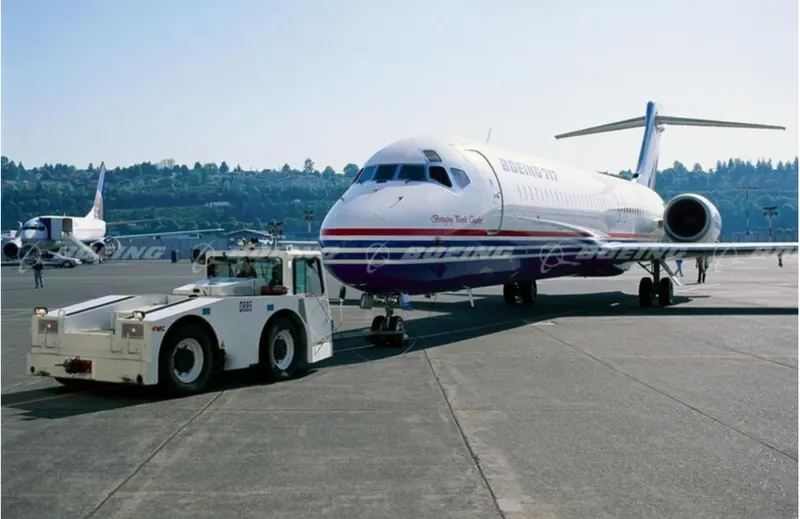
- For push/pull the aircraft mainly three type of forces will act on aircraft and towing vehicle.
- Rolling resistance
- Aerodynamic drag force
- Hill climbing force
- Rolling resistance force :-
Rolling resistance force (Frr) = Urr*m*g,
Where Urr = co-efficient of rolling resistance friction,
M = mass
G = gravitational acceleration
Let assume that towing vehicle mass = 55000kg
Aircraft mass = 183700 kg
Towing vehicle front area = 20 m^2
Speed of vehicle = 30 km/hr = 8.33 m/s
Urr = 0.013
Frr = 0.013*(55000+183700)*9.98
= 30,969 N
- Aerodynamic drag force :-
Aerodynamic force (Fad) = ½*row*V*A*cd
Where row = air density
V = speed of vehicle
A = reference area
Cd = drag coefficient
= 0.5*1.225*8.33*20*0.545
= 51.514N
- Hill climbing force :-
Hill climbing force = m*g*sin(theta)
= 238700*9.98*0
= 0N
So now total traction force = rolling resistance + aerodynamic drag force + hill climbing force
= 30969 + 51.514 + 0
= 31020.514 N
So now we can calculate total power = total force * velocity
= 31020.51 *8.33
= 258 kw
6B. Develop the model for the calculated force and power using Simulink.
Ans.
Model image is below shows.
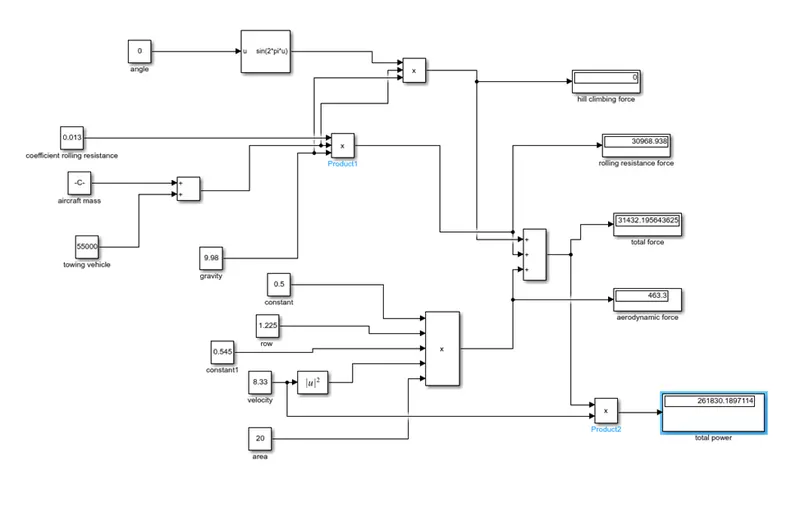
Below the file is attached for more explore and link is below given.
In this model we used constant sine look-up table, sum, multiplier, display, square block to perform the force and power calculation in Simulink.
7A. Design an electric powertrain with type of motor, it’s power rating, and energy requirement to fulfill aircraft towing application in Simulink. Estimate the duty cycle range to control the aircraft speed from zero to highest. Make all required assumptions. Prepare a table of assumed parameters. Draw a block diagram of powertrain.
(Hint :DC7 Block)
Ans.
Assumptions are require which is below table shows.
|
motor assumed parameter |
|
|
Radius of tyre tug |
0.653m |
|
gear ratio |
8 |
|
transmission efficiency |
87% |
|
motor efficiency |
95% |
|
battery capacity |
380v |
|
power required to aircraft |
261.8kw |
|
force required to aircraft |
31.4kN |
|
speed of vehicle |
8.33m/s |
|
towing operation |
30min |
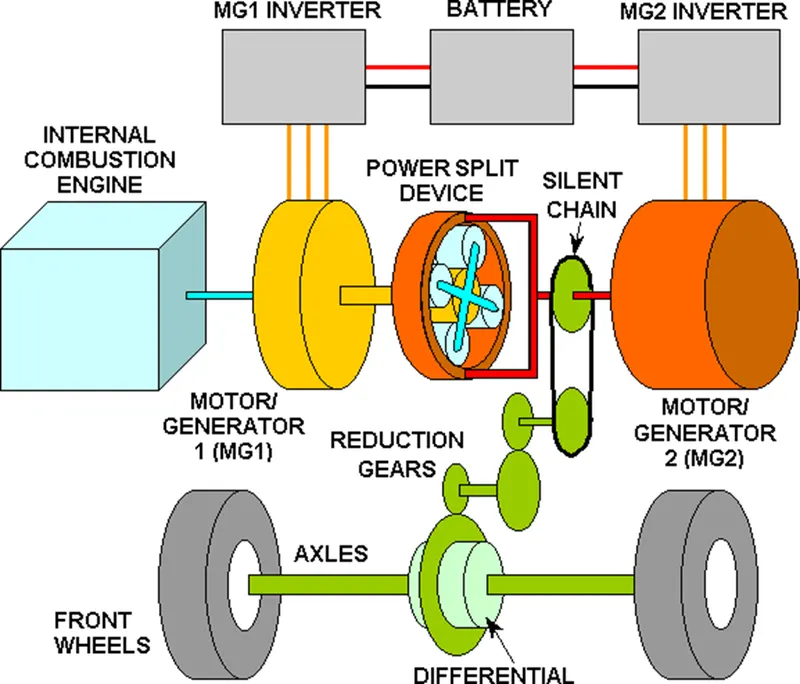
Based on the calculations done in 6A.
Velocity of vehicle = 8.33m/s
Force is required to push/pull aircraft = 31.4KN
Power required = 261.8 KW
Let us assume,
Radius of tyre for tug = 0.635m
Gear ratio = 8
Transmission efficiency(nt) = 87%
Motor efficiency(nm) = 95%
So now we calculate further problem,
Torque required for wheel(Tw) = total force*radius in meters
= 31.4*0.63
= 19.782KNm
Motor torque = wheel torque/(gear ratio*nt)
= 19.782/(8*0.87)
= 2.841 KNm
For nm =95%
Required motor torque = 2.841/0.95
= 2.99KNm
Similarly for power,
Power required by motor considering all efficiencies = 261.8/(0.87*0.95)
= 316.75kw
Let assume that towing operation is done in 30 minutes(0.5 hour).
Total energy consumed = 316.75*0.5
= 158.37 kWh
If we consider battery capacity = 380kw is used by towing vehicle then,
Duty cycle range to control the speed from 0 to max speed is given as
Duty cycle = required power / rated power
= 316.75/380
= 0.833
Therefore the controller will be able to provide a duty cycle ranging from 0 to 83% in order to control towing speed.
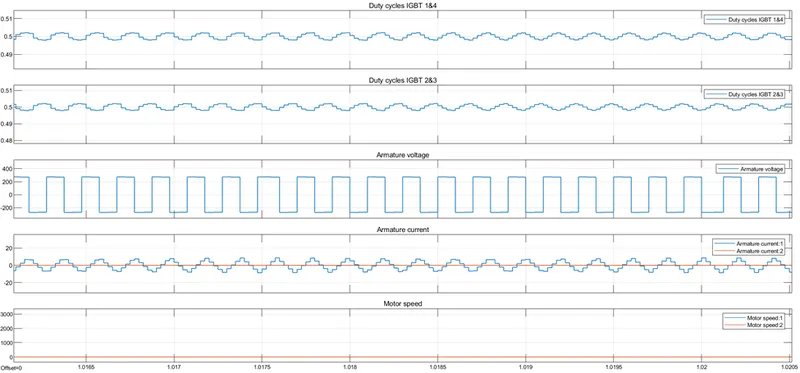
Now we simulate the model of this motor.
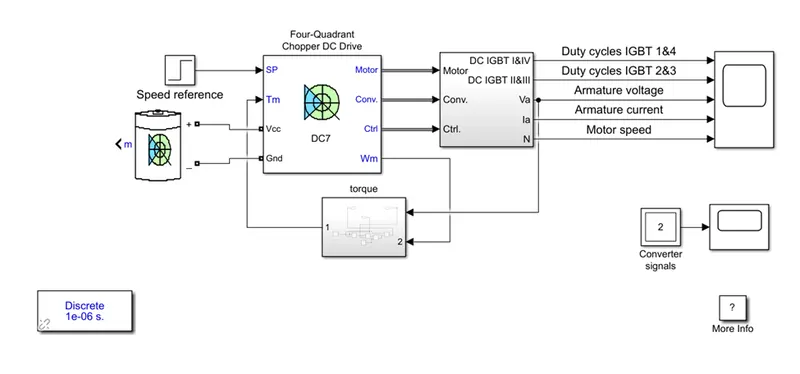
Above model is example of DC7 chopper in that example modified based on our requirement.
And get result as below image.
7B. Also, Design the parameters in excel sheet.
Ans.
| design parameter | |
| mass of towing vehicle | 55000kg |
| mass of aircraft | 183700kg |
| coefficient of rolling resistance | 0.013 |
| air density | 1.2225 |
| coefficient of drag | 0.545 |
| front area of aircraft | 20 |
| Radius of tyre tug | 0.653m |
| gear ratio | 8 |
| transmission efficiency | 87% |
| motor efficiency | 95% |
| battery capacity | 380v |
| power required to aircraft | 261.8kw |
| force required to aircraft | 31.4kN |
| speed of vehicle | 8.33m/s |
| towing operation | 30min |