Project 1
- Design a battery pack for a car of roughly 150 Kw with 120 V. Use a 3500 mAh 3.6V nominal NMC chemistry cell.
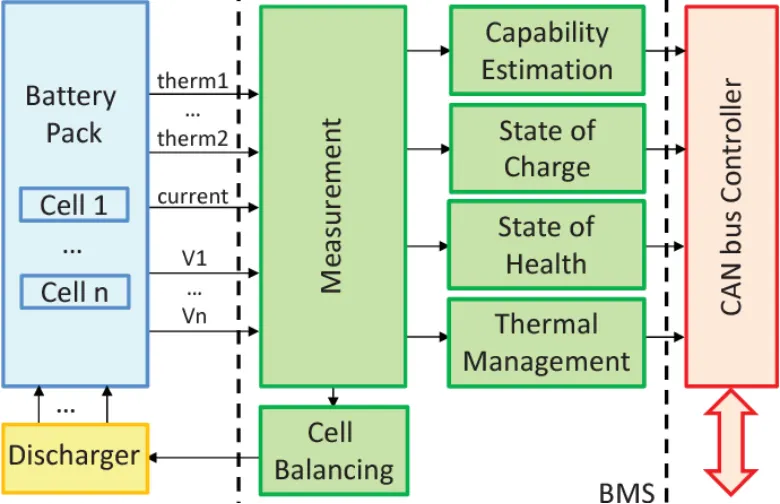
A battery management system (BMS) is said to be the brain of a battery pack. The BMS is a set of electronics that monitors and manages all of the battery’s performance. Most importantly, it keeps the battery from operating outside of its safety margins.
The battery management system is critical to the battery’s safe operation, overall performance, and longevity. Moreover, it protects whatever the lithium battery is installed in (boat, RV, etc.) and the people who are using it.
The primary function of the BMS is to protect the battery cells from damage caused by being overcharged or over-discharged. Additionally, the BMS calculates the remaining charge, monitors the battery’s temperature, and monitors the battery’s health and safety by checking for loose connections and internal shorts. The BMS also balances the charge across the cells to keep each cell functioning at maximum capacity.
If it detects any unsafe conditions, the BMS shuts the battery down to protect the lithium-ion cells and the user.
Given Data:
Power = 150KW
Voltage = 120V
Cell Specifications:
Nominal Voltage = 3.6V
Capacity = 3500mAh = 3.5Ah
Cell Type = NMC
- Design the battery pack configuration.
To Design a Battery Pack following two parameters need to be calculated:
- Number of Cells in Series
- Number of Cells in Parallel
- Number of Cells in Series:
From given Data
Nominal Voltage = 120V
Nominal Cell Voltage = 3.6V
Formula:
Number of Cells in Series = Rated Voltage/Nominal Cell Voltage
= 120/3.6
= 33.33
Number of Cells in Series = 33.33
Rounding of the Cellsthe to highest or lowest Number
Nominal Voltage = Nominal Cell Voltage * Number of Cells in Series
Since it is NMC Cell so Max Voltage = 4.2V and Min Voltage = 2.7V
Max Voltage = 4.2V * Number of Cells in Series
Min Voltage = 2.7V * Number of Cells in Series
|
Sr No |
Number of Cells in Series |
Calculated Voltage |
Max Voltage |
Min Voltage |
Required Voltage |
|
Case 1 |
33 |
118.8V |
138.6V |
89.1V |
120V |
|
Case 2 |
34 |
122.4 |
142.8 |
91.8V |
120V |
The condition to choose the number of cells are
Max voltage of the battery should be less than the Load Max VoltThe age
Min Voltage of the battery should be greater than the Load min Voltage
It is better to have a Nominal Voltage Greater than the Required Voltage so selecting Case 2
So, the Number of Cells in the Series = 34
Output Voltage = 122.4V
- Number of Cells in Parallel
To Calculate the Current Requirement
Power = Voltage * Current
Current = Power/Voltage
Current = 150⋅1000120">150⋅1000120
Current = 1250A
Given Cell Capacity = 3.5Ah
Number of Cells in Parallel = Rated Current / Cell Nominal Capacity
= 1250/3.5
= 357.14
Number of Cells in Parallel = 357.14
Rounding off to a Higher Number
So Number of Cells in Parallel = 358
The Battery Pack Configuration is selected as 34S358P with a Total Number of Cells = 12172
- Draw the BMS topology for this battery pack.
Now for selecting BMS there are 4 types of BMS Topology
- Centralised Topology:
- This Topology is used in Battery Packs where BP consists of less than 18 cells in series.
- It is used in E2w, E3W and Small Energy Storage Systems.
- Master and Slave topology:-
- This Topology is used in Battery Packs where BP consists of 18 or more than of cells in a series.
- It is used in Electric Cars and Large Energy Storage Systems.
- Here Every Slave has 1 Analog Front End(AFE).
- Modular Topology:- This Topology is used in Battery PacPacksere BP consisting of 18 or more than 18 nulls in series.
- a Used in 1MW Battery Pack Systems
- Distributed Topology:
- This Topology is used in Battery Packs where BP consists of 18 or more cells in a series. a
- It is used in smaller battery packs wherewherevidual cell cellist of a PCB Voltage Sensor.
Since Cells in Series = 34
Cells in Parallel = 358
Total No of Cells = Number of Cells in Series * Number of Cells in Parallel
= 34 * 358
Total No of Cells = 12172
Cells are divided such that the Module will 17Cells in series and 179 Cells in Parallel so 1 module will consist of 3043 Cells. So 4 Such Modules will be required to form a Battery Pack with 122.4V 1251Ah
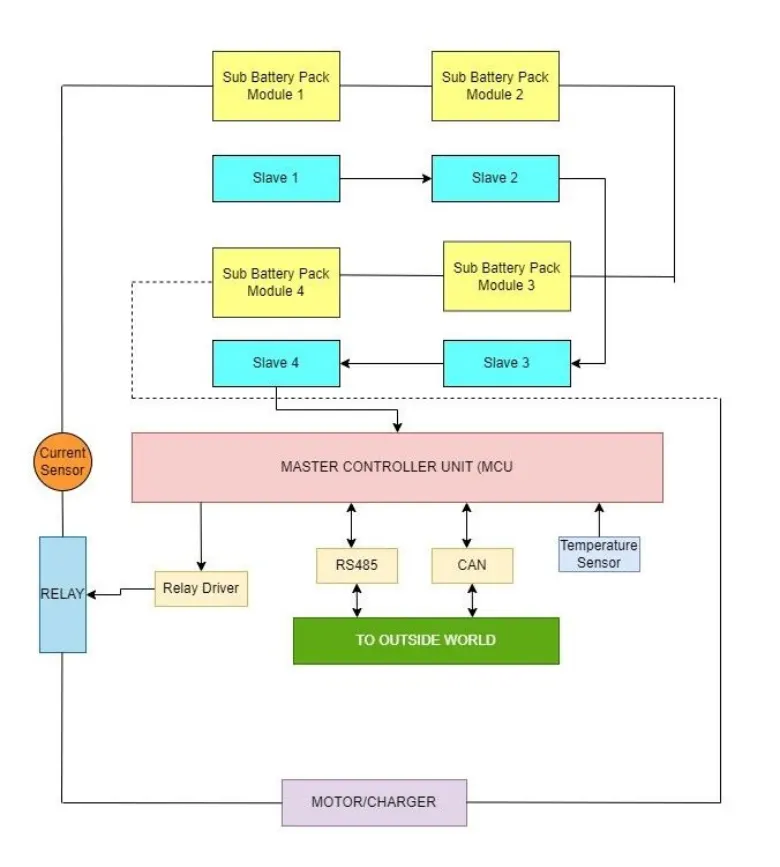
From aabovebove topologies selecting Master and Slave Topology
Master and Slave bms can handle more tha8 of cells the s in a series. So the r above battery pack, there will be 4 slaves and 1 Master MCU. Slaveswicollectslect data from other own modules and git give to other slaves and that slave with its module data with the previous module data will give to it another Slave and the last slave will provide all the data of 4 slaves to Master MCU. All the Slaves will have 1 Analog Front End(AFE). Master and Slave have Scalability since more no slaves can be added.
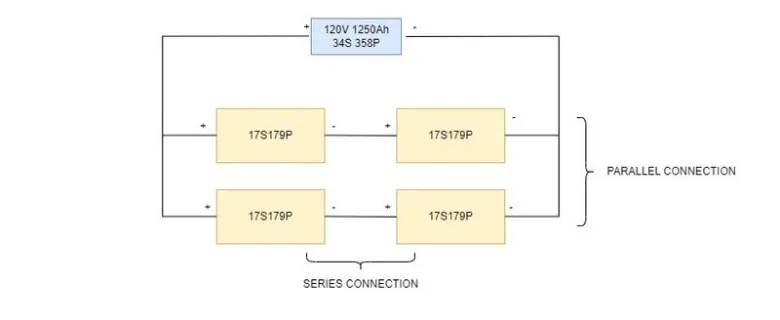
BMS ARCHITECTURE: MASTER AND SLAVE TOPOLOGY
- Build a 3S2P battery pack configuration with a generic battery block using Matlab/Simulink.
The main aim is to design a given battery pacconfigurationon by using a generic battery block in Matlab/Simulink Tool.
Data:
To Build 3S 2P Battery Pack Configuration
Number of Cells in Series = 3
Number of Cells in Parallel = 2
Total Number of cells in Battery Pack = No. of cells in series * No. of cells in parallel
= 3 * 2
= 6
Total Number of cells in Battery Pack = 6Cells
Step 1:
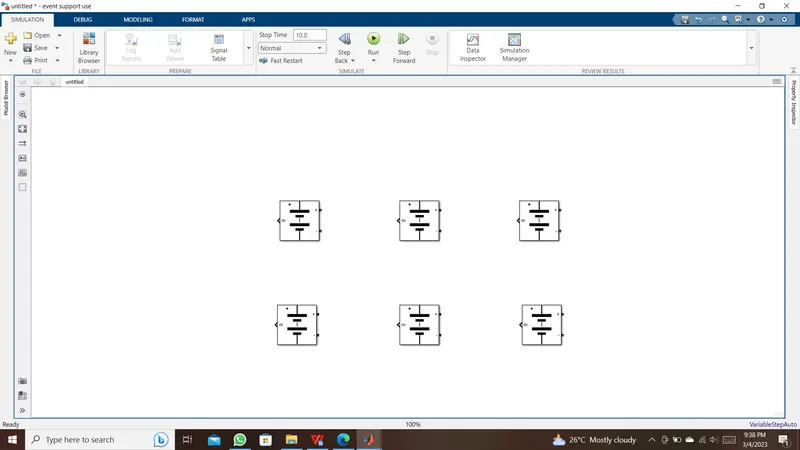
Arrangement of 6 cells. The Below figure shows 6 cells arranged to create a battery pack.
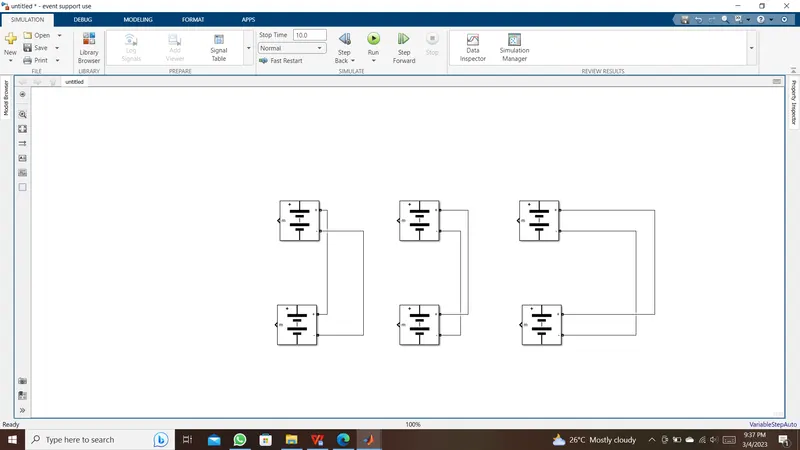
Step 2: Connecting Cells is Parallel
The below figure shows the cells connected in parallel. For parallel connection, batteries are connected from terminals to the same terminals of other batteriestargett is positive terminal (+) of one battery is connected with the positive (+) terminal of another battery, and the negative terminal (-) of one battery with negative terminal (-) of other battery.
Step 3: Connecting Cells in Series
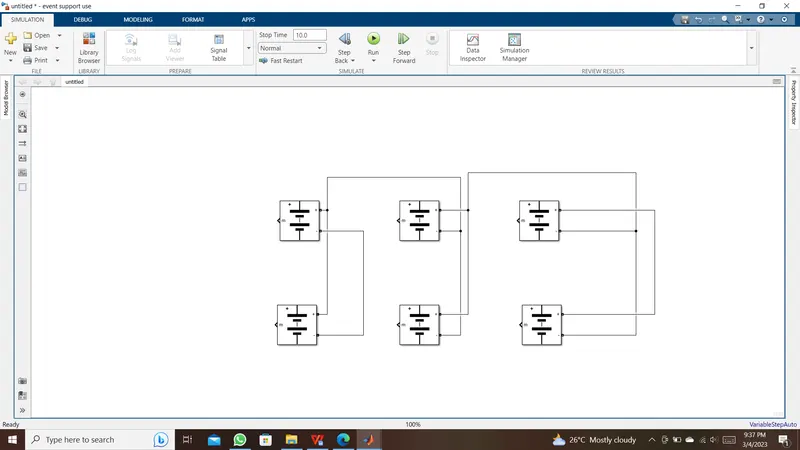
The figure below shows the battery connected in series and parallel combination. Batteries are connected from the terminal to
terminal in a way that the positive (+) terminal of one battery is connected with the negative (-) terminal of the otOne battery the s battery and the negative terminal (-)
One battery'the s battery and negative terminal (-) are connected with the positive terminal (+) of the other battery.
SIMULINK MODEL:
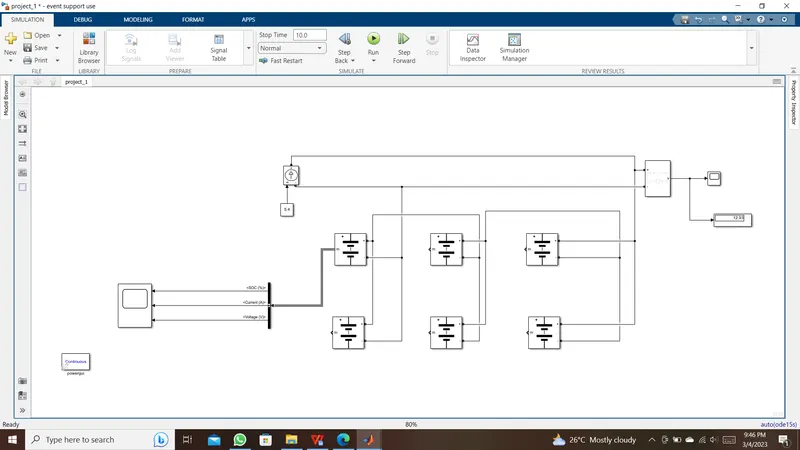
The voltage measurement block is connected across the battery pack to measure the battery pack voltage. The scope output used for the battery pack consists of SOC (State of Charge), Current, and voltage. The controlled current signal block is the load to the battery pack. The constant blockis determined with battery capacity and it is given to the controlled current block.
The parameter given inside the battery is given below:-
- Nominal voltage of a cell 7.2V
- Rated capacity of a cell 5.4Ah
- Maximum voltage of a cell 8.3807V
Nominal Voltage of the Battery Pack = No.of cell in series * Nominal voltage of a cell
= 3 * 7.2
= 21.6V
Nominal Voltage of the Battery Pack = 21.6V
Rated Capacity of the Battery Pack = No.o f cell in Parallel* Rated Capacity of a Cell
= 2 * 5.4
= 10.8Ah
Rated Capacity of the Battery Pack = 10.8Ah
The Battery Pack Rating is 21.6V, 10.8Ah ,233.28Wh
Maximum Voltage of Battery Pack = Maximum Voltage of Cell * No. of Cells in Series
= 8.3807 * 3
= 25.14V
Maximum Voltage of Battery Pack = 25.14V
RESULTS:
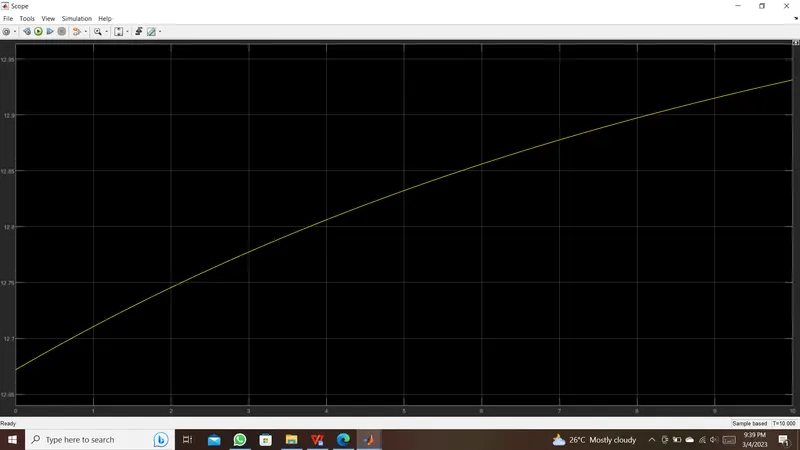
The above plot shows the battery pack's total voltage. The Voltage has reduced from 25.2V to 25.13V.
soc:
state of charge is connected in a plot graph soc is the 25.24
current(A):
ccurrentis connected to a -3
voltage:
voltage is connected to an 8.412
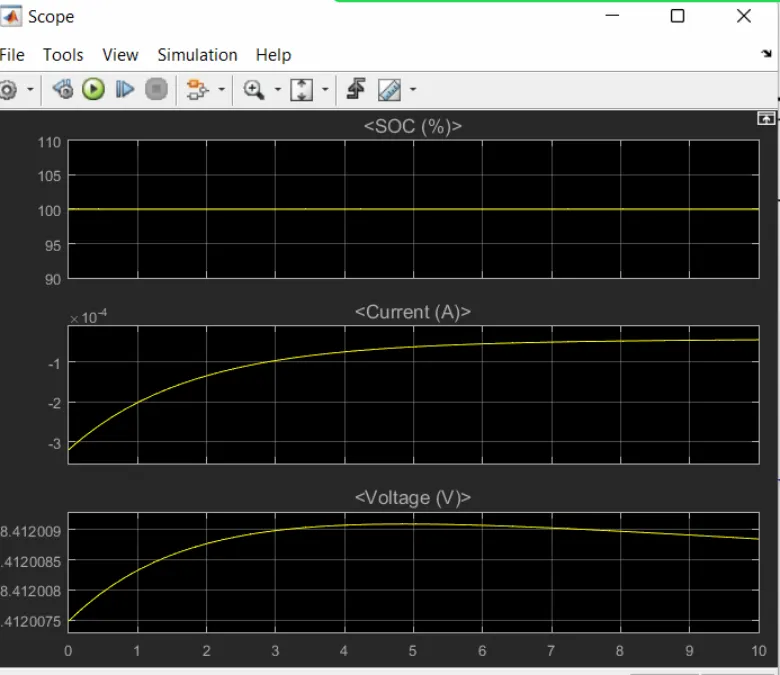
The Simulation is run for 10 seconds with a discharge current of 5.4A
- The 1st plot shows Sthe OC graph. The SOC has reduced from 100% to 99.85% n 10 seconds. The drop is linear since it is discharging and no charging is happening.
- The 2nd plot shows the s Cell Current graph. The current signal is determined by the load and the increase in current is due to regenerative braking.
- The 3rd plot isThee oltage graph. The voltage is around 8.412V at the start of the simulation and has reduced to 8.31V.
CONCLUSION:
The Battery Pack is designed for a car with 150KW 120V by usia ng 3.6V 3.5Ah NMC Cell and BMS Topology are also selected the Battery Pack. A 3S2P battery pack configuration with a generic battery block using Matlab/Simulink is also created.