Benchmarking
Benchmarking:
Benchmarking is defined as the process of measuring products, services, and processes against those of organizations known to be leaders in one or more aspects of their operations. Benchmarking provides necessary insights to help you understand how your organization compares with similar organizations, even if they are in a different business or have a different group of customers.
Benchmarking can also help organizations identify areas, systems, or processes for improvements—either incremental (continuous) improvements or dramatic (business process re-engineering) improvements.
There are four main types of benchmarking: internal, external, performance, and practice.
- Performance benchmarking involves gathering and comparing quantitative data (i.e., measures or key performance indicators). Performance benchmarking is usually the first step organizations take to identify performance gaps.
What you need: Standard measures and/or KPIs and a means of extracting, collecting, and analyzing that data.
What you get: Data that informs decision making. This form of benchmarking is usually the first step organizations take to identify performance gaps.
- Practice benchmarking involves gathering and comparing qualitative information about how an activity is conducted through people, processes, and technology.
What you need: A standard approach to gather and compare qualitative information such as process mapping.
What you get: Insight into where and how performance gaps occur and best practices that the organization can apply to other areas.
- Internal benchmarking compares metrics (performance benchmarking) and/or practices (practice benchmarking) from different units, product lines, departments, programs, geographies, etc., within the organization.
What you need: At least two areas within the organization that have shared metrics and/or practices.
What you get: Internal benchmarking is a good starting point to understand the current standard of business performance. Sustained internal benchmarking applies mainly to large organizations where certain areas of the business are more efficient than others.
- External benchmarking compares metrics and/or practices of one organization to one or many others.
What you need: For custom benchmarking, you need one or more organizations to agree to participate. You may also need a third party to facilitate data collection. This approach can be highly valuable but often requires significant time and effort. That’s why organizations engage with groups like APQC, which offers more than 3,300 measures you can use to compare performance to organizations worldwide and in nearly every industry.
What you get: An objective understanding of your organization’s current state, which allows you to set baselines and goals for improvement.
Problem Statement:
Mr. D.S. Pughazhyendhii is a married man who lives in Bangalore which is a highly crowded city. His Family comprises of five members including his wife, a five-year-old boy, his father, and his mother. He visits his native place Madurai which is 500kms away from Bangalore once a month. Also, he will be using his car to commute to his office. His budget falls between 8 to 10 lakhs on road. Please suggest to him options so that he will buy a good car for his family.
Note: Pughazhyendhii is fond of big cars
Solution:
Considering all of Mr. Pughazhyendhii’s requirements and conditions some common features of all the cars suggested to him would be:
- Vehicle Type: - Mini SUV/ Hatchback
- Fuel Type: - Petrol
- Seating Capacity: - 5-Seater
- Mileage: - Above 15 kmpl
Below are the list of cars that would most suitable for Mr. Pughazhyendhii :
- Tata Nexon XE:
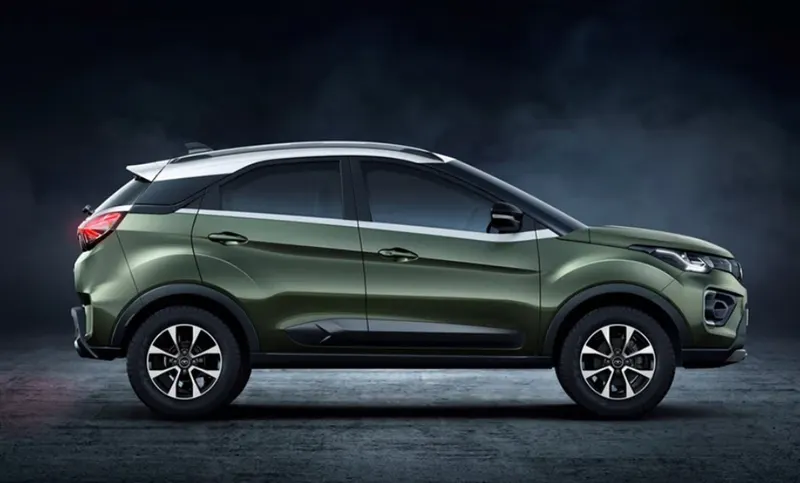
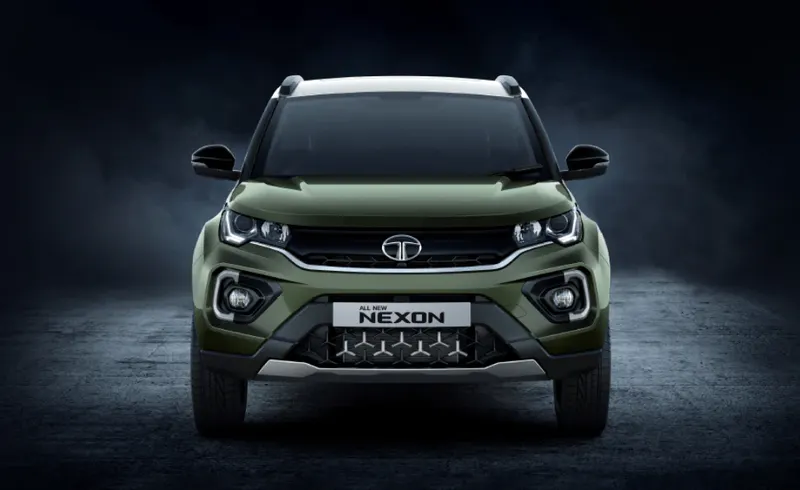
With its 5-star safety rating, the Nexon was already one of the most talked about urban SUVs in the market. Not to forget, the spacious cabin and comfortable rear seats made it the ideal pick for the family. But the competition with its modern features and attention to finer details had the heavier chunk of buyers.
The price of Tata Nexon starts at Rs. 7.55 Lakh and goes upto Rs. 13.90 Lakh. Tata Nexon is offered in 64 variants - the base model of Nexon is XE and the top variant Tata Nexon XZA Plus P Dark Edition AMT Diesel which comes at a price tag of Rs. 13.90 Lakh.
Features:
Safety:
In terms of safety, the Nexon has proved to be the second most secure car in the segment with an NCAP rating of 5 stars. It gets dual airbags, ABS with EBD, ISOFIX child seat anchors, ESP and reverse parking sensors and camera.
Key Specifications of Tata Nexon XE:
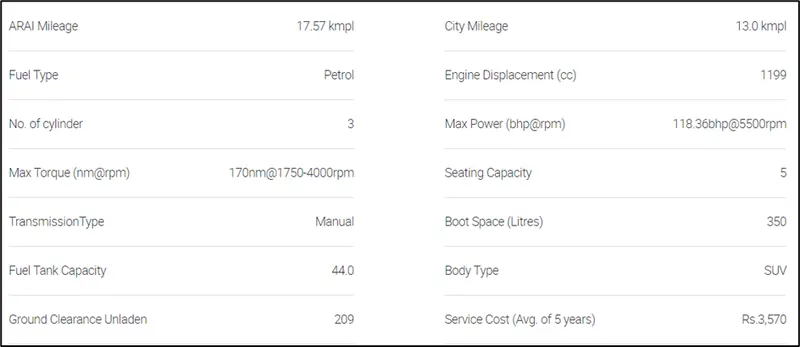
On-Road Price (Bangalore): - Rs.9,18,938
Customer Ratings: - 4.4/5.0
Pros: Cons:
Spacious cabin with comfortable rear seats Engine refinement is lacking
Comfortable ride quality Infotainment system feels dated
Looks attractive and modern
5-star NCAP safety rating
- Maruti Suzuki Baleno:
The price of Maruti Baleno starts at Rs. 6.49 Lakh and goes upto Rs. 9.71 Lakh. Maruti Baleno is offered in 7 variants - the base model of Baleno is Sigma and the top variant Maruti Baleno Alpha AMT which comes at a price tag of Rs. 9.71 Lakh.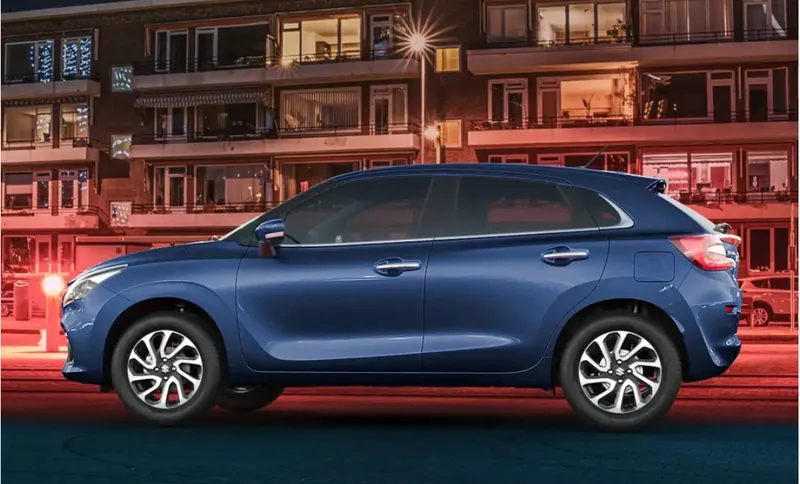
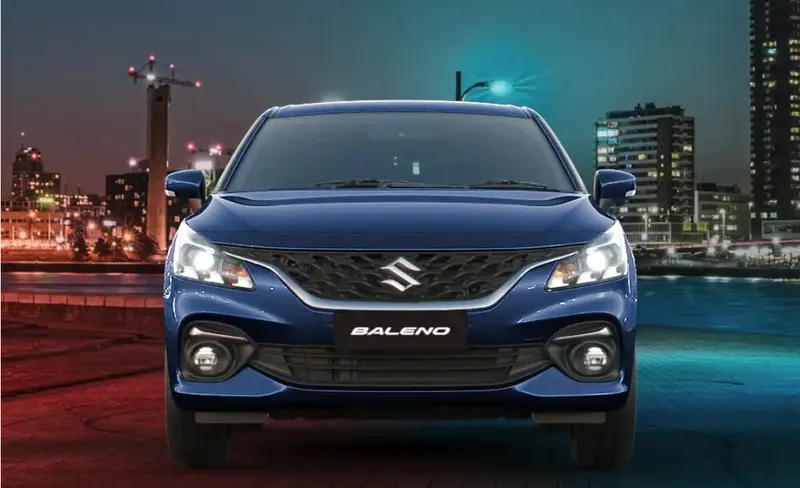
Features:
Safety:
In terms of safety, right from the base variant the new Baleno comes with dual front airbags, ABS with EBD, ISOFIX child seat anchorage and rear parking sensors. The good news is that the top two variants are now offered with 6 airbags. With all the AMT and the Alpha manual variant you also get ESP with hill hold.
Key Specifications of Maruti Baleno Delta AMT:
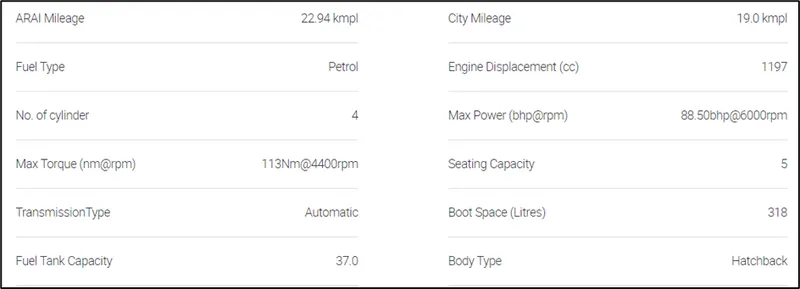
On-Road Price (Bangalore): -9,38,911
Customer Ratings: - 4.4/5
Pros: Cons:
Spacious interior AMT is good but not as sophisticated
Well built on the inside and out. as CVT/DCT
Refined and enjoyable to use petrol engine Seat cushioning is very soft which
Comfortable ride quality even over bad roads may cause problems for long drives.
Boot loading lip is very high
Not a sporty car to drive
- Nissan Magnite XV Premium
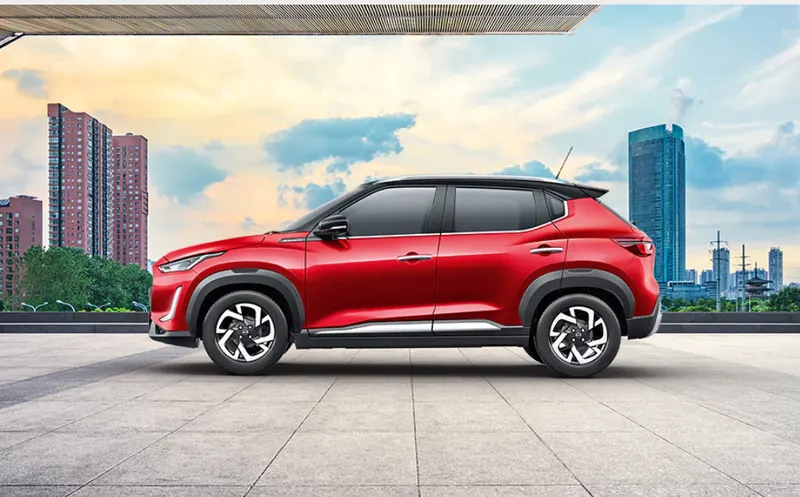
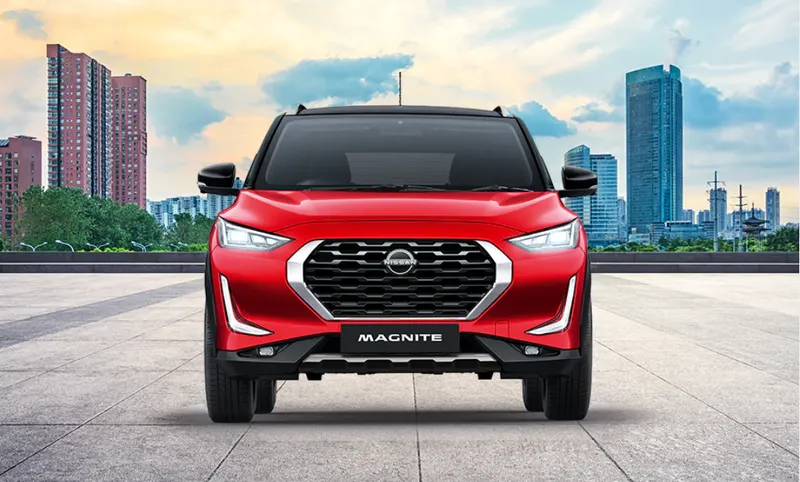
The price of Nissan Magnite starts at Rs. 5.88 Lakh and goes upto Rs. 10.56 Lakh. Nissan Magnite is offered in 23 variants - the base model of Magnite is XE and the top variant Nissan Magnite Turbo CVT XV Prm Opt DT which comes at a price tag of Rs. 10.56 Lakh.
Features:
Safety:
Dual front airbags ABS with EBD and rear parking sensors come as standard. ISOFIX child seats mounts are offered with the XL Turbo, XV and XV Premium grades. The XV adds a rear camera while the XV Premium also gets the 360-degree camera and tyre pressure monitor. All turbo variants get brake assist, traction control, stability control and hill start assist. Unfortunately, side or curtain airbags are not available with any variant.
Key Specifications of Nissan Magnite XV Premium:
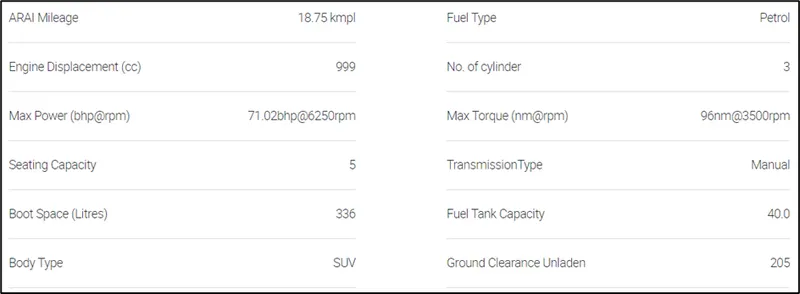
On-Road Price (Bangalore): -9,77,519
Customer Ratings: - 4.3/5
Pros: Cons:
Smartly designed sub-compact SUV. Fitment quality is decent but not premium.
Very well proportioned Not an exciting or fun to drive car,
Spacious and practical cabin. even with the turbo petrol engine
A good SUV for the family No diesel engine option
Comfortable ride quality. Nissan’s sales and service network is
Bad roads can be tackled with confidence currently lagging behind the competition
Turbo petrol engine offers good drivability
and punch.
Impressive features list
- Kia Sonet 1.2 HTK
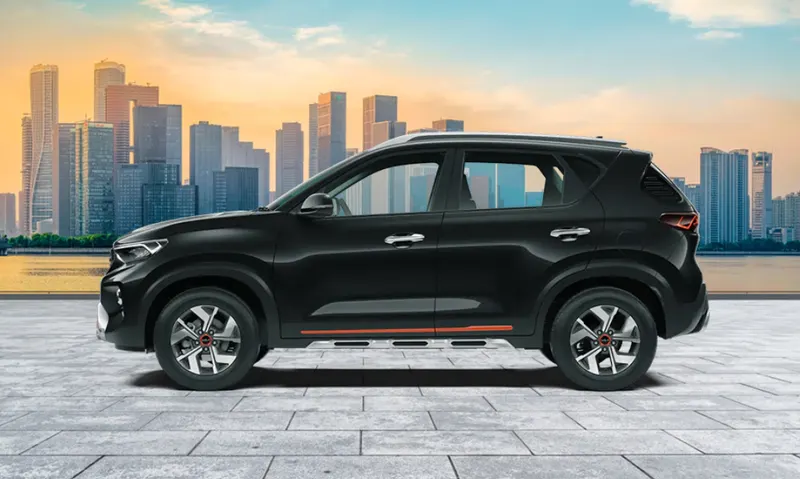
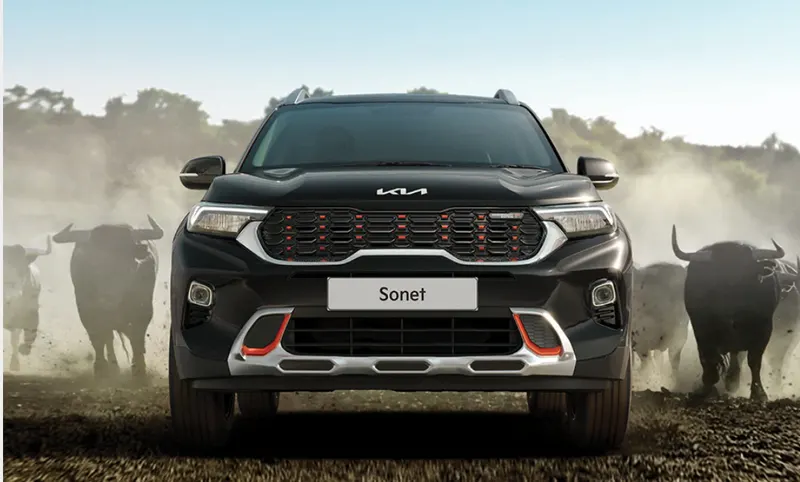
The price of Kia Sonet starts at Rs. 7.15 Lakh and goes upto Rs. 13.69 Lakh. Kia Sonet is offered in 21 variants - the base model of Sonet is 1.2 HTE and the top variant Kia Sonet 1.5 GTX Plus Diesel AT which comes at a price tag of Rs. 13.69 Lakh.
Features:
Safety:
Dual airbags, and ABS with EBD are offered as standard across variants. The top-spec GTX+ variant additionally gets side and curtain airbags. If ISOFIX child seat mounts are a must have for you, that’s available from the HTX variant onwards. Electronic stability control, hill assist and vehicle stability management are offered as standard for the Turbo-DCT variants, and across drivetrain options on the GTX+ variant. A tyre pressure monitor is bundled in for the top two variants.
Key Specifications of Kia Sonet 1.2 HTK
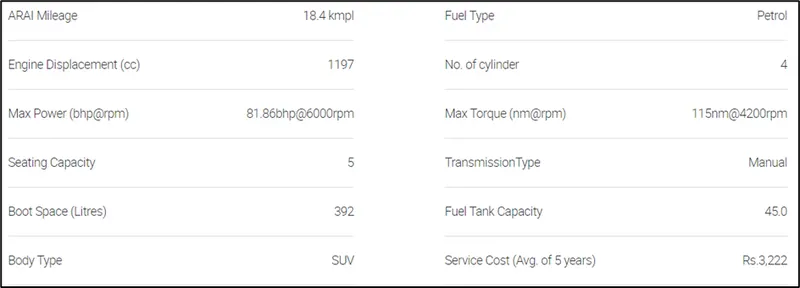
On-Road Price (Bangalore): -9,77,155
Customer Ratings: - 4.0/5.0
Pros: Cons:
Presence. Tall height and bonnet Limited rear-seat width limits
give the Sonet a strong stance. usability as a 5-seater.
Feature packed: ventilated seats, Silly cost-cutting measures:
wireless charging, ambient lighting, backlight only for driver’s power
Bose sound system and lots more. window, missing chilled glovebox
‘Proper’ automatic options: adjustable front armrest.
7-speed DCT for the turbo-petrol, Automatic transmissions limited to
6-speed AT for the diesel. HTK+ and top-spec GTX+
Comfortable ride quality: equally adept variants only.
at tackling bad roads and high-speed cruising.
Conclusion:
After carefully benchmarking the four above cars I would suggest Tata Nexon as the best fit for Mr. Pughazhyendhii. Even though Tata Nexon falls behind Maruti Baleno in terms of mileage and unavailability of Automatic Transmission at the given price range, but still Tata Nexon Edges past all of the other cars due to its world class safety features as it is more spacious and sportier to drive then rest of the cars and on top of that being a mini-SUV also satisfies Mr. Pughazhyendhii fondness of big cars.