Learn heat transfer
A free, ordered path through heat transfer, from Fourier's law and composite walls to fins, convection correlations, radiation and heat exchangers, built from Skill-Lync's GATE solutions, calculators, lessons and student projects.
- 7.8
- GATE ME marks per paper, 2022-26
- 29
- GATE questions solved
- 2
- free calculators
- 2,470
- student project reports
Updated 16 Nov 2026 · Free, no sign-up · GATE data from official ME papers 2022-2026
What is heat transfer?
Heat transfer is the study of how thermal energy moves because of a temperature difference: by conduction through solids, by convection between a surface and a moving fluid, and by radiation. Engineers use it to size insulation, fins, radiators and heat exchangers, and to keep engines, batteries and electronics within safe temperatures.
Why does heat transfer matter for jobs?
Thermal and CFD roles are heat transfer jobs: battery thermal management for EVs, electronics cooling, engine cooling and exhaust systems, HVAC and heat exchanger design. Interviews for these roles ask about thermal resistance, the Nusselt number, fin efficiency and when a body can be treated as lumped, before any software question.
In simulation the subject shows up as conjugate heat transfer (CHT): solving conduction in the solid and convection in the fluid together, as in an exhaust manifold or a graphics card heat sink. The CFD courses teach CHT, but they assume you can already check the answer with a resistance network by hand.
In Skill-Lync's placement records (as of 17 Nov 2026), freshers placed in CFD roles were offered 3.9 LPA on average (n = 150 disclosed offers), with the middle half between 2.8 LPA and 4.5 LPA. These are starting offers from Skill-Lync placements, not a market survey: see the full salary breakdown.
How to learn heat transfer: a 7-step path
Work through these in order. Each step points to the free Skill-Lync resource that teaches it, then to a calculator, article or solved GATE question to test yourself.
- 01
Conduction and thermal resistance
Fourier's law, conductivity, plane walls and cylinders, and the resistance network that turns a wall into a circuit.
- 02
Heat generation and multi-dimensional conduction
Walls and rods that generate heat, where the maximum temperature sits, and 2D conduction solved on a grid.
- 03
Fins and transient (lumped) conduction
Fin efficiency and why fin shape matters, then the Biot number test for treating a body as one temperature while it cools.
- 04
Convection: forced, free and internal flow
Boundary layers, the Nusselt, Reynolds and Prandtl numbers, flat-plate and pipe correlations, and buoyancy-driven flow.
- 05
Radiation
Black and grey bodies, Wien's and Stefan-Boltzmann laws, view factors and radiation networks between surfaces.
- 06
Heat exchangers
Overall heat transfer coefficient, LMTD and the effectiveness-NTU method for sizing and rating exchangers.
- 07
From hand calculation to thermal simulation
The same physics in industry: battery packs, engine cooling and conjugate heat transfer in CFD.
Then test the whole subject on the 29 solved GATE questions.
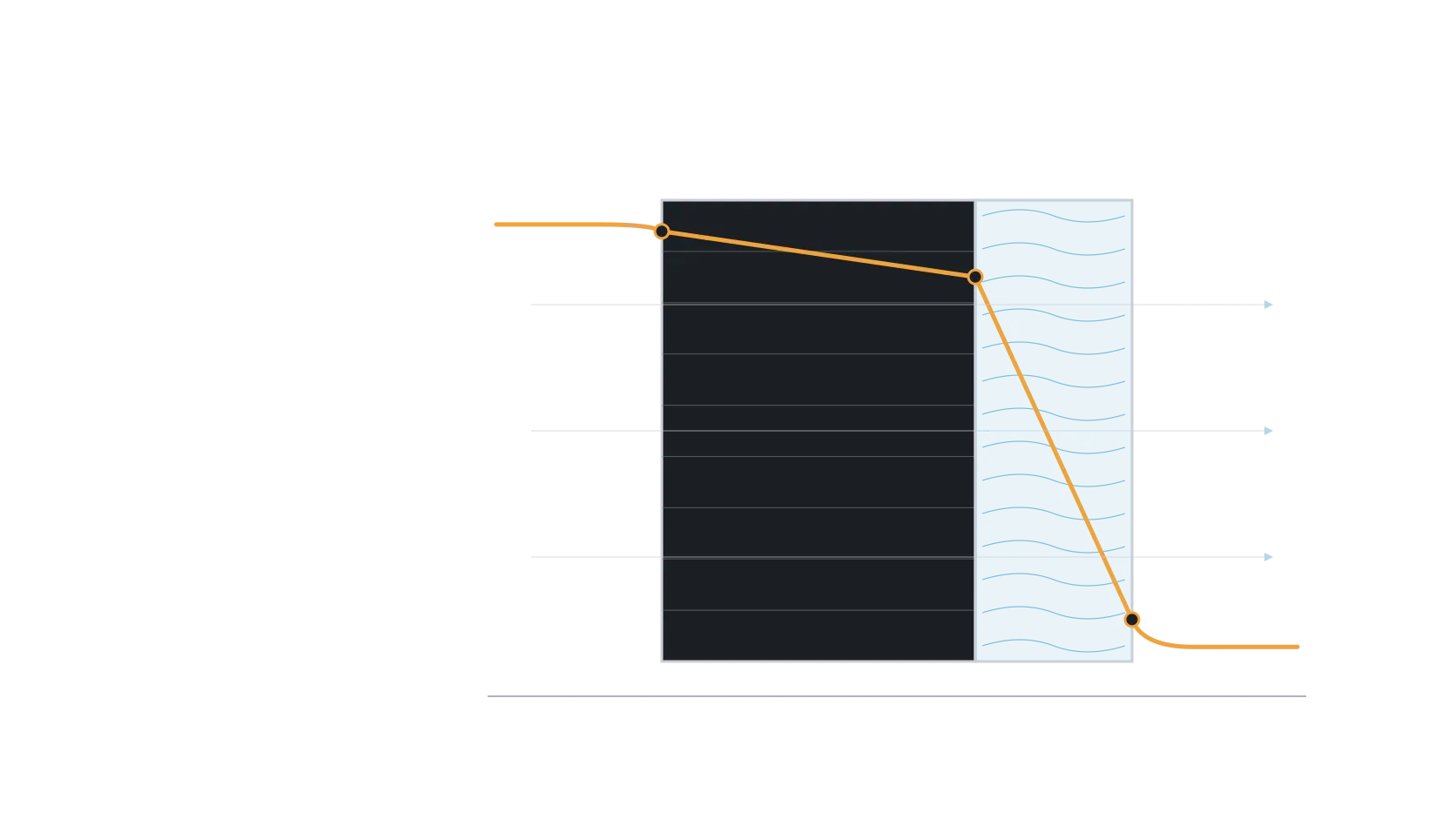
Worked example: how much heat leaks through a furnace wall, and what does the insulation do?
A furnace wall is mm of firebrick ( W/m·K) lined outside with mm of insulation ( W/m·K). Gas inside is at 900 °C with W/m²·K; room air outside is at 30 °C with W/m²·K. Find the heat loss per m² and the temperature at each face.
- Treat each layer and each fluid film as a thermal resistance per m² in series: , , , m²·K/W, so m²·K/W.
- Heat flux: W/m².
- Face temperatures, stepping through the resistances: inner brick face °C, brick-insulation interface °C, outer face °C. Check: °C.
- Without the insulation, m²·K/W and W/m², 5.3 times more, with the outer brick face at about 328 °C.
Answer. About 564 W lost per m² of wall. The 100 mm of insulation carries 81% of the total resistance, which is why the temperature drops by 705 °C across it while the 200 mm of brick drops only 94 °C.
Every number here is recomputed when the page is built and checked by an independent script (Skill-Lync, 16 Nov 2026).
Free heat transfer resources
Everything below is free to read, watch or use. Skill-Lync made all of it except the last group.
Calculators and simulators
Free video lessons
Articles
- How Heat Exchangers Protect Machines from Overheating?Skill-Lync blog
- Heat Transfer Principles in Energy-Efficient Refrigerators and Air ConditionersSkill-Lync blog
- The Importance of Battery Thermal Management Systems in Electric VehiclesSkill-Lync blog
- Understanding the Cooling System in Your CarSkill-Lync blog
- How Thermal Insulation Works: The Key to Comfort in Aircraft, Space Shuttles, and BuildingsSkill-Lync blog
- 50 CFD Engineer Interview Questions and Answers, With Worked ExamplesSkill-Lync blog
Answered by Skill-Lync experts
Beyond Skill-Lync
What Skill-Lync students built
2,470 public project reports on Skill-Lync apply heat transfer directly (counted by title on 16 Nov 2026):
| Project | What it practises | Reports |
|---|---|---|
| 2D heat conduction solver | steady and transient 2D conduction solved with explicit and implicit schemes in MATLAB or Python | 873 |
| Conjugate heat transfer | solid conduction and fluid convection together: graphics card heat sink, exhaust manifold | 1,495 |
| Battery and liquid cooling | air and liquid cooling of battery packs, 1D and 3D thermal models | 102 |
How many marks does heat transfer carry in GATE ME?
Heat Transfer carried 7.8 marks per paper on average in the 6 GATE Mechanical papers from 2022 to 2026 (each out of 100), between 5 and 10. Skill-Lync solved all 29 of those questions and checked each one against the official answer key.
| 2022 S1 | 2022 S2 | 2023 | 2024 | 2025 | 2026 |
|---|---|---|---|---|---|
| 10 | 8 | 7 | 9 | 5 | 8 |
Marks per paper, from the solved questions on the GATE heat transfer page; the subject-wise table for every subject is on GATE ME weightage.
Is there a Skill-Lync heat transfer course?
No dedicated Skill-Lync course on heat transfer yet. The closest are Battery Thermal Management using Ansys Fluent and MATLAB (6 h) and Post Graduate Program in Computational Fluid Dynamics (125 h), which cover heat transfer as it is used in industry: conduction, convection and radiation applied to battery packs, and conjugate heat transfer simulation in Ansys Fluent. Neither is a heat transfer course: they do not teach fins, radiation networks or heat exchanger design by hand, or exam problem practice.
See every Skill-Lync CFD course compared. If you want a full heat transfer course from Skill-Lync, leave your details and we will tell you when one launches.
Heat Transfer: questions learners ask
What are the three modes of heat transfer?
Conduction, convection and radiation. Conduction is heat moving through a solid or a still fluid, by Fourier's law. Convection is heat carried between a surface and a moving fluid, by Newton's law of cooling. Radiation is heat carried by electromagnetic waves, by the Stefan-Boltzmann law, and needs no medium at all.
How many marks does heat transfer carry in GATE Mechanical?
In the six GATE ME papers from 2022 to 2026 heat transfer carried 7.8 marks per paper on average, between 5 and 10. Skill-Lync has solved all 29 of those questions step by step, checked against the official answer keys, on the GATE heat transfer page.
What is the difference between thermodynamics and heat transfer?
Thermodynamics tells you how much energy moves between states, for example how much heat a gas must lose to reach a temperature. Heat transfer tells you how fast it moves and through what, for example how long the cooling takes and how much insulation is needed. Heat transfer adds rates and time to thermodynamics.
Does Skill-Lync have a heat transfer course?
Not yet. Skill-Lync has no course on heat transfer itself. The closest are the Battery Thermal Management course, which applies heat transfer to EV battery packs, and the PG Program in CFD, which teaches conjugate heat transfer simulation. Everything on this page is free, and you can ask to be told when a course launches.