Learn engineering mechanics
A free, ordered path through engineering mechanics, from forces, free-body diagrams and equilibrium to trusses, friction, centroids, kinematics and kinetics, built from Skill-Lync's GATE solutions, calculators, lessons, articles and student projects.
- 4.2
- GATE ME marks per paper, 2022-26
- 17
- GATE questions solved
- 4
- free calculators
- 2,283
- student project reports
Updated 17 Nov 2026 · Free, no sign-up · GATE data from official ME papers 2022-2026
What is engineering mechanics?
Engineering mechanics is physics applied to engineering bodies. Statics finds the forces in a structure or machine that is not accelerating: support reactions, member forces in trusses, friction at contacts. Dynamics links forces to motion through kinematics, Newton's laws, work and energy, and impulse and momentum. Every later mechanical subject builds on it.
Why does engineering mechanics matter for jobs?
Every design and CAE engineer starts with a free-body diagram. Before you size a bracket, pick a bolt or set up an FEA model you need the loads on the part, and those come from equilibrium: support reactions, member forces, friction at a contact. Fresher interviews for design and CAE roles test exactly this, often with a ladder, a truss or a block on an incline.
Dynamics is the base of multibody and vehicle dynamics: MotionSolve, ADAMS and SOLIDWORKS Motion solve Newton's equations for many connected bodies at once, and you can only judge their answers if you can set up the one-body version by hand. It also leads straight into strength of materials and theory of machines.
In Skill-Lync's placement records (as of 17 Nov 2026), freshers placed in CAE (FEA) roles were offered 3.4 LPA on average (n = 285 disclosed offers), with the middle half between 2.8 LPA and 3.5 LPA. These are starting offers from Skill-Lync placements, not a market survey: see the full salary breakdown.
How to learn engineering mechanics: a 7-step path
Work through these in order. Each step points to the free Skill-Lync resource that teaches it, then to a calculator, article or solved GATE question to test yourself.
- 01
Forces, moments and free-body diagrams
Vectors and resultants, the moment of a force and of a couple, Varignon's theorem, and drawing a free-body diagram that shows every force acting on one body.
- 02
Equilibrium and supports
The three equations of planar equilibrium, support types and the reactions they give, two- and three-force members, and stable versus unstable equilibrium.
- 03
Trusses and frames
Method of joints, method of sections, zero-force members, and why a pin-jointed frame needs triangles to be rigid.
- 04
Friction
Dry (Coulomb) friction and impending motion, ladders and wedges, and rope or belt friction around a drum, where the tension ratio grows exponentially with the wrap angle.
- 05
Centroids and moments of inertia
Centre of gravity, centroids of composite areas, area and mass moments of inertia, and the parallel axis theorem.
- 06
Kinematics of particles and rigid bodies
Straight-line and projectile motion, relative velocity, rotation about a fixed axis, the instantaneous centre, and rolling without slipping.
- 07
Kinetics: Newton's laws, energy and momentum
Newton's second law for particles and rigid bodies, D'Alembert's principle, work and energy, impulse and momentum, impact and the coefficient of restitution, and the compound pendulum.
Then test the whole subject on the 17 solved GATE questions.
Worked example: how far up can you climb before the ladder slips?
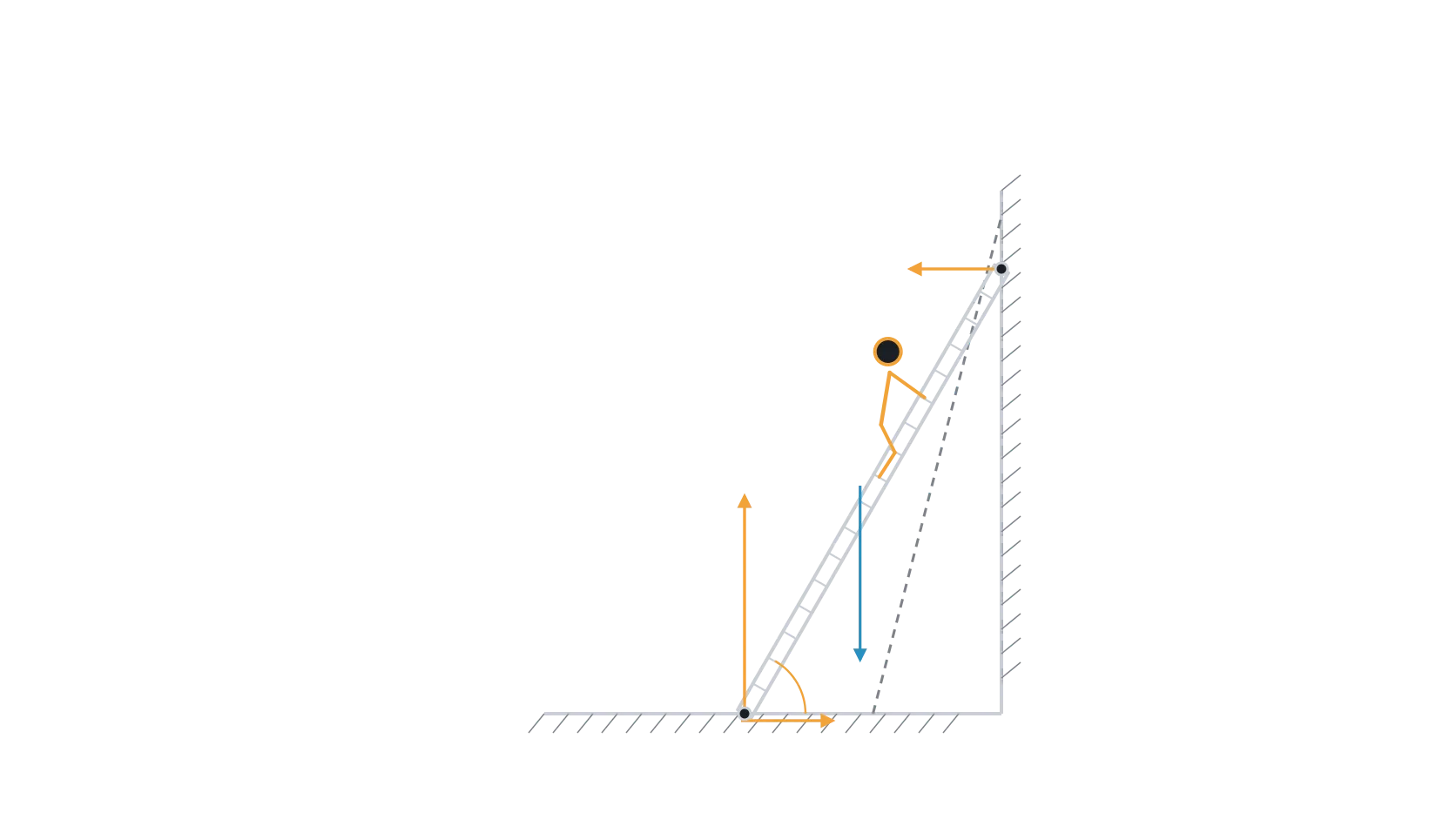
A uniform 5 m ladder weighing N leans against a smooth wall at to the floor. The friction coefficient at the floor is . How far up can a person weighing N climb before it slips? Then check the 1-in-4 safety rule.
- Free-body diagram: the smooth wall pushes horizontally with ; the floor pushes up with and holds the foot back with friction . Vertical equilibrium gives N, horizontal equilibrium gives , and the most friction the floor can supply is N.
- Moments about the foot, with the person a distance along the ladder: . At the point of slipping N, so .
- So m: the ladder slips once the person is 52% of the way up. To reach the top at , the wall would have to push N, which needs .
- The 1-in-4 rule puts the foot out by a quarter of the length, so and . With the person at the top, N, so the floor only needs .
Answer. At 60 degrees the person can climb only 2.62 m (52%) before the ladder slips. Set at the 1-in-4 angle (75.5 degrees), the same ladder needs a friction coefficient of just 0.232 with the person at the very top, so the 0.3 floor holds all the way up. That is why the rule exists.
Every number here is recomputed when the page is built and checked by an independent script (Skill-Lync, 17 Nov 2026).
Free engineering mechanics resources
Everything below is free to read, watch or use. Skill-Lync made all of it except the last group.
Solved GATE questions
Calculators and simulators
- Section modulus calculatorI, Z and bending stress for I, T, tube and box sections · Skill-Lync Resources
- Natural frequency simulatorSpring-mass vibration, damping and energy, animated · Skill-Lync Resources
- Spring simulatorHooke's law: force, deflection, stress and energy · Skill-Lync Resources
- Stiffness calculatorStiffness of bars, beams, springs and shafts · Skill-Lync Resources
Free video lessons
Articles
- What is Engineering Mechanics? Branches, Laws and Worked ExamplesSkill-Lync blog
- Kinematics and Dynamics of Machines: Concepts and Worked ExamplesSkill-Lync blog
- Moment of Inertia for Different Sections using AutoCADSkill-Lync blog
- What is Multibody Dynamics?Skill-Lync blog
- Creating and Simulating a Free Body in MotionViewSkill-Lync blog
- Understanding Force Modeling in Multibody Dynamics Using MotionView and MotionSolveSkill-Lync blog
Beyond Skill-Lync
What Skill-Lync students built
2,283 public project reports on Skill-Lync apply engineering mechanics directly (counted by title on 17 Nov 2026):
| Project | What it practises | Reports |
|---|---|---|
| Section modulus of a cross-section | second moment of area about the centroid and section modulus of a part's section, then a stiffer section | 1,896 |
| Mass-spring-damper | Newton's second law for a mass on a spring and damper, simulated and controlled in Simulink | 287 |
| Multibody models | bodies, joints and forces assembled and solved in MotionView, MotionSolve or SOLIDWORKS Motion | 70 |
| Free fall and projectile motion | a falling or thrown body simulated and compared with the kinematics equations | 30 |
How many marks does engineering mechanics carry in GATE ME?
Engineering Mechanics carried 4.2 marks per paper on average in the 6 GATE Mechanical papers from 2022 to 2026 (each out of 100), between 1 and 8. Skill-Lync solved all 17 of those questions and checked each one against the official answer key.
| 2022 S1 | 2022 S2 | 2023 | 2024 | 2025 | 2026 |
|---|---|---|---|---|---|
| 8 | 7 | 3 | 4 | 1 | 2 |
Marks per paper, from the solved questions on the GATE engineering mechanics page; the subject-wise table for every subject is on GATE ME weightage.
Is there a Skill-Lync engineering mechanics course?
No dedicated Skill-Lync course on engineering mechanics yet. The closest are Multibody Dynamics for Automotive Applications using Motionview and Motionsolve (8 h) and Multibody Dynamics using SolidWorks (3 h), which cover the dynamics half of the subject done in software: building bodies, joints, forces and motions and solving them as mechanisms such as a crank, a Geneva wheel, a planetary gear train and a car's trunk lid. Neither teaches statics, trusses or friction, or hand-solved problems and exam practice.
See vehicle dynamics and multibody courses compared. If you want a full engineering mechanics course from Skill-Lync, leave your details and we will tell you when one launches.
Engineering Mechanics: questions learners ask
What is the difference between statics and dynamics?
Statics deals with bodies at rest or moving at constant velocity, where the forces and the moments on each body add up to zero. Dynamics deals with accelerating bodies: kinematics describes the motion itself, and kinetics links it to the forces through Newton's second law, work and energy, or impulse and momentum.
How many marks does engineering mechanics carry in GATE Mechanical?
In the six GATE ME papers from 2022 to 2026 engineering mechanics carried 4.2 marks per paper on average, between 1 and 8. Skill-Lync has solved all 17 of those questions step by step, checked against the official answer keys, on the GATE engineering mechanics page.
Is engineering mechanics the same as strength of materials?
No. Engineering mechanics treats bodies as rigid and asks what forces act on them and how they move. Strength of materials, the subject that usually follows in the second year, asks what those forces do inside a deformable part: the stress, strain and deflection they cause, and whether the part fails.
Does Skill-Lync have an engineering mechanics course?
Not a full one. Two courses apply its dynamics half in software: Multibody Dynamics using SolidWorks, and Multibody Dynamics for Automotive Applications using MotionView and MotionSolve. No paid course covers statics, trusses or friction; everything on this page is free, and you can ask to be told when a course launches.