DussehraFestive scholarship on Skill-Lync courses, this week onlyFestive scholarship is openOffer ends Wed, 21 Oct, 11:59 pm IST.
Dussehra 2026

Start your next chapter this Dussehra

Tell us where you want to work. A counsellor will match you to the right course and confirm the festive scholarship you qualify for.

  • Festive scholarship on course fees, confirmed on your call
  • Free 20-minute call to map the right course to your goal
  • Real industry projects and placement support with every course

Offer ends Wed, 21 Oct, 11:59 pm IST

3,905 engineers placed since 2019 · 1,277 hiring companies

By submitting you agree to our Terms and Privacy Policy.

You're on the list

Browse courses
Electrical · Course

Electric Motor Design using MATLAB and ANSYS Maxwell

A 3 month course covering the fundamentals of electric motors and how to design them using MATLAB and ANSYS Maxwell

Duration
12 weeks
Content
10 hours
Projects
2
Mode
Online
Overview

What you'll
be able to do.

  • This course focuses on the basics of Electric Motor Design.
  • Students will extensively work on industry-relevant projects on the MATLAB and ANSYS Maxwell.
  • After completing this course, the students will have a better understanding of the topic.
  • Also, they are exposed to the modern trends and standard practices being followed by automotive companies and electric powertrain R & D organizations.
  • All these above-mentioned criteria will strengthen their portfolio and set them apart from the others enabling them to gain better grants and scholarship opportunities for MS Admits.
  • Students can explore options in research and development, and can land that much-coveted job in top core companies.
Tools you'll use
MATLABSimulinkANSYS Maxwell
Curriculum

12 modules,
built with industry.

  1. 01Electric Motor Design using MATLAB and ANSYS Maxwell12 modules
    1. ElectromagneticsW01
      • Basics of electromagnetics
        • Discuss basic definitions of electromagnetic theory and applications
      • Electric and magnetic fields
        • Interaction between electric and magnetic fields
        • Generation of flux
      • Electromagnetic analogies flux
        • Current Flux linkage
        • Voltage Resistance
        • Reluctance
      • Maxwell’s equations
        • Basic Maxwell’s equations to calculate electromagnetic forces
    2. DC MotorsW02
      • Series motor working principle
      • Shunt motor
      • Separately excited motor
        • Equivalent circuit of a separately excited DC motor
        • Calculation of back emf and torque
      • Brushless DC Motors
        • Basics of BLDC motors
        • Their back emf types and equations
      • Modeling of a DC motor
      • Basic modeling of DC motor using equivalent circuit
      • Equations and Math assignments for calculating flux linkage and back emf for different DC Motors
      • Motor commutation
      • Discuss commutation techniques of a DC motor
    3. AC Motors I - IntroductionW03
      • Induction Motors
        • Introduction to AC motors
        • Induction motor components
        • Working principle and equivalent circuits
        • Slip, torque, and efficiency equations
      • Synchronous Motors
        • Discuss asynchronous and synchronous AC electric motors
        • Equivalent circuits
        • Reference frame transformation
      • Discuss stator and rotor reference frames with equations
    4. AC Motors II - ModellingW04
      • Induction motor sizing
        • Sizing equations of an induction motor
        • Equivalent circuit development
      • Motor modeling using MATLAB
        • Importing equations into MATLAB/Simulink and solving equivalent circuits
    5. Torque Speed CharacteristicsW05
      • Torque vs speed for different motors
        • Derive torque vs varying speeds or voltage input equations for different AC motors
      • Deriving characteristics using MATLAB
        • Expand previously developed MATLAB/Simulink model to generate torque vs speed plots
    6. Industrial Applications of Motors 1W06
      • DC Motor applications in different industries
      • AC vs DC (Tesla vs World) Motor as a component of industrial control systems
      • Operating several motors in multi-axis motion systems
        • Discuss applications such as robotics, automation, material handling, and machine tools
    7. Permanent Magnet MotorsW07
      • Magnetic circuits
        • Magnetic circuits explanation
        • Understanding basic transformers and developing equations for flux linkage
      • Permanent Magnet motor modeling
      • Discuss basics of PM motor design equations and explain electromagnetic FEA
      • Different types of PM motors
        • Interior PM motors
        • Surface mount PM motors
      • Components of a PM motor
      • Discuss different types of possible stator slots, rotor poles, flux barriers, air gap, coils, etc
    8. Reluctance MotorsW08
      • Introduction to different types of reluctance motors
      • Synchronous Reluctance and Switched Reluctance Motors
        • Discuss torque equations and saliency ratio
      • Lumped parameter modeling
      • Discuss magnetic equivalent circuits
      • Motor losses
        • Discuss Iron, copper, and eddy current losses
    9. PM assisted Synchronous Reluctance MotorsW09
      • Design of a PMa-synRM
        • Dive into electromagnetic FEA design and simulation
        • Introduction to ANSYS modeling
        • Explain ANSYS Maxwell 2D and initiate a design model using basic tools
      • RMxprt vs Maxwell Predefined motor models vs customized 2D FEA designs
    10. Finite Element Analysis using ANSYSW10
      • Magnetostatic analysis
        • Steady-state electromagnetic analysis and discussion
      • Transient analysis, time-varying fields, and simulation of dynamic electromagnetic FEA
      • Defining surface approximations Boundary, meshing, and approximations to successful FEA simulation
      • Post-processing tools of ANSYS Maxwell FFT, DFFT, exporting reports, plotting EMF and torque vs time
    11. Electromagnetic analysisW11
      • Advanced FEA analysis
        • Importing CAD models
        • Defining surface approximations
        • Post-processing tools of ANSYS Maxwell
        • Optimizing slot/pole combinations
        • Cogging torque vs generated torque
    12. Interior PM Motor Design using ANSYSW12
      • Complete design and simulation of an IPM motor using ANSYS Maxwell 2D
      • Detailed instructions to design an interior permanent magnet-based electric motor
Industry projects

2 projects
you'll ship.

Our projects are designed by experts in the industry to reflect industry standards. By working through our projects, Learners will gain a practical understanding of what they will take on at a larger-scale in the industry. In total, there are 2 Projects that are available in this program.

Startup behavior analysis of an induction motor

Startup behavior analysis of an induction motor

In this project, the students will simulate the startup behavior of a 5 hp 3-phase squirrel cage induction motor and analyze the motor for the free acceleration period and the tran…
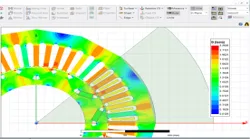
Simulation in ANSYS Maxwell and report creation

Simulation in ANSYS Maxwell and report creation

Simulation of designed IPM motor in ANSYS Maxwell. Preparation of a report for the details observed.

Fee

One fee.
Everything included.

Become job ready with our comprehensive industry focused curriculum for freshers & early career professionals

Premium
₹40,000
Inclusive of all charges
  • 1 Year Access
  • Personalized Page
  • Live Individual & Group Sessions
  • Personalized & Hands-On
  • Job-Oriented Industry Relevant Curriculum
Check eligibility →
FAQ

Questions,
answered.

What are the concepts covered in the electric motor designing course?

Topics like electromagnetics, electric machine theory principles, electric motor designing and modelling, industrial applications of electric motors, etc., constitute the curriculum.

What if I get stuck somewhere or have any doubts?

A professional support expert engineer is always available to help you with any questions or concerns. You can also get personalized assistance through email and forum support.

Are there any prerequisites for this course?

Yes, this program is designed for electrical engineers who have some familiarity or exposure to electric machine theory.

Which technical skills are included in the curriculum, and how are they applicable in the industry?

This electric motor training course makes use of MATLAB and ANSYS Electronics (Maxwell). MATLAB is generally employed to simulate numerical models, while ANSYS is the most extensively leveraged FEA software in the design of electric machines.

Which industries demand the skills taught in this course?

The curriculum skills gained through this program have industrial applications in the electrical, automotive, and aircraft manufacturing sectors.

What is the duration of the course?

The duration of this course is usually three months. However, you may need some more time to finish the project work.

What is the principle of the electric motor?

The principle of an electric motor is that when a current-carrying conductor is placed in a magnetic field the conductor is moved to make a rotational motion. Thus the electric motor converts electrical energy to mechanical energy.

Next step

Not sure it's
the right fit?

A counsellor will walk you through the syllabus, projects and fee options — and tell you honestly if another course suits you better.

Get the syllabus + a call back

We'll email the full syllabus and call within one working day.

By submitting you agree to our Terms and Privacy Policy.

Call usEnquire

Talk to a career counsellor

Free 20-minute call. We'll map the right course to where you want to work.

By submitting you agree to our Terms and Privacy Policy.