Mechanical Engineering Fresher Interview Prep 2026: Plan, Questions, Rounds
How to prepare for a mechanical fresher interview in 2026: an 8-week plan, the rounds, 13 checked technical answers, CAD skills and Skill-Lync offer data.

To prepare for a mechanical engineering fresher interview in 2026, revise five core subjects until you can solve a basic problem in each (strength of materials, theory of machines, thermodynamics, fluid mechanics, machine design), add manufacturing and GD&T, practise one CAD tool until you can model a part under time pressure, and learn to explain two of your projects in two minutes each. Eight focused weeks is enough for most students. Below: the plan, the rounds, 13 checked technical answers and what Skill-Lync's placement records say about fresher offers.
In short
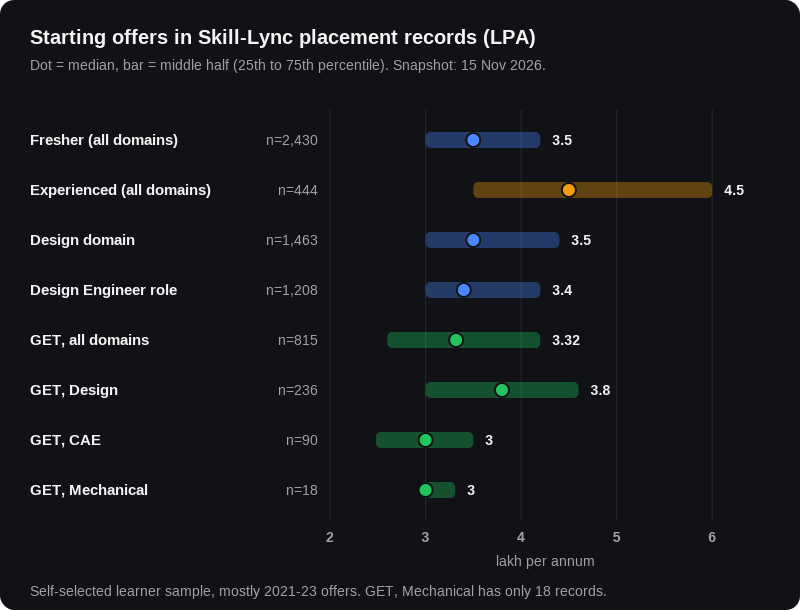
- Fresher starting offers in Skill-Lync placement records have a median of ₹3.5 LPA (n = 2,430), against ₹4.5 LPA for experienced hires (n = 444). Snapshot: 15 Nov 2026.
- Graduate Engineer Trainee (GET) offers: median ₹3.32 LPA across all domains (n = 815) and ₹3.8 LPA in the Design domain (n = 236). Mechanical-domain GET has only 18 records, median ₹3.0 LPA.
- The Design domain is the largest in the records (n = 1,463, median ₹3.5 LPA), and the top recruiters there are engineering design-services firms: Cyient (212 placements), Tata Technologies (98), Hyundai Motor (48).
- The PSU route goes through GATE. GATE 2027 runs on 6, 7, 13, 14, 20 and 21 February 2027, with results on 19 March 2027 (IIT Madras, as of 16 Nov 2026).
About the data: Based on 3,711 Skill-Lync placement records up to 7 Nov 2026 (data snapshot of 15 Nov 2026). This is a starting point; we'll update it as new placements come in. The sample is self-selected (learners who reported a placement, not the whole market), most records are 2021-23 starting offers, and 2025-26 together have only 82 records. The live version is on our mechanical engineer salary page.
What do companies test in a mechanical engineering fresher interview?
Companies test three things: whether you understand core mechanical concepts well enough to reason about a real part, whether you can use a CAD tool and read a drawing, and whether you can explain your own work clearly. Grades get you shortlisted. In the room, expect your resume, then fundamentals, then a small problem. Interviewers want the physical meaning and one worked number, not derivations.
What are the rounds in a mechanical fresher interview?
A typical drive at a core manufacturer or design-services company has four stages: an online aptitude test, a technical written test (or a CAD test at design firms), one or two technical interviews, and an HR interview. PSUs replace the first two with a GATE score cut-off. The exact pattern varies by company and year, so read the drive notice.
| Round | What it tests |
|---|---|
| Online aptitude | Quant, logical reasoning, verbal ability; practise 30 minutes a day |
| Technical test | MCQs on SOM, thermodynamics, fluids, manufacturing, machine design; previous GATE ME questions are good practice |
| CAD test (design firms) | Model a part from a drawing, or make a dimensioned 2D drawing, in a fixed time |
| Technical interview | Fundamentals, your projects, a small calculation, drawing reading, GD&T basics |
| HR interview | Communication, willingness to relocate or work shifts (common in plants), career goals |
GET programmes. A Graduate Engineer Trainee is hired straight out of college and trained on the job, often rotating through production, quality, design or maintenance before a permanent posting. GET drives lean on fundamentals and attitude more than software. In our records, Design-domain GET offers (median ₹3.8 LPA, n = 236) sit above the overall GET median (₹3.32 LPA, n = 815); the Mechanical-domain GET figure rests on just 18 records, mostly from 2022.
Which subjects should a mechanical fresher revise first?
Revise strength of materials first, then thermodynamics, theory of machines, fluid mechanics and machine design, then manufacturing processes and GD&T. SOM comes first because most design, CAE and GET interviews start there. Aim for "can solve one standard problem", not full textbook coverage.
| Subject | Topics interviewers return to |
|---|---|
| Strength of materials (SOM) | Stress-strain curve, Poisson's ratio, beam bending, torsion, thermal stress, failure theories, factor of safety |
| Theory of machines (TOM) | Gear trains, cams, flywheels, governors, balancing, natural frequency |
| Thermodynamics | Laws of thermodynamics, Carnot, Otto and Diesel cycles, entropy, refrigeration and COP |
| Fluid mechanics and heat transfer | Bernoulli's equation, Reynolds number, pipe losses, pumps, conduction, convection, fins |
| Machine design | Shafts, joints, bearing life, gears, springs, fatigue |
| Manufacturing | Casting, forging, sheet metal, machining, welding, hot vs cold working |
| Drawing and GD&T | Orthographic views, limits and fits, tolerance stack-up, the 14 GD&T symbols, datums, MMC |
What is a good 8-week preparation plan?
Spend weeks 1 to 5 on core subjects, weeks 4 to 6 on manufacturing and GD&T, and weeks 6 to 8 on mock interviews. Run CAD practice and 30 minutes of aptitude every day for all eight weeks, and write your project sheets and resume in weeks 3 to 5. That is about 2 to 3 hours a day alongside final-year work.
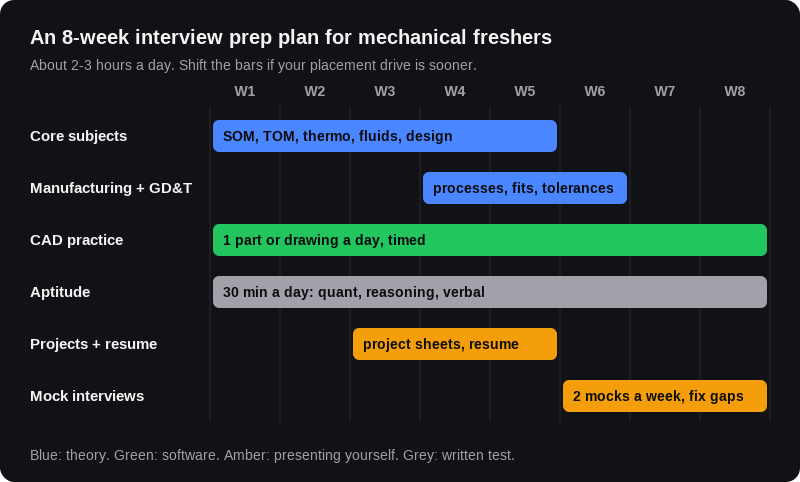
Two habits make the plan work: for each topic, write its 3 to 5 key formulas on one page and solve two numericals; and after every mock interview, list the questions you fumbled and revise only those.
If you want structured help with the theory, the opening lessons of our courses are free on Grow, our free-lessons site, and our YouTube channel has free full-length playlists on strength of materials, GD&T and an introduction to FEA.
What technical questions are asked in mechanical fresher interviews?
Expect concept questions with a short calculation: stress in a rod, bending stress in a cantilever, an engine cycle efficiency, Reynolds number, bearing life, a gear ratio, or a fit at a given size. The 13 below cover the patterns that come up most. Every number has been re-computed by script.
Strength of materials
1. A 10 mm diameter steel rod, 1 m long, carries 10 kN in tension. What are the stress and the elongation? ()
Stress is 127.3 MPa and the rod stretches 0.637 mm.
2. Where is the bending stress highest in a cantilever with a load at the free end?
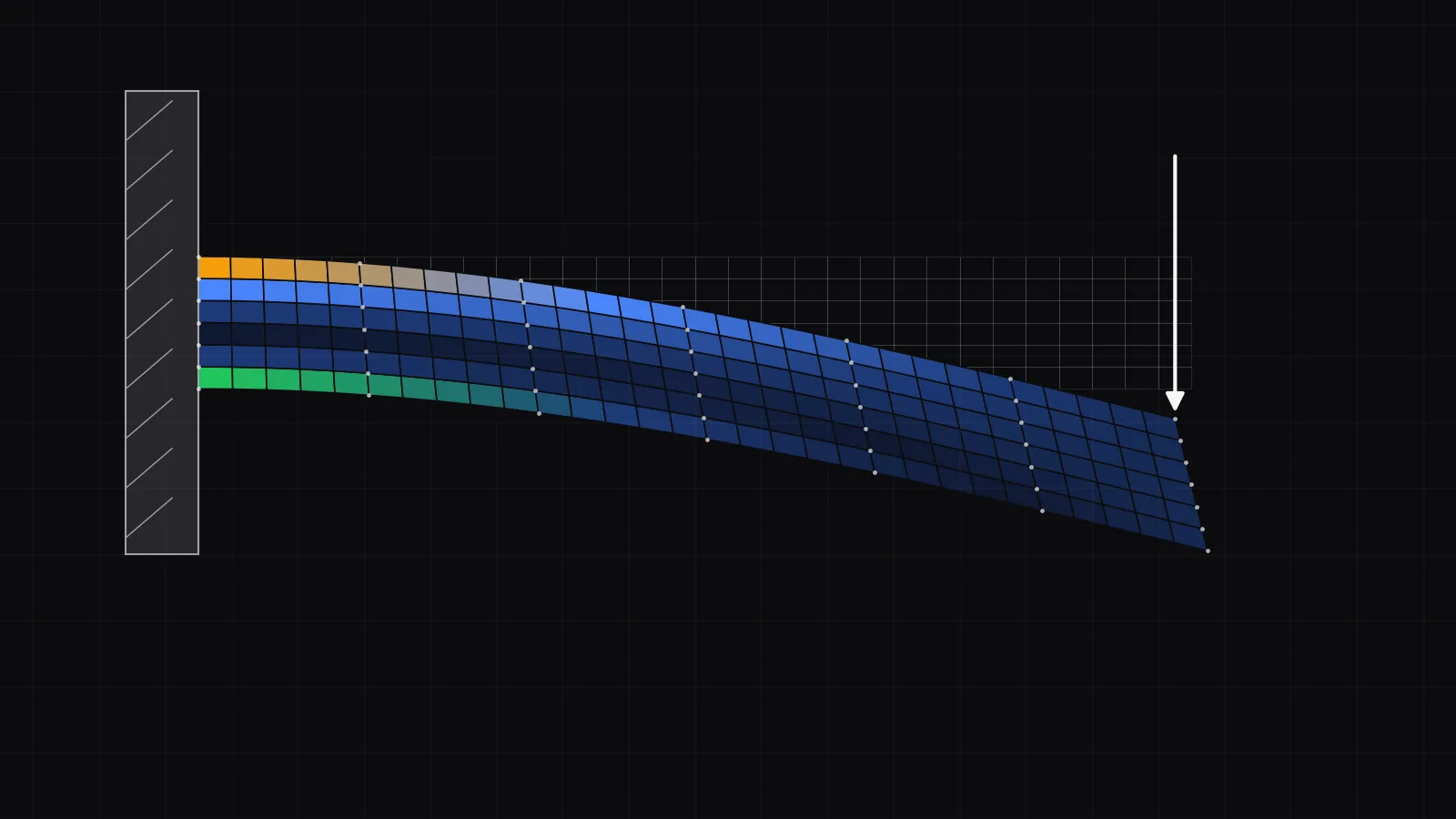
At the fixed end, on the top and bottom surfaces. Bending moment is load times distance, so it is largest at the support (), and bending stress is largest at the fibres farthest from the neutral axis. Example: kN, mm, a section 20 mm wide () and 40 mm deep ():
Turn the same beam on its side (40 mm wide, 20 mm deep) and stress doubles to 187.5 MPa, because grows with . That is why beams are deep, not wide.
3. What is the factor of safety, and what is it for that cantilever if the yield strength is 250 MPa?
Factor of safety is failure stress divided by working stress. For a ductile steel designed against yield, . It covers uncertainty in loads, material and analysis.
4. Which failure theory would you use for a steel shaft, and which for cast iron?
For ductile materials such as steel, use von Mises (distortion energy) or Tresca (maximum shear stress); for brittle cast iron, use maximum principal stress, because it fractures in tension rather than yielding in shear.
5. A steel bar fixed at both ends is heated by 50 °C. What stress develops? (, )
The bar wants to expand but cannot, so the restrained strain becomes stress:
That is 120 MPa, compressive. It does not depend on the bar's length or area.
Thermodynamics, fluids and heat transfer
6. What is the maximum efficiency of an engine working between 600 K and 300 K?
The Carnot efficiency, . Temperatures must be in kelvin. Real engines fall short because of friction and heat losses.
7. What is the air-standard efficiency of an Otto cycle with compression ratio 10? ()
Higher compression raises efficiency, but in a petrol engine it is limited by knock; diesel engines use higher compression ratios because they ignite by compression.
8. What is the best possible COP of a refrigerator keeping −5 °C in a 35 °C room?
COP can exceed 1 because the machine moves heat rather than creating it.
9. Water flows at 1 m/s in a 50 mm pipe. Is the flow laminar or turbulent? ()
That is far above the usual pipe-flow transition of about 2,300, so the flow is turbulent.
10. Why do air-conditioner condensers and motorcycle engines have fins?
Convective heat transfer is . Air has a low heat transfer coefficient , so the designer raises the area . Fins help most where is low, as with air.
Machine design and manufacturing
11. A ball bearing has a dynamic load rating kN and carries kN at 1,500 rpm. What is its rated life?
That is 64 million revolutions, or 711 hours. is the life 90% of identical bearings reach. The exponent is 3 for ball bearings and 10/3 for roller bearings, so halving the load on a ball bearing raises its life times.
12. A 20-tooth pinion drives a 60-tooth gear. The input is 1,500 rpm and 30 N·m. What comes out?
Gear ratio . Output speed rpm; output torque, ignoring losses, N·m. Power stays the same; a gearbox trades speed for torque.
13. What does Ø25 H7/g6 mean, and is it a clearance fit?
It is a hole-basis fit. The hole H7 is 25.000 to 25.021 mm; the shaft g6 is 24.980 to 24.993 mm.
Both are positive, so it is a sliding clearance fit for parts that must move but locate accurately. Check any fit with the limits and fits calculator.
Bonus, stack-up: three parts of 10 ±0.1, 20 ±0.1 and 30 ±0.2 mm stacked in a line give 60 mm. The worst-case tolerance adds the tolerances; the statistical (RSS) one adds their squares:
Try your own stack in the tolerance stack-up calculator. For position, datums and MMC questions, our GD&T interview questions guide has 38 worked answers.
Manufacturing questions are usually qualitative. Know when to choose casting, forging, sheet metal or machining, and that hot working happens above the metal's recrystallisation temperature and cold working below it.
Which CAD and CAE software should a mechanical fresher show?
Show one 3D CAD tool you can use quickly and accurately, plus AutoCAD for 2D drawings. SolidWorks is common in machinery and product firms; CATIA V5 and Siemens NX dominate automotive and aerospace design-services work. For analysis roles, add ANSYS or HyperMesh basics. Depth in one tool beats a list of five.
The largest Design-domain recruiters of our learners are design-services firms, which often run a CAD test:
| Company | Design-domain placements | Median offer (LPA) |
|---|---|---|
| Cyient | 212 | 3.3 |
| Tata Technologies | 98 | 4.6 |
| Hyundai Motor | 48 | 5.0 |
| Expleo Engineering | 44 | 3.0 |
| Tata Elxsi | 38 | 3.5 |
Our placement records, snapshot 15 Nov 2026; counts are placements of our learners, not company-wide hiring. For a wider list of employers that take freshers, see companies hiring mechanical engineering freshers.
A CAD test judges fully constrained sketches, a sensible feature order, a correct drawing and finishing on time. If you are choosing a tool to learn, compare the SolidWorks courses and CATIA courses.
How should a fresher present projects in an interview?
Prepare a two-minute story for each of your two best projects: the problem, your exact role, the method and tools, one number that shows the result, and one thing you would do differently. Interviewers dig into one detail, so know your assumptions, loads and materials, and never claim a teammate's work.
Put each on a one-page sheet with the requirement in numbers and one measurable result, such as a mass saving or a factor of safety.
If your final-year project is thin, add a small, well-documented one. Our mechanical engineering project ideas list projects our learners have actually built, in CFD, FEA, automotive design, mechanisms and more.
Should a mechanical fresher target PSUs through GATE?
Target PSUs through GATE if you want a government-sector engineering job and can give GATE serious preparation. Many PSUs shortlist mechanical engineering trainees on GATE scores, followed by an interview or group discussion. GATE 2027 runs on 6, 7, 13, 14, 20 and 21 February 2027, and results are due on 19 March 2027.
The same core subjects carry both routes. Our GATE hub has GATE Mechanical previous-year questions solved step by step and checked against the official answer keys, and the GATE 2027 mechanical guide covers the syllabus, the paper pattern and how PSUs use scores.
What mistakes cost freshers the job?
Three come up again and again: overstating software skills ("advanced SolidWorks" on a resume means a timed test), quoting formulas without their meaning, and vague answers about your own project. When unsure, reason aloud instead of guessing.
If you want guided practice, our Post Graduate Program in CAD (48 weeks; CATIA V5, Siemens NX CAD, SOLIDWORKS and Autodesk Alias) covers design work with industry projects. You can see recent outcomes on recent placements.
Frequently asked questions
How many days does it take to prepare for a mechanical fresher interview?
About 8 weeks at 2 to 3 hours a day covers the core subjects, CAD practice, aptitude and mock interviews. With 3 to 4 weeks, focus on SOM, thermodynamics, machine design, your projects and CAD.
Is CGPA important for mechanical engineering fresher jobs?
CGPA mainly decides whether you clear the shortlist, since many drives set a cut-off. After that, the technical interview, CAD test and how well you explain your projects carry more weight.
What salary does a mechanical engineering fresher get in India?
In Skill-Lync placement records, fresher starting offers across domains have a median of ₹3.5 LPA (n = 2,430) and Design-domain GET offers a median of ₹3.8 LPA (n = 236), snapshot 15 Nov 2026, mostly 2021-23 offers. See the mechanical engineer salary page for the live figures.
Do PSUs take mechanical freshers without GATE?
Most PSU engineering-trainee recruitment for mechanical graduates uses GATE scores for the shortlist. A few organisations run their own exams, so check each notification. GATE 2027 results are due on 19 March 2027.
Sources and further reading
- Skill-Lync placement records,
placement-stats.json, 3,711 records up to 7 Nov 2026, snapshot 15 Nov 2026; summarised on skill-lync.com/salaries/mechanical-engineer and /recent-placements. - GATE 2027 important dates, IIT Madras, read 16 Nov 2026.
- GATE 2027 Mechanical Engineering syllabus, IIT Madras, read 16 Nov 2026.
- Dynamic load ratings and fatigue life (basic rating life, exponents 3 and 10/3), NSK Europe, read 16 Nov 2026.
- ISO 286-1:2010, ISO code system for tolerances on linear sizes, ISO; values for H7/g6 at 25 mm cross-checked with our limits and fits calculator.
- Skill-Lync YouTube playlists: Strength of Materials, GD&T, Introduction to FEA, checked playable 16 Nov 2026.