GATE 2027 Mechanical (ME): Dates, Syllabus, Pattern, 12-Week Plan, PSUs
GATE 2027 is on 6-21 February 2027 (IIT Madras), results 19 March. Here is everything for the ME paper: official dates and fees, the revised syllabus and what changed, marking, where the marks fell in the 2026 paper, last three years' cut-offs, a 12-week plan and how PSUs hire mechanical engineers through GATE.

GATE 2027 is organised by IIT Madras and will be held on 6, 7, 13, 14, 20 and 21 February 2027, with results on 19 March 2027. Registration has closed: the regular window ran from 2 September to 5 October 2026 and the late-fee window to 12 October. The Mechanical Engineering (ME) paper is a 3-hour, 65-question, 100-mark computer-based test, and its syllabus has been revised for 2027. The date of the ME paper itself has not been announced yet, so plan for the first exam day: that leaves about 12 weeks from today.
GATE 2027 ME at a glance (as of 14 Nov 2026)
- Organising institute: IIT Madras, on behalf of the National Coordination Board (GATE), Ministry of Education. GATE 2027 is the 45th edition.
- Exam days: 6, 7, 13, 14, 20 and 21 February 2027, forenoon (9:30 am to 12:30 pm) and afternoon (2:30 pm to 5:30 pm) sessions. Paper-wise schedule: not yet published.
- Still open: free defect rectification until 30 November 2026; the paid data-correction window closes today, 14 November.
- Exam city slip: 4 January 2027. Admit card: date not yet announced. Results: 19 March 2027.
- Paper: 65 questions, 100 marks: General Aptitude 15, Engineering Mathematics 13, core mechanical 72. Negative marking only on MCQs.
- Last year's ME cut-off: 25.2 marks (General) in GATE 2026; 10,970 of 59,612 candidates qualified.
This guide covers the official dates and fees, the full ME syllabus with what changed for 2027, how the paper is marked, where the marks actually fell in the 2026 ME paper, a realistic 12-week plan, and how public sector undertakings (PSUs) use GATE scores to hire mechanical engineers.
When is GATE 2027, and who is conducting it?
IIT Madras is the organising institute for GATE 2027; the exam is conducted jointly by IISc and the IITs for the National Coordination Board, Ministry of Education. The official website is gate2027.iitm.ac.in and applications are handled on the GOAPS portal.
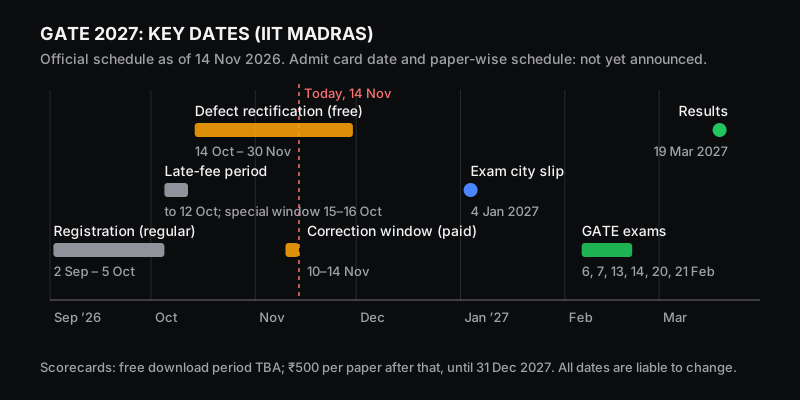
The registration dates moved twice. The portal was first announced for 14 August, then 27 August, and finally opened on 2 September 2026. The table below lists the current dates; the official page shows the earlier ones struck through.
| Event | Date (current official schedule) |
|---|---|
| GOAPS registration opened | 2 September 2026 |
| Regular registration closed (no late fee) | 5 October 2026 |
| Extended registration closed (with late fee) | 12 October 2026 |
| Special registration window (late fee) | 15 October 2026, 10:30 am to 16 October, 10:29 am |
| Application defect rectification (free) | 14 October to 30 November 2026 |
| Data correction window (on request, with fee) | 10 to 14 November 2026 |
| Exam city notification | 4 January 2027 |
| Admit card download | To be announced |
| GATE 2027 exams | 6, 7, 13, 14, 20 and 21 February 2027 |
| Results on GOAPS | 19 March 2027 |
| Scorecard after the free period | ₹500 per paper, until 31 December 2027 |
When is the ME paper? Not announced yet. The brochure says the complete schedule will be notified later. For reference, in GATE 2026 (organised by IIT Guwahati) Mechanical Engineering was a single-session paper on Saturday 14 February 2026, afternoon session. Do not assume the same slot this year; check the official site when the paper-wise schedule is released.
What are the GATE 2027 application fees?
The fee is per test paper; candidates taking two papers pay twice. The official fee table (₹):
| Category | Regular period | Extended (late-fee) period |
|---|---|---|
| Female, SC, ST and PwD candidates | ₹1,000 per paper | ₹1,500 per paper |
| All other candidates, including foreign nationals | ₹2,000 per paper | ₹2,500 per paper |
Corrections requested in the 10 to 14 November window cost ₹500 per change per paper (name, date of birth, exam city, paper and so on), with an extra ₹1,000 where a change removes a fee concession, for example a category change from SC/ST to another category for a candidate not otherwise eligible for the lower fee. Registration was through DigiLocker with live facial capture, and IIT Madras has asked candidates not to delete the DigiLocker account they applied with, because all further communication is tied to it.
Who could apply? Anyone in the third year or later of an undergraduate degree in engineering, technology, science, commerce, arts or humanities, or who has completed such a degree. ME candidates may add a second paper from AE, DA, IN, NM, PI, XE, RA or CS.
What is the GATE 2027 ME exam pattern and marking scheme?
| Item | Detail |
|---|---|
| Mode and language | Computer-based test, English only, on-screen virtual scientific calculator (no physical calculator) |
| Duration | 3 hours (PwD candidates eligible for compensatory time of 20 minutes per hour) |
| Questions | 65: 10 General Aptitude + 55 subject |
| Marks | 100: General Aptitude 15 (5 × 1 + 5 × 2), Engineering Mathematics 13, core ME 72 |
| Question types | MCQ (one correct of four), MSQ (one or more correct), NAT (type a number) |
| Negative marking | MCQ only: −1/3 for a wrong 1-mark answer, −2/3 for a wrong 2-mark answer. None for MSQ or NAT. No partial marks. |
| Score validity | 3 years from the result date |
The mix of question types matters for strategy. In the GATE 2026 ME paper, the answer key shows 45 MCQs (all 10 aptitude questions plus 35 subject questions) and 20 NAT questions, and no MSQs at all. That put 62 marks at risk of negative marking and 38 marks (all NAT) free of it. The 2027 mix may differ, but NAT questions are where guessing costs nothing and where careful arithmetic on the virtual calculator earns marks.
How is the GATE score calculated?
The scorecard shows marks out of 100 and a GATE score out of 1,000. The score rescales your marks between the qualifying mark and the average of the top candidates:
GATE score = 350 + (900 − 350) × (M − Mq) / (Mt − Mq)
Here M is your mark (normalised if the paper runs in several sessions), Mq the General-category qualifying mark, and Mt the mean of the top 0.1% or top 10 candidates, whichever group is larger. For 2027, the General qualifying mark is max(25, min(40, μ + σ)), where μ and σ are the mean and standard deviation of all candidates in the paper; OBC-NCL/EWS candidates qualify at 90% of that and SC/ST/PwD at two-thirds.
Worked example with GATE 2026 ME numbers (Mq = 25.2, Mt = 74.58, from the official performance report):
| Marks | GATE score |
|---|---|
| 25.2 (cut-off) | 350 |
| 30 | ≈ 404 |
| 40 | ≈ 515 |
| 50 | ≈ 626 |
| 60 | ≈ 738 |
| 74.58 (top-0.1% average) | 900 |
So in 2026, every extra 10 marks above the cut-off was worth about 111 score points. The constants change every year with the paper's difficulty, which is why PSUs and IITs compare scores (or marks within the same year), never marks across years.
What is the GATE 2027 ME syllabus?
The official ME syllabus has four sections, plus the General Aptitude section common to all papers. Below is the full content, condensed only in wording; the PDF on the official site is the authority.
Section 1: Engineering Mathematics (13 marks)
- Linear algebra: matrix algebra, systems of linear equations, eigenvalues and eigenvectors.
- Calculus: functions of a single variable, limit, continuity, differentiability, mean value theorems, indeterminate forms; definite and improper integrals; double and triple integrals; partial and total derivatives, Taylor series in one and two variables, maxima and minima, Fourier series; gradient, divergence, curl, vector identities, directional derivatives, line, surface and volume integrals, Gauss, Stokes and Green theorems.
- Differential equations: first-order (linear and nonlinear), higher-order linear with constant coefficients, Euler-Cauchy, initial and boundary value problems, Laplace transforms, solutions of the heat, wave and Laplace equations.
- Complex variables: analytic functions, Cauchy-Riemann equations, Cauchy's integral theorem and contour integral formula, Taylor and Laurent series.
- Probability and statistics: probability definitions, sampling theorems, conditional probability, mean, median, mode, standard deviation, random variables, binomial, Poisson and normal distributions.
- Numerical methods: linear and nonlinear algebraic equations, trapezoidal and Simpson's rules, single- and multi-step methods for ODEs.
Section 2: Applied Mechanics and Design
- Engineering mechanics: free-body diagrams and equilibrium; friction including rolling resistance, belt-pulley, brakes, clutches, screw jack, wedge, vehicles; plane trusses and frames; virtual work; plane kinematics and dynamics of rigid bodies; impulse, momentum and energy methods.
- Mechanics of materials: stress, strain and elastic constants; 2D stress and strain transformation; Mohr's circle; thin-walled pressure vessels; shear force and bending moment diagrams; bending and shear stresses; shear centre; beam deflection; torsion of circular shafts; Euler columns; energy methods; thermal stresses; strain gauges and rosettes; mechanical properties, toughness, hardness, impact strength.
- Theory of machines: displacement, velocity and acceleration analysis of plane mechanisms; dynamic analysis of linkages; cams; gears and gear trains; flywheels and governors; balancing; gyroscope.
- Vibrations: free and forced vibration of linear single- and two-degree-of-freedom systems; damping estimation; isolation and transmissibility; resonance; critical speeds of shafts; control systems, PID controller, transfer function.
- Machine design: static and dynamic loading; failure theories; fatigue and the S-N diagram; bolted, riveted and welded joints; shafts, gears, belt drives, rolling and sliding bearings, brakes and clutches, springs.
Section 3: Fluid Mechanics and Thermal Sciences
- Fluid mechanics: fluid properties; statics, forces on submerged bodies, stability of floating bodies; control-volume mass, momentum and energy; fluid acceleration; differential continuity and momentum equations; velocity potential; Bernoulli; dimensional analysis; viscous incompressible flow, boundary layer, elementary turbulence, pipe flow and losses; one-dimensional high-speed compressible flow; converging and converging-diverging nozzles.
- Heat transfer: modes; 1D conduction, thermal resistance, fins; unsteady conduction and lumped systems; thermal boundary layer; dimensionless groups and correlations for free and forced convection over plates and in pipes; boiling and condensation; heat exchangers (LMTD and NTU); radiation, Stefan-Boltzmann and Wien laws, black and grey surfaces, view factors, radiation networks.
- Thermodynamics: systems and processes; pure substances; ideal and real gases; zeroth, first and second laws; work, heat, energy and entropy changes; closed and open system analysis; property tables and charts; availability and irreversibility; thermodynamic relations.
- Applications: vapour and gas power cycles with regeneration and reheat; air-standard Otto, Diesel and dual cycles; basics of combustion (air-fuel ratio, equivalence ratio); vapour and gas refrigeration and heat pumps; psychrometry; turbomachinery (impulse and reaction, velocity diagrams, Pelton, Francis and Kaplan turbines, steam and gas turbines, compressors, pumps and pump characteristics).
Section 4: Materials, Manufacturing and Industrial Engineering
- Engineering materials: crystal structure of common metals, phase diagrams, heat treatment; properties and uses of metals, alloys, polymers, composites and ceramics; engineering and true stress-strain diagrams.
- Casting, forming and joining: casting processes, patterns, moulds and cores, solidification, riser and gating design, casting defects; plastic deformation and yield criteria; hot and cold working; bulk and sheet forming and load estimation; powder metallurgy; welding, brazing, soldering, solid-state welding, adhesive bonding; non-destructive testing.
- Machining: machining operations and machine tools; single- and multi-point tools; tool geometry in ASA and ORS systems; mechanics of machining; tool materials, tool life and wear; economics of machining; abrasive and non-traditional processes; work holding, jigs and fixtures.
- Additive manufacturing: principles of AM processes; advantages, limitations and applications of AM products.
- Metrology and inspection: limits, fits and tolerances; linear and angular measurement; comparators; interferometry; form and finish; alignment testing; tolerance analysis; principle of the CMM.
- Computer-aided manufacturing and automation: CAD/CAM integration; NC/CNC machines and programming; pneumatic, electro-pneumatic and hydraulic actuators; programmable logic controllers (PLCs).
- Production planning and control: work study, productivity, forecasting, aggregate planning, scheduling, MRP, six sigma, lean; inventory control (deterministic models, safety stock); quality and reliability.
- Operations research: linear programming and simplex, transportation, assignment, network flow, simple queuing, PERT and CPM.
What changed in the GATE 2027 ME syllabus?
IIT Madras says the syllabi have been revised for the first time in five years. We compared the 2027 ME PDF with the GATE 2026 ME PDF line by line. The structure and most topics are the same; the changes worth adjusting your plan for are:
| Area | New or expanded in 2027 | Dropped from the wording |
|---|---|---|
| Vibrations | Two-degree-of-freedom systems, damping estimation, transmissibility; control systems, PID controller, transfer function | (was single-degree-of-freedom only) |
| Engineering mechanics | Rolling resistance (in place of rolling friction), plane trusses | Lagrange's equation |
| Mechanics of materials | 2D stress and strain transformation; mechanical properties, toughness, hardness, impact strength | Testing on the universal testing machine (as a separate item) |
| Machine design | Belt drives | None |
| Fluid mechanics | Velocity potential; 1D high-speed compressible flow; converging and converging-diverging nozzles (was "basics of compressible flow") | None |
| Heat transfer | Boiling and condensation | Heisler charts |
| Applications | Basics of combustion (air-fuel ratio, equivalence ratio); pump characteristics | None |
| Materials and manufacturing | Crystal structure; polymers, composites, ceramics; true stress-strain; casting defects; solid-state welding; NDT; tool geometry (ASA, ORS); additive manufacturing as its own topic | None |
| Automation and IE | Pneumatic, electro-pneumatic and hydraulic actuators; PLCs; work study, productivity, six sigma, quality and reliability | "Computer integrated manufacturing" renamed |
The practical reading: control systems/PID, two-DOF vibration, nozzles, boiling and condensation, combustion basics, PLCs and actuators, and NDT are the topics with no previous-year GATE ME questions to practise from. Budget a few hours for each from standard textbooks rather than skipping them.
Which ME topics carry the most marks?
GATE does not publish topic-wise weightage. To get a real number, we took the official GATE 2026 ME master question paper and answer key, assigned each of the 55 subject questions to one topic of the 2027 syllabus, and summed the marks. The classification is ours (a few questions straddle two topics; we chose the closer one), but the marks per question come straight from the key.
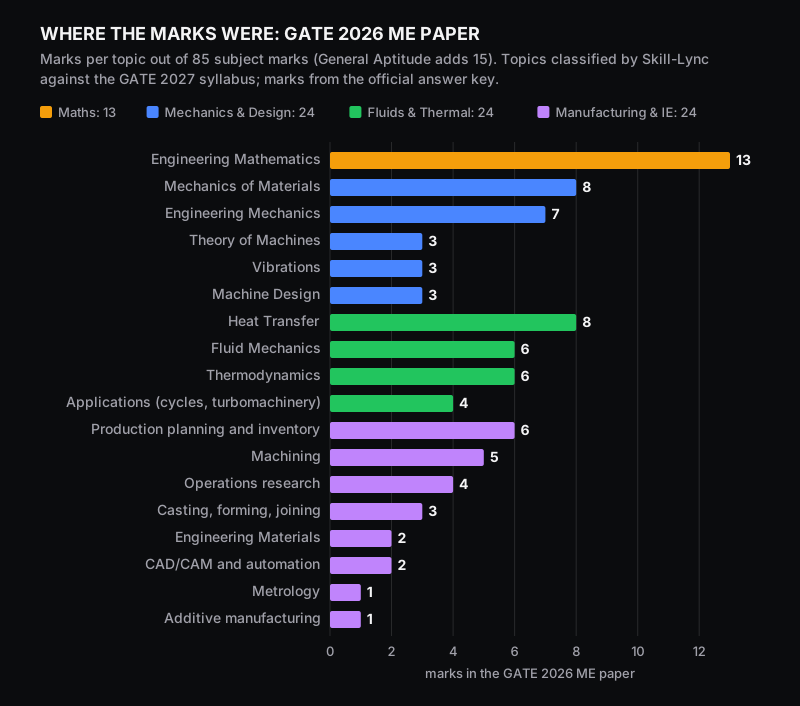
Three things stand out:
- The three core sections were exactly balanced: 24 marks each for Applied Mechanics and Design, Fluid and Thermal Sciences, and Materials, Manufacturing and Industrial Engineering. No section is skippable.
- Aptitude plus maths is 28 marks. Both are fixed by the brochure (15 and 13), and they are the most predictable marks in the paper.
- Industrial engineering was worth 10 marks (production planning, inventory and operations research). These are short, formula-driven questions: forecasting, EOQ, PERT, LP duality. They reward a week of focused practice more than almost any other topic.
One paper is one sample. Topic marks move by a few each year, so use this to rank topics, not to drop any.
What score do you need in GATE ME?
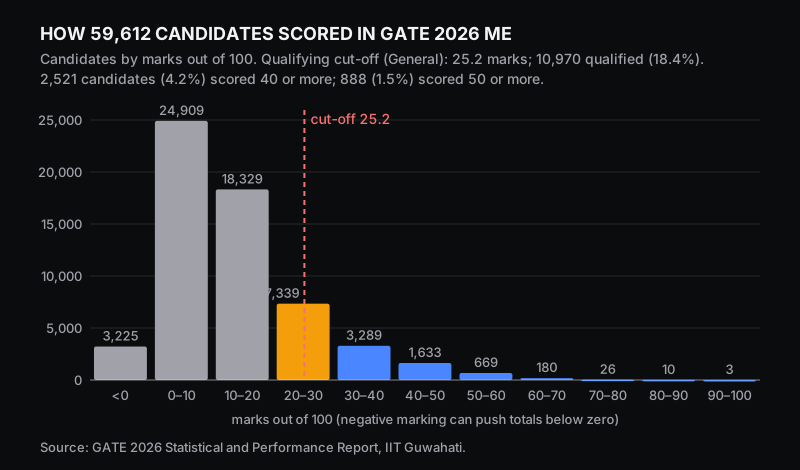
To qualify, very little: the 2026 General cut-off was 25.2 marks. To be competitive for top IIT M.Tech seats or PSU shortlists, far more, because the field is wide and most candidates score low.
| GATE year (organiser) | Registered | Appeared | Cut-off General | OBC-NCL/EWS | SC/ST/PwD |
|---|---|---|---|---|---|
| 2024 (IISc) | 83,114 | 65,546 | 28.6 | 25.7 | 19.0 |
| 2025 (IIT Roorkee) | 79,830 | 62,015 | 35.8 | 32.2 | 23.8 |
| 2026 (IIT Guwahati) | 76,823 | 59,612 | 25.2 | 22.6 | 16.7 |
Two trends: ME registrations have fallen each year (83,114 to 76,823 over two cycles), and the cut-off swings by 10 marks with paper difficulty. In 2026 the mean ME mark was 13.35 with a standard deviation of 11.86, so the cut-off (μ + σ) landed at 25.2; the highest mark was 96.67. For perspective, in 2026 a mark of 40 or more put a candidate in the top 4.2% of ME candidates, and 50 or more in the top 1.5%. NTPC's General-category shortlist for mechanical trainees sat in that range, as the PSU section below shows; the exact bar depends on the organisation, the year and your category.
How to prepare for GATE 2027 ME in the 12 weeks left
From 14 November 2026 to 6 February 2027 is exactly 84 days. If you have studied the core subjects in college, 12 weeks is enough to turn that into exam marks; it is not enough to learn everything from zero, so the plan below prioritises by marks and by how quickly a topic converts into correct answers.
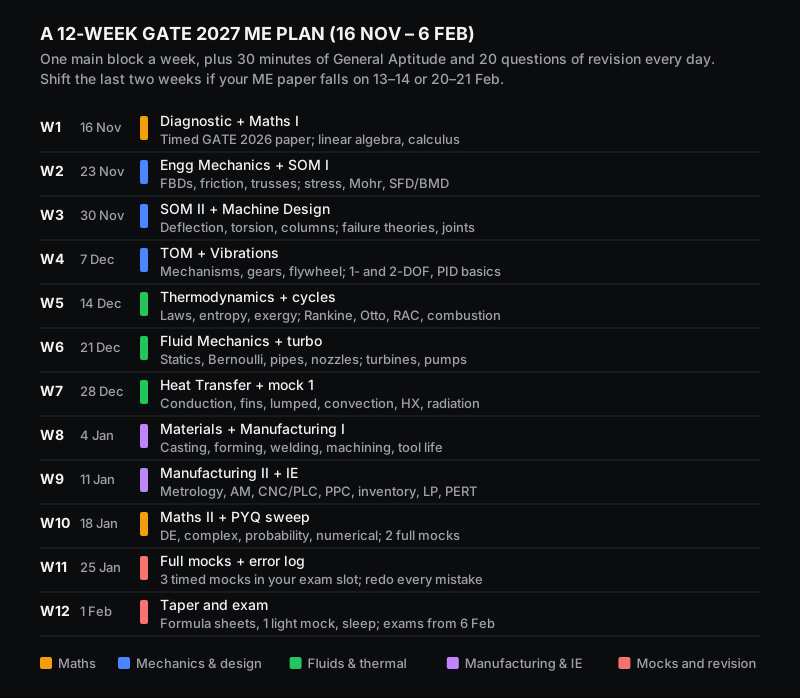
The plan, week by week
- This weekend (14-15 Nov): fix your application if the portal flags a defect (free until 30 November), download the 2026 ME paper and key from the official site, and set up an error log (a spreadsheet with question, topic, why you got it wrong).
- Week 1 (16-22 Nov): sit the GATE 2026 ME paper in 3 hours, using only an on-screen calculator. Mark it. Your topic-wise losses decide the order of weeks 2 to 9. Start maths: linear algebra and calculus.
- Weeks 2-4 (23 Nov-13 Dec): Applied Mechanics and Design, 24 marks. Engineering mechanics and strength of materials first (15 of the 24 in 2026), then machine design, theory of machines and vibrations. Add the new items: two-DOF systems, transmissibility, and enough control theory to handle a transfer function and a PID question.
- Weeks 5-7 (14 Dec-3 Jan): Fluid and Thermal, 24 marks. Thermodynamics with cycles and the new combustion basics; fluid mechanics with compressible flow and nozzles; heat transfer last (it was the biggest single thermal topic in 2026). First full mock at the end of week 7.
- Weeks 8-9 (4-17 Jan): Materials, Manufacturing and IE, 24 marks. Machining and forming numericals, then metrology, additive manufacturing, CNC and PLC basics, and a hard push on production planning, inventory and operations research.
- Week 10 (18-24 Jan): remaining maths (differential equations, complex variables, probability, numerical methods) and a sweep of previous-year ME questions by topic. Two full mocks.
- Week 11 (25-31 Jan): three timed full mocks in the same time slot as your exam session. After each, redo every wrong and every guessed question from the error log.
- Week 12 (1-6 Feb): formula sheets, one light mock, normal sleep. If your ME paper turns out to be on 13-14 or 20-21 February, extend weeks 10 and 11, not the new-topic weeks.
Rules that matter more than the timetable
- Do aptitude every day. 15 marks, five 1-mark and five 2-mark questions, no syllabus to finish. Thirty minutes a day for 12 weeks is enough to make it near-certain marks.
- Attack NAT questions with care, MCQs with judgement. No negative marking on NAT, so never leave one blank if you have a reasonable approach. On a 2-mark MCQ a wrong answer costs 0.67; guess only when you can eliminate two options.
- Practise on the virtual calculator. The exam allows only the on-screen calculator, and IIT Madras says the virtual calculator and mock tests will be available through the official site. Doing 12 weeks of practice on a phone calculator and then switching on exam day costs time.
- Use previous-year papers as the main question bank. The official site hosts past ME papers and keys. The syllabus barely changed in most topics, so they remain the best practice set.
If a subject from college is weak, it is usually thermodynamics or design. Our Foundations of Thermodynamics course covers cycles, refrigeration and property relations in an applied way, and the structural analysis course connects mechanics of materials to how stresses are checked in industry. They are not GATE coaching, but they make the theory stick.
Which PSUs recruit mechanical engineers through GATE?
Fewer than many guides suggest. We checked each PSU's own careers page and recruitment adverts on 14 November 2026. The GATE 2027 brochure lists about 30 PSUs that have used GATE scores at some point, but several big names have since moved mechanical hiring to their own computer-based tests, and others use GATE only for other branches.
Already announced: PSUs that will use GATE 2027 scores for ME
| PSU | Notice | What it says |
|---|---|---|
| NTPC | Advt 11/26 (August 2026) | Engineering Executive Trainees 2027 through GATE 2027, including Mechanical. Only GATE 2027 marks accepted; detailed advert to follow. |
| GAIL | GAIL/OPEN/ET/1/2026, 1 Sep 2026 | Executive Trainees in Chemical, Electrical, Instrumentation and Mechanical on GATE 2027 marks. Applications 17 Feb to 18 Mar 2027; 65% in the degree (60% SC/ST/PwBD); upper age 26 as on 18 Mar 2027. |
| NPCIL | NPCIL/HQ/HRM/ET/2026/03 (ET-2027) | Executive Trainees in seven branches including Mechanical. Accepts a valid GATE 2025, 2026 or 2027 score; detailed advert about 10 days after GATE 2027 results. |
Coal India has also announced GATE 2027 recruitment, but only for Mining Engineering.
Who hired mechanical engineers through GATE in the last cycle?
| PSU and post | GATE score used | ME vacancies | Pay (as advertised) | Selection |
|---|---|---|---|---|
| NTPC, Engineering Executive Trainee (EET-2025) | GATE 2025 | 210 | ₹40,000–1,40,000 (E1) | Shortlist on GATE, document verification |
| NPCIL, Executive Trainee 2026 | GATE 2024, 2025 or 2026 | 125 | ₹74,000/month stipend in training, then Level 10 (₹56,100 basic) | GATE shortlist (1:12), final selection on interview only |
| GAIL, Executive Trainee | GATE 2026 | 16 | ₹60,000–1,80,000 (E2) | GATE shortlist, then GD and/or interview |
| Engineers India (EIL), Management Trainee 2026 | GATE 2026 | 24 | CTC about ₹20.1–21 lakh a year (as stated by EIL) | GATE shortlist, then GD and interview |
| NALCO, Graduate Engineer Trainee | GATE 2025 | 59 | ₹40,000–1,40,000 in training | GATE 90%, interview 10% |
| NHPC, Trainee Engineer (special drive for SC/ST/OBC/PwBD only) | Best of GATE 2024/2025 | 26 + 2 PwBD | ₹50,000–1,60,000 (E2) | GATE 75%, GD 5%, interview 20% |
| DVC, Executive Trainee (Mechanical), open until 6 Dec 2026 | GATE 2025 | 17 | ₹56,100–1,77,500 (Level 10) | Merit on GATE marks, document verification |
| BPSCL (SAIL–DVC joint venture, via DVC), Management Trainee, open now | GATE 2025 | 10 | ₹50,000–1,60,000 in training | GATE 2025 based |
NLC India has also advertised Graduate Executive Trainee posts through GATE (Advt 10/2026, reported as 66 mechanical posts), but its official advert loads through a script we could not read, so treat those details as reported, not verified. Most of these adverts also cap age at 25 to 30 for the general category and ask for 60-65% in the degree; check each advert.
Which well-known PSUs do not currently hire ME through GATE?
- IOCL: its 2026 engineer recruitment (advert of 14 Aug 2026) is through its own computer-based test, weighted 85% CBT, 5% group discussion and task, 10% interview.
- ONGC: recruits engineers through its own CBT since 2025; its last GATE-based round used GATE 2023 scores.
- SAIL and HPCL: own CBT followed by GD and interview.
- BHEL: the latest GATE-based engineer trainee recruitment on its careers portal is from GATE 2018.
- POWERGRID, AAI and Coal India use GATE, but their recent GATE adverts did not include Mechanical.
Coaching material and older blog posts still list these as GATE routes for mechanical engineers. Read the PSU's current advert before you plan around one.
What GATE result did PSUs actually shortlist at?
Only a few PSUs publish official cut-offs, and they use different units:
| PSU and round | Unit | General | EWS | OBC | SC | ST |
|---|---|---|---|---|---|---|
| NTPC EET-2025, final list (27 Jul 2026) | GATE 2025 All-India Rank | 839 | NA | 613 | 2,024 | 2,785 |
| NTPC EET-2025, first list (16 Apr 2026) | GATE 2025 AIR | 587 | NA | 434 | 1,369 | 1,428 |
| NTPC EET-2024 | GATE 2024 AIR | 919 | 1,664 | 953 | 3,306 | 5,239 |
| NHPC Trainee Engineer (special drive), 15 Jun 2026 | GATE marks out of 100 | NA | NA | 72.00 | 64 | 48 |
Put those ranks in context: GATE 2025 ME had 62,015 candidates appear, so an AIR of 839 is about the top 1.4%, and NTPC's first list stopped at AIR 587 (top 0.9%). In GATE 2024, AIR 919 of 65,546 was also about the top 1.4%. NPCIL says it shows cut-offs on its recruitment portal after login; Careers360 reports NPCIL's GATE 2026-cycle ME cut-off as a GATE score of 618 for General, but that is an unofficial compilation we could not check against an NPCIL document.
The takeaway for a 2027 aspirant: for NTPC-style General-category shortlists, plan to finish in roughly the top 1-1.5% of ME candidates. In the 2026 paper that meant about 50 marks or more.
GATE ME or a core industry job: which path after 2027?
A good GATE score opens three doors: M.Tech or MS at IITs, IISc and NITs (with a Ministry of Education stipend at eligible institutes), PSU jobs that shortlist on GATE scores, and some direct recruitment in central government that now uses GATE. None of them is guaranteed by qualifying alone; the brochure itself says GATE qualification does not assure a PSU job.
Many mechanical graduates also go straight into private-sector design, simulation and manufacturing roles, and some do both: write GATE in February and keep building skills that employers test. If that is your plan, the most useful skills alongside GATE preparation are CAD, GD&T and simulation. See our GD&T interview questions guide and how to get a core mechanical job after graduation, or programmes such as the PG Program in CAD and PG Program in CAE.
Frequently asked questions
When is the GATE 2027 Mechanical Engineering exam?
GATE 2027 runs on 6, 7, 13, 14, 20 and 21 February 2027. The date and session for the ME paper had not been announced as of 14 November 2026; IIT Madras will publish the paper-wise schedule on gate2027.iitm.ac.in.
Can I still apply for GATE 2027?
No. Regular registration closed on 5 October, the late-fee period on 12 October and a special window on 16 October 2026. If you applied, the free defect-rectification window is open until 30 November 2026.
Has the GATE 2027 ME syllabus changed?
Yes, modestly. New or expanded topics include two-DOF vibrations and control systems (PID, transfer functions), compressible flow through nozzles, boiling and condensation, combustion basics, PLCs and actuators, NDT and additive manufacturing. Lagrange's equation and Heisler charts no longer appear in the wording.
Is there negative marking in GATE ME?
Only on MCQs: one-third of the marks for a wrong 1-mark answer, two-thirds for a wrong 2-mark answer. MSQ and NAT questions have no negative marking. In the 2026 ME paper, 38 of the 100 marks were NAT questions.
What was the GATE 2026 ME cut-off?
25.2 marks for General, 22.6 for OBC-NCL/EWS and 16.7 for SC/ST/PwD, with 10,970 of 59,612 candidates qualifying. In 2025 it was 35.8, and in 2024, 28.6.
How long is a GATE score valid?
Three years from the result date. GATE 2027 results are due on 19 March 2027, so the score will be usable until March 2030. Each PSU, however, states which GATE year it accepts in its own advertisement.
Sources and further reading
- IIT Madras, GATE 2027 important dates, application fees and home page notices. Accessed 14 Nov 2026.
- IIT Madras, GATE 2027 Information Brochure (dated 17 Oct 2026): pattern, marking, eligibility, two-paper combinations, score and qualifying-mark formulas, PSU list. Accessed 14 Nov 2026.
- IIT Madras, GATE 2027 ME syllabus (PDF). Accessed 14 Nov 2026.
- IIT Madras, press release: GATE 2027 dates, syllabus revision and new paper, 20 Jul 2026.
- IIT Guwahati, GATE 2026 ME syllabus (PDF), used for the syllabus comparison.
- IIT Madras (GATE 2027 downloads), GATE 2026 ME question paper and answer key, used for the weightage chart and question-type counts.
- IIT Guwahati, GATE 2026 Statistical and Performance Report (ME registrations, mean, standard deviation, cut-offs, marks distribution); GATE 2026 cut-off marks; GATE 2026 examination schedule. Accessed 14 Nov 2026.
- IIT Roorkee, GATE 2025 cut-off marks; IISc, GATE 2024 cut-off marks. Accessed 14 Nov 2026.
- PSU careers pages and adverts, all accessed 14 Nov 2026: NTPC recruitment (Advt 11/26 GATE 2027 pre-advert; EET-2025 Advt 14/24 and shortlisting cut-offs; EET-2024 cut-offs); GAIL ET through GATE 2027 (1 Sep 2026) and GAIL ET through GATE 2026 (20 Feb 2026); NPCIL ET-2027 and NPCIL ET-2026; EIL MT-2026; NALCO careers (GET Advt 10250803); NHPC Trainee Engineer special drive and its shortlisting notice (15 Jun 2026); DVC recruitment notices (ET Mechanical and BPSCL MT, 6 Nov 2026); Coal India GATE 2027 notice.
- PSUs recruiting through their own tests, accessed 14 Nov 2026: IOCL recruitment through CBT 2026; ONGC recruitment notices; SAIL MT (Technical) 2025; HPCL job openings; BHEL careers; POWERGRID ET-2026 notice; AAI Junior Executive through GATE (Advt 09/2025/CHQ).
- Reported, not verified against the PSU's own documents: Careers360, NPCIL GATE cut-off (updated 22 Sep 2026); NLC India GET 2026 report.