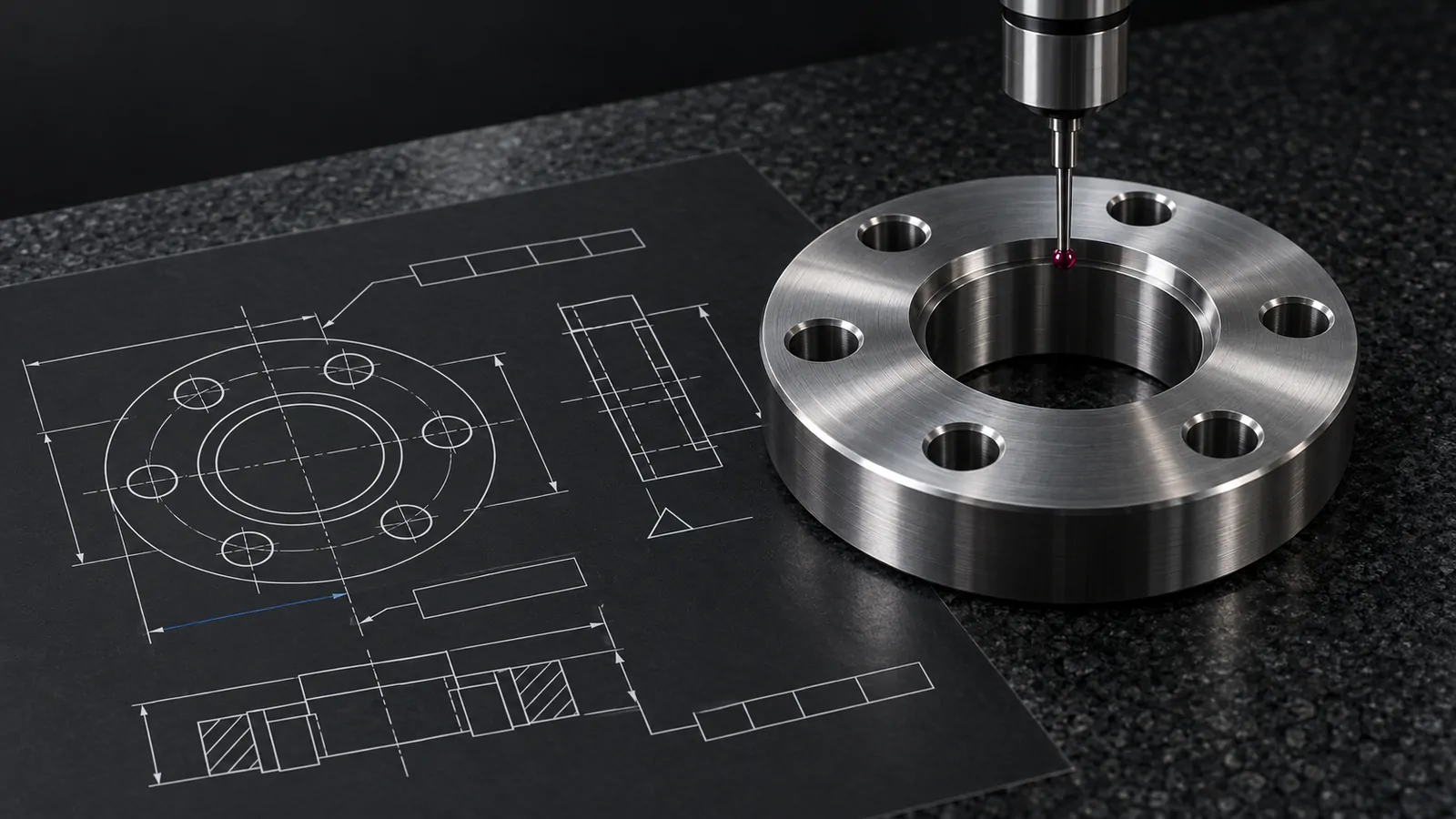
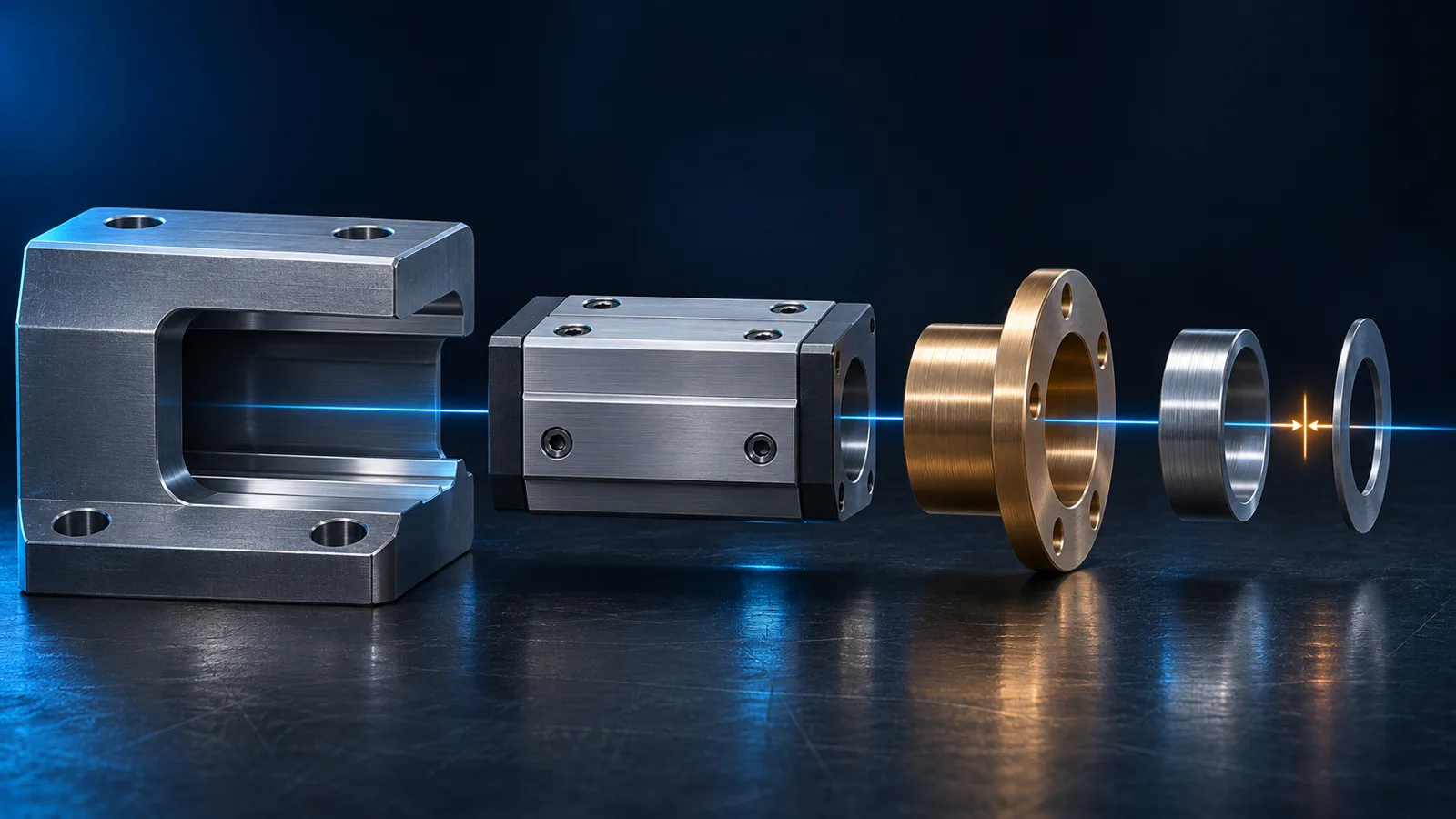
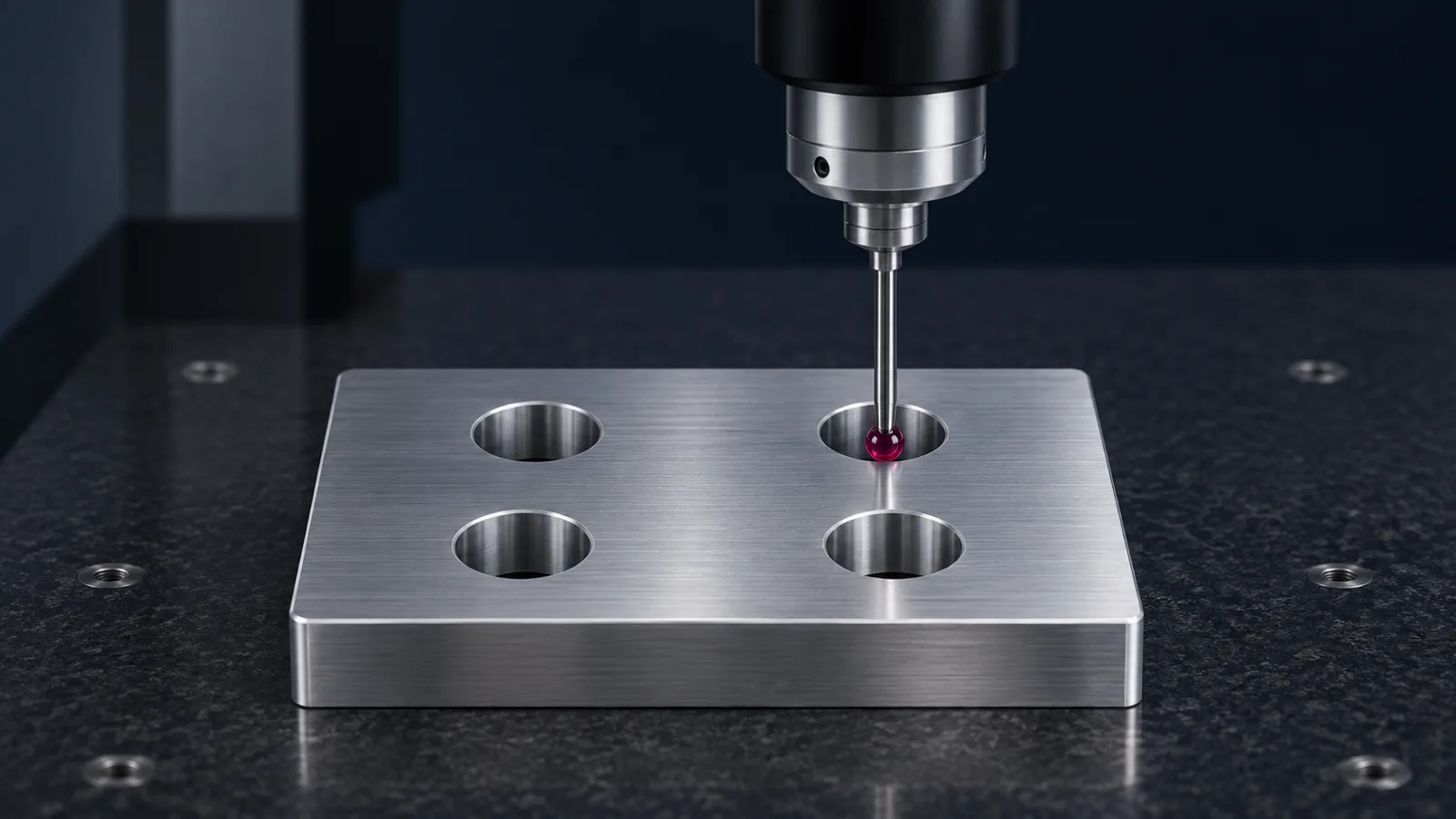
GD&T Interview Questions and Answers: 38 Questions With Worked Examples
38 GD&T interview questions from fresher to experienced, each with a model answer you can say out loud: MMC and bonus tolerance, virtual condition, position from CMM coordinates, fixed vs floating fasteners, runout and profile, plus two drawings to read and five broken feature control frames to fix.
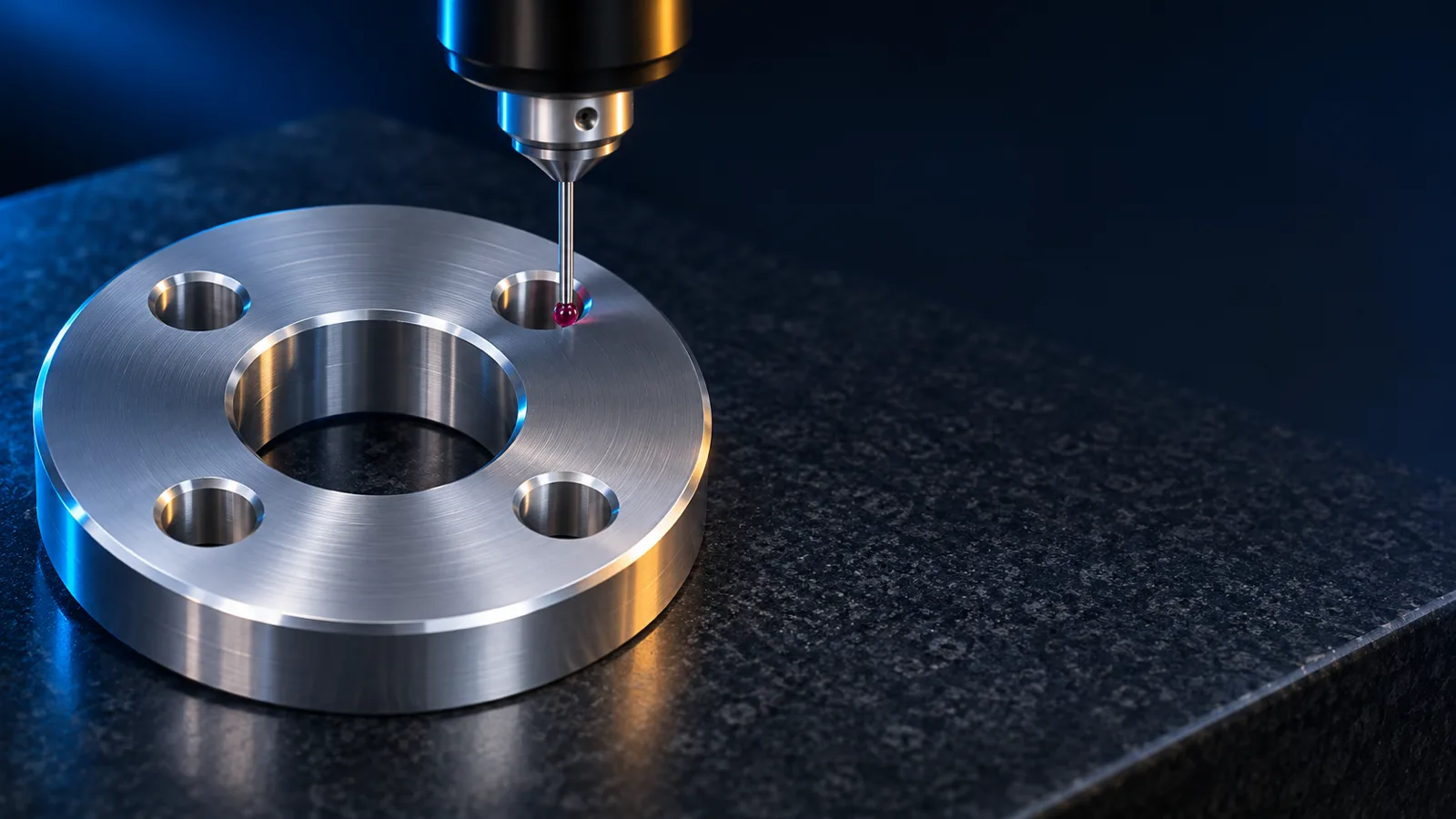
GD&T interview questions test three things: whether you know the vocabulary (datums, feature control frames, MMC, LMC, RFS), whether you can do the arithmetic (bonus tolerance, virtual condition, position from CMM coordinates), and whether you can read a real drawing and spot what is wrong with it. This guide has 38 questions in that order, from fresher to experienced, each with a short model answer you can say out loud. Every number in the worked examples was computed by script and checked twice.
How to use this page
- Freshers (design, quality or manufacturing trainee roles): questions 1 to 12 are the minimum. Expect most of them in the first technical round.
- 1 to 3 years: questions 13 to 25. This is where interviews move from definitions to numbers.
- Experienced (design leads, quality and supplier quality engineers): questions 26 to 38 are drawing-reading and judgement questions. Work through the two drawing figures with a pencil before reading the answers.
- For the symbols themselves, with a full chart, see our companion guide GD&T symbols explained. This page does not repeat it; it tests you on it.
Unless a question says otherwise, answers follow ASME Y14.5-2018, units are millimetres, and "position" means true position.
Fresher-level GD&T interview questions (1 to 12)
1. What is GD&T, and why not just use ± tolerances?
Model answer: GD&T (geometric dimensioning and tolerancing) is a symbolic language on drawings and 3D models that controls the form, orientation, location, profile and runout of features, and says which datums they are measured from. A ± dimension only controls size or distance. It cannot say whether a face may be bowed, whether a bore may lean, or which surface the inspector should clamp on, so two people can measure the same part and disagree.
Give one concrete benefit. A hole located with ±0.1 in x and y gets a square tolerance zone whose corners are already 0.141 mm from nominal, yet the drawing rejects a hole that is only 0.12 mm off along one axis. A position tolerance replaces the square with a circle of Ø0.283 through the corners and accepts every part that will actually assemble. Our post on coordinate vs position tolerance works through that comparison.
2. Which GD&T standards do you know, and which one is used in India?
Model answer: Two families. ASME Y14.5 (current edition 2018, which replaced 2009) and the ISO GPS system, where ISO 1101 covers geometrical tolerancing, ISO 5459 datums and ISO 2692 the maximum and least material requirements. There is no single Indian answer: the drawing follows the customer. Engineering services teams working for American OEMs tend to see ASME drawings, and European customers send ISO drawings. The title block or general notes say which standard applies, and that is the first thing to check.
Bonus point: mention the biggest interpretation difference. ASME applies Rule #1 (size controls form) by default; ISO applies independency (size and form are separate) unless the envelope symbol Ⓔ is shown. Question 17 tests this with numbers.
3. How many geometric characteristic symbols are there, and how are they grouped?
Model answer: Fourteen in ISO 1101 and in ASME Y14.5-2009, in five groups: form (straightness, flatness, circularity, cylindricity), orientation (parallelism, perpendicularity, angularity), location (position, concentricity, symmetry), profile (line, surface) and runout (circular, total). ASME Y14.5-2018 removed concentricity and symmetry, so it has twelve. Interviewers like candidates who know the 2018 change and can say what replaces them (question 36).
4. What is a feature control frame? Read one aloud.
Model answer: It is the rectangular box that carries one geometric requirement. Read it left to right: the symbol, the tolerance (with Ø if the zone is cylindrical), any material condition modifier, then the datums in order of precedence. "Position, diameter 0.2 at MMC, relative to A, B, C" means the axis of the hole must lie inside a Ø0.2 cylinder at the exact location given by basic dimensions, with the part set up on A first, then B, then C, and the zone may grow as the hole departs from its smallest size.
5. What is the difference between a datum, a datum feature and a datum feature simulator?
Model answer: The datum feature is the real, imperfect surface on the part, identified by the boxed letter. The datum feature simulator is the physical (or CMM-software) inverse of it: the surface plate, the gauge pin, the vice jaw. The datum is the theoretically exact plane, axis or point derived from the simulator, and all measurements are made from it. A good answer stresses that you never measure from the rough part surface directly.
6. Explain MMC, LMC and RFS with a hole and a pin.
Model answer: MMC (maximum material condition) is the size at which the feature contains the most material: the smallest hole or the largest pin. LMC (least material condition) is the opposite: the largest hole or the smallest pin. RFS (regardless of feature size) means the geometric tolerance stays the same whatever size the feature is made; it is the default in ASME Y14.5 when no modifier is shown. For a Ø12.00 ±0.05 pin, MMC is 12.05 and LMC is 11.95. For a Ø6.60–6.80 hole, MMC is 6.60 and LMC is 6.80.
7. What is a basic dimension, and why is it in a box?
Model answer: A basic dimension is a theoretically exact value that defines the true position, true profile or angle of a feature. It carries no tolerance of its own. The variation allowed is set by the feature control frame that refers to it. If a location dimension has a ± tolerance and the feature also has a position tolerance, the two conflict, which is why position requires basic dimensions (see error 4 in question 31).
8. What is the difference between flatness and straightness, and between flatness and parallelism?
Model answer: Straightness controls a line element (or a derived median line) and its zone is two parallel lines, or a cylinder for an axis. Flatness controls the whole surface, and its zone is two parallel planes. Both are form controls and never take a datum. Parallelism is an orientation control: the same two-plane zone, but it must be parallel to a datum. Parallelism therefore also limits flatness, but flatness says nothing about parallelism to anything.
9. Circularity vs cylindricity?
Model answer: Circularity (roundness) checks each cross-section on its own: every point of that section must lie between two concentric circles. Cylindricity checks the whole surface at once between two coaxial cylinders, so it also catches taper, barrelling and a bent axis. Cylindricity is the stricter and more expensive control; specify it only when the function needs it, for example a bearing journal.
10. Which geometric controls never use a datum?
Model answer: The four form controls: straightness, flatness, circularity and cylindricity. Profile may be used with or without datums (without datums it only controls form). Orientation, location and runout controls always need at least one datum, because "perpendicular" or "located" only means something relative to something else.
11. What is a feature of size, and why does it matter for MMC?
Model answer: A feature of size is a cylindrical or spherical surface, or a set of two opposed parallel surfaces, with a size dimension: a hole, a pin, a slot, a tab. Only features of size have an MMC and an LMC, so only they can take the Ⓜ or Ⓛ modifiers and earn bonus tolerance. A flat face is not a feature of size; putting Ⓜ on a flatness or perpendicularity callout for a plane surface is a classic drawing error.
12. First-angle or third-angle projection: how do you tell which one a drawing uses?
Model answer: Look for the projection symbol (a truncated cone) in the title block. In first-angle projection the top view is drawn below the front view and the left-side view on the right; in third-angle it is the other way round. First-angle is standard across Europe and most of Asia; drawings made to American practice normally use third-angle. ISO 5456-2 allows both, which is exactly why the symbol must be checked before reading any view.
Intermediate GD&T interview questions with worked numbers (13 to 25)
From here on, interviewers usually hand you a frame and ask for a number. Do the arithmetic aloud. The formulas used below are: bonus = how far the actual size has moved from MMC; virtual condition = MMC ± geometric tolerance; position error = 2 × √(dx² + dy²).
13. A pin is Ø12.00 ±0.05 with position Ø0.10 Ⓜ to A|B|C. It measures Ø11.98. How much position tolerance does it get?
Model answer: For a pin, MMC is the largest size, 12.05. The pin is 12.05 − 11.98 = 0.07 smaller than MMC, so it earns 0.07 of bonus. Allowed position: 0.10 + 0.07 = Ø0.17. At LMC (11.95) the bonus is the full size tolerance, 0.10, so the most it can ever get is Ø0.20.
Many candidates use the hole rule by habit (actual − MMC) and get a negative number. Say it in words instead: bonus is how far the feature has moved away from MMC.
14. For that pin, what are the virtual condition and the resultant condition, and what is each used for?
Model answer: Virtual condition (VC) is the worst-case mating boundary: for a pin at MMC it is MMC + tolerance = 12.05 + 0.10 = Ø12.15. Every good pin will fit a perfect Ø12.15 hole at true position, so that is the gauge hole size and the size the mating hole must clear. Resultant condition (RC) is the opposite worst case: for a pin it is LMC − (tolerance at LMC) = 11.95 − 0.20 = Ø11.75. It is used for minimum wall and minimum-material checks. For a hole the signs flip: VC = MMC − tolerance, RC = LMC + tolerance at LMC.
15. The CMM reports a hole at x = 30.045, y = 19.962. True position is 30.000, 20.000. Is it within position Ø0.20 Ⓜ? The hole is Ø6.60–6.80 and measures Ø6.68.
Model answer: Deviations are dx = +0.045 and dy = −0.038. Radial distance √(0.045² + 0.038²) = 0.0589, so the position error, which is a diameter, is 2 × 0.0589 = Ø0.118. The hole is 0.08 above MMC, so its allowance is 0.20 + 0.08 = Ø0.28. Pass, with room to spare; it would pass even without the modifier.
The trap: forgetting the factor of 2. The tolerance in the frame is a diameter, the CMM offsets give a radius.
16. Here is a four-hole CMM report. Which holes pass?
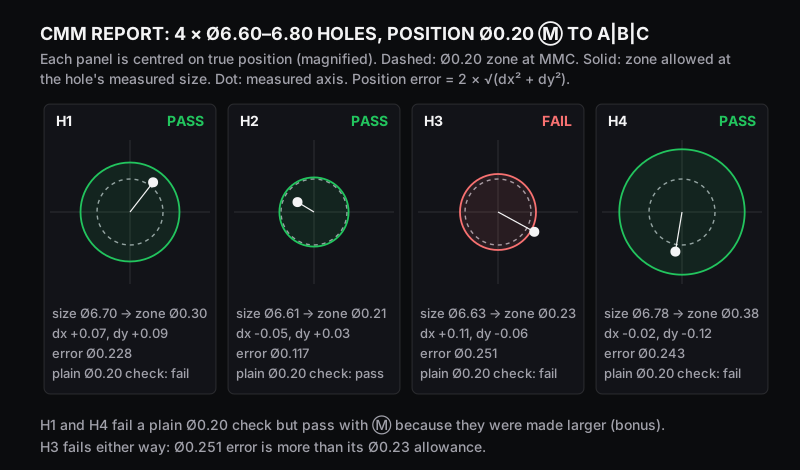
| Hole | Size | dx, dy | Error 2√(dx²+dy²) | Allowed 0.20 + bonus | Result |
|---|---|---|---|---|---|
| H1 | 6.70 | +0.07, +0.09 | Ø0.228 | Ø0.30 | Pass |
| H2 | 6.61 | −0.05, +0.03 | Ø0.117 | Ø0.21 | Pass |
| H3 | 6.63 | +0.11, −0.06 | Ø0.251 | Ø0.23 | Fail |
| H4 | 6.78 | −0.02, −0.12 | Ø0.243 | Ø0.38 | Pass |
What the interviewer wants to hear: check size first (all four are inside 6.60–6.80), compute each hole's own allowance, then compare. Then add the judgement: three of four holes are off in a consistent way, so the pattern may be shifted or the fixture may be off. That observation separates a quality engineer from a calculator.
17. A shaft is Ø20.00–20.05. Every cross-section measures Ø20.02, but the shaft is bowed by 0.04. Accept or reject?
Model answer: Under ASME (Rule #1), reject. A feature of size may not break its perfect-form boundary at MMC, here Ø20.05. The bowed shaft needs a Ø20.02 + 0.04 = Ø20.06 envelope, which exceeds 20.05, so it will not enter a perfect Ø20.05 gauge ring. Under ISO default independency, the two-point size check passes and form is only controlled if a separate tolerance or Ⓔ is given. Same part, same drawing values, two different answers depending on the standard. That is the point of the question.
18. A block is 25 ±0.1 thick and the top face has flatness 0.05. Is that sensible? What if flatness were 0.3?
Model answer: 0.05 is sensible: under Rule #1 the size tolerance already limits flatness to 0.2, so a flatness of 0.05 is a refinement for a face that seals or locates. Flatness 0.3 is meaningless on that face, because Rule #1 would still cap form error at 0.2. A form tolerance on a feature of size should be smaller than its size tolerance, unless Rule #1 has been switched off for that feature.
19. A pin is Ø10.0–10.1 with perpendicularity Ø0.05 Ⓜ to A. What size should the functional gauge hole be?
Model answer: The gauge is made at virtual condition: MMC + tolerance = 10.1 + 0.05 = Ø10.15, square to a plate that simulates datum A. Seat the part on the plate; if the pin enters, size-plus-orientation is good. The gauge does not check size on its own, so a separate go/no-go check on the pin diameter is still required.
20. What is the difference between circular and total runout? Indicator readings at one section are +0.012, +0.020, +0.008, −0.006, −0.010, −0.002, +0.004 and +0.015 mm. Circular runout is 0.025. Pass?
Model answer: Circular runout is checked one cross-section at a time as the part rotates on its datum axis; total runout sweeps the indicator along the whole surface while the part rotates, so it also catches taper and straightness. The runout value is the full indicator movement, maximum minus minimum: 0.020 − (−0.010) = 0.030. That exceeds 0.025, so this section fails, and once one section fails the feature fails.
A follow-up you may get: runout cannot take Ⓜ or Ⓛ, because it is a surface control referenced to an axis of rotation, not a feature-of-size axis.
21. Profile of a surface 0.4 to A|B|C: where is the zone? What does 0.4 Ⓤ 0.1 mean?
Model answer: By default the 0.4 zone is split equally about the true profile: 0.2 outside the material and 0.2 inside. With the unequally disposed symbol, the number after Ⓤ is the part of the total that lies outside the material, so 0.4 Ⓤ 0.1 means 0.1 outside and 0.3 inside. A measured point at +0.08 (outside) passes; one at +0.12 fails, even though it would have passed an equal ±0.2 zone. With datums, profile controls size, location, orientation and form of the surface together; without datums it controls form only.
22. Why does the order of datums in a frame matter? What is 3-2-1?
Model answer: The order is the order of set-up. The primary datum (A) touches the simulator at a minimum of three points and removes three degrees of freedom (one translation, two rotations). The secondary (B) touches at two points and removes two more. The tertiary (C) touches at one point and removes the last. Change the order and you seat the part differently, so a CMM measures a different result from the same part. Choose the primary datum as the surface that actually seats the part in assembly.
23. When would you use MMC, LMC or RFS?
Model answer: MMC when the function is clearance and assembly (bolt holes, dowel clearance): it gives bonus tolerance and allows simple functional gauges. LMC when the function is minimum wall, edge distance or stock left for machining. RFS when the feature must stay accurately located or oriented at every size: a bearing bore, a press fit, a centring spigot. If you cannot say why you chose the modifier, the interviewer will assume you copied it.
24. Floating vs fixed fastener: an M6 bolt passes through Ø6.6–6.8 clearance holes. What position tolerance can each part have?
Model answer: Use the MMC sizes: H = 6.6 (hole), F = 6.0 (fastener). Floating fastener (bolt and nut, clearance holes in both parts): T = H − F = Ø0.6 for each part. Fixed fastener (one part is tapped, so the bolt is fixed in it): the clearance has to be shared, T1 + T2 = H − F = 0.6, for example Ø0.3 on each. Applying the floating formula to a fixed joint is the most common mistake in this question; the fixed case also needs a projected tolerance zone on the tapped hole (question 32).
25. How would you inspect a position callout: CMM or gauge?
Model answer: A CMM aligns the part to A, B and C as the frame orders them, measures each hole's actual mating size and axis, and reports position against the bonus-adjusted limit. It gives numbers, which you need for process correction and capability studies. A functional gauge (pins at virtual condition on a fixture that simulates the datums) is fast and suits production, but it is pass/fail only and only works when Ⓜ is used. Most plants use both: CMM for first article and periodic audits, gauges on the line. Our post on GD&T inspection and measurement covers the instruments.
Experienced-level questions: reading drawings and judging callouts (26 to 38)
Senior interviews usually put a drawing on the table. Questions 26 to 30 use this one. Try them before reading the answers.
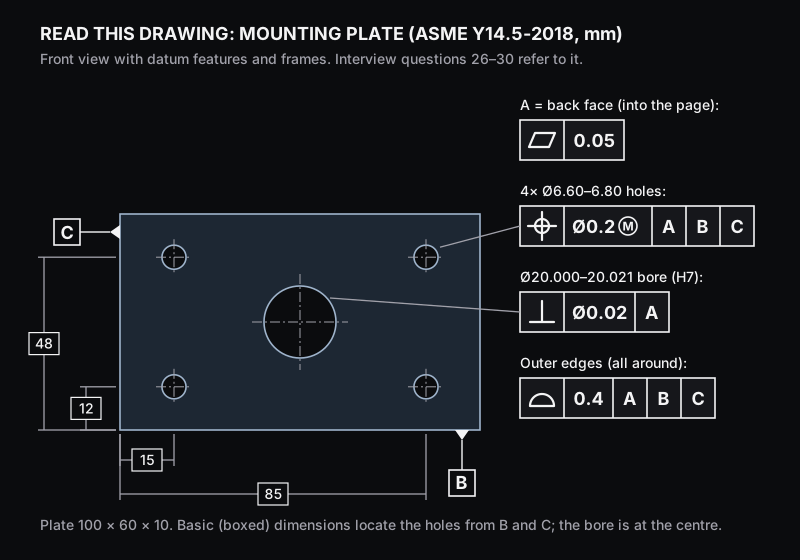
26. Read the hole callout. What size should the gauge pins be, and will an M6 bolt fit?
Model answer: Four holes, Ø6.60–6.80, each axis inside a Ø0.2 cylinder at its basic location (15 and 85 from C, 12 and 48 from B), perpendicular to A, with bonus as the hole grows: up to Ø0.4 at LMC. Virtual condition = 6.60 − 0.2 = Ø6.40, so gauge pins are Ø6.40 at true position on a plate simulating A, B and C. An M6 bolt (Ø6.0 at MMC) fits a Ø6.40 boundary with 0.2 of radial clearance even in the worst case. The floating-fastener formula of question 24 would allow up to Ø0.6 (6.6 − 6.0), so Ø0.2 is a conservative choice; a good follow-up is to ask whether the designer needed it that tight.
27. Why is there a flatness callout on datum A?
Model answer: Datum A is primary for every other frame, so the part is seated on it first. If A were rocking (convex), the set-up would change from one measurement to the next and every perpendicularity and position result would be unrepeatable. Flatness 0.05 qualifies the datum feature so that the simulator contact is stable. Good practice: qualify the primary datum with form, the secondary with orientation to the primary, and so on. On this drawing B and C are not qualified, which you can point out as a possible improvement.
28. The bore is Ø20.000–20.021 with perpendicularity Ø0.02 to A. If the bore is made at Ø20.010, how much perpendicularity error is allowed?
Model answer: Still Ø0.02. There is no modifier, so it is RFS: no bonus at any size. That is the right choice for a bore that locates a bearing or shaft. (Ø20 H7 is 20.000 to 20.021 per ISO 286.) The bore's own size and form are still governed by Rule #1.
29. What does the profile 0.4 to A|B|C on the outer edges control?
Model answer: All four edges must lie within a 0.4-wide band, ±0.2 about the true profile defined by the basic 100 × 60 outline, located from B and C and oriented to A. So the single callout controls the plate's length, width, squareness and edge straightness. Because B and C are themselves edges inside that profile, many designers would apply the profile to the two non-datum edges and qualify B and C separately; this is a good discussion point.
30. What is missing from this drawing?
Model answer: At least three things. (1) The bore has no location control: perpendicularity orients it to A but nothing locates it from B and C, so "at the centre" is not inspectable. It needs a position frame and basic dimensions. (2) Plate thickness has no stated tolerance and datum A has no datum feature symbol in any view (the note says it is the back face, but a side view should show it). (3) No general tolerance note or title block standard reference is visible, so it is unclear whether ASME or ISO rules apply. Interviewers score this question on how systematically you search, not only on what you find.
31. Spot the error in each of these five frames.
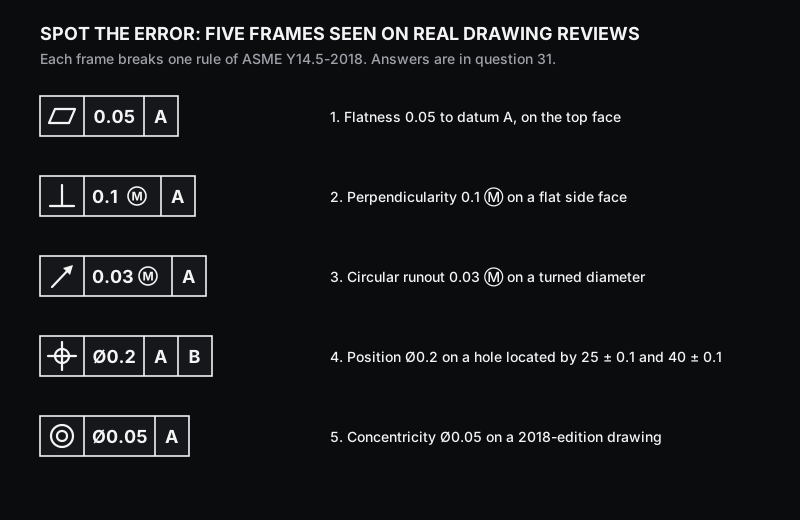
- Flatness with a datum. Flatness is a form control and cannot reference a datum. If the face must be parallel to A, use parallelism.
- Ⓜ on a plane surface. A flat face is not a feature of size, so it has no MMC. Remove the modifier (and the zone is two parallel planes, so no Ø either).
- Ⓜ on runout. Runout is always RFS; modifiers are not allowed.
- Position with ± location dimensions. The location must be basic (boxed). With ±0.1 coordinates as well, the drawing gives two conflicting tolerances for the same location.
- Concentricity under ASME 2018. The symbol was removed in the 2018 edition. Use runout, position or profile, depending on the function (question 36). On a 2009-edition or ISO drawing it would still be legal.
32. Why do tapped holes often carry a projected tolerance zone Ⓟ?
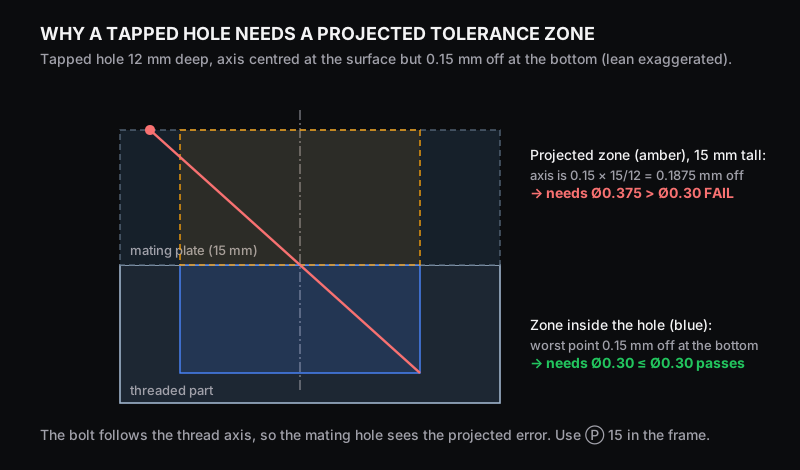
Model answer: The stud or bolt takes the angle of the thread, so what matters for assembly is where the axis goes above the surface, through the mating part. In the example, the tapped hole is 12 mm deep, on position at the surface and 0.15 mm off at the bottom: inside the hole it needs a Ø0.30 zone and just passes a Ø0.30 tolerance. Extended 15 mm upwards through the mating plate, the same axis is 0.15 × 15 / 12 = 0.1875 mm off, which needs Ø0.375, more than the Ø0.30 the fixed-fastener calculation assumed. Adding Ⓟ 15 to the frame makes the zone apply over that 15 mm projected height, which is where the interference would happen.
33. What happens when a datum feature of size is referenced at MMB?
Model answer: If a frame reads |A|B Ⓜ| and datum B is a bore, the gauge pin that simulates B is fixed at B's maximum material boundary. When the actual bore is larger than that boundary, the part can move on the pin, and the whole pattern being controlled may shift and rotate as a group relative to B. Example: datum bore Ø20.00–20.10 referenced at MMB (Ø20.00) and made at Ø20.06 gives 0.06 of diametral looseness, so the pattern can translate up to 0.03 in any direction relative to the pin. This is datum shift. It is not bonus added to each hole: the holes keep their own tolerances relative to each other, but the pattern as a whole may move.
34. Composite position vs two single-segment frames: what is the difference?
Model answer: Both have two rows. In a composite frame (one position symbol spanning both rows), the upper row locates the pattern to the datums with a larger zone, and the lower row controls the holes relative to each other (and only orientation to the repeated datums) with a smaller zone. In two single-segment frames (a symbol in each row), the lower row also locates the pattern, so it is the stricter requirement. Use composite when the hole-to-hole spacing matters more than where the pattern sits. We explain this with diagrams in composite vs multiple single-segment frames.
35. How does a position tolerance enter a tolerance stack-up?
Model answer: Convert it to a ± value along the stack direction: a Ø0.2 position zone allows the axis to move up to 0.1 in any direction, so it contributes ±0.1 to the chain. Then add the size contribution separately (half the size tolerance for a radius, or work from virtual and resultant conditions for a worst-case gap). Mixing a diametral zone straight into a linear chain, without halving it, doubles the contribution and is a common error. Our worked tolerance stack-up analysis post covers worst-case and statistical methods.
36. Concentricity and symmetry were removed in ASME Y14.5-2018. What do you use instead?
Model answer: It depends on the function. For a rotating part where wobble matters, runout (checked easily with an indicator on V-blocks or between centres). For coaxial features that must assemble, position with Ø and usually Ⓜ, which also allows gauging. For a non-cylindrical feature centred on a datum, profile or position. Concentricity was dropped largely because it requires deriving median points across the whole feature, which is slow and expensive to measure for little practical benefit.
37. How do you choose datums on a new part?
Model answer: From function, not convenience. Pick the surfaces that locate the part in its assembly, in the order they make contact: usually the largest mounting face as primary, then a bore or edge that stops sliding, then a feature that stops rotation. Datum features should be accessible for the fixture and CMM, stable (not thin or flexible), and qualified with form or orientation tolerances. Where possible use the same datums for design, machining and inspection, so all three measure the same thing.
38. What is model-based definition, and how does it change GD&T work?
Model answer: In model-based definition the 3D CAD model carries the dimensions and GD&T as PMI (product and manufacturing information), often in place of a 2D drawing. ASME Y14.5-2018 added model views for this reason. When the PMI is semantic, CMM software can generate inspection programs from it, so a wrong callout now flows straight into automatic inspection. A strong candidate mentions one practical check: verifying that the exported STEP AP242 file carries the GD&T semantically, not as graphics only.
What interviewers at Indian automotive and aerospace firms look for
GD&T questions come up in three kinds of mechanical roles, and the emphasis differs:
| Role | Where you will meet it | What they probe |
|---|---|---|
| Design / product engineer | OEM design centres, tier-1 suppliers, engineering services firms designing for global customers | Datum selection from function, choosing MMC/LMC/RFS, fastener formulas, stack-ups, ASME vs ISO, clean drawings |
| Quality / supplier quality engineer | Component suppliers going through customer approval; aerospace machining and structures suppliers | CMM reports, bonus and datum shift, functional gauges, runout and profile checks, judging a borderline part |
| Manufacturing / process engineer | Machine shops, foundries, sheet-metal and assembly plants | Fixturing to the drawing's datums, machining sequence vs datum order, what the process can hold |
Two industry processes explain why quality interviews are so drawing-heavy. In the automotive supply chain, the production part approval process (PPAP) includes a dimensional results record listing every dimension on the ballooned drawing with its specification, measured values and an OK/not-OK decision, usually on at least six parts. In aerospace, first article inspection to SAE AS9102 asks for the same kind of characteristic-by-characteristic accountability for a new part. If you can explain how a position or profile callout becomes a line in that report, you sound like someone who has done the job.
Public skill standards point the same way. India's national qualifications register includes design qualifications whose assessment criteria ask candidates to specify geometric tolerances such as runout, circularity and perpendicularity on drawings. ASME's GDTP certification (Technologist and Senior levels) tests symbol selection, tolerance calculations, datum choice and modifiers. It is optional; check whether your target employers mention it before paying for it.
Patterns in our own interview write-ups agree: GD&T definitions and datum questions appear in design-engineer rounds at engineering services firms, for example in our Tata Technologies design engineer interview notes.
How to prepare in one week
- Day 1-2: learn the symbol groups, modifiers and the datum reference frame from our symbols guide. Be able to read any frame aloud.
- Day 3-4: do questions 13 to 24 on paper without looking. Make your own variants: change the sizes, flip hole to pin.
- Day 5: take any real drawing (NIST publishes free fully-toleranced test models) and write down, for five callouts, what the zone is, how you would inspect it, and the virtual condition.
- Day 6: questions 26 to 38. Practise saying "what is missing" answers in a fixed order: location, datums, standard, size.
- Day 7: one project story. Interviewers ask "where did you use GD&T?" Have one drawing you made or checked, and one decision you would change now.
If you want structured practice on real parts, the Geometric Dimensioning and Tolerancing course applies GD&T in NX CAD, and the PG Program in CAD and PG Program in Manufacturing Design put it inside full design projects.
Frequently asked questions
Are GD&T questions asked for fresher mechanical design jobs in India?
Yes, at least the basics: what GD&T is, datums, MMC/LMC, reading a feature control frame and the difference between form controls. Calculation questions (bonus, virtual condition) are common for quality roles and for candidates with 1 to 3 years of experience.
Should I answer to ASME or ISO in an interview?
Say which one you are using. If the company works mainly for American customers, answer to ASME Y14.5-2018 and mention the ISO difference where it matters (Rule #1 vs independency, concentricity and symmetry). If you do not know, ask; it is a good sign, not a weakness.
What is the most common mistake candidates make in GD&T calculations?
Forgetting that position tolerance is a diameter: the CMM gives x and y offsets, and the position error is twice the radial distance. The second most common is using the floating-fastener formula for a fixed fastener.
Is bonus tolerance available on every callout?
No. Only on features of size, and only when the Ⓜ or Ⓛ modifier is shown. Form controls on surfaces, runout and profile of a plain surface never get bonus.
Do I need a certification to get a GD&T-heavy job?
Not usually. Employers test GD&T in the interview. ASME's GDTP certification is optional and mostly useful if your target employers ask for it.
How is this different from the GD&T symbols guide?
The symbols guide teaches the language: every symbol, datums and one bonus example. This page tests you on it, with new numbers, drawing-reading and judgement questions.
Sources and further reading
- ASME, Y14.5-2018 Dimensioning and Tolerancing (current edition, replaces 2009; model views added; concentricity and symmetry removed). Accessed 14 Nov 2026.
- ASME, GDTP (Y14.5) certification. Accessed 14 Nov 2026.
- ISO, ISO 1101:2017 Geometrical tolerancing and ISO 2692:2021 Maximum and least material requirements.
- GD&T Basics, True position (position error = 2√(dx²+dy²)); Virtual condition; Fixed fastener formula T1 + T2 = H − F; Projected tolerance zone; Unequally disposed profile; Circular runout; Circular vs total runout; Perpendicularity and functional gauging; Rule #1; Composite vs multiple single-segment position; ASME 2009 vs 2018. Accessed 14 Nov 2026.
- Engineers Edge, Fixed and floating fastener calculators (ASME Y14.5 fastener conditions). Accessed 14 Nov 2026.
- Open Exam Prep, Datum shift behaviour (GDTP Senior study guide). Accessed 14 Nov 2026.
- Roymech, How to use ISO tolerances (H7 limits per ISO 286). Accessed 14 Nov 2026.
- Wikipedia, Multiview orthographic projection (first- and third-angle use, ISO 5456-2); Production part approval process (dimensional results element). Accessed 14 Nov 2026.
- SAE International, AS9102 Aerospace first article inspection requirement. Accessed 14 Nov 2026.
- NIST, MBE PMI validation and conformance testing (free fully-toleranced CAD models, STEP AP242). Accessed 14 Nov 2026.
- National Qualifications Register (NCVET), Jr. Designer (Mechanical) qualification file.
- Skill-Lync, GD&T symbols explained, Coordinate vs position tolerance and Tolerance stack-up analysis.