Jupiter Wagons-Woojin Metro JV: What Was Signed and How Propulsion Works
On 23 Nov 2026 Jupiter Wagons filed a framework agreement with Korea's Woojin Industrial Systems for an 80:20 joint venture to build metro coaches and propulsion systems in India. Here is what the filing confirms and what was only reported, how a metro's VVVF inverter, induction motors, bogies and regenerative braking work (with a worked 6-car calculation), India's 75% localisation rules, and what it means for engineering jobs.

On 23 November 2026, Jupiter Wagons Ltd (JWL) told BSE and NSE that it has signed a framework agreement with Woojin Industrial Systems of South Korea. The two will bid together for Indian metro tenders and build metro coaches and train propulsion systems in India. JWL will hold 80% of the planned joint venture and Woojin 20%, and Woojin will transfer its propulsion technology. The filing gives no investment amount, plant site, capacity or start date. The joint venture company has not been formed yet.
Below: what the filing confirms versus what was only reported, how metro propulsion, carbodies and bogies work (with a worked 6-car calculation), who builds metro coaches in India today, and what the deal could mean for engineering jobs.
Key numbers at a glance
- 23 Nov 2026, 15:50 IST: JWL's Regulation 30 disclosure, "Execution of Framework Agreement", reached BSE. The press release followed at 15:53 (BSE corporate announcements, scrip 533272).
- 80:20: JWL's and Woojin's shares in the joint venture once it is formed. Today neither company holds shares in the other (filing, Annexure A).
- 2,200+: metro and commuter cars that Seoul Metro, KORAIL and Busan Transportation Corporation have entrusted to Woojin since 2019, according to JWL's press release.
- 75% / 25%: Indian metro tenders must have at least 75% of the cars built in India, and at least 25% of listed critical equipment made in India (Ministry of Urban Development, 23 Apr 2017, restated in MoHUA's Annual Report 2025-26).
- 1,096 km: metro lines running in 26 cities on 15 Jan 2026, with about 957 km more under construction (MoHUA Annual Report 2025-26).
Courses: the two skills at the centre of this deal are power electronics and structures. Skill-Lync's power electronic converter design course covers the first and crashworthiness analysis with HyperMesh and Radioss covers the second.
What did Jupiter Wagons sign with Woojin?
JWL signed a framework agreement, not a joint-venture contract. Under it, the two companies will chase Indian rolling-stock work through a consortium, in which JWL is the lead partner, and through a joint venture company that is still to be set up. The filing says JWL "will hold 80% and Woojin will hold 20%" of the JV's equity "upon formation of the proposed JV".
The filing lists two areas of work:
- Metro coaches. The partners will bid jointly for metro tenders and build the coaches in India through the joint venture.
- Propulsion systems. Woojin will provide know-how and transfer technology so that propulsion systems, electric multiple units (EMUs), train control and management systems (TCMS) and related products can be designed, made and maintained in India. These are meant for metro coaches, Vande Bharat trains and other railway projects.
The two partners have different jobs. JWL pays for the joint venture's land, plant, machinery and working capital and runs local execution. Woojin brings its reference credentials, technical support, core components and the technology transfer. The filing says Woojin is not related to JWL's promoters, so this is not a related-party deal.
The press release goes further than the filing. It says JWL "has entered into a joint venture" that will build complete metro coaches with Woojin's propulsion, TCMS, automatic doors, bogies and aluminium car body shells, in "a dedicated manufacturing facility". MD Vivek Lohia says the technology comes to India "on an exclusive basis".
The "reference credentials" line explains why a partner is needed at all. On JWL's earnings call of 19 November, an analyst noted that passenger-coach tenders ask bidders to show prior experience. Lohia replied that bids will go "through the JV", with JWL as majority shareholder, using "technology transfer and references from our partners". The plan, in other words, is to pre-qualify on the partner's delivered fleets, which a new entrant could not otherwise show.
What is confirmed and what is only reported?
The filing confirms the parties, the 80:20 split, the scope and the roles. It does not give any rupee figure, capacity, location or timeline. Those details in news reports did not come from the filing.
| Item | Status | Where it comes from |
|---|---|---|
| Framework agreement with Woojin Industrial Systems Co., Ltd., dated 23 Nov 2026 | Confirmed | JWL filing to BSE/NSE |
| JV shareholding 80% JWL, 20% Woojin once formed; no shares held today | Confirmed | Filing, Annexure A |
| Joint bids for metro tenders; propulsion, EMU and TCMS technology transfer | Confirmed | Filing |
| JWL funds land, plant, machinery and working capital | Confirmed (no amount given) | Filing |
| Dedicated plant with aluminium car body capacity | Company statement | Press release (no site or size) |
| Investment of about ₹1,000 crore | Reported | PTI, 23 Nov 2026; not in the filing |
| "₹50 crore joint venture" | Unexplained headline | One business site's headline; its article and the filing give no such figure |
| Plant location | Not decided | PTI reported that the site is not finalised |
| Any metro order | None announced | No order is mentioned in the filing |
JWL's share price closed at ₹185.45 on BSE on 23 November, down 3.08% from ₹191.35. The BSE Sensex fell 1.77% the same day, so the drop tells us little about the deal itself. On 19 November Lohia had said the capex numbers would be announced "very shortly". Until JWL files them, any rupee figure is a report, not a company number.
Why is propulsion the hard part of a metro train?
Propulsion takes electricity from the line and turns it into controlled torque at the wheels. When the train brakes, it runs the other way and sends energy back. It needs high-voltage power electronics, motor control software and rail-specific testing, which is why coach builders often license it from specialists, as Titagarh has done with ABB. JWL's press release calls it "the heart of every electric trainset".
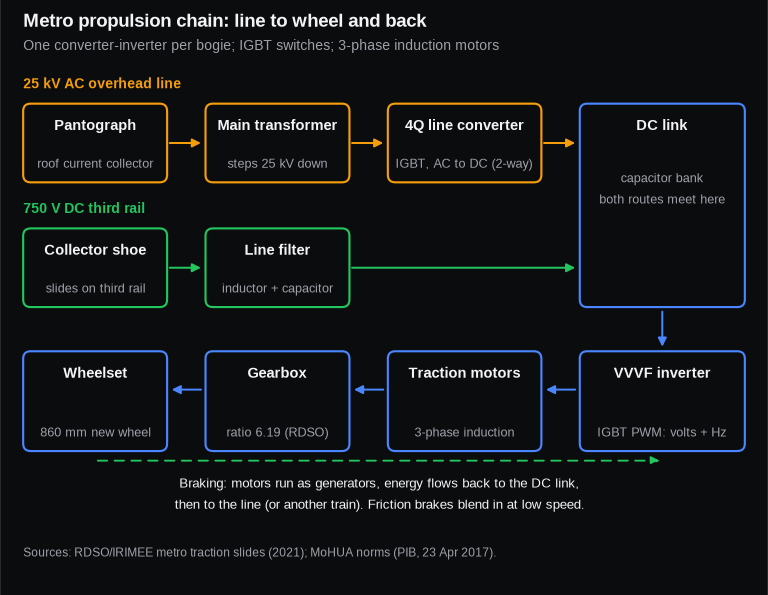
How does a metro train get its power: 25 kV AC or 750 V DC?
Indian metros use one of two supplies. Some have a 25 kV AC overhead wire, collected by a pantograph on the roof. Others have a 750 V DC third rail beside the track, picked up by a sliding collector shoe on the bogie (RDSO). The overhead system needs a heavy transformer on the train to bring 25 kV down. The third rail needs no transformer, but at 750 V the same power means more than 30 times the current, so conductors, switchgear and substations are sized for very large currents.
On an AC train, a four-quadrant converter after the transformer turns the AC into DC. "Four-quadrant" means power can flow either way and either polarity, so braking energy can go back into the overhead wire. Either way, the power ends up on a DC link: a bank of capacitors that acts as a small, steady reservoir.
What do the VVVF inverter and IGBTs do?
The traction inverter turns the steady DC back into three-phase AC whose voltage and frequency it can change at will. That is why it is called VVVF: variable voltage, variable frequency. Its switches are IGBTs (insulated-gate bipolar transistors), which turn on and off very rapidly. By varying how long each pulse lasts (pulse-width modulation, PWM), the inverter shapes the pulses into a smooth sine-like current in the motor.
Think of it like a gearbox made of electronics. At standstill the inverter sends low-frequency, low-voltage power, so the motor gives full torque without drawing a huge current. As the train speeds up, it raises both voltage and frequency together. RDSO's description of a 25 kV metro car specifies one converter-inverter per bogie in each motor car, using four-quadrant IGBT PWM. If you want the theory, our free textbooks cover three-phase inverters and V/f control of induction motors.
Why do metros use three-phase induction traction motors?
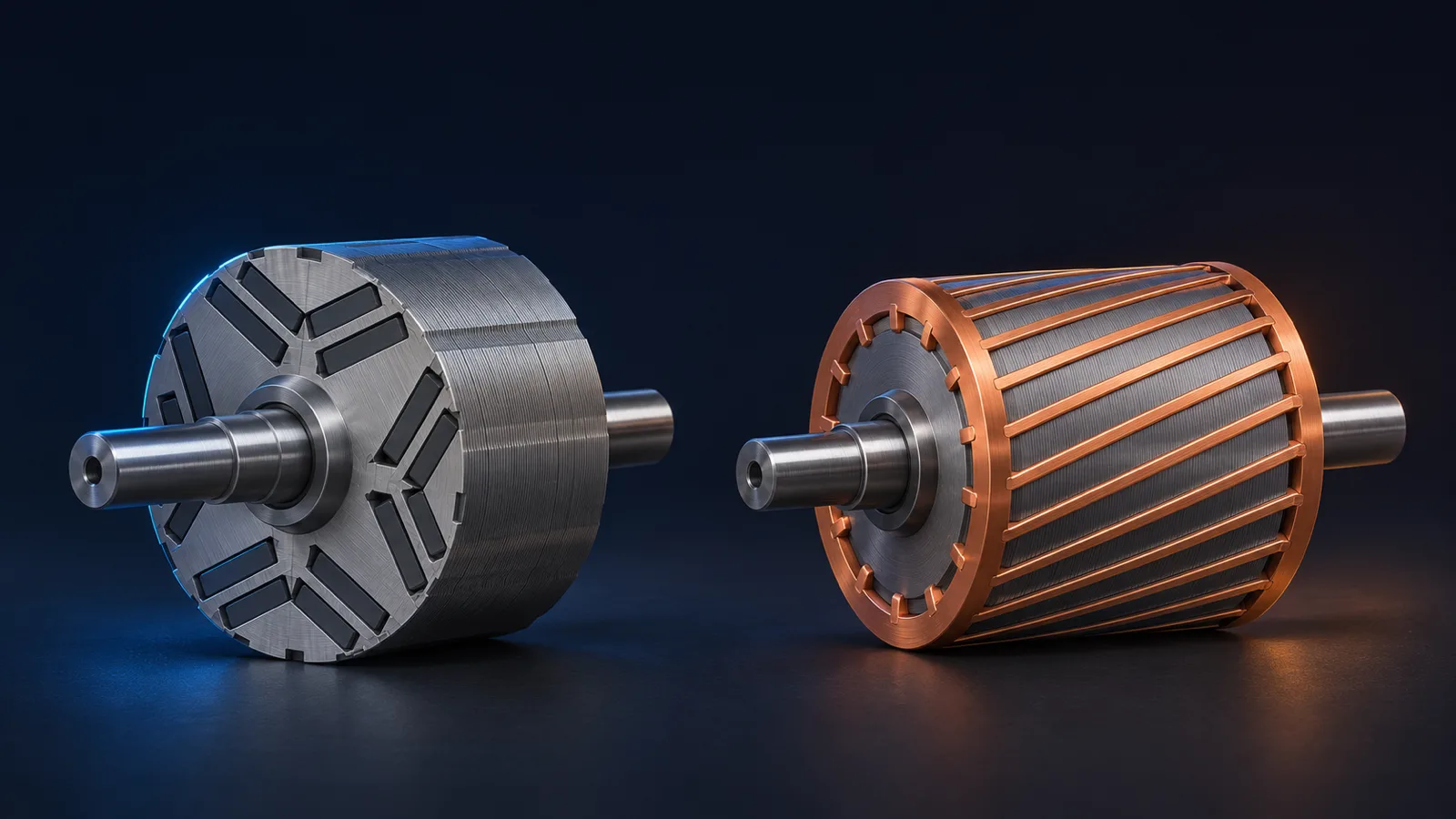
The metro cars RDSO describes use three-phase asynchronous (induction) motors under VVVF control. The motor is fixed to the bogie frame and drives the axle through a flexible coupling and a gear unit (RDSO). An induction motor's rotor has no brushes, no slip rings and no magnets, so it is tough and cheap to maintain. Its main drawback, poor speed control on a fixed-frequency supply, is exactly what the VVVF inverter removes. For a fuller comparison with magnet motors, see our post on PMSM vs induction motors.
How does regenerative braking work on a metro?
To brake, the inverter sets its output frequency below the motor's speed. The motors then work as generators and push energy back through the DC link to the line, where another train can use it. RDSO's slides say 25% to 35% of traction energy is regenerated this way. They also list less brake-pad wear, longer wheel life and less heat in tunnels.
The friction brake is still needed. RDSO describes an electro-pneumatic friction brake blended with the electric brake across the speed range, braking effort scaled to the measured passenger load, and a separate emergency friction brake. The friction brake tops up whenever electric braking is not enough and holds the train at rest. Our older explainer on the principle of regenerative braking covers the basics.
What are a metro car's carbody and bogies made of?
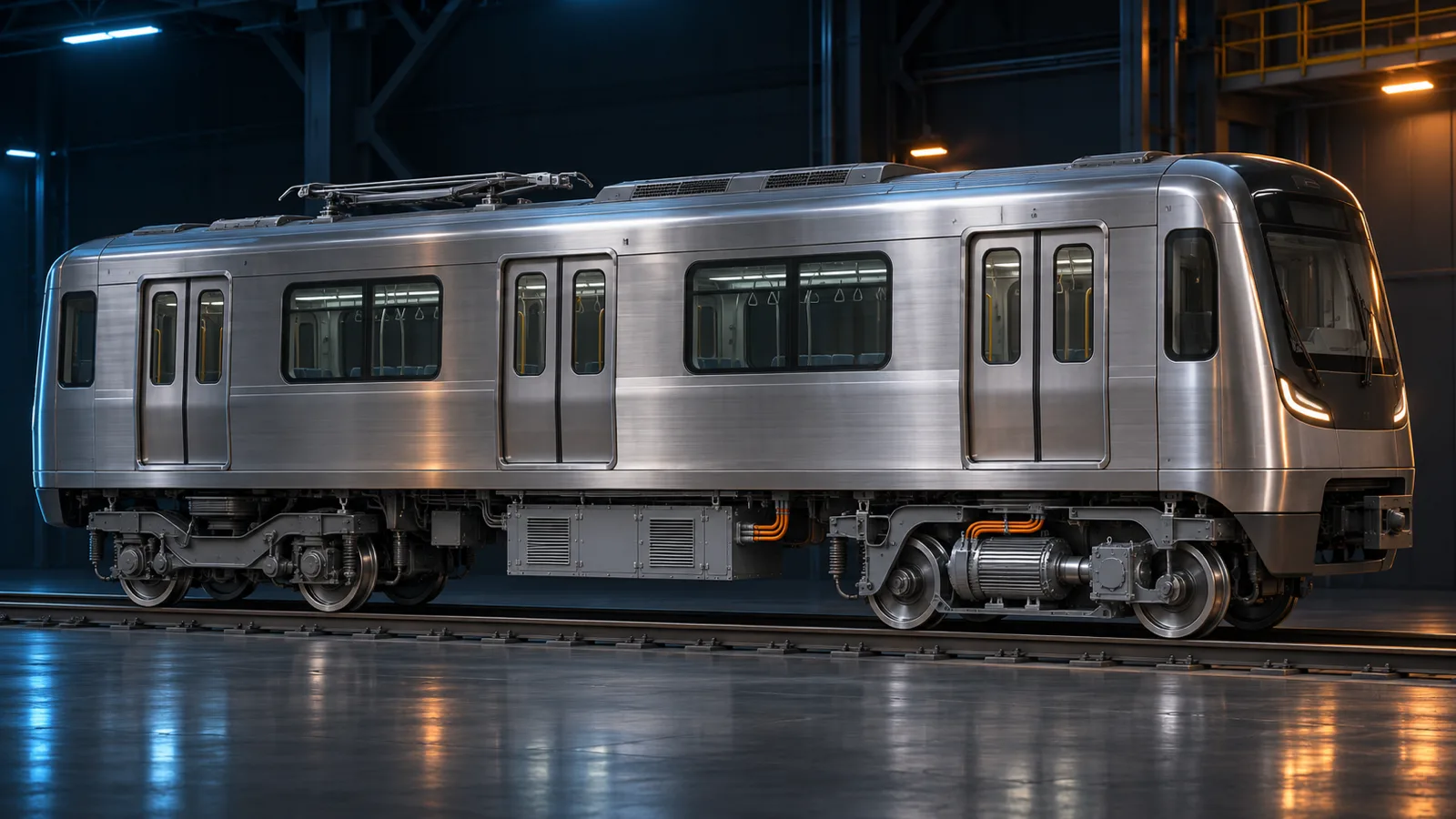
RDSO's overview lists an unpainted austenitic stainless steel body as a standard feature of modern Indian metro cars. Aluminium is the main alternative. Titagarh Rail Systems says its Pune Metro coaches were India's first aluminium-bodied metro coaches, and the JWL-Woojin press release names aluminium car body shells as part of its scope. Aluminium is much less dense than steel, which is why the press release ties the aluminium plant to "lighter and more energy-efficient trains". Aluminium bodies are typically built from long extruded sections welded together, so the plant needs different welding processes, jigs and inspection from a stainless steel line.
The bogie is the four-wheeled frame under each end of the car. It carries the wheelsets, suspension, brakes and, on a motor car, the traction motors and gearboxes. RDSO gives typical values for an Indian metro bogie:
| Parameter | Value |
|---|---|
| Axle load | 16 t |
| Bogie wheelbase | 2,300 mm |
| Wheel diameter, new / fully worn | 860 / 780 mm |
| Gear ratio | 6.19 |
| Maximum service / design speed | 80 / 90 km/h |
| Minimum curve | 120 m in depot (30 km/h), 140 m on main line (40 km/h) |
| Stability check | UIC 518 and EN 14363, by multibody simulation |
The 2017 standard norms (issued by the then Ministry of Urban Development) fix the frame around these parts. Trains use 1,435 mm standard gauge and run as 3, 6 or 9 cars at 80 km/h operating speed. Cars are 2.90 m wide for up to 45,000 passengers per hour per direction, or 3.20 m wide above that. At least 67% of a train must be motorised. That last rule drives the worked example below.
Worked example: how much force does a 6-car metro need to start?
A 6-car Indian metro needs about 200 kN of tractive force to start when empty, and about 300 kN at full design load. With four of the six cars motorised, each driven axle has to grip the rail with a force of only about 12% of the weight on it. Here is the working, using RDSO's car data and MoHUA's motorisation rule.
Inputs. RDSO's car table gives a driving motor car (DMC) at 41 t and a trailer car (TC) at 42 t. It also gives an axle load of 16 t and acceleration of 0.82/0.78 m/s². We use 0.82 for the empty train and the lower 0.78 for the heavy one. Under the 67% rule, a 6-car train has 4 motor cars and 2 trailers. We assume the middle motor cars weigh the same as a DMC, 41 t. The heavy case puts the full 16 t design axle load on every axle.
Tractive force. Force is mass times acceleration:
Grip needed per driven axle. Four motor cars with 4 axles each give 16 driven axles. Divide the force among them and compare it with the weight on each axle. For the empty train, a motor car's axle carries 41/4 = 10.25 t.
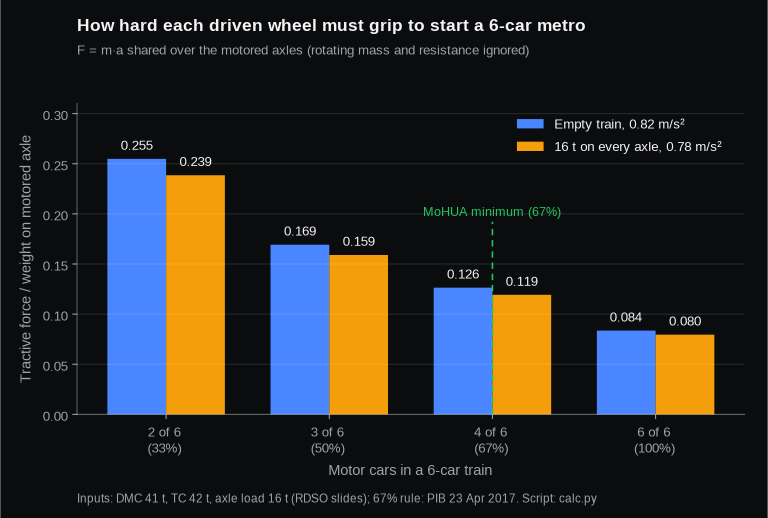
The chart shows what the 67% rule buys. With only half the cars motorised, as in RDSO's older 6-car layout, the demand rises to 0.159 at full load. With a third of the cars motorised, it rises to 0.24 or more. More driven axles keep each wheel further from slipping, especially on wet rail, and also share out the regenerative braking. The empty train needs slightly more grip per axle than the full one, because an empty motor car puts only 10.25 t on each axle.
Motor speed and torque. At 80 km/h (22.22 m/s), a new 860 mm wheel turns at 493.5 rpm. Through the 6.19 gearbox, the motor turns at about 3,055 rpm. At full load, each driven axle's 18.72 kN at the rail means 8,050 N·m on the wheelset, or about 1,300 N·m at the motor shaft, ignoring gear losses.
How much energy does a metro shed at every stop?
A 6-car metro braking from 80 km/h has to get rid of about 17 kWh of kinetic energy when empty and about 26 kWh at full design load. Regenerative braking returns part of it to the line, and the friction brakes turn the rest into heat.
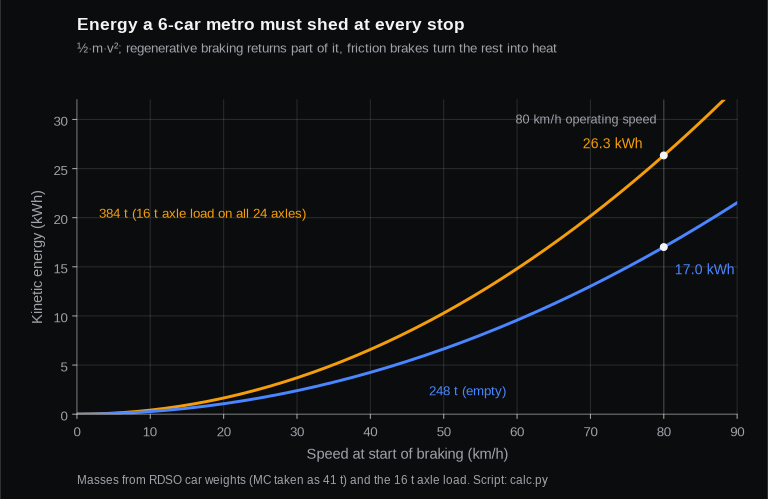
At RDSO's service braking rate of 1.0 m/s², the stop from 80 km/h takes 22.2 s and covers about 247 m, ignoring the jerk limit that softens the start and end. A metro train repeats this at every station, which is why receptivity matters: the energy is only recovered if another train nearby is drawing power at that moment, or the substation can take it back.
What this simple model leaves out. It ignores the extra inertia of rotating wheels, gears and motor rotors, and the train's running resistance, which add to the starting force. It also ignores gradients, the 5% tolerance on the acceleration spec, and converter and motor losses. A real traction study adds all of these over a full run between stations.
Who builds metro coaches in India, and what are the localisation rules?
MoHUA's Annual Report 2025-26 says three companies currently have metro coach manufacturing setups in India. It does not name them. Public records show these coach builders active in Indian metro work:
- BEML had built more than 2,100 metro coaches by March 2026 (PIB, 9 Jun 2026).
- Alstom started building 96 driverless Metropolis cars for Chennai Metro Phase II at its Sri City plant in Andhra Pradesh. Its release of 12 Nov 2026 gives a contract value of €135 million including 15 years of maintenance.
- Titagarh Rail Systems builds aluminium-bodied metro coaches. It says it has a partnership with ABB India for 25 kV metro propulsion, including technology transfer for TCMS, at its Uttarpara works.
The rules that pushed this localisation date from April 2017. When a tender is for more than 100 cars, at least 75% of them must be made in India. At least 25% of the listed critical equipment and sub-systems must also be made in India, either by the OEM's own Indian subsidiary or by an Indian manufacturer. Under the Public Procurement (Preference to Make in India) Order, MoHUA set a minimum local content of 60% for rolling stock on 14 October 2020. Its lists of 1 January 2021 and 3 October 2023 name 65 items that metros must buy only from "Class-I" local suppliers. The propulsion system, pantograph, coupler, braking system and air conditioning unit are all on that list.
That list is the main reason the JWL-Woojin deal is built around propulsion. A propulsion system imported from Korea would struggle in Indian metro tenders that must buy it from Class-I local suppliers. A joint venture that designs and builds propulsion in India can, and the same propulsion can serve Vande Bharat and EMU work. JWL already makes wheels, axles, bogies, couplers and brake systems, so adding propulsion and carbodies would cover most of a train.
What does this mean for mechanical and electrical engineering students?
Nothing changes overnight. The JV company is not yet formed, there is no plant site, and no metro order has been announced. But if the joint venture wins tenders, it will need people in every part of a metro car. The table below shows which skills map to which part.
| Subsystem | Typical work | Skills to build |
|---|---|---|
| Carbody (stainless or aluminium) | Structural and crash design, fatigue of welded joints, jigs and fixtures | CAD, FEA, explicit crash analysis, welding metallurgy |
| Bogie | Frame strength, suspension, ride and curving checks to EN 14363 | Multibody dynamics, vibration, fatigue |
| Propulsion | Converter and inverter design, IGBT thermal design, motor and gear sizing, EMC | Power electronics, electrical machines, drives and control, thermal analysis |
| TCMS and doors | Train networks, fault logging, door control | Embedded C, networks, functional safety |
| Testing and commissioning | Type tests, combined tests, line trials | Instrumentation, data analysis, standards |
| Maintenance | Fleet upkeep, which metros with large fleets are told to do in-house | Reliability, diagnostics, spares planning |
For mechanical students, the bogie and carbody are where FEA and multibody dynamics are used every day. Skill-Lync's multibody dynamics course covers the methods behind ride and stability studies. For electrical students, propulsion is the part Woojin is transferring. Our electric motor design course covers induction machines, and the textbook chapter on inverter-fed induction motor drives and braking is free. For high-speed rail, see our post on the Surat-Bilimora bullet train energisation.
Frequently asked questions
Has the Jupiter Wagons-Woojin joint venture been formed?
Not yet. JWL's 23 November 2026 filing says it executed a framework agreement and that "upon formation of the proposed JV" it will hold 80% and Woojin 20%. Its current shareholding in Woojin is nil. The press release says JWL "has entered into a joint venture", but the joint venture company has not been reported as incorporated.
How much is Jupiter Wagons investing in the metro JV?
The company has not said. The filing says JWL will fund the joint venture's land, plant, machinery and working capital, but gives no amount. PTI reported an investment of about ₹1,000 crore, and on the 19 November earnings call the managing director said capex figures would be announced shortly.
What is a propulsion system in a metro train?
It is the electrical chain that drives and brakes the train. It runs from the pantograph or third-rail shoe, through a converter, DC link and VVVF inverter, to the traction motors and gearboxes. In braking it works in reverse, returning energy to the line. RDSO notes 25% to 35% of traction energy is regenerated.
Why do Indian metros use both 25 kV AC and 750 V DC?
Each metro chooses its supply when the system is planned; RDSO lists both as standard in India. A 25 kV AC overhead wire carries little current but needs a transformer and line converter on the train. A 750 V DC third rail needs no overhead wire or transformer on board, but carries more than 30 times the current for the same power. Both feed the same kind of DC link and inverter.
Which companies make metro coaches in India?
MoHUA says three companies have metro coach manufacturing setups in India. BEML had built more than 2,100 metro coaches by March 2026. Alstom builds Metropolis cars at Sri City, Andhra Pradesh. Titagarh Rail Systems builds aluminium-bodied metro coaches. Tenders over 100 cars must have at least 75% of the cars built in India.
Sources and further reading
- Jupiter Wagons Ltd, Execution of Framework Agreement with Woojin Industrial Systems, Regulation 30 disclosure with Annexure A, BSE, 23 Nov 2026.
- Jupiter Wagons Ltd, Press release: Jupiter Wagons to manufacture metro trains and propulsion systems in India through joint venture with Korea's Woojin Industrial Systems, BSE, 23 Nov 2026.
- Jupiter Wagons Ltd, BSE corporate announcements, scrip 533272, including the Q2 FY2026-27 earnings call transcript of 19 Nov 2026.
- PTI via ThePrint, Jupiter Wagons forms JV with Korea's Woojin to manufacture metro trains, propulsion systems, 23 Nov 2026 (reported investment figure).
- P. C. Ray, RDSO, Traction System and Rolling Stock in Metro Railways, slide deck hosted by IRIMEE, 2021.
- Press Information Bureau, Make in India gets metro boost; local procurement made mandatory, Ministry of Urban Development, 23 Apr 2017.
- Ministry of Housing and Urban Affairs, Annual Report 2025-26, sections on metro rail and PPP-MII implementation.
- Press Information Bureau, Infrastructure at the Core of India's Development, 9 Jun 2026.
- Alstom, Alstom commences manufacturing of 96 additional Metropolis driverless metro cars for Chennai Metro Phase II, 12 Nov 2026.
- Titagarh Rail Systems, company website (metro projects and propulsion partnership), accessed 24 Nov 2026.