PMSM vs Induction Motor for EVs: Torque, Efficiency and Indian Models
How a permanent magnet synchronous motor and an induction motor each make torque, worked with real numbers: synchronous speed and slip, a torque-slip curve from a textbook equivalent circuit, and P = Tω on the motor ORNL tested from the Nissan LEAF. Then efficiency, cost and magnets, why Tesla and Tata's Harrier.ev pair the two, the rare-earth-free options, and which Indian EVs use which motor.

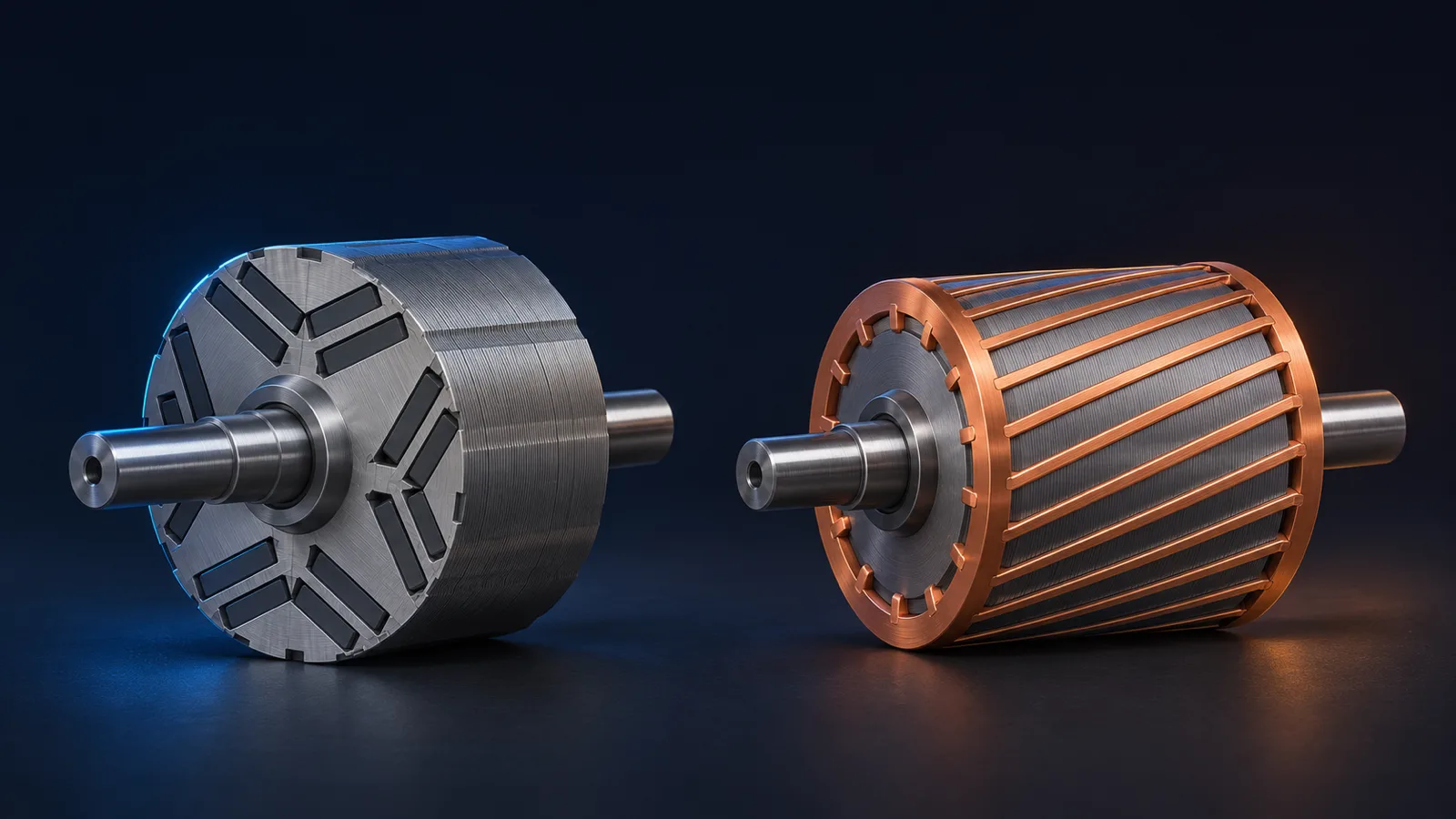
A permanent magnet synchronous motor (PMSM) gets its rotor field from magnets, so the rotor turns in step with the stator's rotating field and wastes almost no energy. An induction motor has no magnets: the stator field induces currents in a copper or aluminium rotor cage, which only happens if the rotor slips slightly behind the field. That makes the PMSM smaller and more efficient in everyday driving, and the induction motor cheaper, free of rare earths and able to switch its field off when idle. Every Indian EV we checked whose maker names the motor type, from the Nexon.ev to the Ather 450X, uses a PMSM. Tata's Harrier.ev QWD adds an induction motor on the second axle.
Below, both machines are worked through with numbers: synchronous speed and slip, a torque-slip curve from a textbook equivalent circuit, and P = Tω on a motor Oak Ridge National Laboratory tested. Then efficiency, cost, control, the rare-earth-free options and the Indian line-up.
Key numbers at a glance
- 2,728 rpm: base speed of the 2012 Nissan LEAF's 80 kW, 280 N·m interior-magnet motor, about 40 km/h in the car. Below it the motor gives full torque, above it full power up to 10,390 rpm (ORNL test data, 2013).
- 85.5% vs 83.0%: efficiency of a Toyota Prius 2010 interior PM motor and a same-size copper-cage induction motor, both making about 221 N·m at 250 A. The induction motor's active parts were 11% heavier and 9% cheaper (Gundogdu, Zhu and Chan, 2022).
- 6%: at 6% slip, 6% of the air-gap power of an induction motor becomes heat in the rotor: 967 W out of 16.1 kW in our textbook example.
- Rear PMSM + front induction: the layout of the Tesla Model 3 and Model Y (2021) and of the Tata Harrier.ev QWD (175 kW rear, 116 kW front; Tata Motors, 3 June 2025).
Courses: to design or control these machines, see Skill-Lync's electric vehicle courses, including Electric Motor Design using MATLAB and ANSYS Maxwell and Control Theory PMSM.
What is the difference between a PMSM and an induction motor?
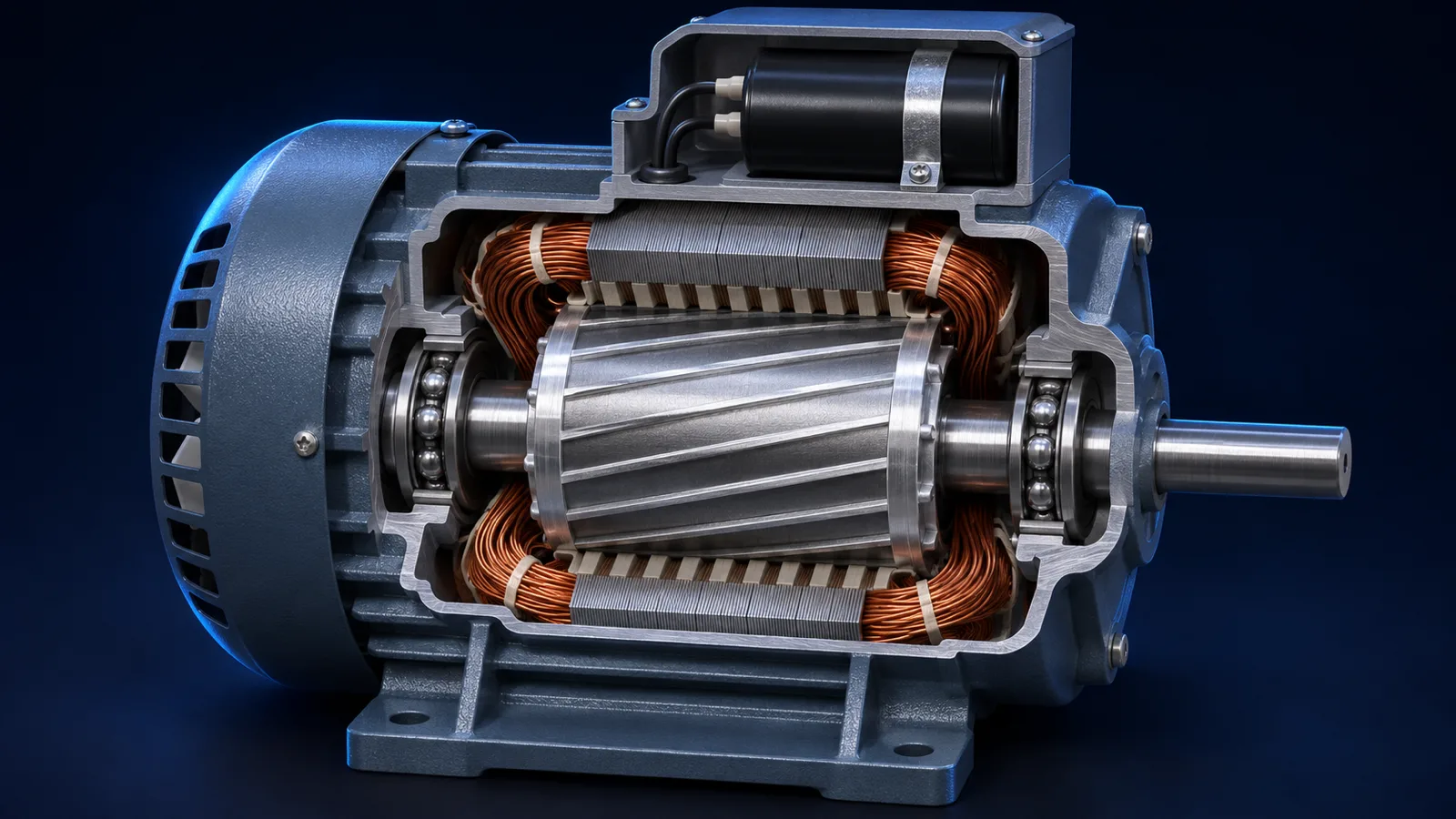
Both motors have almost the same stator: laminated steel with three-phase windings fed by an inverter. The difference is the rotor. A PMSM rotor carries permanent magnets, usually neodymium-iron-boron (NdFeB), and turns at exactly synchronous speed. An induction motor rotor is a steel stack with shorted copper or aluminium bars, magnetised by currents the stator induces in them.
| Feature | PMSM | Induction motor (squirrel cage) |
|---|---|---|
| Rotor field from | Permanent magnets, always on | Currents induced in the rotor cage |
| Rotor speed | Exactly synchronous | Slightly below synchronous (slip) |
| Rotor losses | Very small | Slip × air-gap power |
| Part-load efficiency | Higher | Lower; draws magnetising current even at light load |
| Torque per kg | Higher | Lower for the same size |
| Rare earths | NdFeB, often with dysprosium for heat resistance | None |
| Spinning while idle | Magnets still magnetise the steel: iron loss and back-EMF | No current, no field, almost no drag |
| Main risk | Demagnetisation at high temperature and current | Rotor heat, which is hard to remove |
For the background theory, see the chapters on traction motors and induction motor performance in our free textbooks.
How does a PMSM make torque?
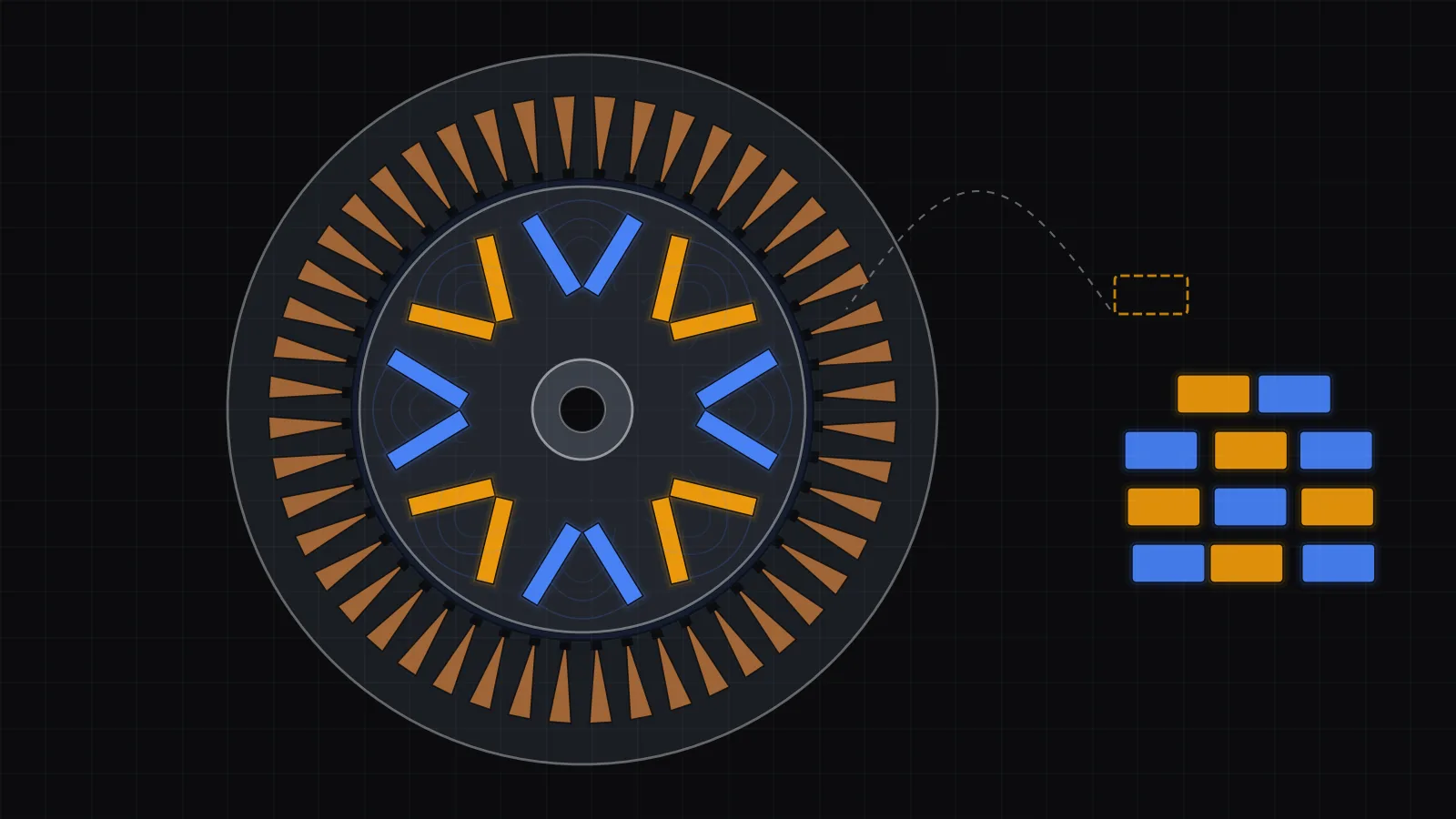
A PMSM makes torque because the stator's rotating field pulls on the rotor magnets, like dragging a compass needle around with a magnet. The inverter keeps the stator field about 90 electrical degrees ahead of the magnets, where the pull is strongest. Interior-magnet designs add a second, "reluctance" torque from the rotor steel.
Engineers write this in the rotor's own frame: the d-axis along the magnet flux, the q-axis 90 electrical degrees ahead. With pole pairs, magnet flux linkage , inductances and , and currents and :
The first term is magnet torque. The second is reluctance torque: the rotor steel tries to line up with the stator field along its easiest magnetic path.
Surface magnets vs interior magnets
In a surface PMSM (SPM) the magnets are bonded to the outside of the rotor. Magnet material is magnetically almost like air (NdFeB has a relative permeability of about 1.05), so and all the torque comes from . In an interior PMSM (IPM) the magnets sit in slots inside the steel, often in a V. The magnets block the d-axis flux path while the q-axis runs through steel, so exceeds , and negative adds reluctance torque. Buried magnets are also held in place at high speed.
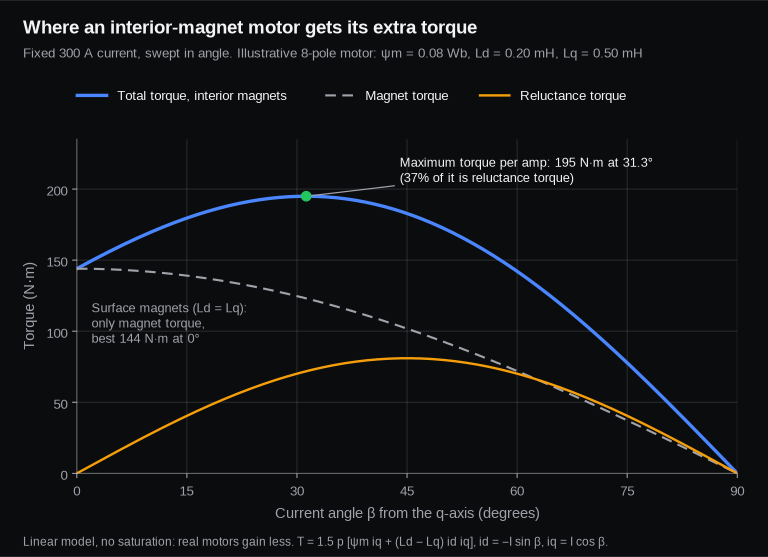
With surface magnets, 300 A gives at most 144 N·m, at 0°. With interior magnets, the same magnet flux and current give up to 195 N·m at 31.3°, 35% more, and 37% of it is reluctance torque. That best angle is the maximum torque per ampere (MTPA) point, and tracking it is the controller's job. This is why well-documented car PMSMs, such as the Prius 2010 and LEAF motors, are interior-magnet designs.
How does an induction motor make torque?
The rotating stator field sweeps past the rotor bars and induces currents in them. Those currents make their own field, which the stator field drags along. Induction needs relative motion, so the rotor always turns a little slower than the field. That difference, the slip, sets both rotor current and torque.
Synchronous speed and slip, worked
The stator field rotates at the synchronous speed set by the supply frequency and the number of poles :
A 4-pole motor on India's 50 Hz grid has rpm. If the rotor turns at 1,450 rpm, .
In an EV the inverter sets . At 150 Hz the same 4-pole design has rpm. With the rotor at 4,410 rpm the slip is 2%, and the rotor currents alternate at only Hz. A PMSM has no slip: the LEAF's 8-pole motor at 10,390 rpm needs exactly Hz.
The torque-slip curve from the equivalent circuit
The per-phase equivalent circuit has the stator resistance and leakage reactance (, ), a magnetising branch that carries the current needed to magnetise the motor, and the rotor (, ). The air-gap power splits by slip:
We used Example 4 from the University of Utah's ECE 3600 notes: a 480 V, 4-pole, 60 Hz, 20 hp motor with = 1 Ω, = 2 Ω, = 0.6 Ω, = 2 Ω and = 75 Ω. Our script first reproduces the notes' answer: at 6% slip, 24.0 A, 16.12 kW across the air gap, 1,692 rpm and 85.53 N·m. The rotor copper loss is kW, all of it heat inside a spinning rotor.
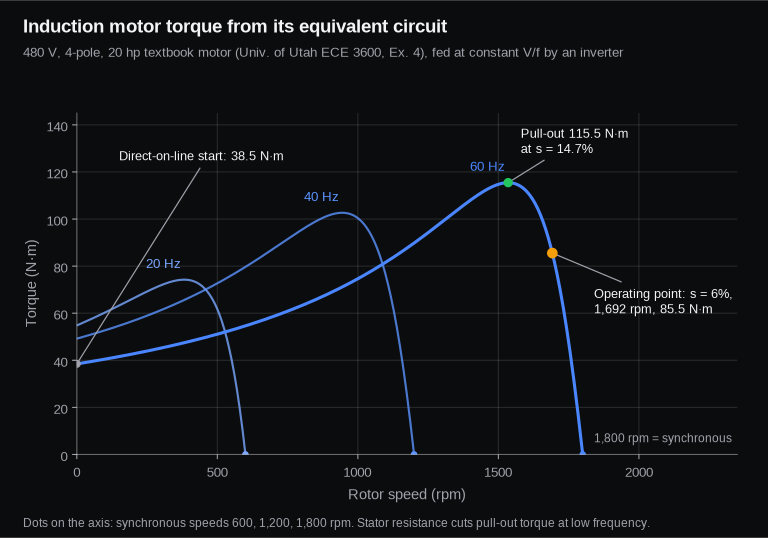
Read the 60 Hz curve from the right. Torque is zero at synchronous speed (1,800 rpm) and rises almost in proportion to slip: 51.0 N·m at 3%, 85.5 N·m at 6%. That steep, stable stretch is where the motor runs. The peak, the pull-out torque, is 115.5 N·m at 14.7% slip, and the curve falls to 38.5 N·m at standstill.
A grid-fed motor is stuck on that one curve; an inverter-fed EV motor is not. Lowering the frequency at constant volts per hertz slides the curve left, so the motor stays on the steep part at any road speed. The 20 Hz and 40 Hz peaks are lower (74.3 and 102.7 N·m) because stator resistance matters more at low voltage, which is why drives add a "low-speed boost". The electrical drives textbook covers V/f, vector control and PMSM drives.
What do torque, power and speed mean on an EV motor spec sheet?
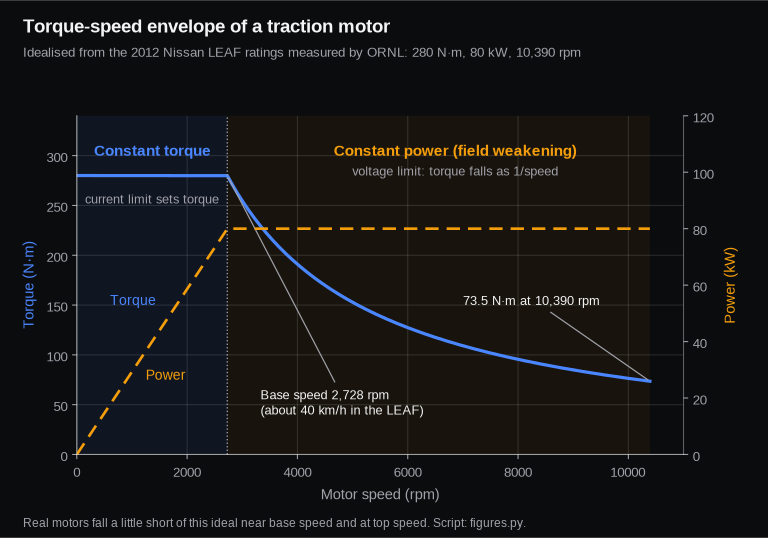
Power is torque times angular speed, with . A traction motor is limited by current at low speed, which caps torque, and by battery voltage at high speed, which caps power. So every EV motor has a constant-torque region up to its base speed and a constant-power, field-weakening region above it.
Oak Ridge National Laboratory (ORNL) confirmed the 2012 Nissan LEAF motor's ratings of 280 N·m and 80 kW; its speed rating is 10,390 rpm. Base speed is where full torque meets full power:
ORNL lists 7,000 motor rpm at 64 mph (103 km/h), so 2,728 rpm is about 40 km/h. Below that, the full 280 N·m is available, 2,223 N·m at the wheels through the 7.94 final drive before gear losses. At 1,500 rpm the motor can give only kW. At 10,390 rpm the 80 kW limit leaves N·m. The 3.81 ratio of top speed to base speed is one reason EVs manage with a single-speed gearbox, as our ICE vs EV powertrain comparison explains.
What is field weakening, and why do the two motors do it differently?
Field weakening means reducing the motor's effective flux so its back-EMF, the voltage the spinning motor generates against its supply, stays below the battery voltage as speed rises. Without it, the inverter runs out of voltage at base speed.
- PMSM: the magnet flux cannot be switched off, so the controller injects negative d-axis current to oppose it. That current makes no useful torque but still heats the copper. Interior magnets help, because reluctance torque keeps working at high speed.
- Induction motor: the flux comes from the magnetising current, so the controller simply asks for less. Raising frequency at the voltage limit lowers the flux on its own.
Our EV range calculator shows how much of a drive cycle such as the MIDC is spent at low speed and part load. That is where the efficiency contest below is decided.
Which is more efficient: PMSM or induction motor?
A PMSM is more efficient at the low and medium speeds and part loads of city driving, by 2.5 percentage points in the same-size study below. It has no slip loss and draws no magnetising current. An induction motor narrows the gap at high speed and light load, where it can cut its flux while a PMSM's magnets keep magnetising the steel.
Gundogdu, Zhu and Chan (2022) took the Toyota Prius 2010 interior-magnet motor and designed a copper-cage induction motor with the same stator diameter (264 mm), stack length (50.8 mm), current (250 A peak) and voltage limit:
| Same-size machine | Torque | Output | Efficiency | Losses | Active mass | Material cost |
|---|---|---|---|---|---|---|
| Interior PM (NdFeB) | 222.4 N·m | 34.9 kW at 1,500 rpm | 85.5% | 5.91 kW | 22.7 kg | £76.70 |
| Copper-cage induction | 220.8 N·m | 33.5 kW at 1,450 rpm | 83.0% | 6.87 kW | 25.2 kg | £69.71 |
Source: World Electric Vehicle Journal 13, 137 (2022), Table 3; losses worked from output and efficiency by our script. One operating point at full current, not a drive-cycle average.
At equal torque the induction motor loses 16% more energy, much of it in the rotor bars, which the authors call the induction motor's "major disadvantage". They also found that below rated current the IPM makes more torque, while above it the induction motor's torque rises faster. The PMSM is stronger at the part loads where cars spend most of their time.
The other side is in a 2021 Chalmers University report by Mikael Alatalo. Magnet-free machines "have the possibility to lower the flux density in the motors at not so demanding operating points", which matters when a powerful motor is lightly used. In his simulations, pairing a PM motor with a magnet-free reluctance machine halved the WLTP-cycle losses compared with two PM machines. That is the logic behind the Tesla layout.
Why does Tesla use an induction motor on one axle?
Tesla's dual-motor Model 3 and Model Y pair an efficient permanent magnet motor on the rear axle with an induction motor on the front (Gundogdu et al., 2022; Chalmers, 2021). An induction motor with no current has no field, so it can spin almost freely while the PM motor cruises, then join in for acceleration or grip.
- Early cars: Tesla's first models used AC induction motors; the Model 3 introduced its permanent magnet motor (Electrek, reporting Tesla's Investor Day, 1 March 2023).
- Model S and X update, 23 April 2019: a permanent magnet motor moved to the front, and the rear induction motor "engages when extra power is needed". Engadget reported the Long Range Model S's EPA range rising from 335 to 370 miles.
- Model 3 and Model Y, 2021: induction front, interior PM rear (World Electric Vehicle Journal, 2022, Table 1).
tesla.com refused automated access and we found no Tesla technical paper giving its reasoning, so treat the free-spinning explanation as engineering logic, not a company statement.
India now has the same layout. Tata's release for the Harrier.ev QWD (3 June 2025) gives 238 PS (175 kW) and 158 PS (116 kW) from its two motors and 504 N·m combined. A review on the Tata Group newsroom describes the rear unit as a permanent magnet synchronous motor and the front as an induction motor. Rear-wheel-drive variants use the PMSM alone.
Power density, cost and magnets: what does each motor trade?
A PMSM gives more torque per kilogram but needs NdFeB magnets. An induction motor uses cheaper copper, aluminium and steel but is heavier for the same output. In the same-size study, the induction motor's active parts were 11.1% heavier and 9.1% cheaper.
- Specific torque: 9.80 N·m per kg of active material for the IPM, 8.75 for the copper-cage motor.
- Whole motor: the LEAF motor, about 56 kg and 19 litres for 80 kW, gives 1.43 kW/kg and 4.2 kW/L (ORNL), housing and cooling included.
- Materials: the study priced NdFeB at £42.28/kg, copper at £7.354/kg and electrical steel at £0.44/kg. A kilogram of magnet costs as much as nearly 6 kg of copper.
Supply is the bigger exposure: NdFeB depends heavily on China, and the heat-resistant grades on dysprosium or terbium. The 2025 export controls, India's ₹7,280 crore magnet scheme and how much magnet a motor holds are in Rare Earth Magnet Shortage: What It Means for EV Motors in India.
What limits each motor: heat and demagnetisation
A PMSM is limited by its magnets. NdFeB loses coercivity, its resistance to demagnetisation, as it heats up. A hot magnet facing a strong opposing stator field, in hard acceleration or a fault, can lose strength for good; Gundogdu et al. found the IPM's demagnetisation risk rising with current. Designers cap peak current, cool the rotor and pick high-temperature grades, which brings back the dysprosium question.
An induction motor is limited by rotor heat. Its rotor losses (967 W at 6% slip in our 20 hp example) arise in a spinning part that is hard to cool. But there are no magnets to damage, and the same study cites earlier work crediting induction motors with better overload capability. That suits an axle that works hard for a few seconds at a time.
One more PMSM property: its magnets generate back-EMF whenever the rotor turns, even with the inverter off. At high speed that voltage can exceed the battery voltage, so the drive must handle a sudden loss of field-weakening current. An unexcited induction motor generates nothing.
How are EV motors controlled? Field-oriented control in one paragraph
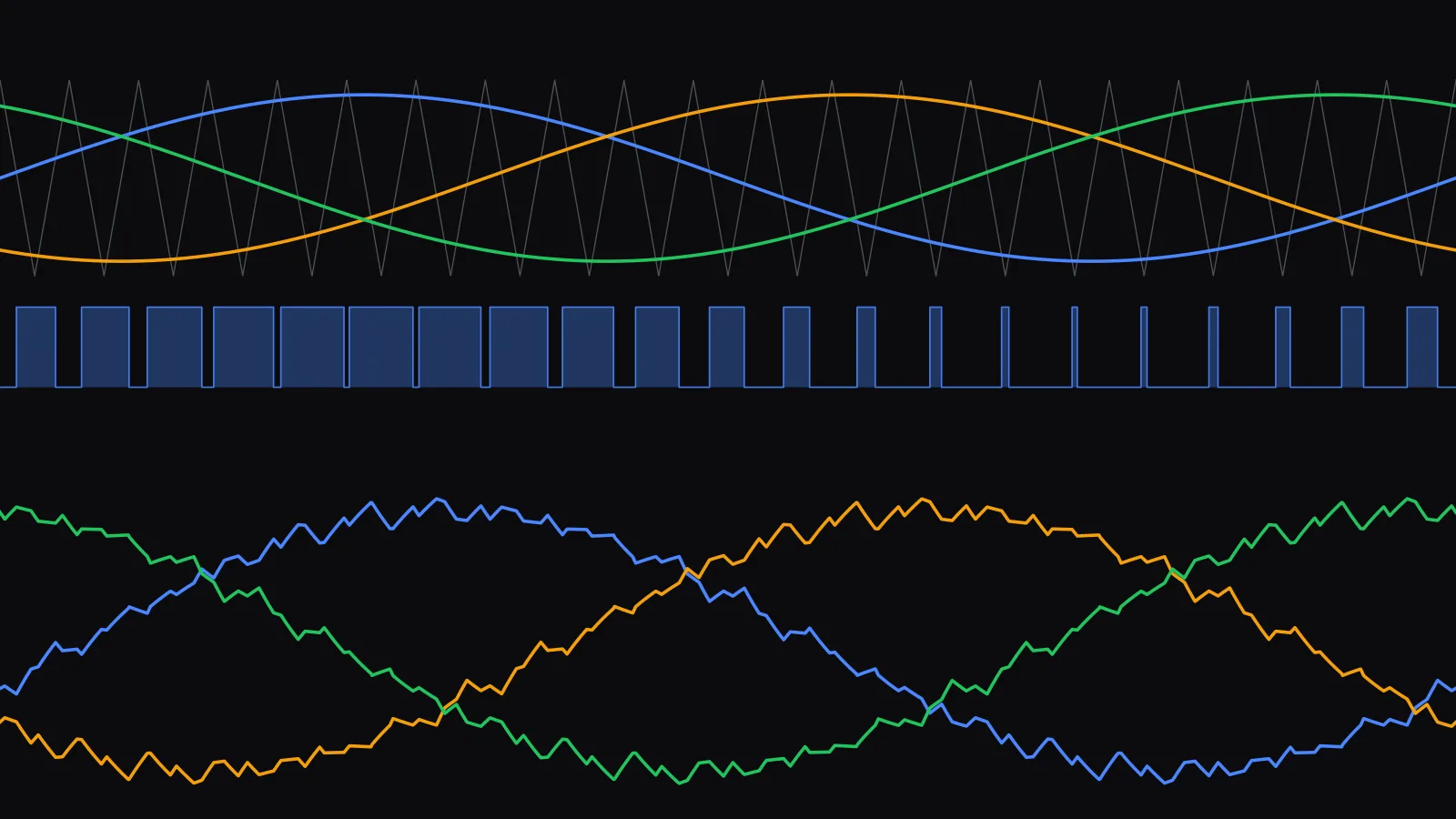
Both motors use field-oriented control (FOC), or vector control. The controller measures the phase currents and uses the Clarke and Park transforms to turn them into two steady values in a frame that rotates with the rotor field: , which makes flux, and , which makes torque. Two PI regulators hold them at their targets, inverse transforms give the voltage commands, and space-vector PWM switches the inverter. Texas Instruments' application note BPRA073 (1998) describes this as giving an AC motor the easy control of a DC machine. A PMSM controller reads rotor angle from a resolver, encoder or observer and picks for MTPA or field weakening. An induction motor's rotor-flux angle cannot be measured directly, so the controller estimates it, typically from the commanded slip, and that estimate depends on a rotor resistance that changes as the rotor heats. The cascaded speed and current loops are the same ones you can try on a DC motor in our DC motor speed control calculator.
What about rare-earth-free options: switched reluctance and wound-rotor motors?
Besides the induction motor, two magnet-free designs matter. The wound-rotor synchronous motor (also called EESM, electrically excited synchronous motor) is in production. The switched reluctance motor (SRM) is still mostly in research for cars.
- Wound rotor (EESM): a DC-fed copper field winding replaces the magnets, so it works like a PMSM whose "magnet" the controller can turn down. Renault has used it since the Kangoo Z.E. in 2011, and the Renault 5 uses the 110 kW 6AK motor; Renault says such motors are "slightly bigger" than PM motors (16 October 2025). BMW says the iX3's 210 kW motor, built from 2020, "eliminates the need for rare earth materials". The costs are rotor copper loss and transferring power to a spinning rotor.
- Switched reluctance (SRM): plain toothed steel rotor, no windings, no magnets, pulled from pole to pole as stator coils switch in turn. Rugged and cheap, but its torque ripple is "severely pronounced", so it is noisy, and it needs its own converter instead of a standard three-phase inverter (Abdel-Aziz et al., Energies, 2024).
Ferrite magnets and reduced-dysprosium NdFeB keep the PMSM layout but change the magnet; see our rare earth magnet explainer.
Which motor do Indian EVs use?
Every mainstream Indian EV in our check whose maker publishes a motor type uses a PMSM, with the Harrier.ev QWD adding a front induction motor. The table lists only what each manufacturer's own sheet or page states.
| Vehicle | Motor type (as the OEM states it) | Peak power, torque | Source |
|---|---|---|---|
| Tata Nexon.ev | Permanent magnet synchronous AC motor | 106.4 kW (Long Range) / 95 kW (Medium Range), 215 N·m | Tata Motors spec sheet, Sep 2023 |
| Tata Harrier.ev QWD | Rear PMSM, front induction | 175 kW + 116 kW, 504 N·m combined | Tata Motors, 3 Jun 2025; Tata newsroom, Jan 2026 |
| MG Windsor EV | Permanent Magnet Synchronous Motor | 136 PS, 200 N·m | MG Motor India model page |
| Ather 450X | PMSM | 6.4 kW, 26 N·m | Ather spec sheet, Oct 2024 |
| Ola S1 X | Mid-drive IPM (interior permanent magnet) | Not used here | Ola Electric S1 X page |
Mahindra's INGLO page gives 210 kW and 380 N·m but, like the BE 6 specification brochure we opened, does not name the motor type, so Mahindra is not listed. Scooter makers have also changed magnet grades since 2025 (Ather's heavy-rare-earth-free motor, Ola's ferrite motor), so "PMSM" alone does not tell you which magnet is inside.
PMSM or induction motor: which should an EV use?
Use an interior-magnet PMSM as the main drive motor when efficiency, range and size matter most, which covers most cars and nearly all two-wheelers. Consider an induction or wound-rotor motor for a second axle that idles most of the time, for high power used briefly, or when magnet cost and supply risk outweigh a few points of efficiency. Performance AWD cars often do both, as Tesla and the Harrier.ev QWD show.
The limits of this article: the efficiency figures come from one same-size study at one load point and one simulation report, and real motors are optimised differently. The IPM figure uses illustrative, unsaturated parameters, and the induction curve is a 20 hp textbook machine, not a traction motor. Use the worked numbers to understand the behaviour, and finite-element analysis and test data to choose a motor.
To go further, Skill-Lync's EV Powertrain: Component Sizing and Specification course sizes a motor against a vehicle and drive cycle. Our posts on power converters in EVs and the single-phase induction motor cover the inverter side and the household cousin of the traction motor.
Frequently asked questions
Is a BLDC motor the same as a PMSM?
They are built almost the same way, with magnets on the rotor and windings on the stator, but driven differently. A BLDC motor has a trapezoidal back-EMF and is driven with six-step switching from Hall sensors. A PMSM has a sinusoidal back-EMF and is driven with sinusoidal currents under field-oriented control. Our BLDC drives chapter walks through six-step commutation.
What is the slip of an induction motor in an EV?
Usually a few percent at normal load, because the inverter keeps the motor on the steep, low-slip part of its torque curve. In our textbook example, full-load slip is 6% and pull-out comes at 14.7%. Rotor copper loss equals slip times air-gap power, so lower slip means a cooler rotor.
What is base speed in an EV motor?
It is the speed at which the motor reaches full power while still at full torque. Below it torque is constant; above it power is constant and torque falls with speed. For the 2012 Nissan LEAF motor, 80 kW and 280 N·m give 2,728 rpm, about 40 km/h in that car.
Do electric scooters in India use PMSM or BLDC motors?
The makers' own sheets say PMSM or IPM for the scooters we checked: the Ather 450X lists a 6.4 kW PMSM and Ola lists a mid-drive IPM for the S1 X. Some budget scooters advertise "BLDC hub motors". The label tells you more about how the motor is driven than how it is built.
Sources and further reading
- Oak Ridge National Laboratory for the US Department of Energy, APE006: Benchmarking EV and HEV technologies (Burress, 2013): 2012 Nissan LEAF motor ratings and tests
- T. Gundogdu, Z.-Q. Zhu and C. C. Chan, Comparative study of permanent magnet, conventional, and advanced induction machines for traction applications, World Electric Vehicle Journal 13(8), 137 (2022) (open PDF)
- M. Alatalo, Efficiency impact of motor type and motor size choice, Chalmers University of Technology, technical report 2021:1
- A. Stolp, Induction Motor Examples, ECE 3600, University of Utah (rev. 2022)
- MathWorks, PMSM block reference, Simscape Electrical: dq torque equation
- Texas Instruments, Field Orientated Control of 3-Phase AC-Motors, BPRA073 (Feb 1998)
- Engadget, Tesla's Model S and Model X get new motors with more range (23 Apr 2019)
- Electrek, Tesla is going back to EV motors with no rare earth elements (1 Mar 2023)
- Renault Group, All about electric motors with no rare earths (16 Oct 2025); BMW Group, The efficient drivetrain for the purely electric BMW iX3 (18 Dec 2019)
- Abdel-Aziz, Elgenedy and Williams, Review of switched reluctance motor converters and torque ripple minimisation techniques for EV applications, Energies 17, 3263 (2024)
- Tata Motors, Nexon.ev specification sheet (Sep 2023); Harrier.ev launch release (3 Jun 2025); Tata Group newsroom, Harrier.ev review (Jan 2026)
- MG Motor India, Windsor EV specifications; Ather Energy, Ather 450 spec sheet (Oct 2024); Ola Electric, S1 X specifications; Mahindra, INGLO platform