Surat-Bilimora Bullet Train Energisation: 2x25 kV OHE, Progress, Jobs
NHSRCL set 20 November 2026 to energise the overhead wires on the first 50 km of India's bullet train line, Surat to Bilimora. Here is what is confirmed and what is only reported, how the 2 x 25 kV autotransformer system works (current and energy worked out by script), what the B-28 train is, the official progress figures and the civil and electrical skills the project uses.

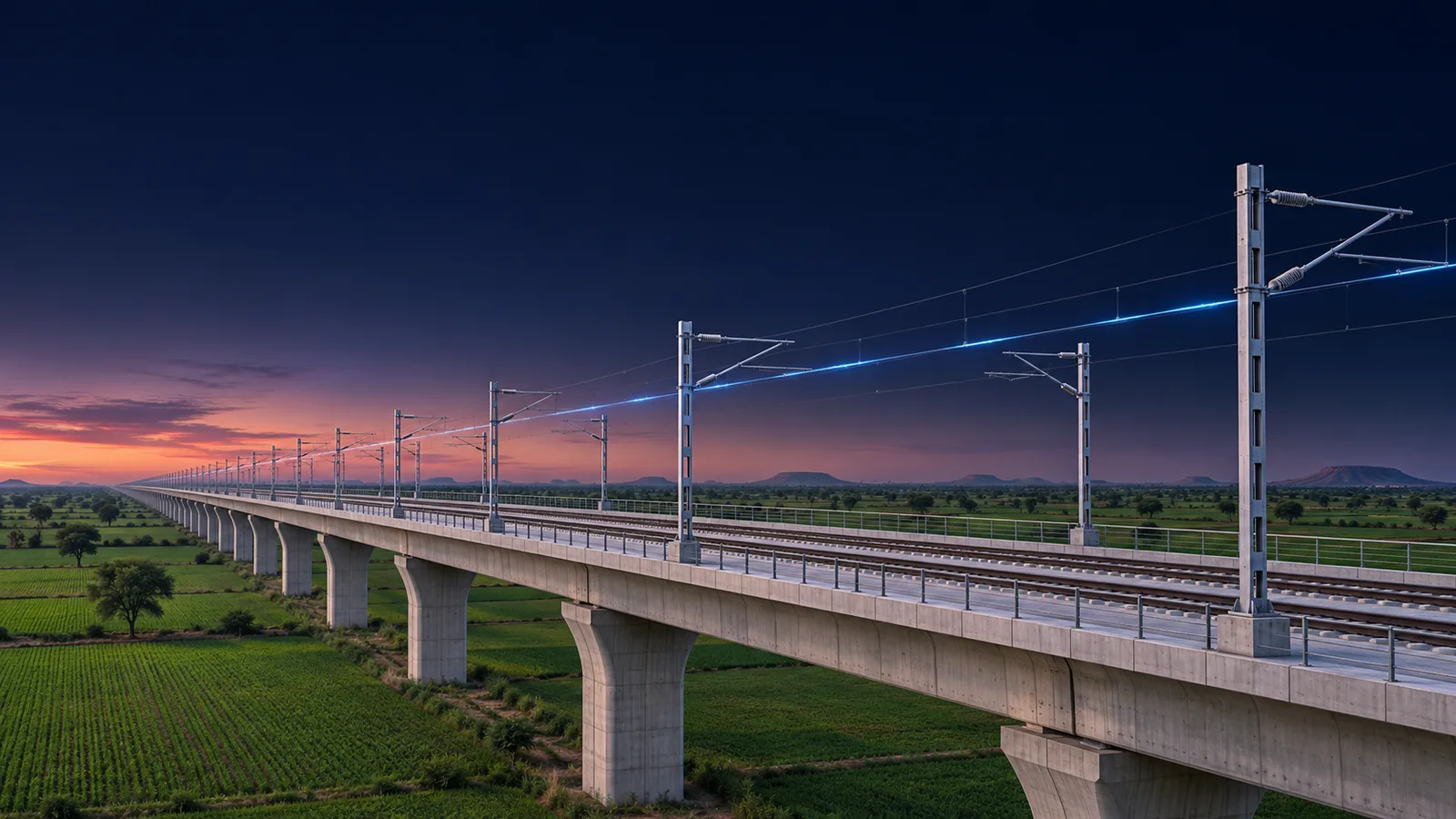
The first 50 km of India's bullet train line, the Surat-Bilimora section in south Gujarat, was due to have its overhead wires switched on, at 25,000 volts, on 20 November 2026. The National High Speed Rail Corporation (NHSRCL), which is building the 508 km Mumbai-Ahmedabad corridor, announced the date in a media brief on 18 November 2026. It covers both the Up and Down lines on the elevated viaduct. From that day the wires are to be treated as live at all times. By the morning of 21 November NHSRCL had not put out a release saying the switch-on was complete, so this post treats the date as scheduled, not as a reported success.
Below: what NHSRCL actually said and what is only in press reports, where the section sits and why it comes first, what "energising" means on a 2 x 25 kV autotransformer system (with the current and energy worked out by script), what the official B-28 train is, how far the corridor had got by the last official count, and which civil and electrical skills this project is hiring for.
Key facts at a glance
- 18 November 2026: NHSRCL's media brief says the overhead equipment (OHE) on the Surat-Bilimora section will be energised on 20 November 2026. The section is 50 km long and includes both lines on the viaduct.
- The system: a 2 x 25 kV overhead traction system fed by 14 traction substations along the 508 km route (NHSRCL, 18 Nov and 30 Oct 2026). NHSRCL says this is the first use of 2 x 25 kV in India (22 Jul 2026).
- The first substation: at Bilimora in Navsari district. It takes power from the Gujarat Energy Transmission Corporation (GETCO) 220 kV Ambetha grid substation (NHSRCL, 30 Oct 2026).
- Official progress (Lok Sabha reply, 22 Jul 2026): piers 452 km, girders 356 km, track bed 209 km and OHE masts 190 km of 508 km. On the 97 km Surat-Vapi stretch all civil works were done and 87% of the track bed was laid.
- The trains: PIB's 3 Jul 2026 backgrounder says a new Bengaluru complex is building "B-28 coaches". The Indian-made train is specified for 280 km/h in testing and 249 km/h in service, with 8 cars and about 557 seats (NHSRCL/PIB, 1 Nov 2026). The first service is expected in August 2027, from Surat to Vapi (PIB, 3 Jul 2026).
Courses: the structures and power systems behind these numbers are taught in Skill-Lync's Design of Elevated Metro Viaducts using STAAD.Pro and Introduction to Electric Power System courses.
What did NHSRCL announce about the Surat-Bilimora section?
On 18 November 2026 NHSRCL said the overhead equipment on the 50 km Surat-Bilimora section, both Up and Down lines, would be energised on 20 November 2026. It called this the first section of the corridor to reach that stage. The brief also carries a public safety advisory: from that date the wires stay live, and nobody should approach them, touch them or work near them without authorisation.
The brief adds three system facts. The corridor uses a 2 x 25 kV overhead traction system. Fourteen traction substations (TSS) along the route will take power from the grid and feed it to the wires. The whole network will be watched from one central control centre.
A 30 October 2026 brief filled in the substation side. The first TSS, at Bilimora, sits on about 18,000 m². By then its control panel, changeover switch, transformer and circuit breaker buildings were built, and all its gantry towers and beams were up. Equipment installation, testing and commissioning were still going on. The Gujarat substations draw from GETCO's 220 kV Ambetha grid substation.
NHSRCL spells the town both "Bilimora" and "Billimora" in its own releases. They are the same place.
What is confirmed and what is only reported?
The energisation date, the 50 km length, the 2 x 25 kV system and the substation details come from NHSRCL itself. The idea that a "B28 train launch" is about ten months away comes from a newspaper headline. We could not find it in any NHSRCL, Ministry of Railways or PIB document.
| Claim | Status | Source |
|---|---|---|
| Surat-Bilimora OHE to be energised on 20 Nov 2026; 50 km; both lines | Confirmed (announced) | NHSRCL media brief, 18 Nov 2026 |
| Energisation actually completed on 20 Nov | Not yet confirmed by NHSRCL as of 21 Nov morning | No completion release on nhsrcl.in |
| 2 x 25 kV system, 14 TSS, Bilimora TSS fed from GETCO 220 kV Ambetha | Confirmed | NHSRCL, 30 Oct and 18 Nov 2026 |
| "B-28 coaches" being developed at the Aditya complex, Bengaluru | Confirmed (name only) | PIB backgrounder, 3 Jul 2026 |
| Indian-made train: 280 km/h test, 249 km/h service, 8 cars, ~557 seats | Confirmed (does not use the label "B28") | NHSRCL/PIB, 1 Nov 2026 |
| First service August 2027, Surat to Vapi | Confirmed as an expectation | PIB backgrounder, 3 Jul 2026 |
| B28 train launch "targeted in 10 months" | Reported | The Indian Express headline, 19 Nov 2026 |
| Service from 15 Aug 2027 on Surat-Bilimora | Reported (minister quoted) | DeshGujarat, 1 Jan 2026 |
The government also hedges in Parliament. Its 11 February 2026 Lok Sabha reply says exact timelines "can be reasonably ascertained" only after civil, track, electrical, signalling and telecom works are done and the trainsets arrive. The 22 July 2026 reply repeats that line.
Where is the Surat-Bilimora section, and why is it first?
Surat-Bilimora is a stretch of the corridor in south Gujarat, between Surat and Bilimora (Navsari district), about 220-268 km from the Mumbai end. It falls inside the 97 km Surat-Vapi stretch, where PIB says the first passenger service will run. It is first because the Gujarat civil works are furthest ahead, and electrification began here.
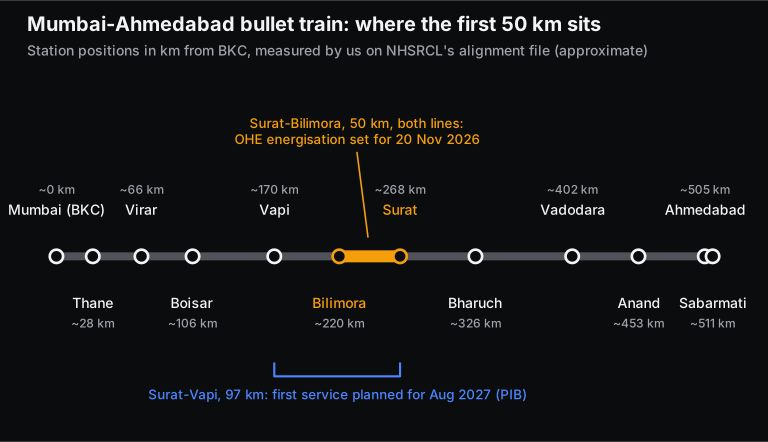
We measured the alignment ourselves using NHSRCL's published KMZ file. Station to station, Surat to Bilimora comes out at about 47 km along the line (45 km in a straight line). NHSRCL's 50 km section therefore runs a little past the two stations. On the same file, Vapi to Surat measures about 98 km, against PIB's 97 km. That is close enough to trust the figure above.
Three official facts explain why this stretch is first:
- Electrification started here. NHSRCL's project overview says electrification began with steel masts on the viaduct between the Surat and Bilimora stations.
- The first substation is here. The Bilimora TSS was the first one nearing completion (30 Oct 2026). A section can only be energised once a substation can feed it.
- Gujarat is ahead. Land acquisition delays in Maharashtra held the project back until 2021 (Lok Sabha reply, 11 Feb 2026). By 22 Jul 2026 all civil works on Surat-Vapi were complete.
Our reading, not an official statement: this stretch was the first to have viaduct, track, masts, wires and a working substation all in place together.
What does "energising" a bullet train line mean?
Energising means connecting the overhead wires to a live traction substation, so the contact wire sits at 25 kV AC above the rail, ready for a train's pantograph (the arm on the roof that touches the wire). It is the step that turns finished wires into a power supply. It is also why the safety warning matters: anything touching or arcing to the wire can be lethal.
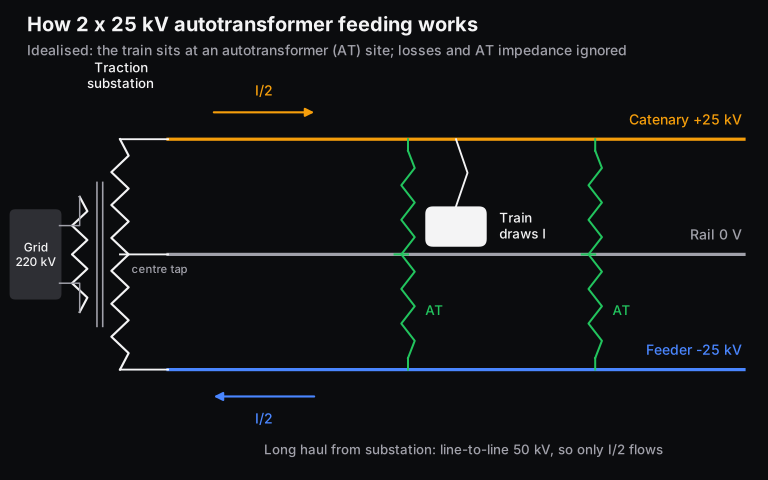
On this corridor the supply is a 2 x 25 kV autotransformer (AT) system, which NHSRCL calls one of the most advanced electrification systems used for high-speed rail worldwide. The substation transformer has a centre-tapped secondary winding. One end feeds the catenary (overhead wire) at +25 kV. The centre tap goes to the rail at 0 V. The other end feeds a separate feeder wire at -25 kV, half a cycle out of phase. Autotransformers along the line tie all three together.
Why 2 x 25 kV instead of plain 25 kV? The current, worked out
The train still takes 25 kV at its pantograph. The difference is how the power travels from the substation. Between catenary and feeder the voltage is 50 kV, so the same power needs half the current over the long haul. At unity power factor (our assumption; modern trains with IGBT converters run close to it):
Resistive loss in the conductors goes as the current squared, and voltage drop goes as the current. On the same wires:
So the long-haul losses are a quarter, and the voltage drop, as a share of supply voltage, is also a quarter. Take an example train drawing 8 MW (our illustrative figure; NHSRCL has not published a power rating). It pulls 320 A through its pantograph, but only about 160 A has to travel the long distance from the substation. This is why a high-speed line can space its substations far apart and still keep the voltage steady at 320 km/h.
The official numbers bear this out. The corridor has 12 mainline traction substations plus 2 at depots (NHSRCL project overview), so each mainline substation serves about
on average. NHSRCL's July brief lists nearly 22,000 masts across 1,125 track-km, including depots. That works out to one mast every
Switching on Surat-Bilimora powers about 100 track-km (50 km times two lines). That is roughly 9% of those 1,125 track-km.
Speed brings a mechanical problem too. NHSRCL says every wire is strung under a precisely calculated tension, using a compound catenary (a first in India), so the pantograph collects current at speed without sparking or losing contact. The masts are 10.5-14.5 m tall, and NHSRCL says all major transformers, the cross arms and the feeder, protection and ground wires are made in India. For the line theory behind voltage drop and losses, the Power Systems book on this site works through it chapter by chapter.
What is the B28 bullet train?
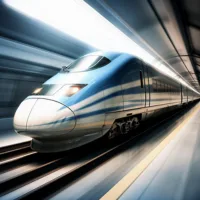
B-28 is the name PIB uses for the coaches of India's own high-speed train. PIB's 3 July 2026 backgrounder says the new Aditya complex in Bengaluru "is designed for the development of B-28 coaches". It adds that Integral Coach Factory (ICF) and BEML are designing and building indigenous 280 km/h trainsets.
A 1 November 2026 release (on NHSRCL's site, issued by PIB) gives the train's specification without using the B-28 label:
- Maximum test speed 280 km/h; operational speed 249 km/h.
- About 202 m long; 8 cars, 4 motor cars and 4 trailers; two sets can couple into a 16-car train.
- About 557 seats: seven standard-class cars (3+2 seating) and one executive car (2+2).
- 25 kV, 50 Hz single-phase AC from a heavy compound catenary; regenerative braking; nose and body shaped using CFD.
The corridor itself is designed for 350 km/h and will run at up to 320 km/h (PIB, 3 Jul 2026). The Indian-made train, at 249 km/h in service, will be slower than the line allows. NHSRCL's 12 June 2026 release defines high-speed rail as operation above 250 km/h, so 249 km/h falls just short of that line. Whether the B-28 train will run the first passenger services is a press claim. We found no official statement that says so.
How much energy does a bullet train carry at speed?
At 249 km/h, every tonne of train stores about 0.66 kWh of kinetic energy. At the corridor's 320 km/h it is 1.10 kWh, or 65% more. This energy has to come from the wires when the train speeds up. Regenerative braking can send part of it back when the train slows down.
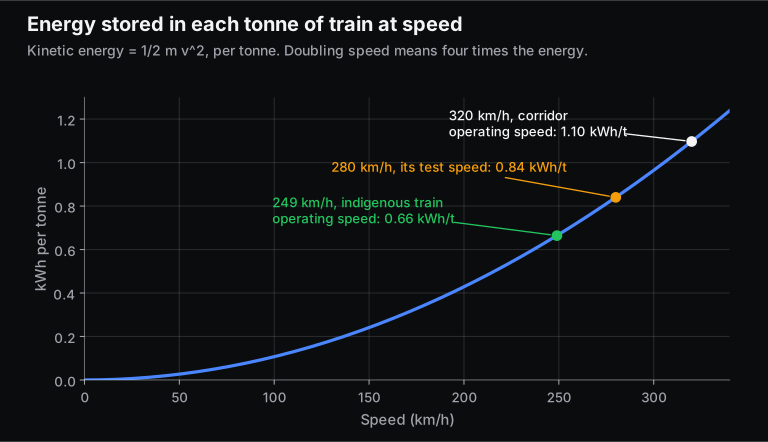
For a whole train, assume a loaded 8-car set of 400 t. This is our round number for illustration; neither NHSRCL nor ICF has published the mass. At 249 km/h it would carry about 266 kWh (957 MJ), or roughly 0.48 kWh per seat across 557 seats. Real energy use per trip is higher, because air drag at these speeds takes power the whole time. Our regenerative braking energy calculator shows how much of that kinetic energy braking can win back. For a sense of time, a train running the 50 km section at a constant 249 km/h would take 12.0 minutes, before allowing for acceleration and braking.
How much of the Mumbai-Ahmedabad bullet train is built?
The latest official count is the Ministry of Railways' Lok Sabha reply of 22 July 2026. Of the 508 km, piers were done for 452 km (89%), girders for 356 km (70%), track bed for 209 km (41%) and OHE masts for 190 km (37%). The Ministry's 2025 year-end review put overall physical progress at 55.63% as of 30 November 2025.
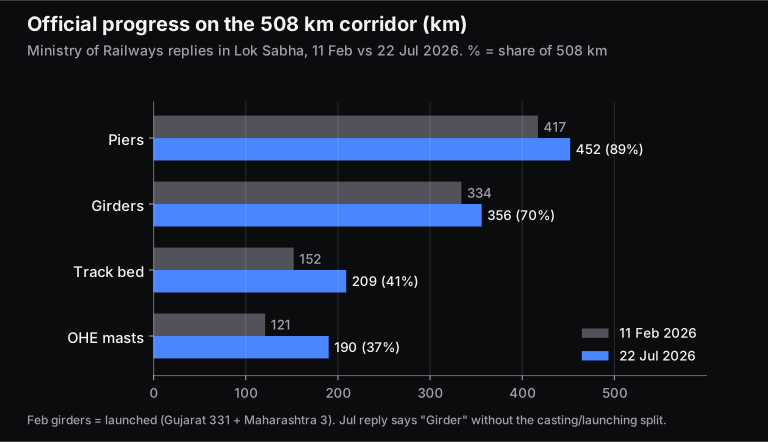
In five months, OHE mast coverage grew by 69 km and track bed by 57 km, against 35 km more piers. The work is moving from building the structure to fitting it out: track, wiring and power. Other official milestones:
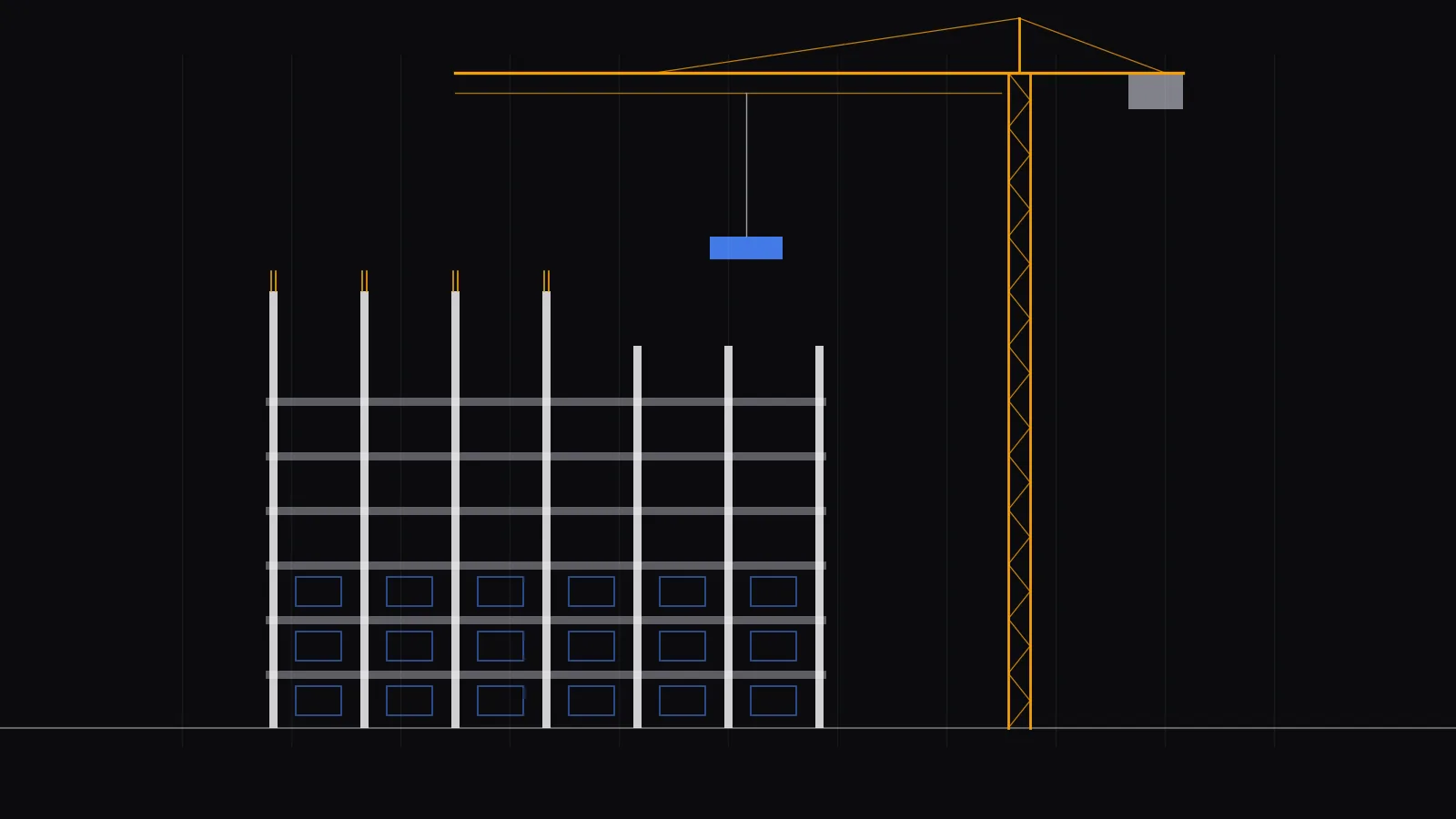
- River bridges: the corridor has 25, with 21 in Gujarat and 4 in Maharashtra. By 3 October 2026, 18 of the 21 in Gujarat were complete, including the 480 m Sabarmati bridge, which was built by the balanced cantilever method.
- The big crossings (status on 22 Jul 2026):
- Narmada (1,366 m): 21 of 25 wells done and 4 spans launched.
- Tapi (720 m): 10 of 12 wells done.
- Vaitarna (2,320 m): 11 of 58 piers built.
- Tunnel: 4.8 km of the 21 km tunnel, which includes India's first undersea rail tunnel under Thane Creek, was complete between Ghansoli and Shilphata.
- Construction method: about 90% of the route is elevated. Most of it is built by the full span launching method (FSLM), which places whole 40 m girders. NHSRCL says this is ten times faster than segmental construction. Our precast construction explainer covers how those girders are cast.
What happens after the wires go live?
With live wires, a train can draw power on this section. That is a precondition for running and testing rolling stock under its own power. NHSRCL has not published a test schedule in the documents we read. These parts are still to come before passengers ride:
- Trainsets: the B-28/ICF-BEML train is still being manufactured (PIB, 3 Jul 2026; NHSRCL, 1 Nov 2026).
- Signalling and telecom: the government lists these alongside civil, track and electrical works as conditions for fixing a timeline (Lok Sabha replies, Feb and Jul 2026).
- Safety systems: 28 seismometers, 22 along the line at substations and switching posts and 6 inland, will cut traction power when they detect an earthquake (NHSRCL, 22 Jul 2026).
- The rest of the power network: 13 more traction substations, 31 switching posts and 16 distribution substations.
The official target for the first service remains August 2027 on Surat-Vapi (PIB, 3 Jul 2026). How braking works at these speeds, including regenerative and emergency braking, is covered in our post on braking at 300 km/h.
What jobs does the bullet train project create for civil and electrical engineers?
The project hires civil, track, electrical, signalling and safety engineers, directly and through contractors. NHSRCL's own careers page, in November 2026, listed document verification for Junior Engineer (Civil/Track), Facility Controller (Civil and Track), Junior Engineer (Safety, Civil and Track) and Junior Technician posts, plus test results for two batches of 2026 vacancy notices.
As the work moves from structures to systems, the skills in demand change with it:
| Area | What the work involves on this corridor | Skills to build |
|---|---|---|
| Viaducts and bridges (civil) | Full-span 40 m girders, portal beams over live railway lines, balanced cantilever river bridges, piers and well foundations | Prestressed concrete, bridge analysis (STAAD.Pro), foundations, erection staging |
| Track (civil) | J-slab ballastless track, high-speed turnouts with movable crossings | Track geometry, slab track tolerances, surveying |
| Traction power (electrical) | 14 TSS, 2 x 25 kV OHE, switching posts, compound catenary under tension | Power systems, transformers, protection and earthing, voltage-drop and fault calculations |
| Control and monitoring | Central control centre, early earthquake detection, rain and wind monitoring | SCADA, instrumentation, reliability |
| Planning and contracts | Sequencing work near operating railway lines, progress reporting | Primavera P6, quantity and progress measurement |
For broader context on starting roles and pay, see our guides to civil engineering jobs for freshers and electrical engineering jobs for freshers, and the civil engineer salary page. On the structures side, Skill-Lync's Post Graduate Program in Bridge Design and Analysis covers superstructures and substructures. Construction Planning using Primavera P6 covers scheduling. Nothing here promises a job on this project. It describes the skills this kind of work uses.
The figures in this post are dated. The progress numbers are from July 2026, and the energisation status is as of 21 November 2026. NHSRCL publishes updates on its press page, and the next Lok Sabha reply will carry a new progress table.
Frequently asked questions
Has the Surat-Bilimora bullet train section been energised?
NHSRCL announced on 18 November 2026 that the overhead wires on the 50 km Surat-Bilimora section would be energised on 20 November 2026, and told the public to treat them as live from that date. As of the morning of 21 November, NHSRCL had not issued a separate release confirming completion.
When will the Mumbai-Ahmedabad bullet train start running?
PIB's 3 July 2026 backgrounder says the first high-speed rail service is expected in August 2027, on the Surat-Vapi section. Press reports have quoted the railway minister giving 15 August 2027. In Parliament, the government says exact timelines depend on finishing civil, track, electrical, signalling and telecom works and receiving the trainsets.
What voltage does the bullet train use?
The train takes 25 kV, 50 Hz single-phase AC from the overhead wire. The corridor uses a 2 x 25 kV autotransformer system: catenary at +25 kV, rail at 0 V and a feeder at -25 kV. Power therefore travels from the substations at 50 kV, which halves the current and cuts long-distance losses to about a quarter.
Is B28 the same as the Japanese Shinkansen train?
No. B-28 is PIB's name for the coaches of the indigenous trainset that ICF and BEML are building in Bengaluru, specified for 280 km/h in testing and 249 km/h in service. The corridor itself uses Japanese Shinkansen technology for track, electrification and operations, and is designed for 320 km/h in service.
How long is the Mumbai-Ahmedabad bullet train route, and how many stations does it have?
The route is 508 km long with 12 stations: Mumbai (BKC), Thane, Virar, Boisar, Vapi, Bilimora, Surat, Bharuch, Vadodara, Anand, Ahmedabad and Sabarmati. About 90% of it is elevated. PIB gives the end-to-end journey as about 1 hour 58 minutes.
Sources and further reading
- NHSRCL, Media Brief: First Section of Mumbai-Ahmedabad Bullet Train Corridor to be Energised on 20 November 2026, 18 Nov 2026 (press release list).
- NHSRCL, Media Brief: 14 Traction Substations (TSS) to power India's First Mumbai-Ahmedabad Bullet Train Corridor, 30 Oct 2026.
- NHSRCL / PIB: Bharat's First Bullet Train in Making, 1 Nov 2026.
- NHSRCL, Media Brief: Powering India's First Bullet Train: Electrification Works Gain Pace, 22 Jul 2026.
- NHSRCL: Project Overview, and Technical Details (alignment KMZ, 2021 horizontal alignment data), accessed 21 Nov 2026.
- NHSRCL: Latest Updates (careers notices), accessed 21 Nov 2026.
- PIB (Ministry of Railways): Mumbai-Ahmedabad High-Speed Rail (Bullet Train) Project Updates, Lok Sabha reply, 11 Feb 2026.
- PIB (Ministry of Railways): Parliament question, railway projects in Maharashtra, including bullet train progress table, Lok Sabha reply, 22 Jul 2026.
- PIB Backgrounder: India's High-Speed Rail Future: Building a Standardised Path for Expansion, 3 Jul 2026.
- PIB (Ministry of Railways): Year End Review 2025, 28 Dec 2025.
- DeshGujarat (report): Bullet train to run on Surat-Bilimora route from August 15, 2027, 1 Jan 2026.
- The Indian Express (report, headline only): "Mumbai-Ahmedabad bullet train project: Railways to energise Surat-Bilimora section, B28 train launch targeted in 10 months", 19 Nov 2026.