How to Get Placed in TCS as a Mechanical Fresher: NQT, Pay and Design Roles
How mechanical engineering freshers get into TCS: the NQT pattern and eligibility rules from TCS's own hiring page, Ninja, Digital and Prime pay, what TCS's mechanical design postings actually ask for, technical questions with worked answers, and an 8-week prep plan. With Skill-Lync placement data (snapshot 15 Nov 2026).
A mechanical engineering fresher gets into TCS the same way every engineering fresher does: through the TCS National Qualifier Test (NQT). It is a single 190-minute test with a Foundation part and an Advanced part. You need 60% or more in Class 10, Class 12 and your degree, and no pending backlog. Your score decides whether you are called for a Ninja, Digital or Prime interview. TCS does hire mechanical engineers for design and simulation work. But every mechanical design opening on its job portal on 18 Nov 2026 asked for at least 3 years' experience, so a fresher's way in is the NQT.
In short
- The test: 190 minutes. Foundation (75 min) has numerical, verbal and reasoning ability. Advanced (115 min) has 25 minutes of advanced quant and reasoning and 90 minutes of coding, and is mandatory for Digital and Prime (TCS hiring page, read 18 Nov 2026).
- The pay: For 0-1 year of experience, TCS lists Prime at ₹9.09-9.30 lakh CTC for graduates and Digital at ₹7.09-7.30 lakh. The Ninja minimum is ₹3.4 lakh (UG) or ₹3.6 lakh (PG). Same page and date.
- The rules: 2024-2026 batch, B.E./B.Tech in any branch, 60% throughout, no pending backlog, gaps of 24 months at most, age 18-28.
- Design jobs: The 5 TCS mechanical postings we opened on 18 Nov 2026 asked for 3-15 years' experience. None was a fresher role.
- Our data: TCS is not among the top 25 recruiters of Skill-Lync's design learners. Their median starting offer is ₹3.5 lakh (n = 1,463, snapshot 15 Nov 2026), close to the TCS Ninja floor.
This guide is for final-year and recent mechanical graduates in India. Rules and pay come from TCS's own pages (read 18 Nov 2026); candidate reports are labelled as such. If TCS changes its rules for the next drive, its notice overrides this page.
Can a mechanical engineer get a job in TCS?
Yes. TCS's All India NQT hiring is open to B.E. and B.Tech graduates "in any specialization", so mechanical engineers apply on equal terms with computer science students. The catch is the job. New graduates go through TCS's Initial Learning Program (ILP), which TCS describes as preparing them for "a successful IT career". A mechanical design role is not guaranteed.
The test is the same for every branch: TCS's FAQ calls it a "standard Integrated Test Pattern". But the skill you pick at registration counts later, because shortlisted candidates are "evaluated predominantly on the skill chosen". Pick the option closest to the work you want (we could not see TCS's list without registering) and be ready to defend it.
TCS's engineering work sits in a unit it calls Industrial Autonomy & Engineering (IAE), covering automotive, aerospace, smart manufacturing and robotics. The mechanical postings we read (fuel systems, car body closures, aero-engine repair, electronics cooling, automotive CAE) were all of this kind.
What do Skill-Lync's placement records say about TCS?
About our numbers: Based on 3,711 Skill-Lync placement records up to 2026-11-07 (data snapshot of 2026-11-15). These are learners who chose to report a placement, not a survey of the job market. Most are starting offers from 2021-2023, recent years are thin, and groups under 10 people are left out. We will update this as placements come in. The individual records are on our recent placements page.
TCS is not a major recruiter of our mechanical learners. It appears in the snapshot's Data Science and Software lists (5 placements each) but not among the top 25 design recruiters (the 25th has 9) or the CAE list. That is too few to quote a TCS salary, so we do not.
The firms that did hire our design learners are mostly engineering-services companies doing the same kind of outsourced design work as TCS's engineering unit:
| Employer (design domain) | Placements | Median starting offer (₹ lakh a year) |
|---|---|---|
| Cyient | 212 | 3.3 |
| Tata Technologies | 98 | 4.6 |
| Tata Elxsi | 38 | 3.5 |
| Tech Mahindra | 33 | 3.25 |
| L&T Technology Services | 27 | 4.0 |
| Quest Global | 16 | 4.2 |
| All design placements | 1,463 | 3.5 (middle half 3.0-4.4) |
| Offers titled "Design Engineer" | 1,053 | 3.4 (3.0-4.2) |
Skill-Lync placement records, snapshot 15 Nov 2026. The full employer list for freshers is on our companies hiring mechanical freshers page. Pay by city and title is on the design engineer salary page.
The TCS Ninja floor (₹3.4 lakh) is within ₹0.1 lakh of the median design starting offer in our records (₹3.5 lakh), and a Digital offer (from ₹7.09 lakh) is about twice it. So take the NQT seriously alongside core design applications, not instead of them.
What is the TCS NQT exam pattern?
The TCS NQT for engineering hiring is one 190-minute test taken at a TCS iON centre. Part A, Foundation (75 minutes), has numerical, verbal and reasoning ability, 25 minutes each. Part B, Advanced (115 minutes), has 25 minutes of advanced quantitative and reasoning ability and 90 minutes of advanced coding.
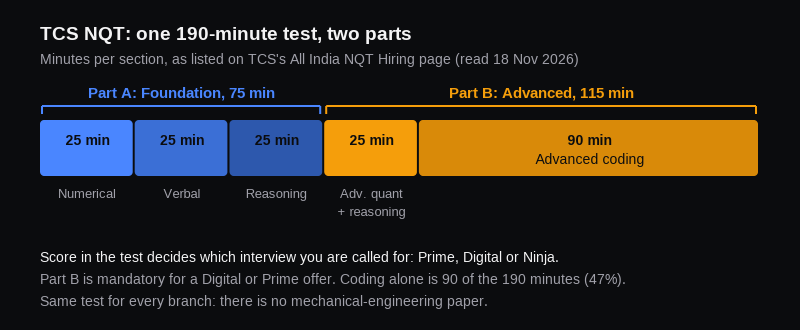
TCS encourages everyone to attempt both parts, but Part B is "mandatory if you aspire for a Digital or Prime offer", and "based on the test performance, candidates will qualify for Prime, Digital or Ninja interviews". Your branch knowledge is tested in the interview, not here. For most mechanical students the 90-minute coding block is the real gap, so the 8-week plan below starts there.
Who is eligible for TCS NQT hiring?
For the latest drive (registration opened 18 Feb 2026), you needed to be from the 2024, 2025 or 2026 batch with a B.E., B.Tech, M.E., M.Tech, MCA or M.Sc in any specialisation, and to meet these rules:
- Marks: at least 60% or equivalent CGPA in Class 10, Class 12, diploma (if any), graduation and post-graduation (if any), counting all subjects.
- Backlogs: "No pending backlog will be permitted at the time of appearing for the TCS selection process."
- Duration: no extended education. You must finish the course in its normal duration, and the offer holds only if your degree certificate shows a first class.
- Gaps: you must declare them, and the total must not exceed 24 months up to your highest qualification.
- Course type: full-time only. NIOS schooling is accepted if your degree was full-time.
- Experience and age: up to 2 years of work experience; age 18 to 28.
CGPA to percentage. TCS's form takes a percentage, and its FAQ gives the rule: percentage = 10 × CGPA. A 7.2 CGPA becomes 72%. On this rule a 6.0 CGPA (60%) just meets the cut-off and a 5.9 (59%) does not. Use your university's official conversion if it gives one on your marksheet.
Is the TCS iON NQT the same as the TCS hiring NQT?
No. TCS iON, TCS's testing arm, sells a public "TCS iON NQT" (₹599 for the Cognitive test, ₹999 for the IT test, read 18 Nov 2026). Its score is valid for 2 years and is shared with companies you apply to, but TCS iON "will not arrange for any job interviews" and has no mechanical test. TCS's own hiring drive is a separate registration on the TCS NextStep portal under the "IT" category, where you must click "Apply For Drive". That page lists no test fee, and TCS says it never asks candidates for money.
Ninja vs Digital vs Prime: what is the difference and what do they pay?
They are TCS's three entry cadres, and your NQT score decides which interview you get. Ninja is application development and maintenance, with a minimum CTC of ₹3.4 lakh (UG). Digital is solution development and integration, at ₹7.09-7.30 lakh. Prime is complex projects on advanced technologies, at ₹9.09-9.30 lakh for graduates with 0-1 year of experience.
| Cadre | Nature of work (TCS's words, shortened) | CTC, UG, 0-1 yr | CTC, PG, 0-1 yr | CTC, UG, 1-2 yrs |
|---|---|---|---|---|
| Prime | Complex projects, advanced technologies and algorithms, emerging tech | ₹9.09-9.30 lakh | ₹11.59-11.80 lakh | ₹9.45-9.66 lakh |
| Digital | Solution development and integration, frameworks and tools, new products | ₹7.09-7.30 lakh | ₹7.39-7.60 lakh | ₹7.50-7.72 lakh |
| Ninja | Application development and maintenance, systems engineering | ₹3.4 lakh minimum | ₹3.6 lakh minimum | Not stated |
Source: TCS All India NQT Hiring page, read 18 Nov 2026. TCS says actual pay depends on relevant work experience and job location. Internships do not count towards salary fitment.
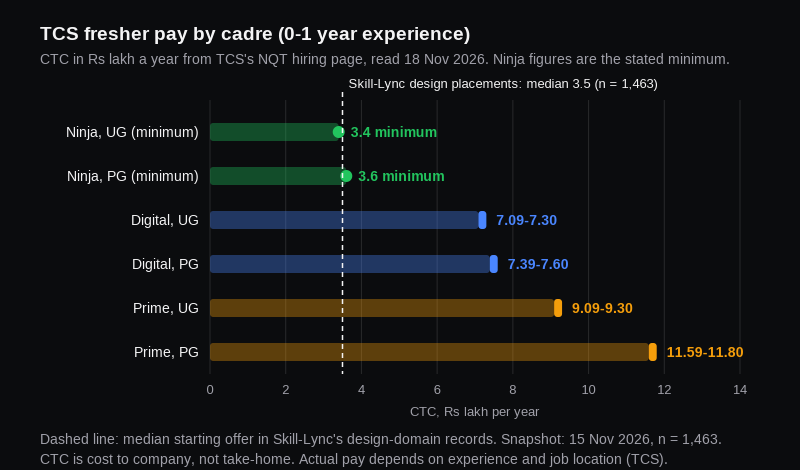
Per month, CTC ÷ 12 is about ₹28,333 for the Ninja UG minimum, ₹59,083 for Digital and ₹75,750 for Prime (UG). That is cost to company, not take-home: PF and tax come out of it. The last drive was framed around Prime and Digital; TCS's FAQ says Ninja offers "will be based on the performance during the hiring process".
Does TCS hire freshers for mechanical design engineer roles?
Not directly, as of 18 Nov 2026. On TCS's iBegin job portal we searched "mechanical", "design engineer", "CAE", "CATIA", "Siemens NX" and "Ansys". Every mechanical result asked for at least 3 years' experience. Freshers reach TCS's engineering unit through the NQT and internal allocation, not through these postings. These are the five design and simulation postings we opened:
| Posting (iBegin ID) | Experience | Tools named | What the role does |
|---|---|---|---|
| Fuel System Design Engineer (402465) | 4-9 years | SolidWorks, CAD/CAM | Designs electromechanical flow and pressure devices, works with the customer and reads engineering drawings |
| Body, Closures and Exteriors Design (435808) | 4-8 years | Siemens NX | Designs bumpers, grilles and BIW doors, with plastic-part rules (wall thickness, draft, sink marks) and DFM/DFA |
| Thermal Engineer (438263) | 4-10 years | FloTHERM, Ansys | Designs cooling for electronics in mostly sheet-metal products |
| CAE Engineer (437711) | 5-12 years | HyperMesh, OptiStruct | Runs static, modal, durability and NVH analysis, including fatigue and fracture |
| MRO Repair Engineer (389855) | 3-15 years | Drawing and GD&T software | Develops repairs for aero-engine parts and writes the approval documents |
Source: TCS iBegin, opened 18 Nov 2026 (apply by 30-31 Dec 2026). The other mechanical results, an automotive CAE role, a CATIA V5 chemical-compliance role and a mechanical subject-expert role, asked for 5-12, 3-8 and 4-6 years. Postings change daily.
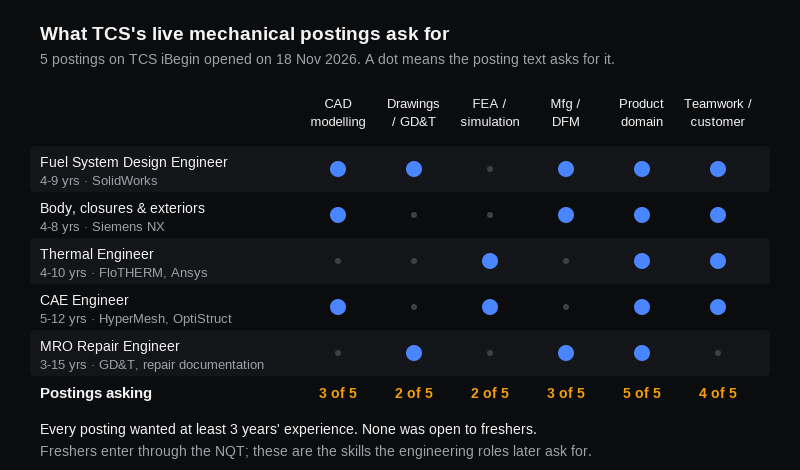
Read this as a map of where a mechanical TCS career can go, and of what to put on your resume: one CAD tool used properly, drawing reading, manufacturing sense and the ability to talk to a customer.
What skills should a mechanical fresher build for TCS?
Build two things at once: NQT skills (aptitude plus one programming language at the level of the 90-minute coding section), and the design skills TCS's engineering postings name (one CAD tool, drawings with GD&T, basic FEA and design for manufacturing). The first gets you the interview; the second gives you something real to talk about in it.
- One CAD tool, done properly. The postings named SolidWorks, Siemens NX and CATIA V5. Pick the one your target employers use and build a full assembly with drawings. Start free with Skill-Lync's CATIA V5 full course, or see our Siemens NX and SolidWorks hubs.
- Drawings and GD&T. Read a drawing and explain a position tolerance on it. Use the free Introduction to GD&T full course and our GD&T interview questions (38 worked examples).
- FEA basics. Static vs modal analysis, meshing and boundary conditions: start with the free Introduction to Finite Element Analysis, then FEA using SOLIDWORKS or CAE simulation using SolidWorks.
- Manufacturing sense. Draft, wall thickness and sink marks for plastic parts, bend rules for sheet metal. The free Product Design and Development course covers the process end to end.
- Fundamentals. Revise strength of materials and drafting with the free Strength of Materials and AutoCAD Essentials for Mechanical Engineers playlists.
- Coding. Learn C, Java or Python well enough to solve two array or string problems without help. One candidate who sat the test advises practising in a plain editor with no auto-complete.
All seven Skill-Lync playlists above were checked on 18 Nov 2026. For a structured route with mentor-reviewed projects, Skill-Lync's PG program in engineering design covers CAD, GD&T and DFM. The full catalogue of free lessons is on Grow by Skill-Lync.
What are the TCS interview rounds?
Shortlisted candidates face technical (TR), managerial (MR) and HR interviews, sometimes as one combined panel. TCS's page says only that you will be "evaluated predominantly on the skill chosen in addition to the usual course of interview". The details below are from candidate reports, not TCS.
- Technical: your chosen skill, your projects, and basic programming. In a February 2025 report, a mechanical student in a Ninja interview was asked about TPM, Lean Six Sigma and the PDCA cycle. The same panel asked for a small HTML form and basic Java.
- Managerial: scenarios, conflict in a team, and why you want this role. The same student was asked, "Why are you transitioning from Mechanical Engineering to IT?"
- HR: relocation, shifts, documents. "Are you open to relocating and working night shifts?" came up in that report.
In that report all three panels sat in one combined round. In a June 2026 report from the All India NQT drive, TR and MR were held together and the candidate called the interview "highly resume-driven". Do not list a tool you cannot demonstrate.
TCS technical interview questions for mechanical engineers (with answers)
The first two are topics a mechanical candidate reported. The rest come from what TCS's engineering postings ask for. For more, see our 50 mechanical design interview questions and TCS technical round questions.
1. What is TPM?
Total Productive Maintenance is a plant-wide approach that aims for no breakdowns and no equipment-caused defects. Operators do routine care themselves (cleaning, inspection, lubrication) so problems are caught early, and maintenance staff focus on planned work and improvement. Add an example from your internship or lab.
2. Explain PDCA and Lean Six Sigma.
PDCA (Plan-Do-Check-Act), also called the Deming or Shewhart cycle, is a repeating four-step loop: plan a change, test it small, check the results, then roll it out or try again. Lean Six Sigma combines Lean (removing waste such as waiting and excess inventory) with Six Sigma (reducing variation), whose projects follow DMAIC: Define, Measure, Analyze, Improve, Control. Name one tool per phase, such as a Pareto chart in Measure.
3. A hole's position is toleranced at Ø0.25 mm. Is this part good?
Under ASME Y14.5, a diameter position tolerance is a cylindrical zone around the true (basic) location. Say the basic location is (25.00, 15.00) mm and the hole measures at (25.08, 14.94) mm. Then:
0.20 mm is within the Ø0.25 mm zone, so the part passes (ignoring any bonus tolerance from MMC). The factor 2 converts the radial deviation to a diameter. The point interviewers look for: the zone is round, not a square ±0.125 box. Try your own numbers in our true position calculator.
4. How do you do a tolerance stack-up?
Add the dimensions around a loop to get the gap, then combine their tolerances. Example: three parts of 20 ± 0.10, 30 ± 0.15 and 10 ± 0.05 mm sit in a housing of 60.5 ± 0.10 mm. The nominal gap is 60.5 − 60 = 0.5 mm.
- Worst case: add every tolerance: 0.10 + 0.10 + 0.15 + 0.05 = ±0.40 mm. The gap runs from 0.10 to 0.90 mm, never negative, so the parts always fit.
- Statistical (RSS): mm, giving about 0.29 to 0.71 mm, the range to expect in production when tolerances vary independently.
Say which method you would use and why: worst case for safety-critical fits, RSS for high-volume parts. Check it in the tolerance stack-up calculator.
5. What is the factor of safety of this bar?
A steel bar 10 mm × 20 mm in cross-section carries 10 kN in tension, and the material's yield strength is assumed to be 250 MPa.
At 30 kN, stress becomes 150 MPa and the factor of safety drops to 1.67. Then mention what real parts add: stress concentration at holes and fillets, and fatigue if the load repeats, which the CAE posting asks for by name.
6. What is the difference between static and modal analysis?
Static analysis finds stress and deflection under loads that do not change with time. Modal analysis finds the structure's natural frequencies and mode shapes, with no load applied, so you can keep them away from operating frequencies such as engine speed, where resonance would amplify vibration. TCS's CAE posting asks for both.
7. Why do plastic parts need draft and uniform wall thickness?
Draft is a small taper on faces parallel to the mould's opening direction, so the part releases without dragging. Uniform walls cool evenly; thick sections cool last and shrink more, causing sink marks and warpage. The Siemens NX body-design posting lists draft, sink-mark control and warpage reduction as must-have skills.
How should you answer HR and managerial questions at TCS?
Be honest and specific. For "Why IT after mechanical?", link your background to TCS's engineering and manufacturing work, say you are open to the role TCS assigns, and show you learn software quickly (your NQT coding prep or a project). For relocation and shifts, give your real answer now, not at the offer stage. For team conflict, use a real project: the disagreement, what you did, what changed. Bring original marksheets and certificates: TCS checks them at the interview and at joining, and discrepant details disqualify you.
An 8-week TCS preparation plan for mechanical students
About 15 hours a week for 8 weeks (120 hours) fits alongside final-year classes. The plan front-loads coding, the usual gap for mechanical students, and builds one design project to talk about in the technical round.
| Week | NQT (about 9 h) | Mechanical and interview (about 6 h) |
|---|---|---|
| 1 | Pick one language. Learn loops, arrays and strings, writing in a plain editor | Choose your CAD tool and a small product to model (a bracket, a clamp or a gear pump) |
| 2 | Arrays and strings: 15 easy problems. Numerical ability: percentages, ratios, time and work | Model the parts. Revise drawing views and first- vs third-angle projection |
| 3 | Sorting, searching and hashing: 15 problems. Reasoning: series, coding-decoding, puzzles | Assembly and a 2D drawing with dimensions. Revise GD&T symbols |
| 4 | A timed Part A mock (75 min). Verbal: reading comprehension and grammar | Add a position tolerance and a stack-up check to your drawing |
| 5 | Medium problems: two-pointer, prefix sums, simple recursion | A static FEA of one part: mesh, loads, factor of safety |
| 6 | A timed full mock (190 min). Review every wrong answer | A modal analysis of the same part. Write a one-page project summary |
| 7 | Advanced quant and reasoning. Two coding problems a day under time | Revise strength of materials, TPM, PDCA and Lean Six Sigma |
| 8 | A second full mock and light revision | A mock interview with a friend: your resume line by line, "Why IT?", relocation |
With more time, stretch weeks 1-3. For core-company rounds too, see our mechanical fresher interview prep guide. The interview questions hub lists company-specific guides, including Tata Technologies' GET interview.
When is the next TCS NQT hiring drive?
As of 18 Nov 2026, TCS had not announced the next All India NQT drive for engineers. Its hiring page shows the last drive, for the 2024-2026 batches, as closed: registration ran from 18 Feb to 20 Mar 2026, with tests from 10 Mar 2026. Watch TCS's entry-level careers page and the NextStep portal. TCS iON's public NQT runs every 2-4 weeks.
Media-reported context, not a TCS notice: People Matters (9 Oct 2026) reported TCS's chief HR officer saying on the 8 Oct earnings call that TCS onboarded 10,000 graduates in the July-September 2026 quarter and was "in the final stages of campus hiring for the next financial year". If your college has TCS on campus, that route may open first.
Frequently asked questions
Is TCS NQT compulsory for mechanical engineers?
For TCS's fresher engineering hiring, yes. Every candidate in the All India NQT drive takes the same 190-minute test, and the score decides whether you are called for a Prime, Digital or Ninja interview. A 2025 candidate report describes an on-campus drive that also used the NQT. Experienced engineers apply instead through TCS iBegin postings.
Can I apply to TCS with a backlog?
Not with a pending one. TCS's NQT page says no pending backlog is permitted when you appear for the selection process. A backlog you have already cleared is not ruled out by that line, but you must finish within the normal course duration and have a first-class degree. Read the eligibility rules of the specific drive you apply to.
Is TCS NQT negative marking?
TCS iON's public NQT page says its tests have no negative marking. TCS's hiring-drive page does not mention negative marking either way. Treat unanswered questions as lost marks and attempt everything, but confirm the rule in your test instructions on the day.
Will I get mechanical work at TCS?
It depends on where TCS allocates you after joining. That is not promised at the offer stage. Mechanical postings on TCS's portal on 18 Nov 2026 all wanted 3+ years' experience. Choosing the skill closest to engineering work at registration, and proving it in the interview, is the clearest way to signal what you want.
Sources and further reading
- TCS All India NQT Hiring, Batch of 2024, 2025 and 2026, Tata Consultancy Services (test pattern, eligibility, CTC by cadre, FAQs; read 18 Nov 2026)
- TCS iON National Qualifier Test, TCS iON (public NQT tests, fees, score validity; read 18 Nov 2026)
- TCS India careers: Entry level and TCS ILP, Tata Consultancy Services (read 18 Nov 2026)
- Industrial Autonomy & Engineering, Tata Consultancy Services (read 18 Nov 2026)
- TCS iBegin postings 402465, 435808, 438263, 437711 and 389855 (opened 18 Nov 2026)
- Skill-Lync placement records, snapshot of 15 Nov 2026 (3,711 records up to 7 Nov 2026); see recent placements
- TCS Interview Experience for Ninja Role 2025, non-CS background, LeetCode Discuss (candidate report, 15 Feb 2025)
- TCS NQT All India Hiring 2026: Interview Experience, LeetCode Discuss (candidate report, 11 Jun 2026)
- TCS adds 4,258 employees, onboarded 10,000 freshers in Q2, People Matters (9 Oct 2026)
- PDCA cycle and DMAIC, American Society for Quality (read 18 Nov 2026)
- ASME Y14.5 Dimensioning and Tolerancing, ASME