EV Powertrain Sizing: A Worked Example from Road Load to Battery kWh
Size an EV powertrain end to end for a 1,300 kg Indian hatchback: road load, continuous and peak motor power, torque and gear ratio with a traction check, Wh/km on the MIDC, battery kWh, pack voltage and C-rate, charging time and inverter kVA. Every number scripted and checked against the Tata Tiago.ev.

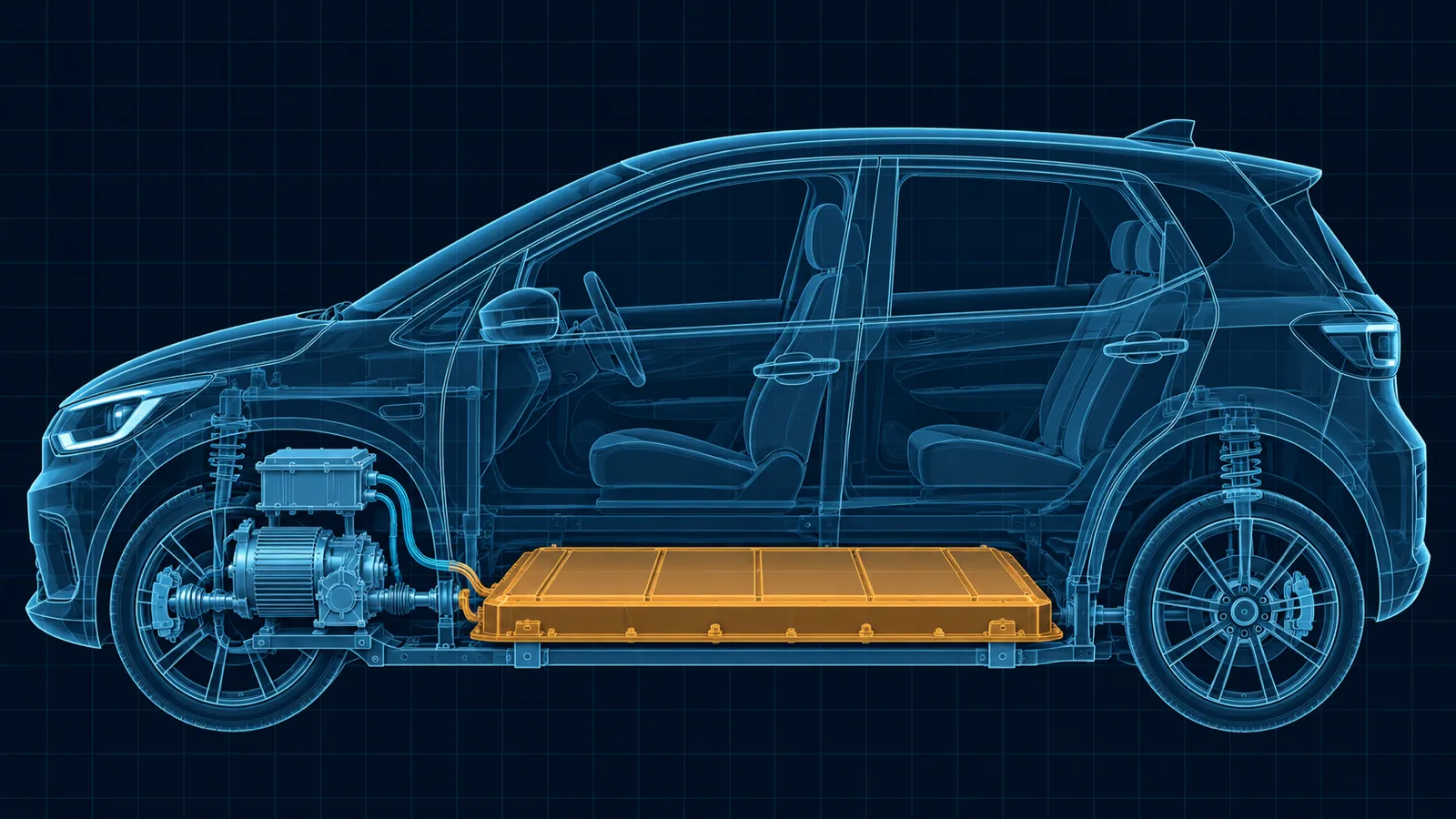
EV powertrain sizing works backwards from the vehicle targets: road load gives the continuous power for top speed and hill climbing, the 0-100 km/h target gives the peak power, the motor's maximum rpm and launch torque fix the single-speed gear ratio, a drive cycle gives Wh/km and therefore the battery kWh for the range, and the pack voltage then sets the currents the cells and inverter must carry. For the 1,300 kg hatchback sized below, that chain gives a 30 kW continuous / 62 kW peak motor with 148 Nm, a 9.5:1 reduction, 117 Wh/km on the Indian MIDC cycle, a 33 kWh LFP pack for 250 km and an 80 kVA inverter.
This is the worked calculation for EV students who have the formulas but have never carried one vehicle through all of them. Every number is computed by a Python script kept with the post (Skill-Lync engineering desk, 29 Nov 2026) and checked against the published specification of the Tata Tiago.ev. For the career side read how to become an e-powertrain engineer; for the parts list, ICE vs EV powertrain.
In short: the sized powertrain (our assumptions, our script, 29 Nov 2026)
- Road load: 140 N rolling + 526 N aerodynamic = 666 N at 130 km/h, 24.1 kW at the wheels, 25.3 kW at the motor.
- Peak power: 0-100 km/h in 12 s needs 61.9 kW (62.4 kW from the Ehsani closed form). Chosen: 62 kW peak, 30 kW continuous, 148 Nm to 4,000 rpm.
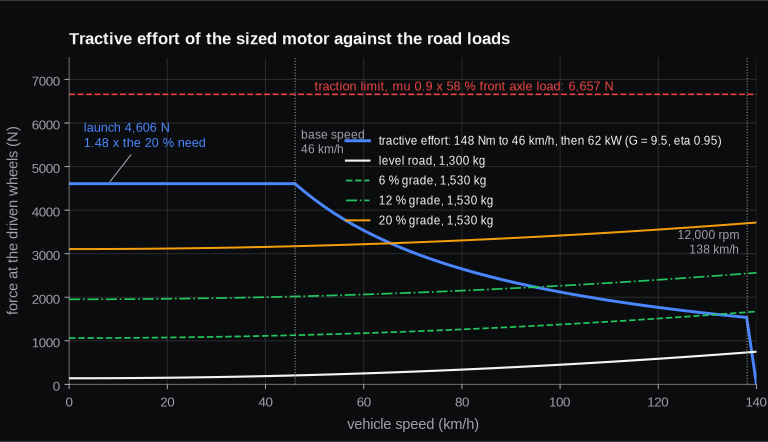
- Gear ratio: window 6.4 to 10.1; chosen 9.5:1, giving 4,606 N at launch against a 6,657 N tyre-grip limit.
- Energy: 117 Wh/km at the battery on the full MIDC with 300 W of auxiliaries and 50 % regeneration; 250 km needs 29.4 kWh usable, 32.6 kWh gross at a 90 % SoC window.
- Pack and inverter: 104 LFP cells of 100 Ah in series: 332.8 V, 33.3 kWh, 1.9 C peak, 0.9 C continuous; 4.6 h for 10-100 % at 7.2 kW AC, about 28 min for 10-80 % at 50 kW DC; 74 kVA inverter.
- Reality check: the Tata Tiago.ev 24 kWh has a 55 kW / 114 Nm PMSM, does 0-60 km/h in 5.7 s and is certified at 285 km (MIDC P1+P2) with a real-world "C75" range of 205-215 km (Tata Motors pages, read 29 Nov 2026). Our car does 0-60 in 5.3 s, and 24 kWh at our 117 Wh/km gives 184 km, inside Tata's own real-world band.
Which vehicle are we sizing, and what are the assumptions?
We size a five-seat B-segment electric hatchback for Indian roads. The targets and parameters below are our own assumptions, chosen to sit close to the Tiago.ev's published dimensions (3,781 × 1,677 × 1,536 mm, 175/65R14 tyres) so that the comparison at the end is fair. Change any of them in the script and the whole chain recomputes.
| Quantity | Value | Why |
|---|---|---|
| Kerb mass (with battery) | 1,150 kg | Assumed; Tata does not publish the Tiago.ev kerb mass on its spec page |
| Sizing mass (two up) | 1,300 kg | Kerb + 150 kg, used for acceleration, top speed and energy |
| Gross mass | 1,530 kg | Kerb + 5 × 68 kg (the per-person figure in AIS-053) + 40 kg luggage, used for gradeability |
| Drag coefficient , frontal area | 0.32, 2.1 m² | width × height = 0.8 × 1.677 × 1.536 = 2.06 m² |
| Rolling resistance | 0.011 | Typical radial car tyre on dry asphalt, kept constant with speed |
| Wheel radius | 0.29 m | 175/65R14: (14 × 25.4 + 2 × 0.65 × 175)/2 = 291.6 mm, about 1 % deflected |
| Air density, gravity | 1.2 kg/m³, 9.81 m/s² | Air at about 20 °C, sea level |
| Rotational inertia factor | 1.05 | Wheels, rotor and gears add about 5 % to the translating mass |
| Gear efficiency | 0.95 | Single-stage reducer plus differential |
| Targets | 130 km/h top speed; 0-100 km/h in 12 s (two up); start on a 20 % grade and hold 60 km/h on 6 % at gross mass; 250 km MIDC range | Our targets for this class |
How do you calculate the road load of an electric vehicle?
Road load is the force the motor must overcome to hold a steady speed: rolling resistance, aerodynamic drag and the gravity component on a slope. With the vehicle mass , speed and road angle (grade ), the standard form used in EV textbooks (Ehsani et al.) is
Accelerating adds the inertia term , and the total is the tractive effort the wheels must deliver. On the level at 1,300 kg the rolling term is a constant N. The drag term grows with : N at 130 km/h (36.1 m/s). The two are equal at 67 km/h; below that, tyres dominate, above it, air does.
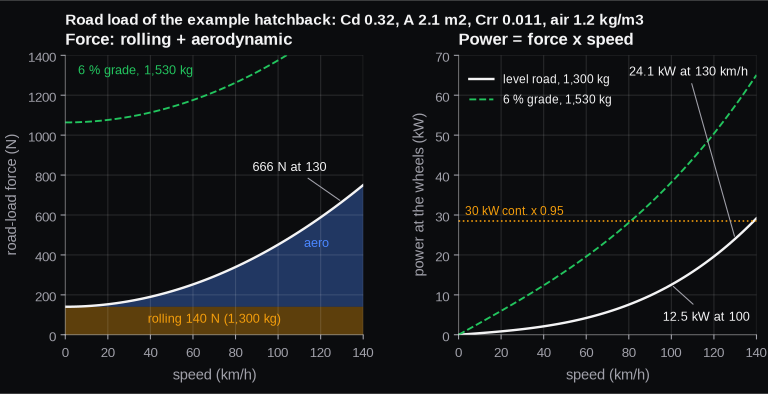
Power at the wheels is , and the motor must supply . The table below is what the script prints; the Skill-Lync EV powertrain sizing calculator does the same arithmetic interactively for any vehicle.
| Speed | Rolling | Aero | Total force | Wheel power |
|---|---|---|---|---|
| 50 km/h | 140 N | 78 N | 218 N | 3.0 kW |
| 100 km/h | 140 N | 311 N | 451 N | 12.5 kW |
| 130 km/h | 140 N | 526 N | 666 N | 24.1 kW |
How much power does an EV need for top speed and gradeability?
Top speed and sustained hill climbing set the continuous rating, because the motor must hold them for minutes without overheating. For this car, 130 km/h needs 24.1 kW at the wheels and kW at the motor; a steady 120 km/h needs 20.6 kW. Holding 60 km/h on a 6 % grade at gross mass needs
with . The largest of these is 25.3 kW, so we choose a 30 kW continuous rating, leaving margin for headwind, tyre pressure and a hot day. With 30 kW the gross-mass car can hold 60 km/h on a 9.6 % grade. For the full treatment of slopes, including what Indian type approval asks of commercial vehicles, see gradeability of commercial vehicles and the gradeability calculator.
How do you size peak motor power from the 0-100 km/h target?
Peak power comes from the acceleration target, not from top speed. The motor is modelled with the usual envelope: constant peak torque up to a base speed , then constant peak power up to maximum speed. Newton's second law with the inertia factor gives the acceleration time as an integral over speed:
where is the gear ratio and the motor speed. The script integrates this with a 10 ms step and bisects on until the 0-100 km/h time equals 12 s: the answer is 61.9 kW with the base speed at 46 km/h. Ehsani's closed-form estimate, which assumes the motor is at peak power for most of the run,
agrees within 1 %. We choose 62 kW peak. Peak torque follows from the base speed: at 4,000 rpm (418.9 rad/s), Nm.
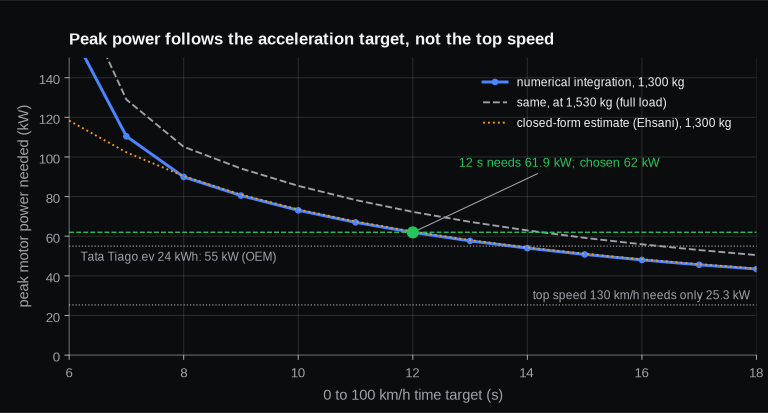
Two checks the same model gives: at gross mass the car takes 14.2 s to 100 km/h, and two up it reaches 60 km/h in 5.3 s. The second number is the one Indian OEMs quote, and we return to it in the comparison.
Continuous vs peak rating: what do the two numbers on a motor spec mean?
Continuous (S1) power is what the motor can deliver indefinitely at its rated cooling; peak (S2, typically 30 or 60 s) is what it can deliver until the windings or the inverter's switches reach their temperature limit. Our 62 kW over 30 kW is a ratio of 2.07, in the usual 2 to 3 range for liquid-cooled traction motors. The MIDC never demands more than 21 kW from the battery, so the motor lives well inside its continuous rating most of the time.
How do you choose the single-speed gear ratio?
A single-speed EV reducer has to satisfy two inequalities at once: low enough that the motor's maximum rpm is not exceeded at top speed, high enough that peak torque can start the loaded car on the steepest grade. The window is
Upper bound: 12,000 rpm is 1,257 rad/s, so . Lower bound: starting on a 20 % grade at 1,530 kg needs N, or 901 Nm at the wheels, so . We choose G = 9.5, nearer the top of the window so that the motor runs at lower torque (and higher efficiency) in traffic. At 130 km/h the motor turns at 11,296 rpm; the rpm-limited top speed is 138 km/h, and the power-limited top speed, where tractive effort meets road load, is also 138 km/h.
Launch torque at the wheels is Nm, a tractive force of 4,606 N, 1.48 times the 20 % grade requirement. Now the traction check: a front-wheel-drive car can only push as hard as the front tyres grip. With on dry asphalt and 58 % of the static weight on the front axle,
Our 4,606 N is below that, so the car does not spin its wheels on a dry road. Load transfer at 3.4 m/s² (centre of gravity 0.55 m, wheelbase 2.40 m) unloads the front axle and the limit falls to 5,752 N, still above the launch force; on a wet road () it would not be, which is why the torque map has a traction-control input. At gross mass the car can start on a 31 % grade.
Which motor type fits: PMSM or induction?
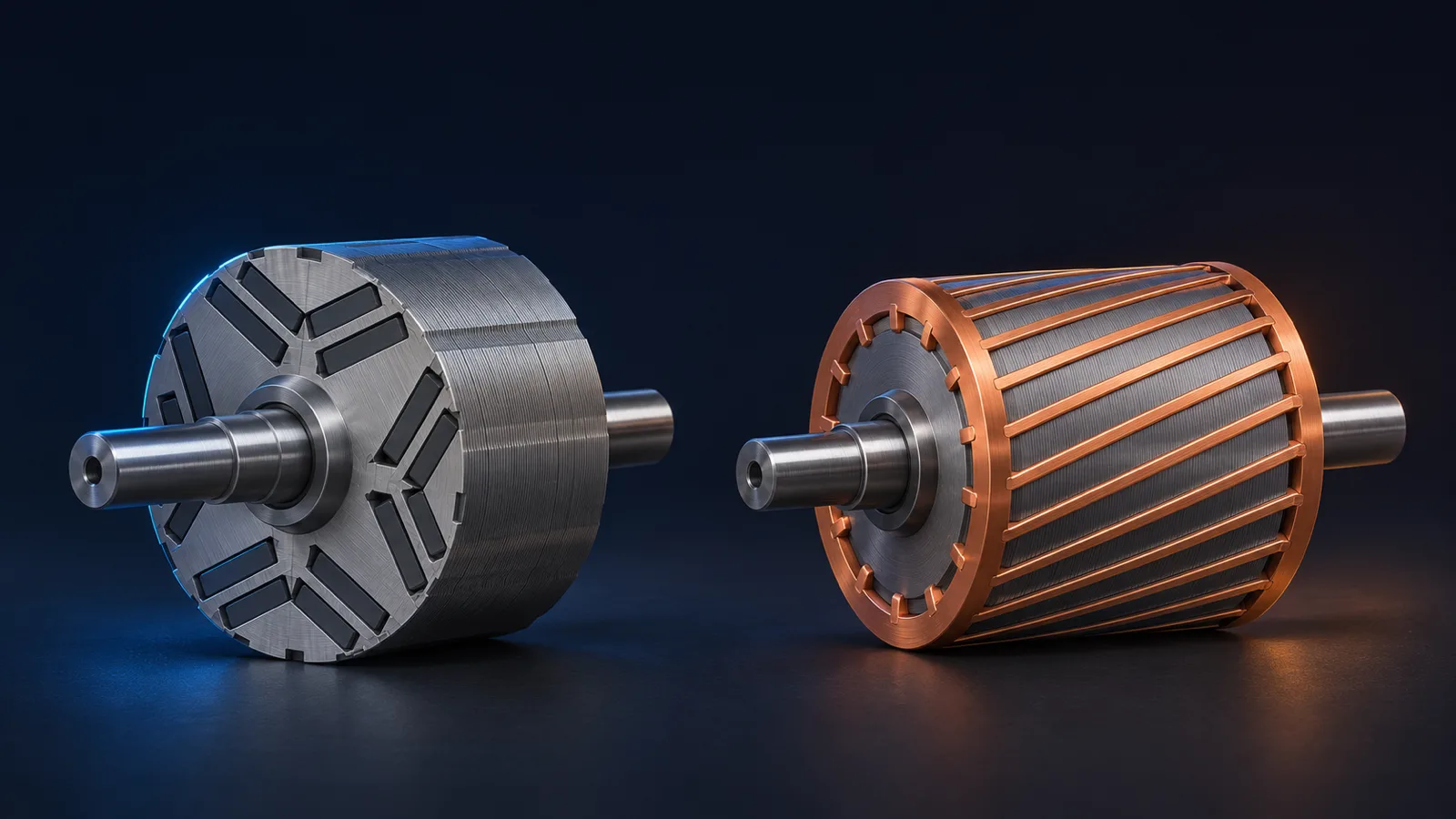
For a 62 kW hatchback the choice is a permanent-magnet synchronous motor, as in the Tiago.ev and nearly every Indian passenger EV: the highest efficiency where this car spends its time (20-60 km/h, light load) and the highest torque per kilogram, at the cost of rare-earth magnets. An induction motor avoids the magnets but is less efficient at part load, and every point of efficiency shows up as battery kWh. The full comparison is in PMSM vs induction motor for EVs; the magnet supply question in rare-earth magnets and Indian EV motors.
How much energy does the car use per km on the MIDC?
Range sizing needs an energy per km, and that depends on how the car is driven, so you need a drive cycle. India's type-approval cycle for cars is the Modified Indian Driving Cycle (MIDC) of CMVR TAP-115/116: four urban cycles of 195 s and 1.013 km each (19 km/h average, 50 km/h top) followed by one extra-urban cycle of 400 s and 6.594 km (59.3 km/h average, capped at 90 km/h), 1,180 s and 10.65 km in all. We ran the cycle second by second through the road-load equation:
with a combined gear, motor and inverter efficiency in both directions, a regeneration share (friction brakes and battery limits take the rest) and W for lights, pumps and 12 V loads with the air-conditioner off. The result is 117.5 Wh/km at the battery, which splits into rolling 41, aerodynamic 37, acceleration 42 and auxiliaries 9 Wh/km, minus 12 Wh/km recovered by regeneration.
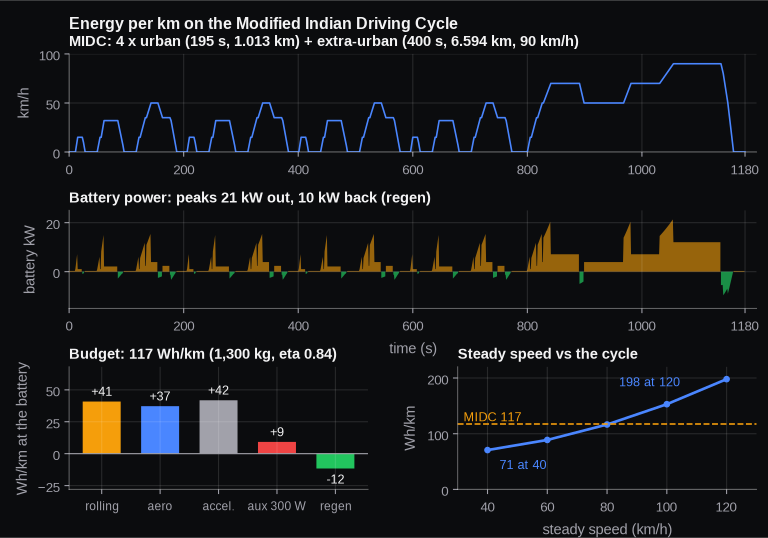
Constant-speed driving is cheaper at town speeds and far dearer on the highway: 71 Wh/km at a steady 40 km/h, 89 at 60, 117 at 80, 153 at 100 and 198 Wh/km at 120 km/h. Two sensitivities worth knowing: switching the regeneration off raises the cycle figure by about 12 Wh/km, and a 1.5 kW air-conditioner adds 46 Wh/km, because at the MIDC's 32.5 km/h average it runs for nearly two minutes per kilometre. The EV range calculator runs the same balance on MIDC, WLTC and the US cycles.
How big must the battery be for a 250 km range?
Usable energy is range times consumption: kWh. The battery cannot be run from 100 % to 0 %: the BMS keeps a window, here 10-100 %, so the usable share is 0.9 and the gross capacity is kWh. (LFP packs are often charged to 100 % because the chemistry tolerates it; an NMC pack would typically keep a narrower window and need a larger gross figure.)
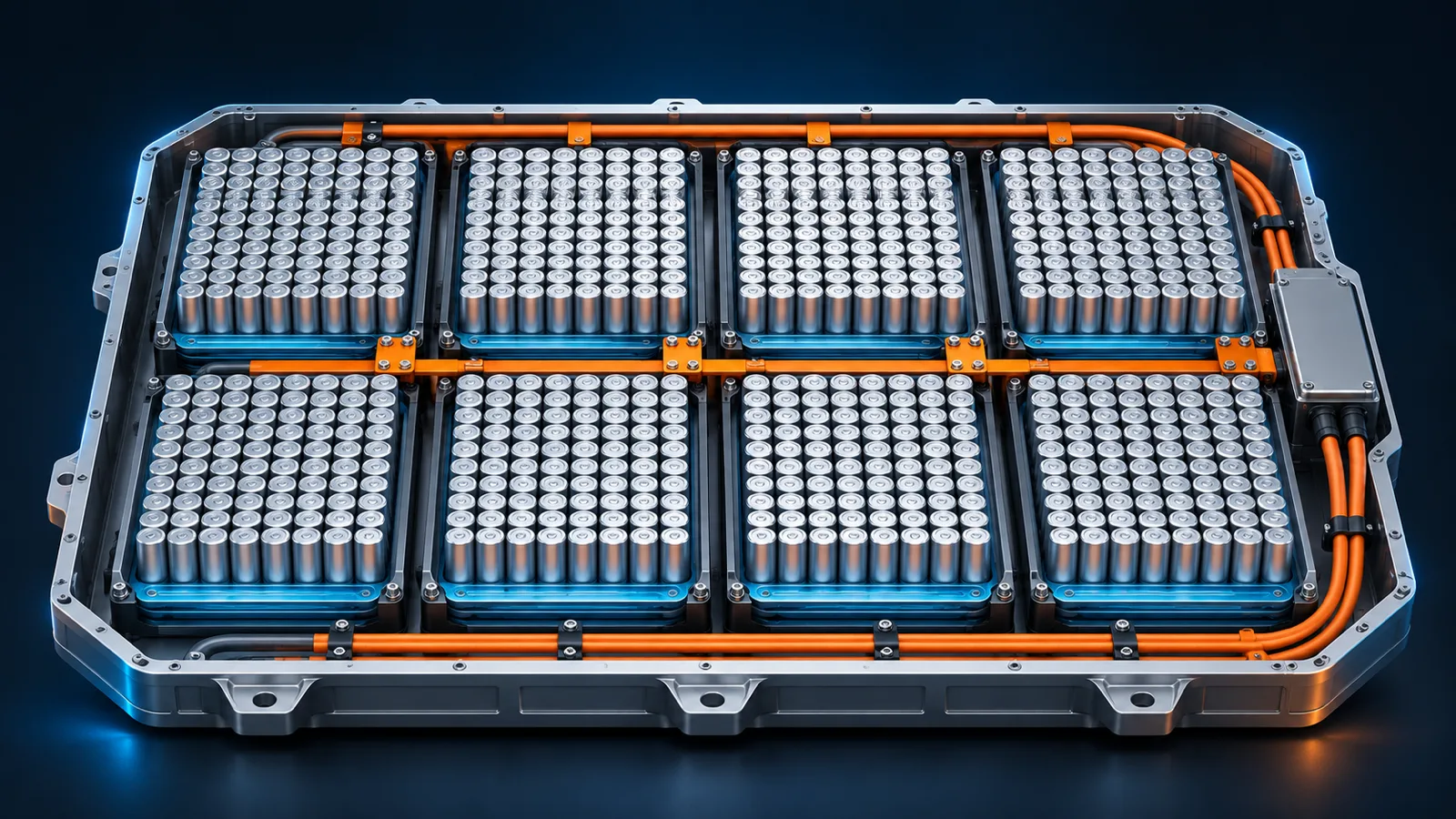
Now choose cells: prismatic LFP, 3.2 V nominal, 2.8 V empty, 3.65 V full, 100 Ah, the format used across Indian passenger EVs. A 96-cell string gives 307.2 V and 30.7 kWh, 27.6 kWh usable, only 235 km at our 117.5 Wh/km. One more module of eight cells, 104S1P, gives 332.8 V nominal (291 V empty, 380 V full), 33.3 kWh gross, 30.0 kWh usable and 255 km. At a pack-level 7 kg/kWh that is about 233 kg of battery, already inside the kerb mass assumption; a proper design loops once more with the new mass. Series and parallel counts, modules and cooling are worked through in battery pack design: an EV worked example; chemistry in LFP vs NMC; the battery pack calculator gives S × P for any kWh and voltage.
Pack voltage, current and C-rate: can the cells deliver the power?
Current is power over voltage, and the pack sees the motor's power divided by the inverter efficiency (0.97 at peak). At 332.8 V nominal:
At the empty-pack voltage of 291 V the peak current rises to 219 A, the number the fuse, contactors and busbars are sized for. A 1.9 C, 30-second pulse and a 0.93 C continuous draw are modest for a 100 Ah prismatic LFP cell, but the cell datasheet is the authority, and the BMS must derate the inverter when the pack is cold or near empty. On the MIDC the average current is only about 0.1 C, so the cooling system is really sized for DC fast charging and repeated hill climbs.
How long does charging take at 7.4 kW AC and 50 kW DC?
AC charging is limited by the on-board charger. For a 7.2 kW charger (Tata's home fast-charger figure; a 32 A single-phase supply gives 7.4 kW) at 90 % efficiency, 10-100 % on the 33.3 kWh pack takes h (4.5 h at 7.4 kW); a 3.3 kW charger needs about 10 h. The pack-side current is only 0.21 C. DC fast charging bypasses the on-board charger: 10-80 % is 23.3 kWh, which a steady 50 kW would deliver in 28 minutes at 1.5 C. Real sessions taper at high SoC and cell temperature, so the OEM figure is always longer: Tata's 2022 release quoted 57 min for 10-80 % on the 24 kWh Tiago.ev, an average of 17.7 kW, and its 2026 page says "adds 100 km in 18 minutes" on the faster-charging version.
What inverter rating does the motor need?
The traction inverter is rated in kVA at its DC voltage range and in phase current. Apparent power is the motor's input power over its power factor:
With space-vector PWM the maximum line-to-line voltage is about , so at the empty-pack 291 V the inverter can make 206 V rms, and the phase current for 74 kVA is A rms, about 294 A peak. A production choice would be an 80 kVA unit with 300 A class SiC or IGBT modules, a DC link rated for 250-420 V and liquid cooling shared with the motor; at 97 % efficiency it rejects about 2 kW at peak. Skill-Lync's traction inverter hardware design course covers the device and DC-link selection that follows, and the EV powertrain component sizing course does the whole chain in Simulink.
How does the result compare with a real Indian EV?
The Tata Tiago.ev is the closest production car to our assumptions. Its specification page (read 29 Nov 2026) lists a 55 kW / 114 Nm permanent-magnet synchronous motor for the 24 kWh pack (45 kW / 110 Nm for the 19.2 kWh pack, and a 48 kW / 114 Nm variant), 0-60 km/h in 5.7 s (6.2 s for the 19.2 kWh), 175/65R14 tyres and a 3.3 kW AC charger with a 7.2 kW option. Its product page states an ARAI-certified 285 km (MIDC P1+P2) for the 24 kWh pack and a real-world "C75" range of 205-215 km. The 2022 launch release quoted 315 km MIDC, 3 h 36 min for 10-100 % at 7.2 kW and 57 min for 10-80 % DC.
| Item | Our sized car | Tata Tiago.ev 24 kWh (OEM) | Comment |
|---|---|---|---|
| Peak motor power | 62 kW | 55 kW | Our 12 s 0-100 target is a little quicker than the car |
| Peak torque | 148 Nm | 114 Nm | Tata's implied base speed is 55,000/114 = 482 rad/s, 4,600 rpm, versus our 4,000 rpm |
| 0-60 km/h | 5.3 s (two up) | 5.7 s | Within 0.4 s, consistent with the power difference |
| Battery | 33.3 kWh for 250 km at 117 Wh/km | 24 kWh; 285 km certified, 205-215 km C75 | 24 kWh at our 117 Wh/km gives 184 km usable; Tata's certified figure implies 84 Wh/km of gross capacity, its C75 figure about 114 Wh/km |
| 7.2 kW AC, 10-100 % | 4.6 h | 3 h 36 min (2022 release) | Our pack is 39 % larger; the per-kWh rate matches (3.3 h for 24 kWh by our method) |
| DC 10-80 % | 28 min at a steady 50 kW | 57 min (2022); "100 km in 18 min" (2026) | Charging power, not the pack, sets this |
The method lands in the right ballpark on every line that depends on physics: power, torque, acceleration, AC charging rate. The one large gap is range, and it is a gap between test conditions, not in the method: a certification test runs at reference mass with auxiliaries off, while our 117 Wh/km includes a passenger, 300 W of auxiliaries and only 50 % regeneration. Rerun the script at kerb + 100 kg with no auxiliaries and 60 % regeneration and the cycle figure drops to 103 Wh/km; on the urban part alone, which Indian certification used until the 2024 switch to P1+P2 (Autocar Professional, 3 Sep 2024), it is 87 Wh/km, within 4 % of Tata's certified 84. Size the battery for the number your customers will see.
Where does this worked example simplify?
- Constant efficiencies. A real motor-inverter map varies from under 70 % at low torque and speed to about 95 % near its sweet spot; the 0.88 cycle average is a reasonable B-segment figure but should come from the supplier's map.
- Battery voltage and derating. We used nominal voltage for currents; a full state-of-charge and temperature model (and the cell datasheet's pulse limits) decides the real power available at 10 % SoC on a cold morning.
- Mass loop. The pack mass depends on the kWh, which depends on the Wh/km, which depends on the mass. One more pass with the 233 kg pack closes the loop; the range calculator iterates it automatically.
Even so, this arithmetic is what a powertrain engineer does in the first week of a concept study, and what interviewers ask you to reproduce on a whiteboard. Skill-Lync's Master's in electric vehicle design and development takes a vehicle like this through Simulink modelling, motor control and battery design.
Frequently asked questions
How do you calculate the motor power required for an electric vehicle?
Take the largest of three numbers: the road-load power at top speed divided by the gear efficiency (25.3 kW for our 1,300 kg car at 130 km/h), the power to hold the required grade at speed (20.6 kW for 6 % at 60 km/h, gross mass), and the peak power that meets the acceleration target (61.9 kW for 0-100 km/h in 12 s). The first two set the continuous rating, the third the peak.
How do you calculate the gear ratio of an EV?
Bound it from both sides. The upper limit is motor maximum speed times wheel radius over top speed (12,000 rpm and 0.29 m at 130 km/h give 10.1); the lower limit is the start-up force on the steepest grade times wheel radius over peak torque and gear efficiency (3,105 N, 148 Nm and 0.95 give 6.4). Pick a value in the window, then check launch force against the tyre-grip limit.
How many kWh does an EV battery need for a given range?
Multiply the range by the energy per km on the drive cycle your customers will see, then divide by the usable share of the pack. 250 km at 117.5 Wh/km is 29.4 kWh usable; with a 10-100 % window that is 32.6 kWh gross. Using a certification figure such as 84 Wh/km would undersize the pack by about a third for real driving.
What is a good Wh/km for an electric car in India?
Our model gives 117 Wh/km at the battery for a 1,300 kg hatchback on the full MIDC with 300 W of auxiliaries, and 157 Wh/km with a 1.5 kW air-conditioner running. Tata's own real-world C75 figure for the Tiago.ev 24 kWh (205-215 km) implies about 114 Wh/km, while its certified 285 km implies 84 Wh/km. Highway driving at 120 km/h costs about 200 Wh/km.
Why is peak power so much higher than the power needed for top speed?
Because acceleration stores kinetic energy quickly while top speed only has to overcome drag. Bringing 1,300 kg (1,365 kg with rotating parts) to 100 km/h stores 527 kJ; doing it in 12 s is 44 kW of kinetic power alone, before road load. Holding 130 km/h needs just 24 kW at the wheels. That is why a 62 kW motor has a 25 kW top-speed requirement.
Sources and further reading
- Tata Motors, Tiago.ev specifications (battery packs 19.2 and 24 kWh, PMSM 45 kW/110 Nm, 55 kW/114 Nm and 48 kW/114 Nm, 0-60 km/h in 6.2 s and 5.7 s, 175/65R14, dimensions, 3.3 kW AC charger box). Read 29 Nov 2026.
- Tata Motors, Tiago.ev product page ("ARAI Certified full charge range of 285 km (P1+P2), real world C75 range of ~205-215 km", "adds 100 km in just 18 mins" for the 24 kWh pack). Read 29 Nov 2026.
- Tata Motors press release, 28 Sep 2022, Get ready to go EV with Tiago.ev (55 kW / 114 Nm, 315 km MIDC for 24 kWh and 250 km for 19.2 kWh, 0-60 km/h in 5.7 s, 7.2 kW AC 10-100 % in 3 h 36 min, DC 10-80 % in 57 min). Accessed 29 Nov 2026.
- MoRTH / CMVR / TAP-115/116 (Issue 4), Part 14 Chapter 3, Type I test: operating cycle on the chassis dynamometer, Tables II, II-A, III and III-A (urban cycle 195 s, 1.013 km, 19 km/h average; extra-urban 400 s, 6.594 km, 59.3 km/h average, 90 km/h maximum). ARAI, accessed 29 Nov 2026.
- Autocar Professional, 3 Sep 2024, Tata announces revised ranges for its EVs, based on new MIDC tests (ranges now declared on urban plus extra-urban cycles; average test speed from 19 to 31 km/h; Tata's C75 definition). Accessed 29 Nov 2026.
- Ehsani, M., Gao, Y., Longo, S. and Ebrahimi, K., Modern Electric, Hybrid Electric, and Fuel Cell Vehicles, 3rd ed., CRC Press, 2018, doi:10.1201/9781420054002 (road-load equation, rotational inertia factor, acceleration-time integral and the closed-form peak-power estimate).
- Skill-Lync, EV powertrain sizing calculator, EV range calculator (MIDC trace per CMVR TAP-115/116), gradeability calculator and battery pack calculator, 2026.
- Skill-Lync engineering desk, 29 Nov 2026: sizing.py and figures.py (Python, NumPy, Matplotlib) in the post's run folder; every number and figure above comes from these scripts and the assumptions table.