Core vs IT Jobs for Mechanical Engineers: Pay, Growth and Job Security
Starting offers in core and IT roles are closer than you think: 3.0-3.5 LPA median for core mechanical fields and 3.6-3.8 LPA for software and data in 3,711 Skill-Lync placement records (snapshot 15 Nov 2026). The gap opens after five years. Here is the pay, hiring growth and job-security picture, the hybrid roles in between, and a decision table by situation.

For a mechanical engineering fresher in India, core and IT jobs start closer in pay than most people think. In Skill-Lync's placement records, median starting offers were 3.0 to 3.5 lakh a year in core mechanical fields and 3.6 to 3.8 lakh in software and data roles. Salary sites show a wider gap that grows with experience. On AmbitionBox, the "Software Engineer" title averages more than twice the "Mechanical Engineer" title at 1-3 years, and "Technical Lead" about three times it at 6-9 years. Hybrid roles such as embedded, PLM and CAE automation sit in between and still use your degree.
In short
- Skill-Lync placement records (snapshot 15 Nov 2026): median starting offer 3.5 LPA for design (n = 1,463), 3.2 for CAE/FEA (n = 456), 3.5 for CFD (n = 240). Software was 3.8 LPA (n = 54) and data science 3.6 (n = 174).
- The difference is at the top, not the middle. One in ten software placements was at 7.0 LPA or more, against 5.0 LPA for design.
- Embedded had the highest median of any large group in our records: 4.0 LPA (n = 278). It is a hybrid field open to mechanical graduates who learn C or Simulink.
- Third-party data, 1-3 years' experience (AmbitionBox, viewed 21 Nov 2026): "Mechanical Engineer" ₹3.2-3.6 lakh, "Software Engineer" ₹7.5-8.3 lakh. At 6-9 years: mechanical engineer ₹5.7-6.3 lakh, technical lead ₹18.3-20.2 lakh, PLM consultant ₹13.7-15.7 lakh.
- Demand in October 2026 (Naukri JobSpeak, year on year): auto hiring +36%, industrial products and heavy machinery +32%, IT software and services +5%.
This guide is for mechanical, automobile and production graduates in India deciding between a core engineering job and an IT or software job, in final year or in the first few years of work. It compares pay at entry and after 5-10 years, growth in hiring, job security and the hybrid roles that use both skill sets, then ends with a decision table. It does not promise a job or a salary. For the roles themselves, read mechanical engineering jobs for freshers. For the job hunt, see how to get a core mechanical job after graduation.
About the numbers. Based on 3,711 Skill-Lync placement records up to 7 Nov 2026 (data snapshot of 15 Nov 2026). This is a starting point; we will update it as new placements come in. These are Skill-Lync learners who reported a placement, not the whole job market. Most records are starting offers from 2021 to 2023. Recent years are thin: 338 records from 2024, 52 from 2025 and 30 from 2026. Groups with fewer than 10 people are left out, and every figure shows its sample size (n). Salaries are in lakh per annum (LPA) as reported.
Can our data separate core from IT? Only partly, and it is better to say so up front. The file groups placements by the Skill-Lync programme a learner took (design, CAE, embedded, software, data science and so on), not by their degree. So we cannot isolate mechanical graduates. The IT side is also small. Software and data science together are 228 of 3,711 records (6%), and the software group has just 54. Fresher and experienced offers are only split for the whole file, not by domain. What the file does show well is the pay of core mechanical programmes against hybrid and software ones at the start of a career. Where it is silent, we use third-party data, labelled as such.
Which pays more for a mechanical fresher: core or IT?
At the start, the gap is small. In Skill-Lync's placement records, core mechanical programmes had median offers of 3.0 to 3.5 LPA. Software and data science had 3.8 and 3.6 LPA. The bigger difference is in the upper tail. The best 10% of software offers started at 7.0 LPA or more, against 5.0 for design. On salary sites, fresher software pay looks much higher, partly because they include software engineers at product companies and banks.
| Group | Programme domain | Median offer | Middle half | Top 10% from | n |
|---|---|---|---|---|---|
| Core mechanical | Design (CAD) | 3.5 LPA | 3.0-4.4 | 5.0 | 1,463 |
| CAE / FEA | 3.2 LPA | 2.8-4.0 | 4.75 | 456 | |
| CFD | 3.5 LPA | 2.81-4.5 | 5.6 | 240 | |
| Mechanical (other) | 3.0 LPA | 3.0-3.5 | 4.0 | 54 | |
| Hybrid | EV | 3.5 LPA | 3.4-4.5 | 6.0 | 452 |
| Embedded | 4.0 LPA | 3.5-5.0 | 5.81 | 278 | |
| MBD | 5.0 LPA | 4.25-5.0 | 6.1 | 25 | |
| IT / software and data | Data science | 3.6 LPA | 3.0-4.26 | 5.38 | 174 |
| Software | 3.8 LPA | 3.3-4.53 | 7.0 | 54 |
Skill-Lync placement records, snapshot 15 Nov 2026. "Middle half" is the 25th to 75th percentile; "top 10% from" is the 90th percentile. Groups are by programme taken, not by degree.
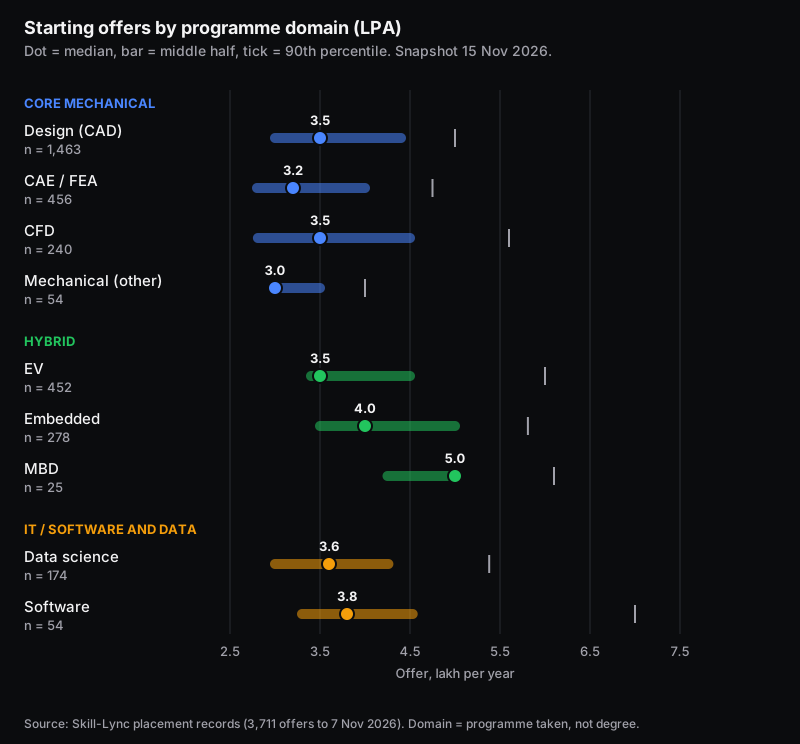
Three things stand out. First, the middles overlap. Design's middle half (3.0-4.4 LPA) almost covers software's (3.3-4.53). Second, the software group has a longer tail. Its 90th percentile is 7.0 LPA, the highest of any domain with more than 25 records. By job title, the 49 "software / test engineer" placements across all programmes had a median of 4.2 LPA and a 90th percentile of 8.0. Third, the hybrid groups pay at least as well as pure software at the start. Embedded has the highest median of any group with more than 25 records (4.0 LPA). MBD's 5.0 LPA median comes from only 25 people, so treat it as a hint, not a rule.
One more detail shows how blurred the line is. The top hirers of our software-programme learners were TCS (5 placements), Ashok Leyland (3) and Infosys (3). Ashok Leyland is a truck and bus maker, not an IT firm. A lot of "IT" work for mechanical graduates is software inside engineering companies.
What do salary sites say about fresher pay?
Self-reported salaries on AmbitionBox put the IT start higher than our records do, as the next table shows. Two reasons explain most of the gap. AmbitionBox's "software engineer" title covers everyone with that title, including those at software product companies and financial services firms, which its page lists among the best-paying industries. Our software group is small (54 records). It comes from learners who took a Skill-Lync software programme, often to change field, and its top hirers were services firms and an automaker. Read the two sources together. Our data shows what field-changers were actually offered, and the salary site shows the wider market.
| Job title (AmbitionBox) | Average range, 1-3 years | Salaries behind the page |
|---|---|---|
| Mechanical Engineer | ₹3.2-3.6 lakh | 59.5k |
| Design Engineer | ₹3.8-4.2 lakh | 1.4 lakh |
| CAE Engineer | ₹4.3-4.7 lakh | 4.8k |
| Data Analyst | ₹5.2-5.7 lakh | 1.5 lakh |
| Associate Software Engineer | ₹5.2-5.7 lakh | 1.1 lakh |
| Embedded Software Engineer | ₹5.4-5.9 lakh | 12.7k |
| Software Engineer | ₹7.5-8.3 lakh | 7.5 lakh |
Third-party data: AmbitionBox job-title pages, viewed 21 Nov 2026 (pages updated 15-21 Nov 2026). These are averages of self-reported salaries, not offers, and the "mechanical engineer" title includes plant, maintenance and site roles.
How does pay compare after 5 to 10 years?
This is where IT pulls ahead. On AmbitionBox, the "Mechanical Engineer" title averages ₹5.7-6.3 lakh at 6-9 years and ₹6.9-7.7 lakh at 9-12 years. At the same bands, the "Technical Lead" title, a common senior title in software teams, averages ₹18.3-20.2 lakh and ₹21.5-23.8 lakh. PLM consultants, a hybrid role, reach ₹13.7-15.7 lakh at 6-9 years.
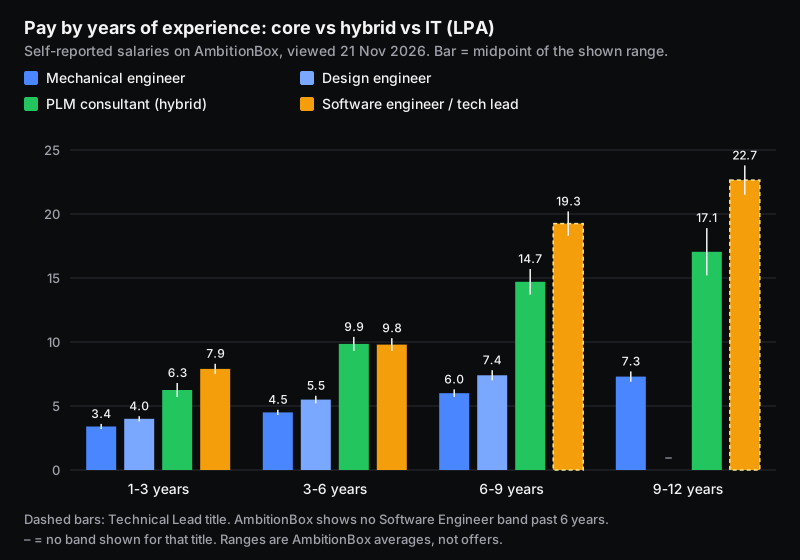
Be careful with this chart. It compares job titles, not people. A mechanical engineer who is promoted becomes a "senior engineer", "lead" or "manager", and leaves the "mechanical engineer" title. So the title's averages at 9-12 years partly reflect people who were not promoted. The nearest like-for-like comparison is the senior titles. AmbitionBox shows "Senior Mechanical Engineer" at ₹10.6-11.7 lakh (4-17 years, 878 salaries) against ₹20.3-22.4 lakh for "Technical Lead" (6-13 years). The gap shrinks from about 3.2 times to about 1.9 times, but it is still large.
The IT side has its own split. AmbitionBox's software engineer average is ₹7.2-8.0 lakh in IT services and consulting, against ₹12.6-13.9 lakh in software product companies. AmbitionBox has about 4.1 lakh software engineer salaries from IT services against 61.8k from product companies, so the services figure is the more typical one.
What about Skill-Lync's own records? Across all domains, experienced hires had a median offer of 4.5 LPA (n = 444), against 3.5 LPA for freshers (n = 2,430). The middle half for experienced hires was 3.5-6.0 LPA, and the top 10% started at 8.0. The file's own caveat is that most records are starting or early-career offers, and it does not split experienced offers by domain, so it cannot answer the 10-year question by itself.
Worked example: how fast does pay grow?
One way to compare growth is the implied yearly growth rate between two experience bands. Take the midpoint of each band's AmbitionBox range. The 1-3 year band is centred near 2 years and the 9-12 year band near 10.5 years, so they are years apart:
Mechanical engineer title, ₹3.4 lakh at 1-3 years to ₹7.3 lakh at 9-12 years:
Software engineer at 1-3 years (₹7.9 lakh) to technical lead at 9-12 years (₹22.65 lakh):
The PLM consultant title grows from ₹6.25 lakh to ₹17.05 lakh over the same bands, about 12.5% a year. So the hybrid role grows at close to the IT rate.
Two cautions. These are snapshots of different people at different stages, not one person's career. And the IT line mixes two titles. But the ratio matters more than the exact rate. Over those 8.5 years, the first rate multiplies pay by about 2.1 and the second by about 2.9. That compounding gap, not the first offer, is the real money question.
Which is growing faster: core or IT hiring?
Right now, core engineering hiring is growing faster. Naukri's JobSpeak index for October 2026 shows auto and auto ancillary hiring up 36% from a year earlier, and industrial products and heavy machinery up 32%. IT software and services rose only 5%. October 2025 was a weak, festive-season month, which inflates every year-on-year figure, so read the ranking more than the size.
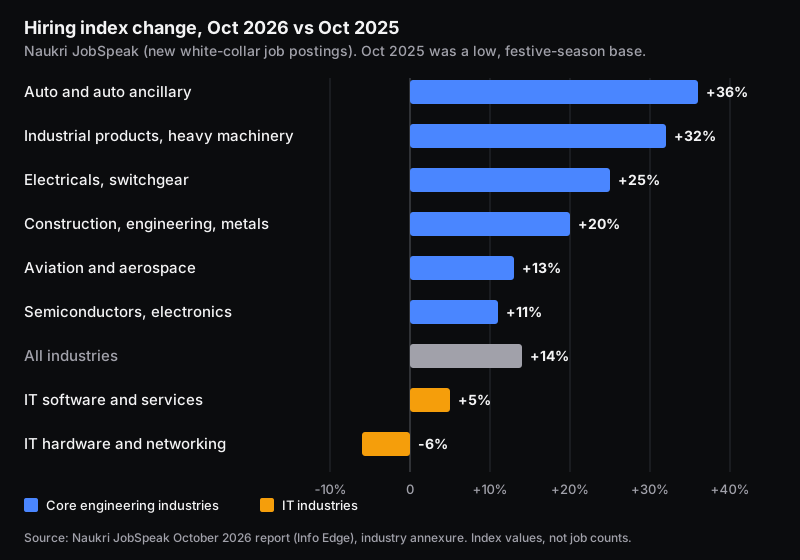
Our October 2026 engineering jobs analysis covers the base effect in detail. Against October 2024, auto is up about 17% and overall hiring about 4%: smaller numbers, but auto still leads.
The longer-run picture is mixed, not one-sided:
- The tech industry is still big but slower. Nasscom's Annual Strategic Review (24 Feb 2026) estimates India's tech industry revenue at USD 315 billion in FY26, up 6.1%, with headcount up about 2.3%. Headcount grew at well under half the rate of revenue, in a year Nasscom describes as AI moving into scaled use.
- Engineering R&D is a fifth of that industry. Of the USD 315 billion, USD 63 billion is ER&D (engineering research and development services) and USD 149 billion is IT services. ER&D is where design, CAE, embedded and PLM work for car, aircraft and machinery makers sits. In other words, a large share of "tech" jobs are engineering jobs.
- Factory employment is rising. The government's Annual Survey of Industries (press note of 30 Sep 2026) estimates persons engaged in registered manufacturing grew from 1.96 crore in 2023-24 to 2.10 crore in 2024-25, up 7.19%. That counts all factory staff, not only engineers, and it covers an earlier year than the Nasscom figure.
Is a core mechanical job more secure than an IT job?
Neither is guaranteed; the risks are different. IT headcount moves with client demand and can fall fast. TCS's headcount fell about 5% in six months in 2025, then partly recovered. Core jobs move with manufacturing cycles, are tied to a plant or city, and many freshers start on project work at engineering services firms. PSU jobs are generally the most stable, but selection is competitive.
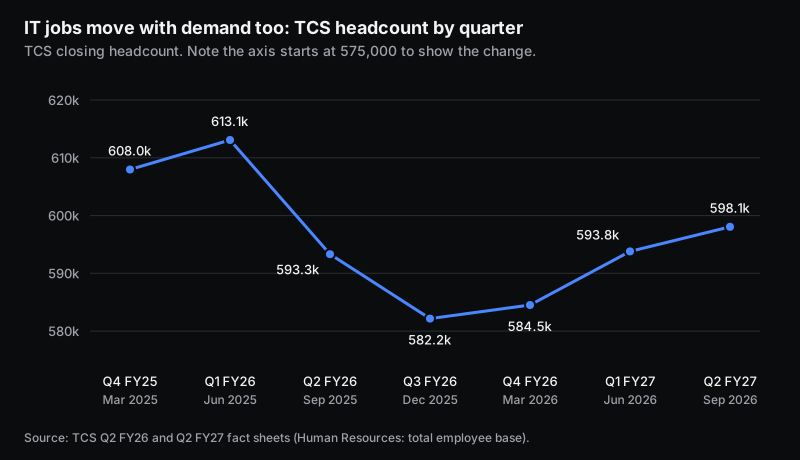
The TCS numbers come from the company's own quarterly fact sheets. Headcount fell from 613,069 in June 2025 to 582,163 in December 2025, a drop of 30,906 (5.0%). The September 2025 quarter also carried a one-off restructuring charge of ₹1,135 crore. By September 2026 the count was back to 598,056, up 15,893 from the low. The lesson is not that IT is unsafe. It is that even the biggest IT employers resize quickly when demand shifts.
Core jobs carry different risks:
- Cycles. Auto and capital-goods hiring follows vehicle sales and factory investment. It is strong in late 2026, as the JobSpeak figures above show, but it rises and falls with those cycles.
- Who employs you. In our records, most fresher design placements were at engineering services firms. These firms staff projects for OEMs (original equipment manufacturers, such as car and aircraft makers), so your work depends on their contracts. Among the 25 biggest hirers of Skill-Lync's design learners, services firms took 78% of placements (see our role map).
- Location. Plant, site and testing roles tie you to an industrial cluster.
- PSU route. Public-sector jobs through GATE or a company exam are generally the most stable, but selection is competitive and exam-driven. Our PSU recruitment guide tracks which ones still use GATE.
In both sectors, what protects you is a skill that is hard to replace. Repetitive work, such as manual meshing or manual testing, is the easiest to automate in either sector. An engineer who understands the physics and can automate the work is much harder to replace.
Which jobs use a mechanical degree and coding together?
Hybrid roles pay closer to software over time while still using what you learned in mechanical engineering. The main ones are CAE automation, embedded and model-based development (MBD), PLM (product lifecycle management), EV and simulation software, and engineering data analysis. In our records, embedded (4.0 LPA) and MBD (5.0 LPA, small sample) started above every pure core domain.
| Hybrid role | What you do | Skill-Lync data (snapshot 15 Nov 2026) | Third-party (AmbitionBox, 21 Nov 2026) |
|---|---|---|---|
| CAE automation / methods engineer | Write Python or Tcl scripts that drive meshing and post-processing tools such as HyperMesh, so repetitive set-up work becomes a script | Not a separate group; CAE domain median 3.2 LPA (n = 456) | CAE Engineer: ₹4.3-4.7 lakh (1-3 yrs), ₹6.0-6.7 lakh (3-6 yrs) |
| Embedded / MBD engineer | Build control logic in Simulink or C for ECUs (a vehicle's embedded computers); mechanical graduates bring plant and vehicle-dynamics knowledge | Embedded 4.0 LPA (n = 278); MBD/controls role 3.5 (n = 118); MBD domain 5.0 (n = 25) | Embedded Software Engineer: ₹5.4-5.9 lakh (1-3 yrs), ₹7.7-8.5 lakh (3-6 yrs) |
| PLM engineer / consultant | Configure and customise systems such as Siemens Teamcenter, PTC Windchill or Dassault ENOVIA that hold a product's CAD data, parts lists and engineering changes | No group in our records | PLM Consultant: ₹5.7-6.8 lakh (1-3 yrs) to ₹15.2-18.9 lakh (9-12 yrs); 509 salaries only |
| EV systems and software test | Model batteries and motors, write and run test cases for vehicle software | EV domain 3.5 LPA (n = 452), top 10% from 6.0; EV software/test role 4.5 (n = 17) | Not compared |
| Engineering data analyst | Clean and analyse test, quality or plant data in SQL and Python, build dashboards | Data science 3.6 LPA (n = 174) | Data Analyst: ₹5.2-5.7 lakh (1-3 yrs), ₹7.2-7.9 lakh (3-6 yrs) |
Who hires for these roles? In our records, the top embedded hirers were Cyient, Nexteer Automotive, Expleo and Tata Technologies. The only employer with three or more MBD-programme placements was Expleo (12 of 25). The top data-science hirers were NielsenIQ, RNTBCI (Renault Nissan Technology and Business Centre India) and Kabira Mobility. Apart from NielsenIQ, a market-research firm, these are engineering and vehicle companies hiring people who can code, not IT companies.
The common thread is scripting. Altair documents both a Tcl and a Python interface for HyperMesh. MBD control logic is built as Simulink models, and PLM systems are configured and extended with code. Our guide to Python for mechanical engineers shows four scripts of the kind these jobs use. Skill-Lync's CAE automation program, embedded systems courses and MATLAB and Simulink courses teach the hybrid skills directly. For full pay breakdowns, see the embedded engineer, MBD engineer and data analyst salary pages.
Should I choose core or IT? A decision table
Choose by the work you want to be doing in year five, not by the first offer. The first-offer gap is small for most mechanical graduates. The growth gap is large, and hybrid roles close much of it. Use the table to match your situation to a direction and a concrete first step.
| Your situation | Lean towards | Why | First step |
|---|---|---|---|
| You enjoy design or analysis and have (or can build) CAD/CAE projects | Core: design, CAE, CFD | Largest fresher market in our data (1,463 design records); entry pay similar to IT for career-switchers | Finish two projects in the tool your target employer uses; check design engineer pay |
| You like programming and want the highest pay ceiling | IT / software | Long-run pay is highest (technical lead ₹18.3-23.8 lakh at 6-12 years, AmbitionBox), but you compete with computer science graduates | Data structures, one language in depth, a deployed project; see high-paying IT jobs |
| You want to keep your degree useful and still earn close to software over time | Hybrid: embedded, MBD, PLM, CAE automation | Best-paid engineering starts in our records; PLM grows at close to IT rates | Python or C plus one engineering tool (HyperMesh, Simulink, a PLM system) |
| You want a government or PSU job | Core, through GATE or company exams | Generally the most stable route; competitive and exam-driven | PSU recruitment through GATE |
| You plan an MS in mechanical engineering abroad | Core or hybrid | Design, simulation or controls work connects directly to a mechanical MS application | Pick a role with project work you can describe in a statement of purpose |
| You are in IT now and want to move back to core | Hybrid first | PLM, CAE automation and embedded value both your coding and your degree, so you don't restart as a fresher | Build one engineering project with a script in it |
| Final semester, no offer yet | Whichever offer gives real work | The first job matters less than the skills and projects you build in it | Apply to both; see companies hiring freshers |
If you are still unsure, book a free counselling call with Skill-Lync and talk through your projects and options before you commit to a direction.
Frequently asked questions
Is IT better than core for mechanical engineers?
Not at the start, and not for everyone. In Skill-Lync's records, starting offers were close: 3.5 LPA median for design and 3.8 LPA for software (snapshot 15 Nov 2026). IT pays much more after five years on AmbitionBox, but you compete with computer science graduates. Hybrid roles like embedded and PLM give much of that growth while using your degree.
Can a mechanical engineer get an IT job as a fresher?
Yes. Skill-Lync's software-programme learners were placed at TCS and Infosys, and at engineering firms such as Ashok Leyland (snapshot 15 Nov 2026). Prepare for aptitude and coding rounds and basic data structures. A small project you built and can explain counts for more than a list of certificates.
Which core field pays best for a mechanical fresher?
In Skill-Lync's placement records (snapshot 15 Nov 2026), CFD and design both had a median of 3.5 LPA, with CFD offers spreading higher (top 10% from 5.6 LPA). Embedded (4.0 LPA, n = 278) and MBD (5.0 LPA, only 25 records) paid more, but they are hybrid fields that need programming. The employer often matters as much as the field; the salary pages show offers by company.
Can I switch from IT back to core after two years?
Yes. A direct move into an entry-level design job can mean starting over on pay, so the smoother path is usually a hybrid role that values your coding: PLM, CAE automation, embedded testing or engineering data. Keep one engineering tool current while in IT, and build a project that uses it. Your IT experience then counts instead of being written off.
Do mechanical engineers need to learn coding?
For most growth paths, yes, even in core jobs. CAE teams automate meshing with Python or Tcl, controls engineers work in MATLAB and Simulink, and PLM systems are customised with code. You don't need to become a software developer. Enough Python to automate one repetitive task is a practical edge for a fresher.
Sources and further reading
- Skill-Lync placement records, data snapshot of 15 Nov 2026 (3,711 records up to 7 Nov 2026): medians, percentiles and top hirers by programme domain and role. Live views: recent placements, salary pages, mechanical engineer salary, companies hiring mechanical freshers, companies hiring embedded freshers.
- AmbitionBox (Info Edge), job-title salary pages for Mechanical Engineer, Software Engineer, Technical Lead, Senior Mechanical Engineer, Design Engineer, CAE Engineer, Embedded Software Engineer, PLM Consultant, Data Analyst and Associate Software Engineer (viewed 21 Nov 2026; pages updated 11-21 Nov 2026).
- Info Edge, Naukri JobSpeak, October 2026: industry annexure index values, October 2025 and October 2026 (read 21 Nov 2026).
- Nasscom, Annual Strategic Review 2026 press release, 24 Feb 2026: revenue, segment split and headcount growth.
- Tata Consultancy Services, Q2 FY27 fact sheet (8 Oct 2026) and Q2 FY26 fact sheet (9 Oct 2025): closing headcount by quarter and restructuring charge.
- Ministry of Statistics and Programme Implementation, Press note on Annual Survey of Industries 2024-25, 30 Sep 2026: persons engaged in registered manufacturing.
- Altair, HyperMesh Python API and Tcl command reference.
- PLM systems: Siemens Teamcenter, PTC Windchill, Dassault Systèmes ENOVIA.
- Skill-Lync: mechanical engineering jobs for freshers, engineering jobs in India, October 2026, how to get a core mechanical job, high-paying IT jobs in India.