Week 8 - Challenge 5 - Core & Cavity Design
CORE AND CAVITY
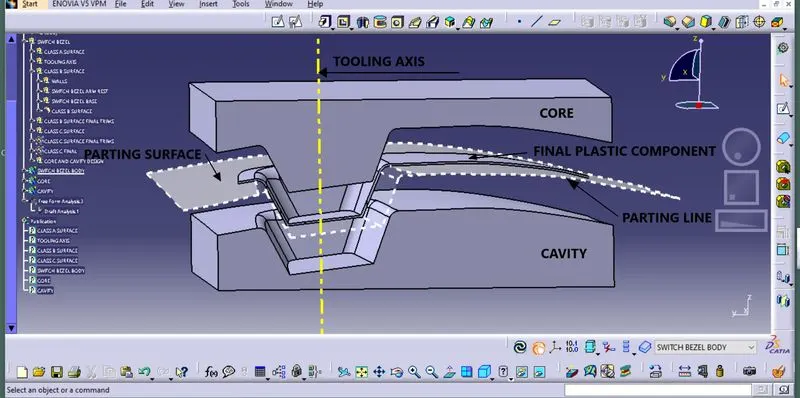
In a typical injection molding machine, one half of the mold (the A-side) is attached to the fixed side of the press, and the other half of the mold (the B-side) is attached to the moving clamp side of the press. The clamp (or B) side contains the ejection actuator, which controls the ejector pins. The clamp forces the A and B-sides together, molten plastic is injected into the mold and allowed to cool, the clamp pulls the B-side of the mold away, the ejection pins are actuated, and the part releases from the mold.
Let's use a mold for a plastic drinking glass as an example. To ensure that the part stays in the mold half with the ejector system, we would design the mold so that the outside of the glass is formed in the cavity of the mold (A-side) and the inside would be formed by the core of the mold (B-Side). As the plastic cools, the part would shrink away from the A-side of the mold and shrink onto the core in the B-side. As the mold opens, the glass will release from the A-Side, and stay in the B-side, where it can be pushed off from the core by the ejector system.
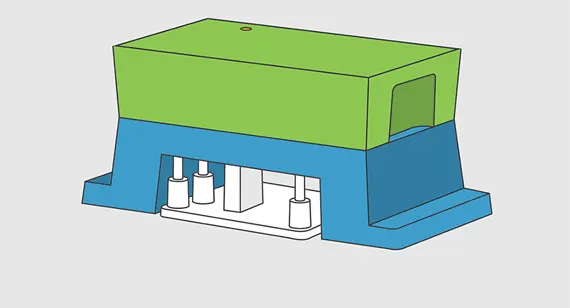
If the mold design were reversed, the outside of the glass would shrink away from the cavity in the B-side and onto the core in the A-Side. The glass would release from the B-side and stick to the A-side where there are no ejector pins.
Design considerations
- Draft: Required in both the core and cavity for easy ejection of the finished component
- Shrinkage allowance: Depends on shrinkage property of material core and cavity size
- Cooling circuit: In order to reduce the cycle time, water circulates through holes drilled in both the core and cavity plates.
- Ejection gap: The gap between the ejector plate face and core back plate face should hold dimension within the core. It must allow component to be fully removed from the mold.
- Air vents: Removes gases entrapped between core and cavity (usually less than 0.02 mm gap), because excessive gaps can result in flash defects.
- Mold polishing: The core, cavity, runner and sprue should have good surface finish and should be polished along material flow direction.
- Mold filling : The gate should be placed such that the component is filled from the thicker section to thinner section.
INJECTION MOULDING.
- A part is created by two or more tools moving together to create a closed volume, into which plastic is injected under pressure.
- In a 2 part tool the cavity (A) creates the quality outer surfaces and the core (B) creates inner details.
- There are often extra “cores” sliding into the cavity to allow more complex parts.
PROCEDURE
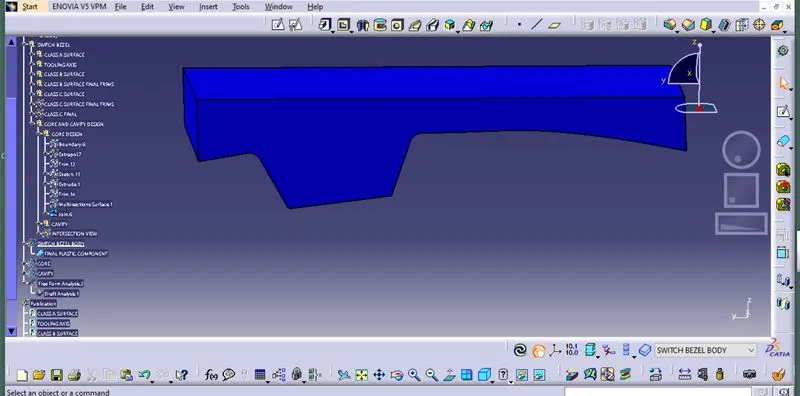
*Core design.
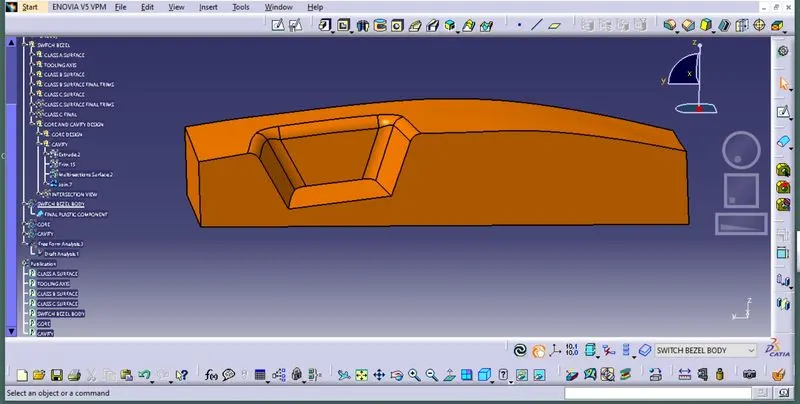
*Cavity design.
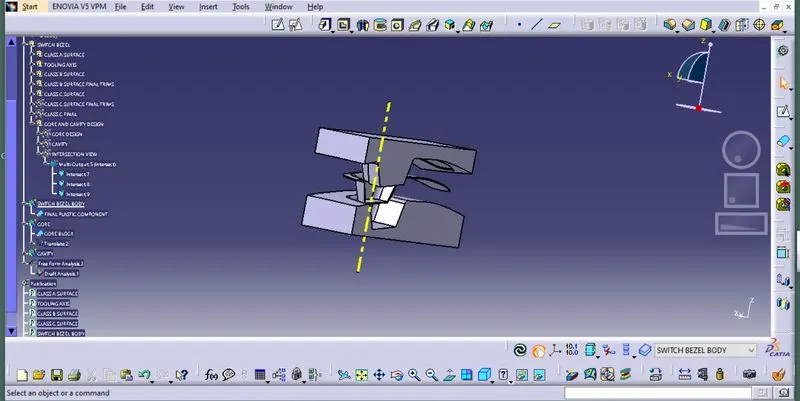
*Intersection between Core and Cavity for the switch bezel component.
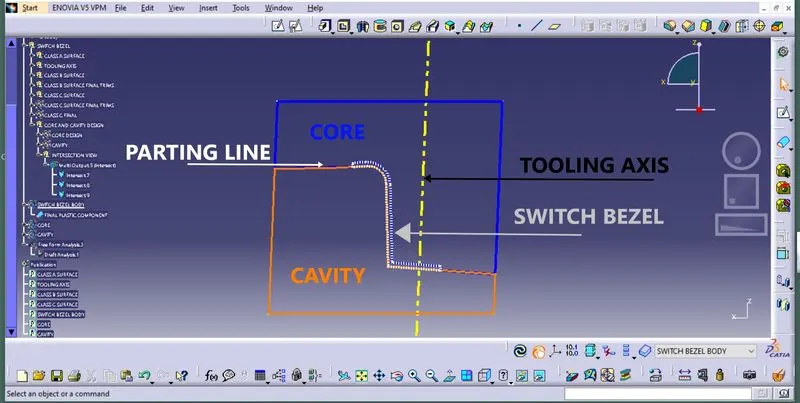
* Solid components between Core and Cavity for the switch bezel component.
*Schematic representation of the injection moulding .
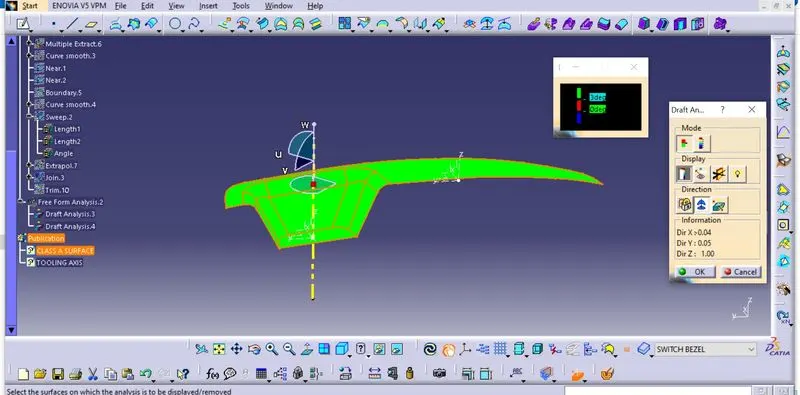
*Draft analysis for the Switch Bezel by quick analysis mode.
*Draft analysis for the Switch Bezel by Full analysis mode.
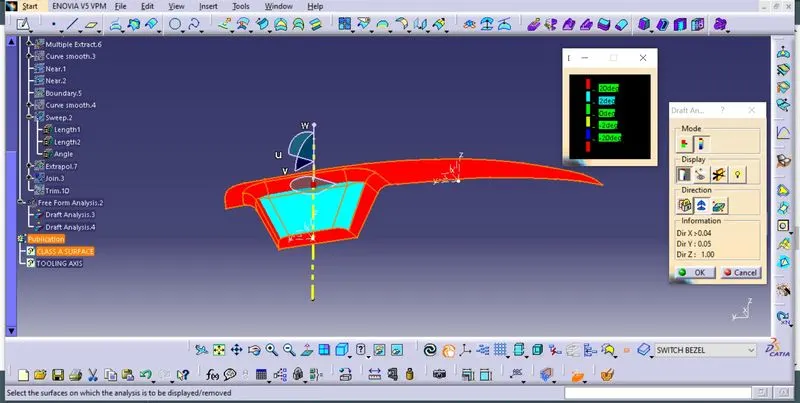
*Draft analysis for the Switch Bezel in Isometric view.
*Draft analysis for the Switch Bezel in Front view.
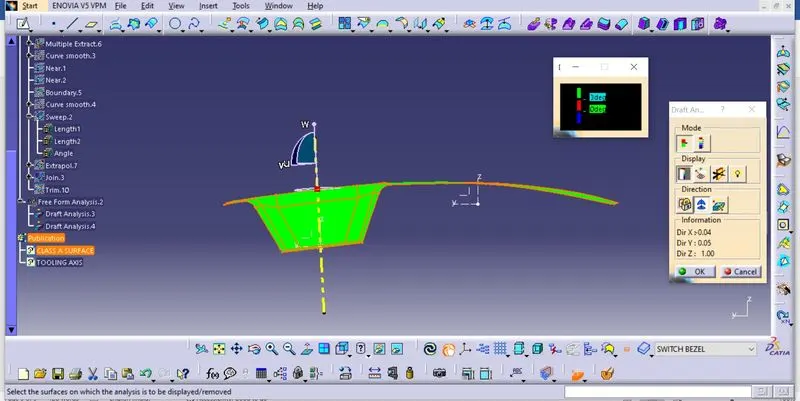
*Draft analysis for the Switch Bezel in Side view.
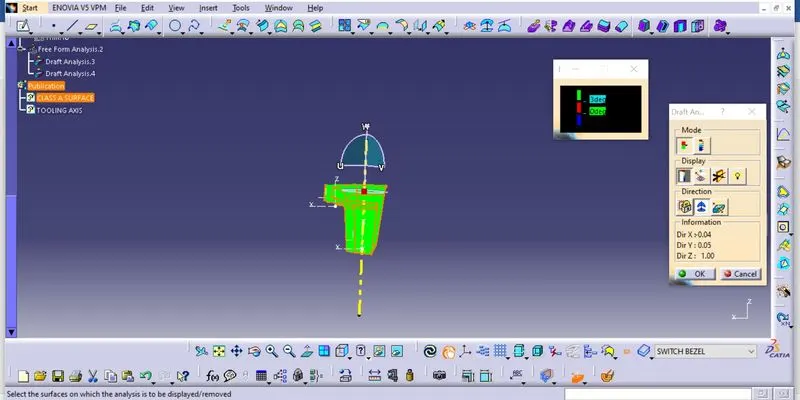
*Draft analysis for the Switch Bezel in Top view.
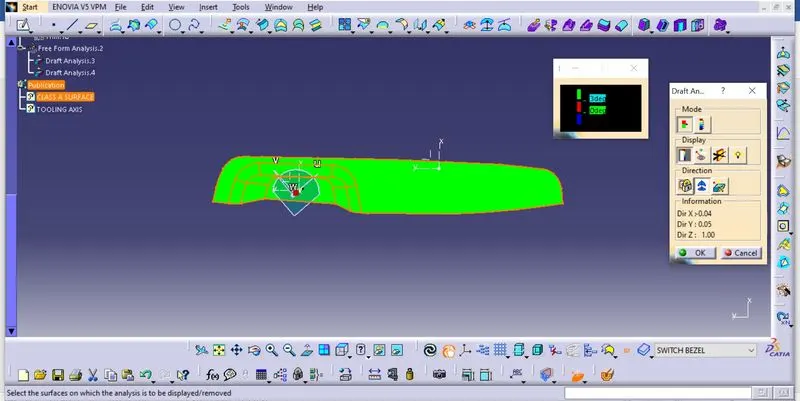
*Draft analysis for the Switch Bezel with Core and Cavity.
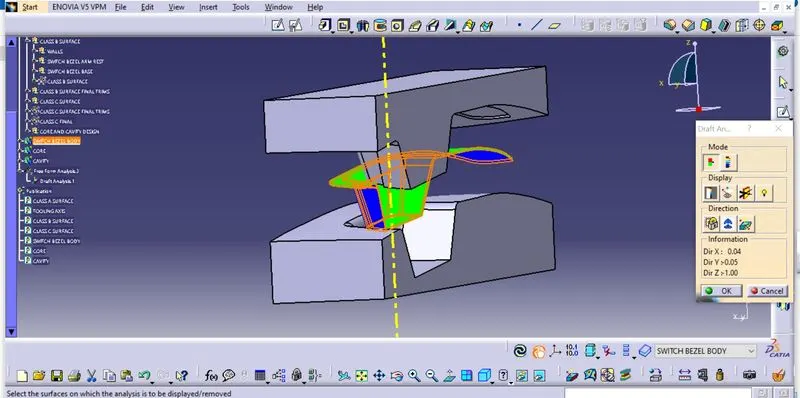
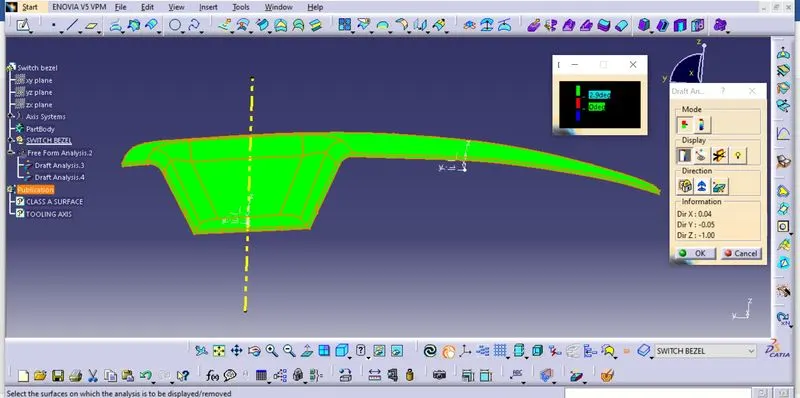
*Draft analysis for the Switch Bezel Body by quick analysis mode.
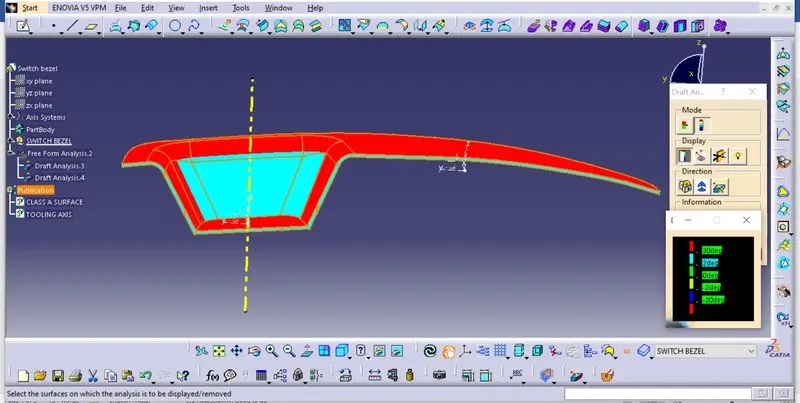
*Draft analysis for the Switch Bezel Body by Full analysis mode.
CONCLUSION:-
- A detailed report is been done explaining the draft analysis and the tooling axis creation.
- An explanation is been given on the way of creating the tooling axis by Bisecting method.
- Screenshots of the Draft analysis report and the final plastic component.
- Image of the complete Draft analysis.
- Images of the color scale variant.
- Screenshots of the model with the proper color code of the draft angle in various orientations (Isometric, Front, Side, and Top View.