Week 8 - Challenge 1 - Draft Analysis on a Fan Cover
Draft analysis is a method of checking the draft angle on various faces of a part with a particular direction.
Draft Angle is an important requirement in the die casting process. It is described as an angle or amount of slope that is incorporated into a wall of a die casting mold making the opening of the die cavity wider than its base. To avoid high pressure in castings, the inside corners must be protected with fillets.Draft angles are a hassle. As designers, we like to work with straight, perpendicular models that can be easily read, measured and modified. Instead, we're required to deal with trapezoidal shapes that can impact functionality, fit and aesthetics due to the addition of the draft.
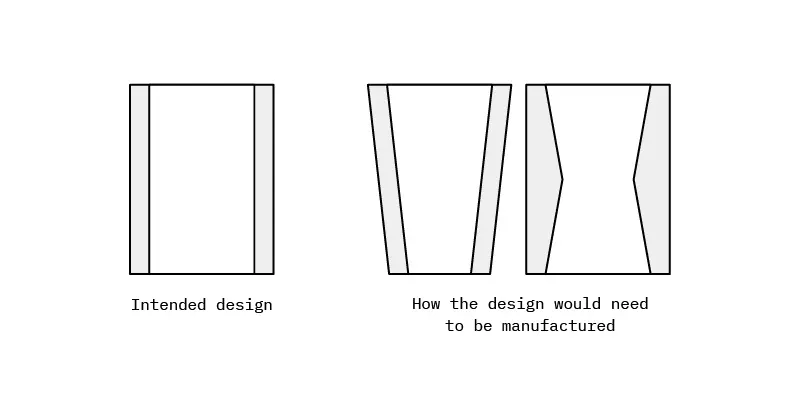
Importance of draft angles
However they are a required feature. A functional part for injection molding has to have drafts facing both cavity and core sides to reduce the risk of damage to the parts and ensure ejection. As the molten plastic flows into the closed die and fills the cavity, the material shrinks inside the mold upon cooling and as a result grips the core.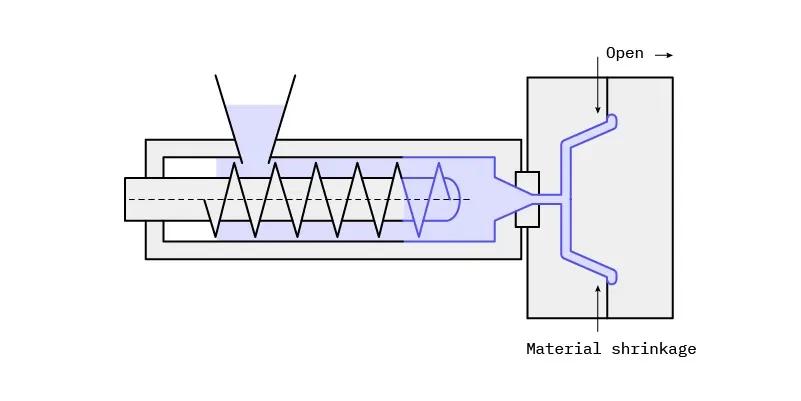
Without any taper, the part would come out scratched while increasing wear and tear on the mold and shortening the tool life. Even worse - if the part does not eject, it requires a production halt to manually peel it off.What’s also important is to overcome the vacuum forces by letting air in between the metal and the plastic for the part to release properly. Adding an adequate draft angle ensures that warpage upon ejection is prevented while maintaining a decent cosmetic finish.
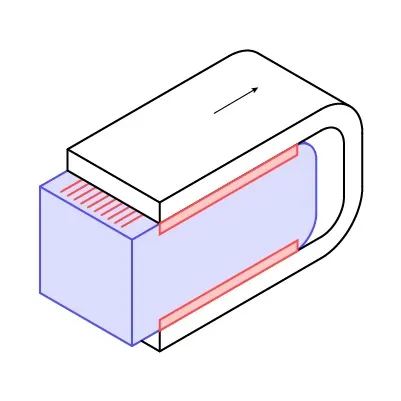
There is an inherent tradeoff between the ejection mechanism and the cooling system - they both compete for real estate within the core. By making the part easy to release you simplify the ejection mechanism. Therefore, instead of having numerous pins or sleeves to push the part out of the core - you leave a lot of room for cooling channels that significantly cut down your cycle time. As a result, you get a more competitive per unit price for your project which plays a huge role at high production volumes.
To sum up, adding draft angles to your design:
- Minimizes the warping to your geometry
- Increases the tool life of the mold
- Improves the surface finish on your plastic parts
- Cuts down cost by reducing the cooling time
-
Generally, for the plastic materials draft value, you are very from 0.5 degrees to 3 degrees.
-
A value of 3 degrees draft for a plastic part is nominal and accepted all over the world.
Reason for tooling axis selection
- In both X and Y directions the fan cover geometry was not covered or visible so by selecting the Z direction entire geometry will be covered
- In X there is a side cut by reference to the boundary so the feature will not be captured.
- In Y there is a hole by reference to the boundary so the feature will not be captured.
PROCEDURE
*Create an intersection between the ZX plane and fan cover.
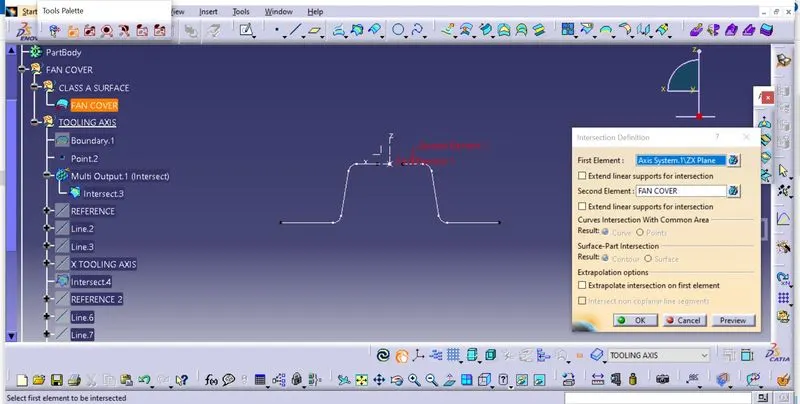
*Creating lines by point to point method and bisecting the lines to create X tooling axis.
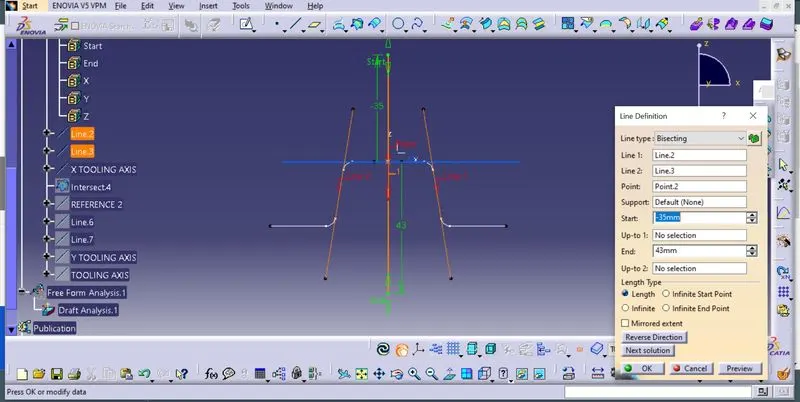
*Create an intersection between the YZ plane and fan cover.
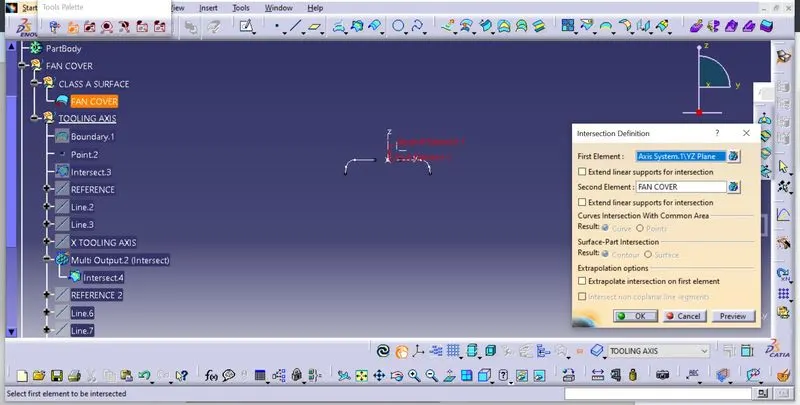
*Creating lines by point to point method and bisecting the lines to create Y tooling axis.
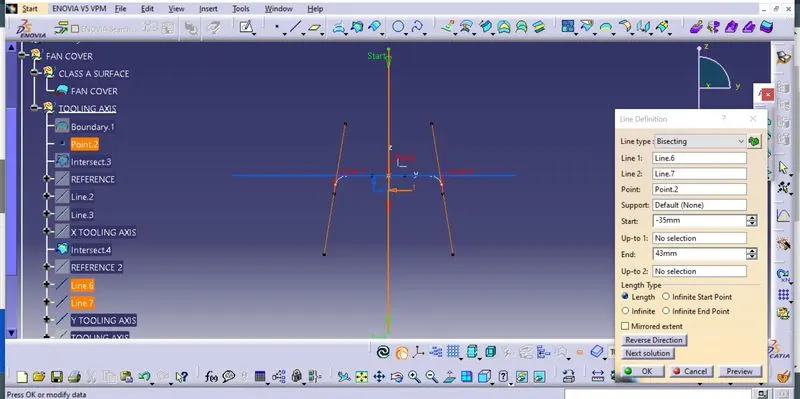
*From X tooling axis and Y tooling axis bisecting the lines to create the TOOLING AXIS.
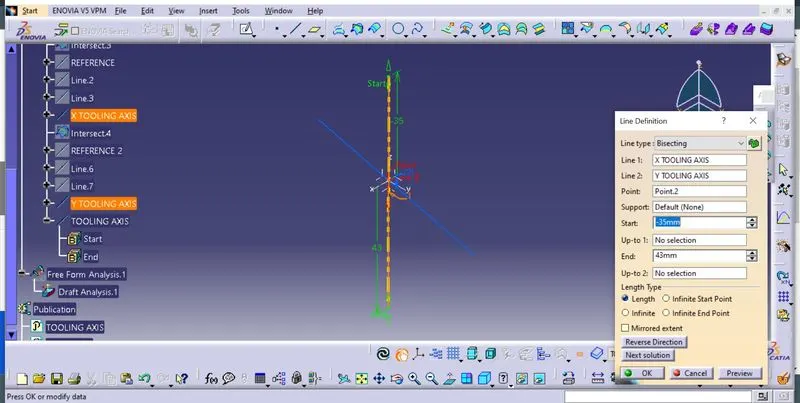
*Draft analysis for the fan cover by quick analysis mode.
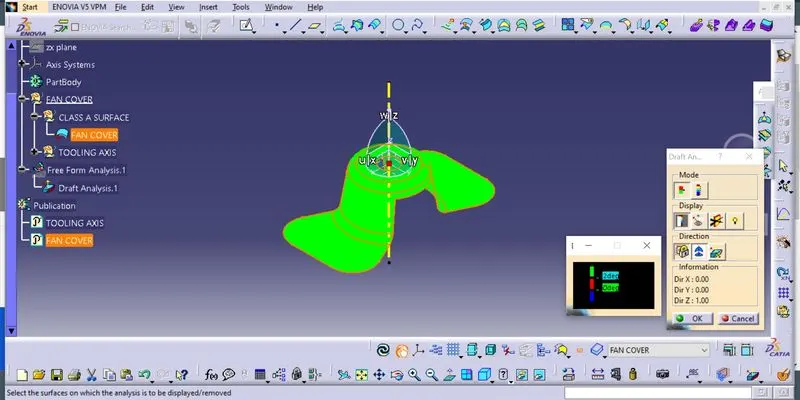
*Draft analysis for the fan cover by Full analysis mode.
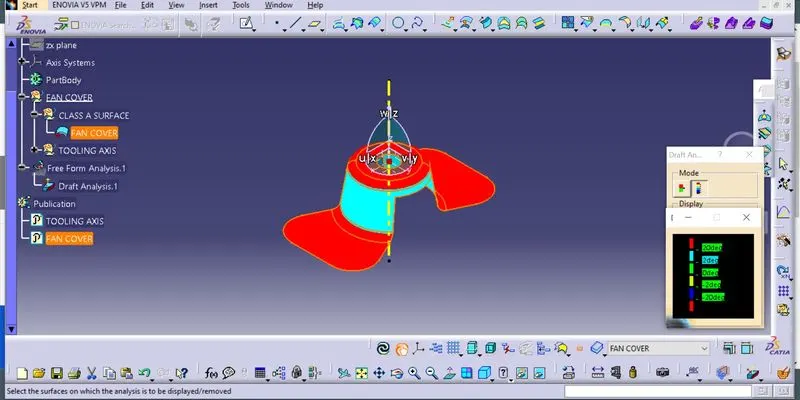
*Draft analysis for the fan cover in Isometric view.
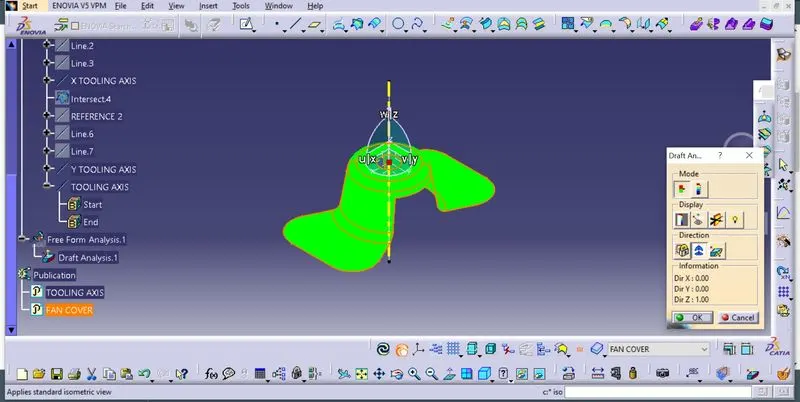
*Draft analysis for the fan cover in Front view.
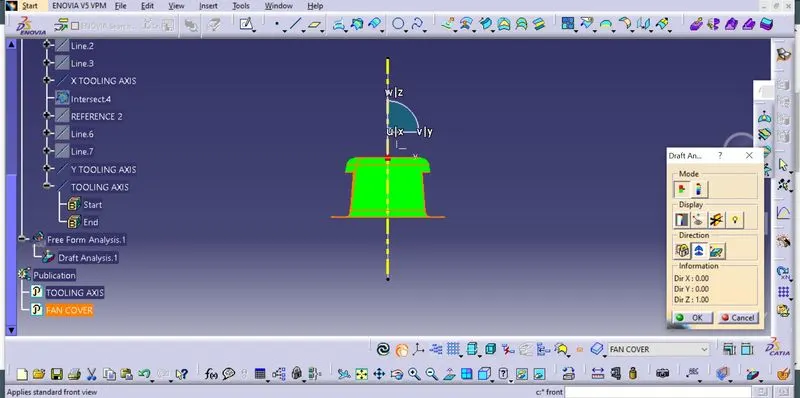
*Draft analysis for the fan cover in Left side view.
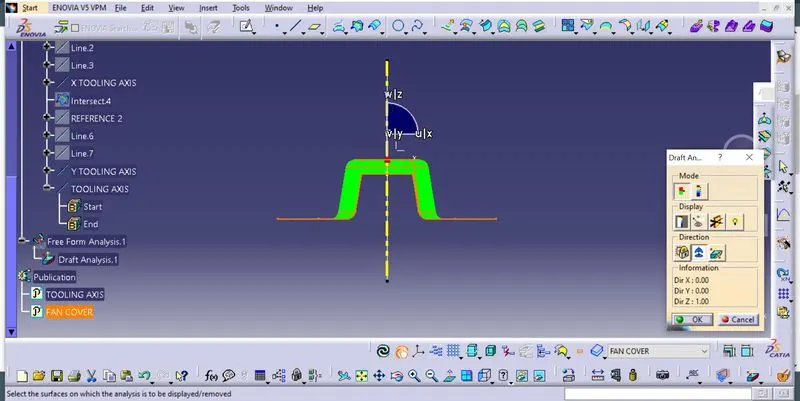
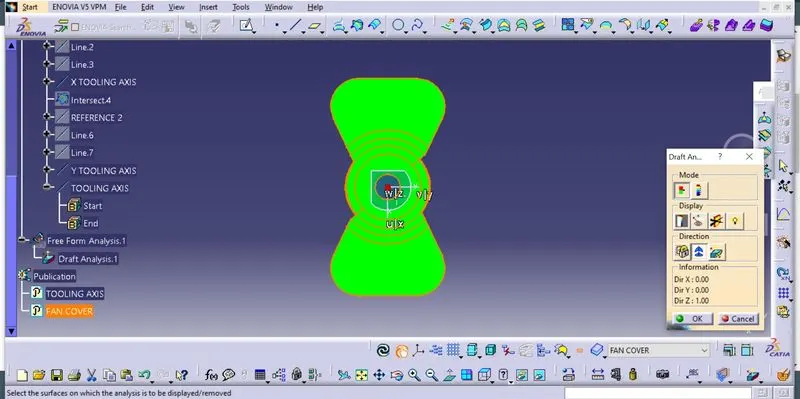
*Draft analysis for the fan cover in Top view.
CONCLUSION:-
- A detailed report is been done explaining the draft analysis and the tooling axis creation.
- An explanation is been given on the way of creating the tooling axis by Bisecting method.
- Screenshots of the Draft analysis report.
- Image of the complete Draft analysis.
- Images of the color scale variant.
- Screenshots of the model with the proper color code of the draft angle in various orientations (Isometric, Front, Side, and Top View.