Week 7 State of charge estimation
Now,At first we have to simulate 3 test cases from harness dashboard.We need to, select the harness dashboard from project file which we downloaded with reference link.
1)Click on the test sequence varient block and select test case as 1.
Now by clicking on the BMS sequence block we get the chart.
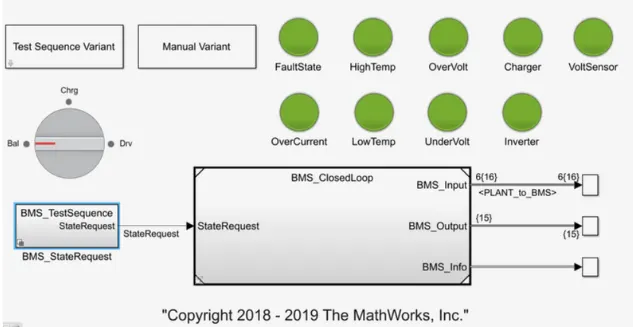
When simulation will start ,the model will be in driving condition.After 3000 seconds,it will be standby mode and after 1000 sec it will be in charging mode.Now by running the simulation.
Result:-
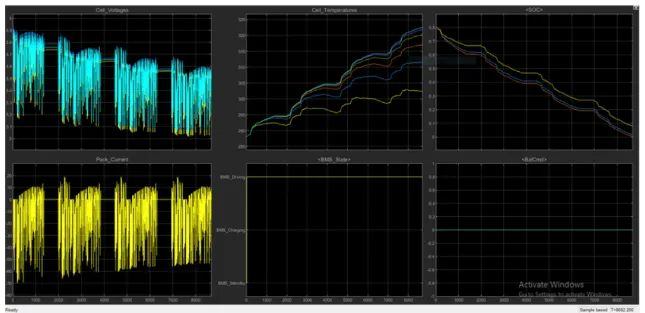
Here all the indicators are green .So we can see no errors and we check the plot for this model and is shown below.
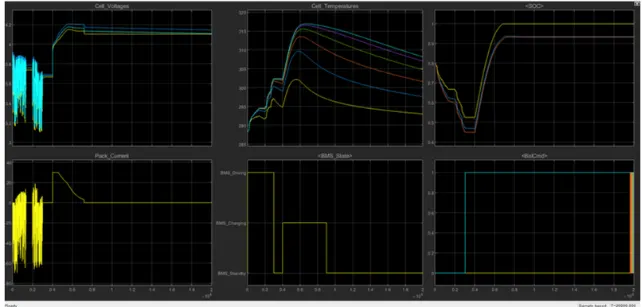
From the plot we can see the vehicle is initially in driving state and charging was done till 90%.After charging it reaches to stanby mode.It can vbe seen in BMS state plot.Battery volltage was increased to 4.2 while charging.Current plot shows the value of cuurrent supplied to vehicle while driving.SOC decreased up to 50% in driving condition and it was increased while charging.
2) Now change the test sequence varient in case 2.
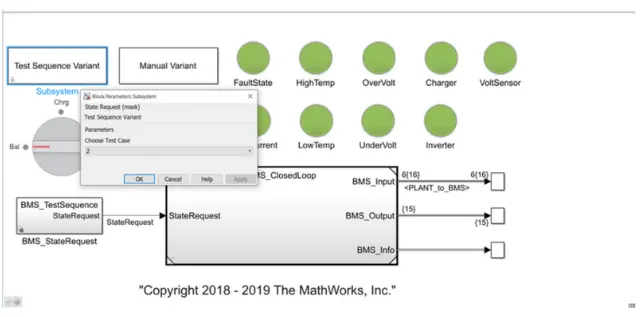
Now by clicking the BMS state request block.
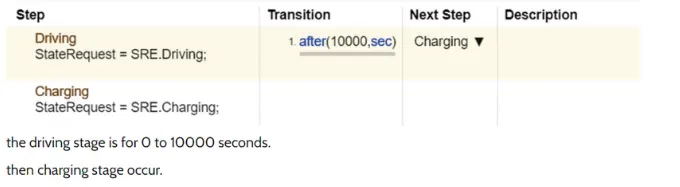
Result:-
From the above graph ,A fault condition occured in second case.So even afetr charging was started ,the SOC didn't increased.It continue to decrease.
3) Now change the test sequence varient in case 3.
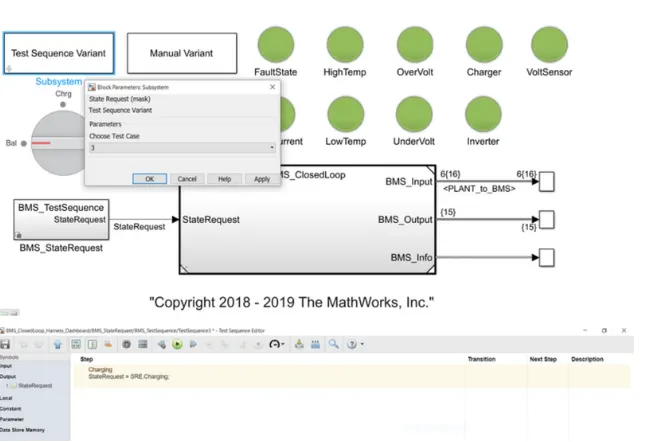
This case has only one phase and taht is charging.Thus 0 To 20000 sec simulation runs.
Result:-
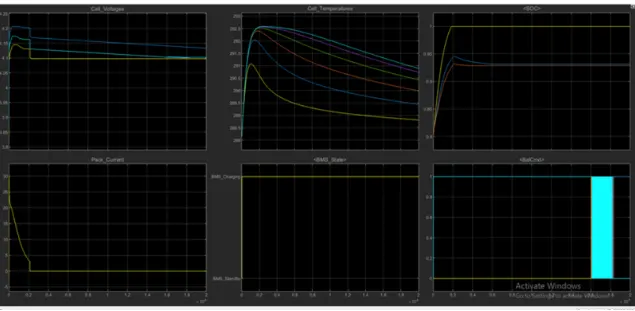
Here,we can see that the soc reached 100% in charging and remained in stand by mode.Cell temperature also decreased when standby mode was achieved.
#Coulomb Counting:
The coulomb counting method measures the discharging current of a battery and integrates the discharging current over time in order to estimate SOC. Coulomb counting method is done to estimate the SOC, which is estimated from the discharging current, I batt, and previously estimated SOC values
To determine available capacity, coulomb counting relies on the integration of the current drawn from and supplied to a battery over time,

where I is the current and η is the efficiency during charge and discharge operations . Coulomb counting is advantageous in terms of a simple structure and its ease of implementation. However, some problems make it difficult to accurately estimate battery SOC by coulomb counting. Because battery capacity and efficiency are significantly influenced by operating temperature and current direction, these factors should be considered to correct for battery SOC. Sensor accuracy is also important because accumulated errors can lead to a drift in the estimated battery SOC. Furthermore, one of the main problems in coulomb counting is that it is necessary to calibrate the initial battery SOC. In several applications, the initialization involves rest and the initial SOC is estimated based on the voltage inversion method described next.
For example we can lookminto the project file we downloade .A Bms system in the file is represented below.
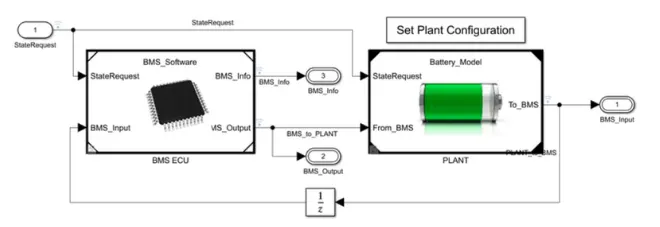
BMS algorithm model,protects,report the measurment from battery pack.
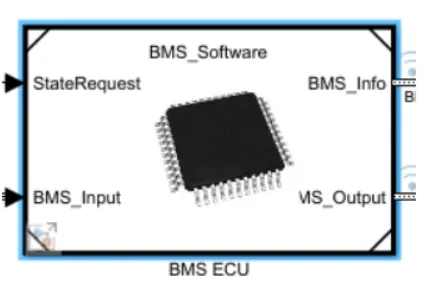
By clicking on the BMS ECU block we get,
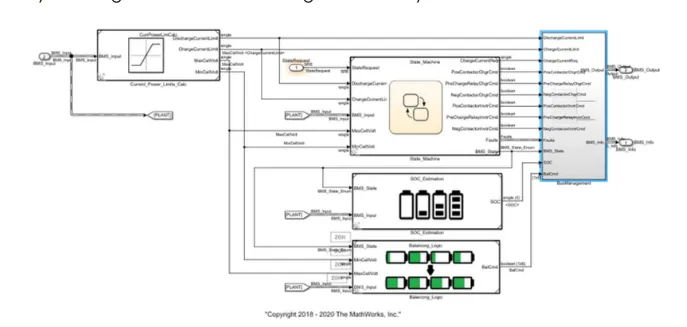
By clicking on the SOC estimation block,
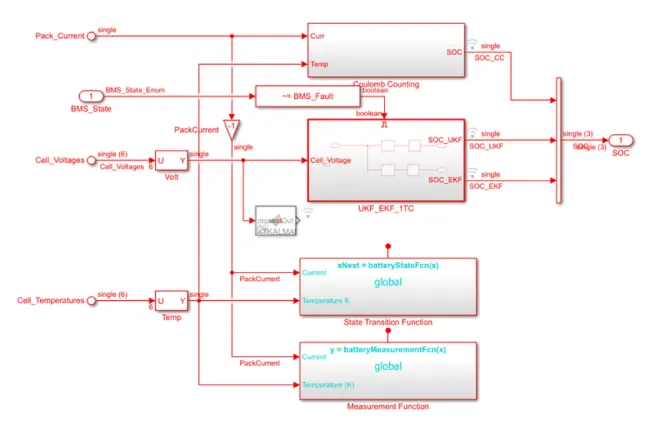
From above we observe the coulomb counting block,
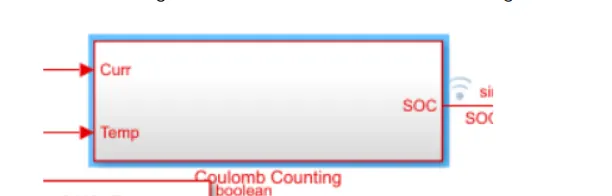
A subsystem opens when we click on the coulomb counting,
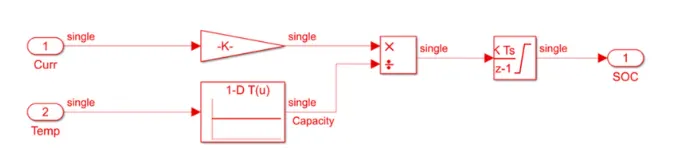
- This system does the estimation by coulomb counting equation mentioned above.
- Advantageds of coulomb counting method is its simplicity and low computational cost.Tempearture and current from the battery is given as inputs.
- Current signal is given to a gain block and temperature is given to capacity since it varies according to temperature.
- These inputs are given for integration where current will be integrated withbrespect to time.
- This output is given to another block where it is divided by capacity.
- hense the SOC is estimated .