Week 7 State of charge estimation
------COULUMB COUNTING-------
Coulumb counting or Current integration is a method devised to track the state of charge (SOC) of a cell or a battery.
A cell or a battery is characterised by the amount of power it can supply before it drains out. This power comes form the charges(electrons) stored in the battery. Movement of these charges gives current. The method simply counts the no. of these charges in terms of coulumbs being taken out of the battery over time.
If a cell gives out current I in amps for a period of time t in hrs, then the charge taken out is simply the product of them both i.e I*t Amp-hrs. This is nothing but the charge removed from the capacity of the cell. The ratio of amount of capacity used to the inital capacity of the cell when it is completely charged gives the SOC of the cell.
The coulumb counting method measures the discharging current of a cell and integrates it over time to estimate the charge or capacity used. Integrating is used to count the charge removed in the past and add it to the charge removed in the present, there by giving an absoulte value of charge removal as the initial value of the charge is known.
if current I(t) is removed from a cell for a time dt, then according to coulumb counting, the amount of charge removed is
I(t)dt.
if currently at time t, SOC value is SOC(t), then SOC value at time t+dt is given as :
`SOC(t+dt) = SOC(t)-[[I(t)dt]/(Q*3600)]*100`
if the cell was charging, then
`SOC(t+dt) = SOC(t)+[[I(t)dt]/(Q*3600)]*100`
Total charge removed over a period of time t can be obtained by integrating the first equation.
`intI(t)dt`
Now, if the cell is at an initial SOC of 100% , then SOC after time t of discharging is:
`SOC(t) = 100- [[int(I(t)dt)]/(Q*3600)].100`
-----------IMPLEMENTATION OF COULUMB COUNTING IN BMS---------
The BMS model incorporates the coulumb counting method as shown in the diagram below.
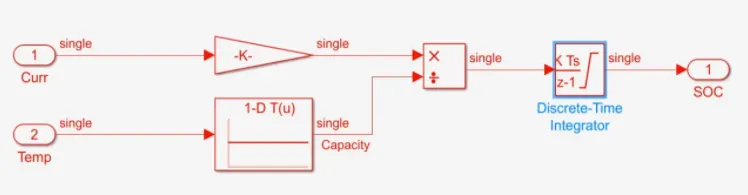
The instantaneous current is taken at each time step and is divided by the capacity of the battery whose value is taken from a 1 D look up table mapped to capacity vs temperature data. This is then fed to a discrete time integrater block in which inital conditions of the cell and SOC initial reference values are already input. The output of this block is SOC which is then fed to a scope for the user's perusal.
Advantages of Coulumb counting method:
- This is a very simple method with least complications which gives out results close to the real value and is cheap to implement.
Disadvantages :
- It is an open loop method and very sensitive to the current sesnor precision placed in the BMS hardware.
- It is uncertain as it requires initial values to estimate the current value
- Factors such as temperature, battery history, initial SOC and cycle life also influence the precision of the SOC estimate. Some phenomena, such as decreasing SOC when the battery is resting, and variations with temperature changes, cannot be captured by the Coulomb counting method.
- Hysterisis behavior of cell is not accounted.