Week - 7 - Checking and correcting the edges
AIM:
To check and correcting the edges.
OBJECTIVE:
- Create a code that displayed free and T edges for displayed elements.
- Free edge color red and T edge cyan.
- Except for edges, all other components must be made transparent.
- Also, temp nodes must be automatically created for “free nodes” for a tolerance value of 0.01.
- Also, create a code to turn off free edge display and restore the window to the way it was.
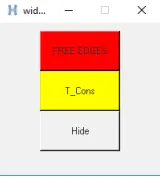
- Map these codes over a key and also create a tk widget for the same.
PROCEDURE:
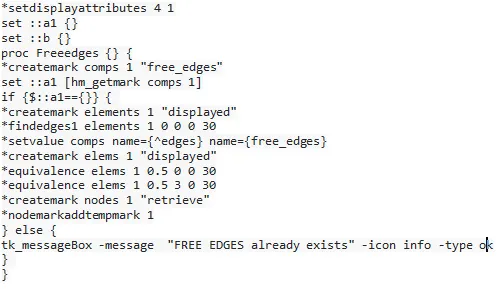
Initially, the display is set to transparent mode using (*setdisplayattributes ) command.
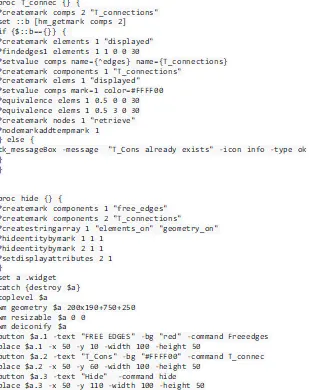
Two Different functions were created to display Double cons and Triple cons.
- Elements displayed were selected using the (*createmark)command
- Then edges of the selected elements are shown using the (*findedges1) command for Free edges and T Connected edge the edge_type values are 0 and 1.
- Then component with name ^edges is renamed with "respective edge name " using (*setvalue) command
- temp nodes are created by marking the node using( *equivalence )with tolerance of 0.01 and (*nodemarkaddtempmark )
Syntax
- *setdisplayattributesstyle colortype
style Set to:
- 0 wire frame
- 1 hidden line
- 2 hidden line with mesh
- 3 hidden line with features
- 4 hidden line transparent
colortype Determines how the components are colored. The options are:
- 0 none
- 1 component color
- 2 assigned plots
- 3 contours
- *findedges1entity_type mark_id edge_type created_entity smooth break_angle
entity_type The entity types to find edges for. Valid values are comps and elements .mark_idThe mark ID containing the entities. Valid values are 1 and 2.
edge_type The type of edges to find:
- 0 - Free edges.
- 1 - T-connected edge
created_entity The entity type to create on the found edges:
- 0 - Plot elements
- 1 - Free lines
smooth The smoothing to use when created_entity is 1:
- 0 - No smoothing.
- 1 - Smooth the lines through the nodes.
- *equivalenceentity_type mark_id tolerance mode location numbering
entity_type The entity types to consider. Valid values are elems, comps and nodes.
mark_id The ID of the mark containing the input entities. Valid values are 1 and 2.
tolerance The tolerance used to find neighboring nodes to equivalence.modeOperating mode of the command:
- 0 - Preview found nodes.
- 1 - Equivalence found nodes.
- 3 - Place found nodes on user mark.
location Location of equivalenced nodes:
- 0 - Equivalence at the location of the node with the lowest ID.
- 1 - Equivalence at the location of the node with the highest ID.
- 2 - Equivalence at the midpoint of the two nodes.
numbering The numbering of the retained node:
- 0 - Retain the number of the node with the lowest ID.
- 1 - Retain the number of the node with the highest ID.
CODE:
OUTPUT:
RESULT:
- The code has been created and displayed for T-edges & fre elements.
- Free edge is indicated in colour red and T edge in cyan.
- Except for edges, all other components transparent.
- Temp nodes is created for “free nodes” for a tolerance value of 0.01.
- Code has been created to turn off free edge display and restore the window to the way it was.
- Maps has been coded over a key and tk widget is created for the same.