Week-7 Challenge: DC Motor Control
1) Matlab Demo of ‘Speed control of a DC motor using BJT H-bridge’.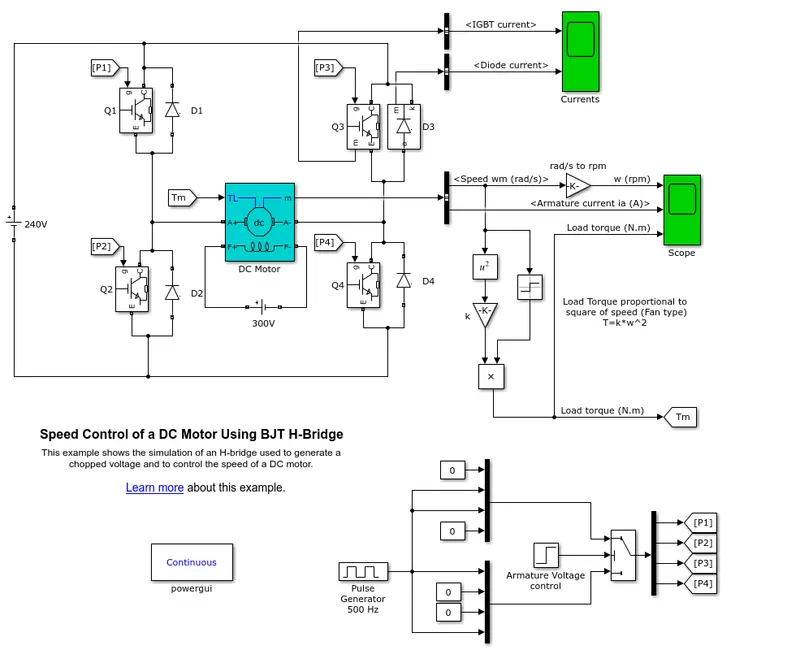
The BJTs H bridge circuit is used for changing the direction of the motor and controlling the power supplied to motor based on fast switching semiconductor devices functioning. The switches in the above figure are controlled by simulink signals. The DC motor used is the preset model of 5HP 24V 1750rpm. The load torque is proportional to square of speed. The voltage supplied varies from 0 to 240 V based on duty cycle applied, which is fed by the pulse generator.
The H bridge has 4 pairs of BJT-Diodes , each pair in antiparallel setup as shown in the figure. At any given instance, Q1 and Q4 are on or Q2 and Q3 are on simultaneosly. the diodes act as flyback diodes. When Q1 and Q4 are on, the voltage applied across the motor is positive and allows the motor to turn in one direction. When they are off, the diodes D3 and D2 act as flyback diodes. When Q2 and Q3 are on, the voltage applied across the motor changes in direction and the motor direction reverses. When they are off, D1 and D4 act as fly back dodes.
The simulation is run with positive direction and a duty cycle of 75%. At t= 0.5 sec the armature voltage is reversed suddenly and the motor runs in the negative direction. This is observed in the scope .
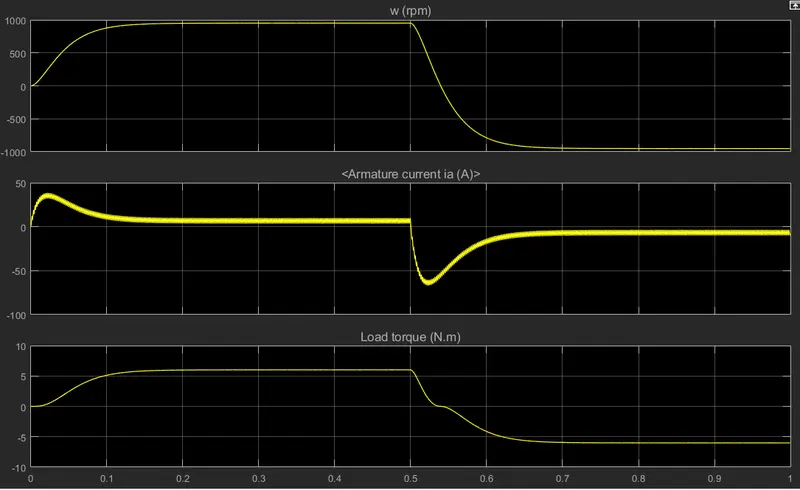
The armature current reverses and shoots up at t= 0.5 sec. The shoot is due to higher voltage applied and the sudden reduction in speed of the motor to change its direction which reduces back emf and increases effective voltage across armature leading to the shoot up in the current.
We need to modify the model such that this shootup is prevented. For this we can reduce the duty cycle in the pulse generator model which will reduce the voltage across the motor and in theory should reduce the current acorss the armature.
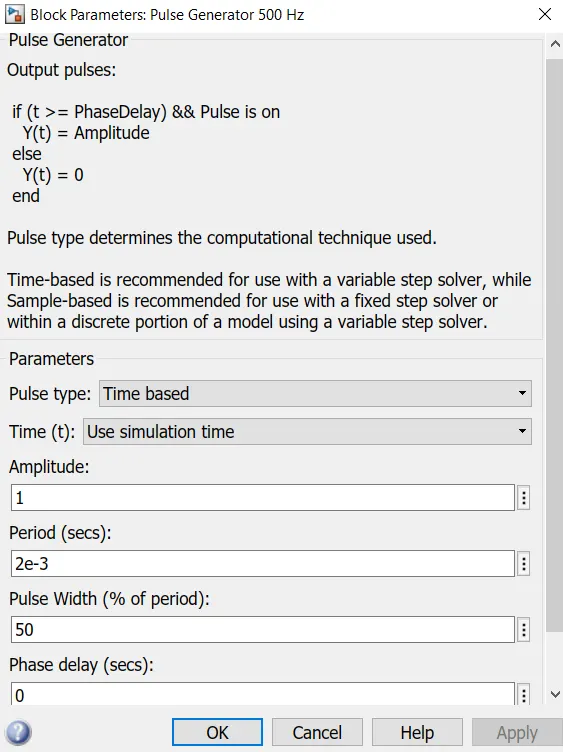
The pulse width is changed from 75% to 50% in the pulse generator block. The model is run again and the plot obtained is as follows.
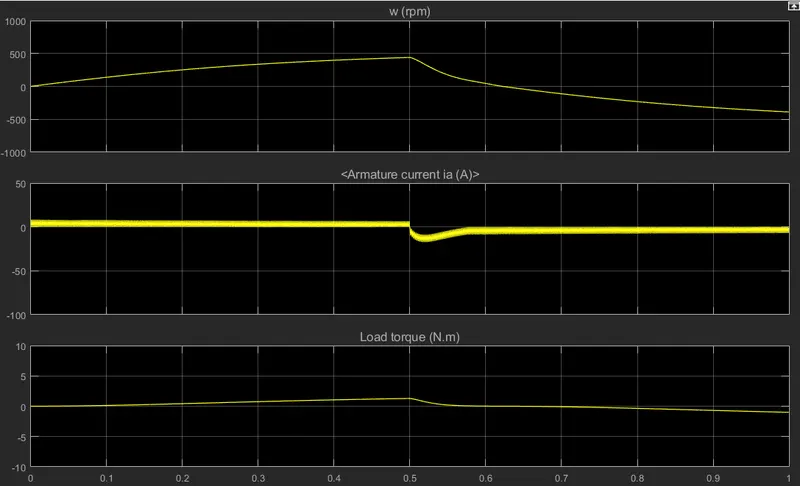
The current curve is smooth and doesnot have a sharp slope. For reversing the direction of the motor and preventing the shootup of armature current, the duty cycle has to be reduced first and then the direction has to be changed. Alternatively, the circuit can be cut off from the power supply until the motor reaches rpm at which point the negative voltage can be applied to the motor to reverse the direction.
------------------------------------------------------------------------------------------------------------
2) The Four-Quadrant Chopper DC Drive (DC7) block
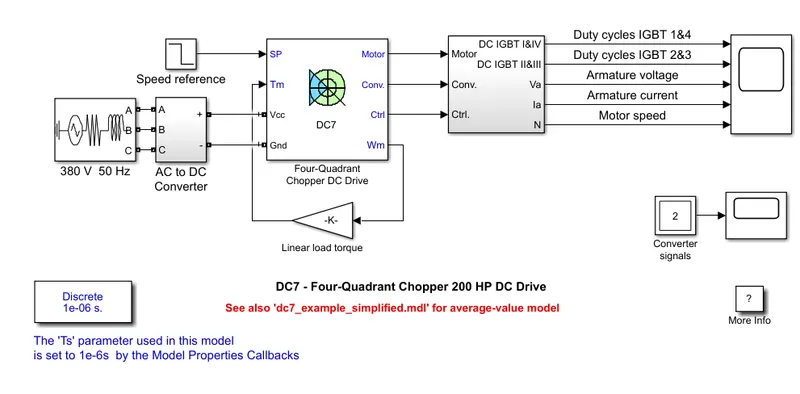
the 200 hp motor used in this model is excited with a constant 150 V Dc field voltage source obtained by rectifying and regulating the 380 C 50 hz AC supply using an AC to DC converter.
In this model, only the load and speed are given as inputs. The block takes care of all the switching operations required for the working od the motor as per the performance required. The model allows for a smooth transistion in the acceleration adn deceleration phases to prevent any surges such as over current that could destabilize the system.
Speed regulators and current regulators are used. The speed regulator gives out the armature current reference used by the current controlled in order to obtained the torque needed to gain the desired acceleration and speed. The duty cycle is self calculated from the 5kHz pulses.
-------------------------------------------------------------------------------------------------------
3) EV model using DC7 block :
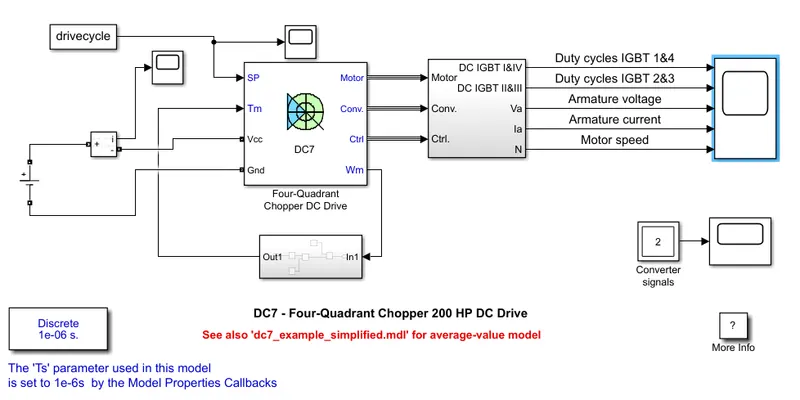
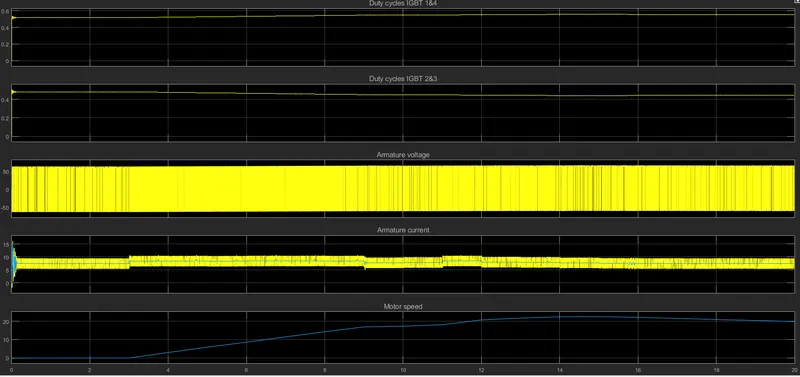
The model is changed accordingly as show in the above figure. The voltage source is changed to a DC source and a current measurement block is added in series with the the motor. The drive cycle data replaced the speed reference block. This can be added by making a new drive cycle.
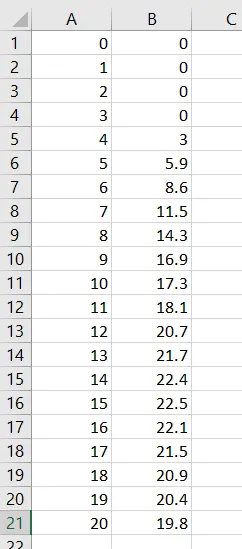
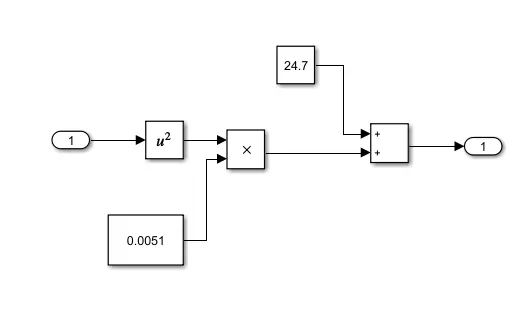
The torque rpm relation is changed to as follows:
Result: