Week 6-Meshing of Hood Challenge
AIM:
1) Check the geometry for the given model.
2) Extract all the mid-surfaces of the given component.
3) Mesh the component by following the mentioned quality criteria & asssign the thickness.
Target Element Length = 5 Units
| S.N | Quality Criteria | Value |
| 1 | Aspect Ratio | 5 |
| 2 | Skewness | 45 |
| 3 | Warping | 15 |
| 4 | Taper | 0.5 |
| 5 | Min. Length | 2 Units |
| 6 | Max. Length | 8 Units |
| 7 | Min angle Quad | 45 |
| 8 | Max angle Quad | 135 |
| 9 | Min angle Tria | 20 |
| 10 | Max angle Tria | 120 |
| 10 | Tria % | 10 |
DESCRIPTION:
THEORY:
The hood or bonnet is the hinged cover over the engine of the motor vehicles. Hoods can open to allow access to the engine compartment, or trunk for maintenance & repair. Hoods are typically made out of the same material as the rest of the body work. This may include steel, aluminum, fiberglass or carbon fiber. However, some aftermarket companies produce replacements for steel hoods in fiberglass or carbon fiber to make the vehicle lighter.
PROCEDURE:
We import the model by using geometry option in the form of stp file.
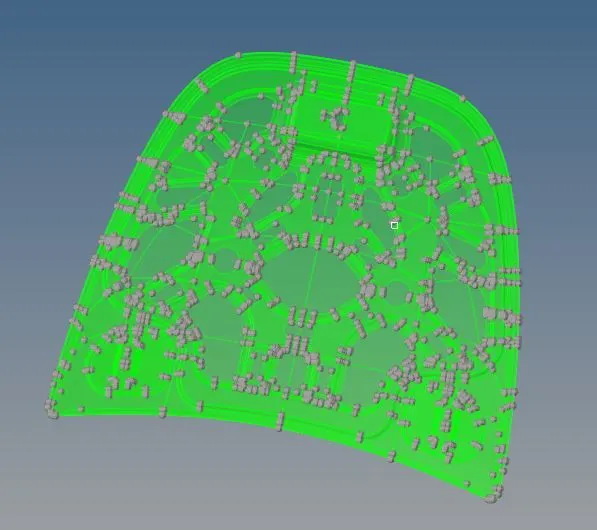
Once the model is imported midsurface has to be created & we have to check for the geometry clean-up.
HINGE:
First we take mid-surface for the hinge component, by using midsurface option we can re-arrange the construction lines. By using split option, we can split the surfaces. We can delete other half of the symmetrical surfaces so once we meshed the one side it can be reflected the other half by using reflect from the tool option.
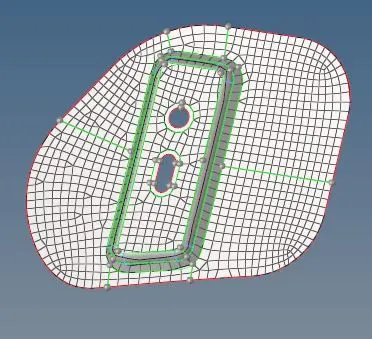
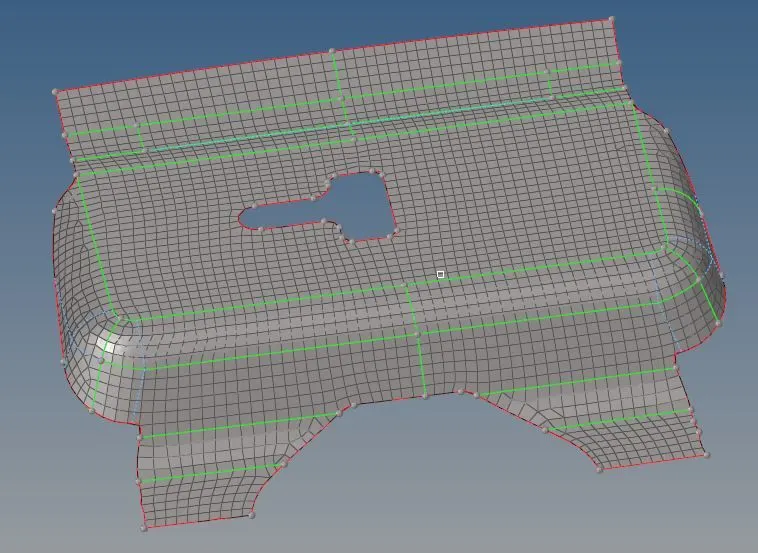
Then we follow the same steps for the following components latch reinforcement, outer extracted body & inner extracted body.
LATCH REINFORCEMENT:
OUTER EXTRACT BODY:
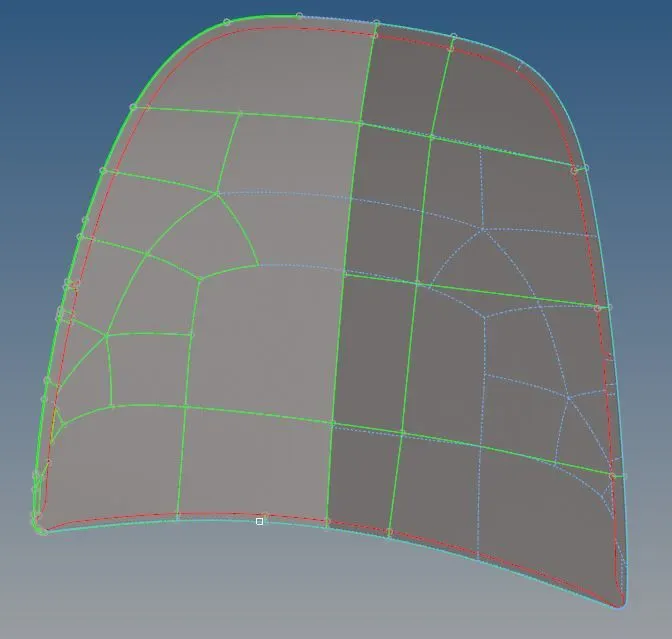
INNER EXTRACT BODY:
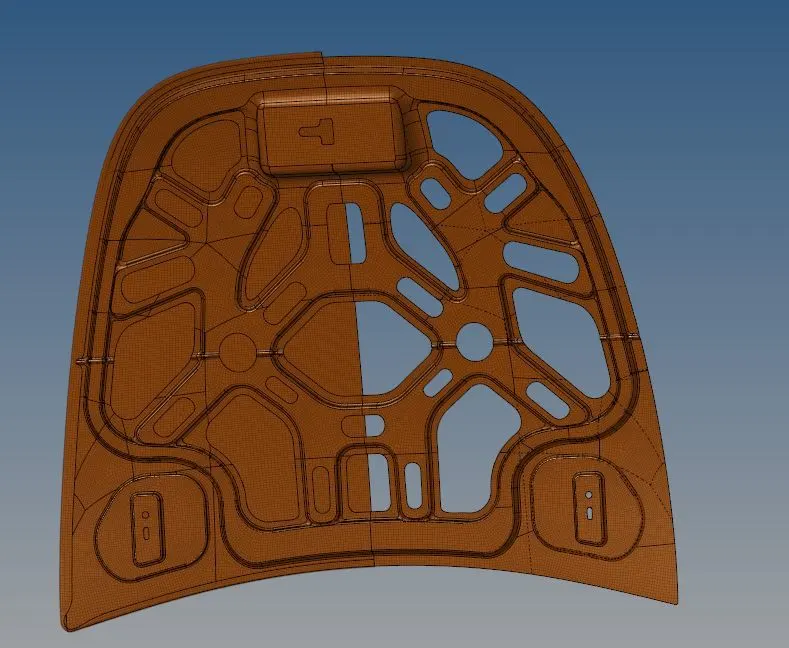
MESHING:
- Before meshing all contruction lines should be, which can be toggled for the proper mesh flow.
- The meshing element size should be 5mm as a target which has been given in the quality criteria.
- Quality index option has been used in some regions to avoid issues & to get a proper mesh flow, the tools which has been followed are element optimize, drag tria element swap edge, combine tria elements etc.
- Once meshing is done, we use smooth option for the whole component to perform proper mesh flow & to neglect element failure.
- The inner extract has more components, its been didvide into several small components, so the mesh flow will be seems good.
- The free edges are removed by using equivalence oprtion & manually replacing the node.
- While neglect the element failure warpage can be removed by splitting the elements & trias can be moved at some distance.
- In some areas opposite trias are not removed at different surfaces, to avoid allignment of mesh flow in various surfaces.
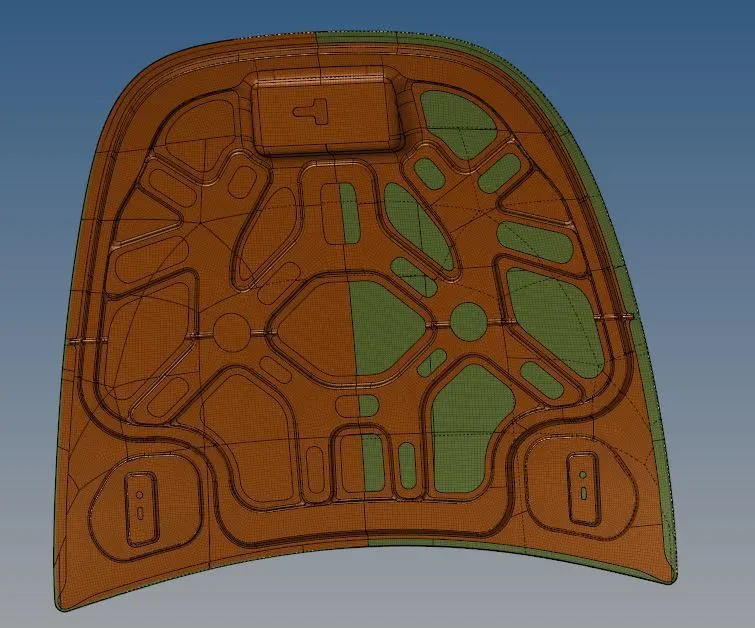
RESULTS:
- The given hood model is checked for geometric errors & cleaned.
- Mid-surface has been created for all the components.
- The components were meshed as per the quality criteria & issues has been resolved.
- The symmetrical surfaces for inner & outer extract body has been reflected on other side.