Week-6 Challenge: EV Drivetrain
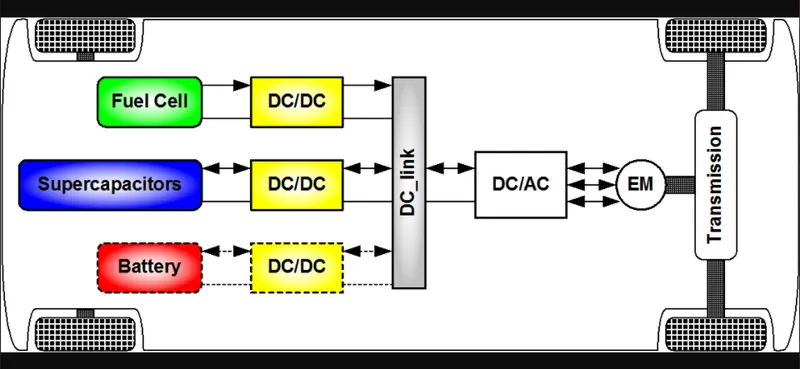
Power converters are used in electric/hybrid vehicles to manipulates the form and magnitude of voltage and current fed from and to the vehicle.
- DC/DC converter - This converts one value of DC voltage into other value of DC voltage ( increase/ decrease) .
AC/DC converter ( rectifier) - These convert AC voltage into regulated DC voltage. The form and magnitude are regulated. Used to get back regen power from vehicle to the battery.
DC/AC converter (inverter) -These convert DC voltage into regulated AC voltage. Form and magnitude are regulated. Usually emplyed when AC motor is used to dirve the vehicle.
AC/AC converter - Regulated AC out put from AC input.
The above converters either increase the magnitude of the output voltage ( boost converters) or reduce the output voltage ( buck converter) .
2) As the duty cycle is 0.7, the effective voltage to the motor is 72 * 0.7 = 50.4 V
The equation representing characteristics of DC motor is
`T = (V.k phi)/R - (Kphi^2. w)/R`
Comparing this with the given equation

gives ---
`(V.k phi)/R - (Kphi^2. w)/R = 24.7 + (0.0051).w^2`
`(50.4 * 0.7)/0.5 - (0.7 ^2 *w)/0.5 = 24.7 + 0.0051.w^2`
Solving for w gives -
`0.0051 w^2 +0.98 w - 45.86 = 0`
w= 38.95 rad/s --- steady state speed.
3) The blog gives a breif description of Motors used in electric vehicles in the recent years and focuses on two types of motors -
- DC brushless motor
- Induction motor
The author compares the two motors based on their working, performance characteristics, efficency points, and suitability for the EV application.
| DC brushless motor | AC Induction motor |
| Uses permannet magnet as rotor, to produce magnetic field. | Uses alternating current in a stator to produce rotating magnetic field. |
| Stator core involves current flowing within the windings to produce torque interaction between stator and rator. Requires inverter for operation. | The stators for the 3-phase induction motor and the DC brushless motor are virtually identical. It has no magnets. Does not require inverter for operation but integrating it with one gives a smoother operation of this motor for EV. |
| Requires angle position sensor for operation | requires speed sensor for operation |
| Does not produce much heat . Cooling is easier | Has heating issues and efficiency depreciation as an effect. |
| Has higher peak efficieny point | Comparitively lower efficiency point compared to DC Brushless motor. |
| Permanent magnets are expensive and the motor cost increases as a result. Handling becomes difficult because of the strong magnetic forces between ferromagnetic materials and magnets. | Requires just coils to make the motor and is inherently cheaper to produce and easier to handle as coils need to be excited to produce any magnetic field. |
| Easier to control for lower to medium performance ranges. | Achieving stability over the entire torque-speed range and over temperature is more difficult with induction than with DC brushless. |
| difficult to alter motor parameters such as field strenght because of permanent magnets. | induction machines have no magnets and B fields are “adjustable,” since B is proportionate to V/f (voltage to frequency). |
| Speed is controlled by PWM method. | Speed is controlled by altering RMS speed by altering frequency of fed in voltage. |
| As the motor size increases, magnetic losses inrease proportionately and loead efficiency drops . | induction motors do not follow the same trend and are thus desired for high performance applications as average efficiency is better than DC machine counterpart. |