Week-6 Challenge: EV Drivetrain
SOLUTION FOR QUESTION 1:
There are generally threee types of electrical eehicles :
(1) Hybrid Electric Vehicle
(2)Plug in Hybrid Electric Vehicle
(3)Battery Electric Vehicle
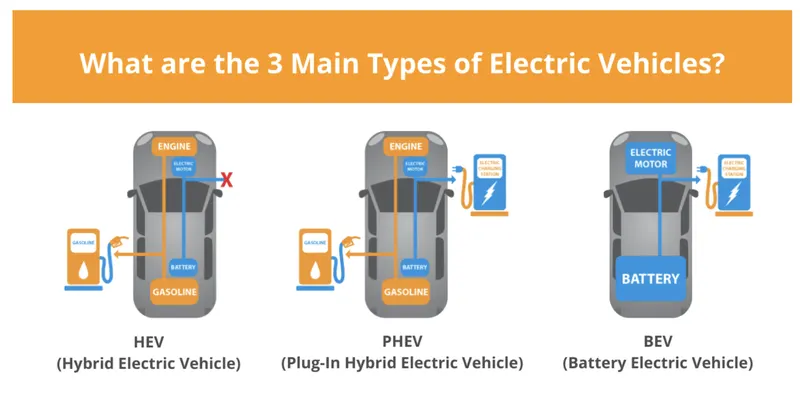
(1) HYBRID ELECTRIC VEHICLE :
A hybrid electric vehicle is a type of hybrid vehicle that combines a conventional internal combustion engine(ICE) system with an Electric propulsion system. The presence of the electric powertrain is intended to achieve either better fuel economy than a conventional vehicle or better performance. There is a variety of HEV types and the degree to which each function as an electric vehicle (EV) also varies. The most common form of HEV is the hybrid electric car, although hybrid electric trucks (pickups and tractors), buses, boats and aircraft also exist.
Modern HEVs make use of efficiency-improving technologies such as regenerative brakes which convert the vehicle's kinetic energy to electric energy, which is stored in a battery of super capacitor. Some varieties of HEV use an internal combustion engine to turn an electrical generator which either recharges the vehicle's batteries or directly powers its electric drive motors; this combination is known as a Motor generator. Many HEVs reduce idle emission by shutting down the engine at idle and restarting it when needed; this is known as a start stop system. A hybrid-electric produces lower tailpipe emissions than a comparably sized gasoline car since the hybrid's gasoline engine is usually smaller than that of a gasoline-powered vehicle. If the engine is not used to drive the car directly, it can be geared to run at maximum efficiency, further improving fuel economy.
(2) PLUG IN HYBRID ELECTRIC VEHICLE :
A plug-in hybrid electric vehicle (PHEV) is a hybrid electric vehicle whose battery pack can be recharged by plugging a charging cable into an external electric power supply source, in addition to internally by its on-board ICE-powered generator. Most PHEVs are passenger cars, but there are also PHEV versions of commercial vehicles and vans, utilityy buses,trucks, trains,motor cycles and even military vehicles.
Similar to all electric vehicle(BEVs), PHEVs displace greenhouse gas emission from the car tailpipe exhaust to the power stations generators powering the electricity grid. These centralized generators may be of renewable energy source (e.g.solar,wind or hydroelectric) and largely emission-free, or have an overall lower emission intensity, than individual internal combustion engines. Compared to conventional hybrid elecytric vehicles (HEVs), PHEVs have a larger battery pack that can be charged from the power grid, which is also more efficient and can cost less than using only the on-board generator, and also often have a more powerful electric output capable of longer and more frequent EV mode driving, helping to reduce operating costs A PHEV's battery pack is smaller than all-electric vehicles for the same vehicle weight but has the auxillary option of switching back to using its gasoline/diesel engine like a conventional HEV if the battery runs low, alleviatingrange anxiety especially for places that lack sufficient charging infrastructure.
(3) BATTERY ELECTRIC VEHICLE :
A battery electric vehicle (BEV), pure electric vehicle, only-electric vehicle, fully electric vehicle or all-electric vehicle is a type of electric vehicle(EV) that exclusively uses chemical energy stored in rechargable battery packs with no secondary source of propulsion (e.g. hydrogen fuel cell, internal combustion engine, etc.). BEVs use electric vehicles and motor controllers instead of ICEs for propulsion. They derive all power from battery packs and thus have no internal combustion engine, fuel cell, or fuel tank. BEVs include – but are not limited to – motorcycles, bicycles, scooters, skateboards, railcars, watercraft, forklifts, buses, trucks, and cars.
But in all this type of vehicles we usually use three type of power converters
1. AC-DC converter
2.DC-DC converter
3. DC-ACconverter
1. AC-DC converter :
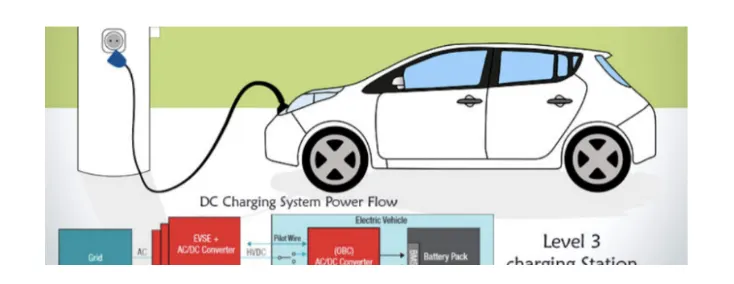
AC-DC converter is used for charging.
As battery stores energy in form of DC, so AC DC power converter is required.
This are usually used in Plug in HEV and PEV .
2. DC-DC Converter :
We know light indicators and other signal generators requires only low voltage.
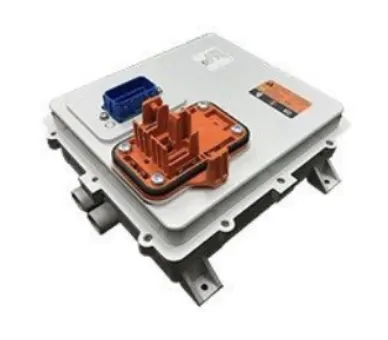
So the battery energy will convert low voltage DC by DC to DC converter.
3.DC-AC converter :
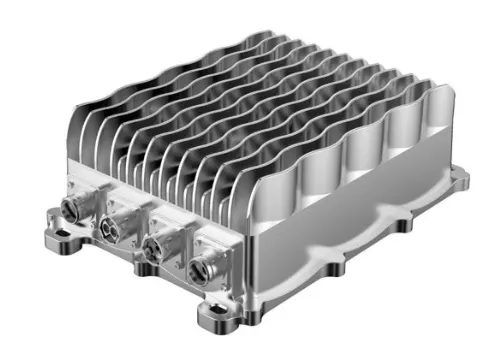
DC-AC converter is used to convert the battery energy to AC to supply the motor.
Therefore converted energy is used for motor operation.
QUESTION 2 : An Electric Vehicle's powertrain with 72V battery pack in shown in the diagram below. The duty ratio for acceleration operation is 'd1' and for the braking operation the duty ratio is 'd2'.
according to torque formulaa, we will be finding speed in rad/sec.
Rated armature voltage = Va = 72V
Rated armature cuurent = 400A
R(alpha) = 0.5ohm
k(phi) = 0.7 volt second
chopper switiching frequency = 400Hz
Tv = 24.7 +(0.0051)omega^2
for duty cycle = 70%
Voltage = Va*duty cycle
=72*0.7
=50.4V
Now, since torque T = k(phi)/Ra*[Va - K(phi)omega]
by substituting the values,
Torque T = (0.70/0.5*(50.4-0.7w)
= 1.4 * (50.4 - 0.7w)
= 70.56 - 0.98 omega
T = 70.56 - 0.98 omega and
Tv = 24.7 + 0.0051omega^2
at T = Tv;
70.56 - 0.98omega = 24.7 + 0.0051omega^2
or 0.0051omega^2 +0.98 omega +24.7 - 70.56 = 0
or 0.0051omeag^2 + 0.98omega -45.86 = 0
i.e
omega = 38.91 or -231.07
Since speed cannot be negavtive we Will consider that the EV steady state speed if the duty cycle is it 70% is
omega = 38.915 rad.s^-1 or 371rpm.
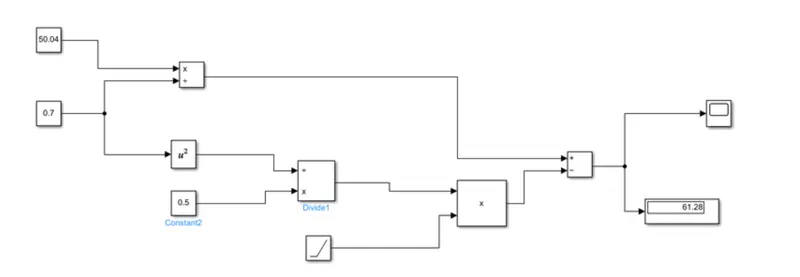
QUESTION (3) Develop a mathematical model of a DC Motor for the below equation using Simulink.
ω">ωω= V/Kϕ">ϕϕ -Ra/Kϕ">ϕϕ^2 .T
SIMULINK MODEL :
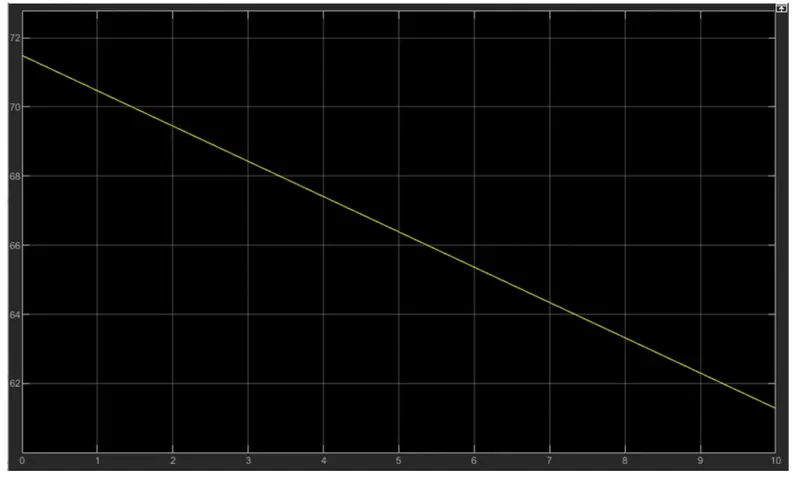
OUTPUT :
QUESTION (4) : Refer to the blog on below topic:
Induction Versus DC brushless motors by Wally Rippel, Tesla
Explain in brief about author’s perspective.
1. There is no such thing called the best engine according to the personal requirements we need to adapt the engine type.
2. In the course of time lead acid batteries are replace by lithium ion batteries.
3 in the course of time DC brush motors are replaced by DC brushless or induction motors.
4. In the course of time contactor controllers are replaced by modulating inverters.
5. There is a bigger concern regarding the stable use of these elements mention about over the next few decades.
6. The author discusses the two technology such as DC brushless drives and induction motor with its feature of operation.
7. He says the priceless motors are useless motors without the inverter.
8. He also mentioned that the three phase induction motor has great utility but with several limitations.
9. The major limitation being the induction motor cannot operate from DC and AC is a must.
10. He also compares the future trends which may occur in DC brushless as well as an induction motor.