Week 1 Understanding Different Battery Chemistry
AIM : To understand the chemistry of different batteries.
OBJECTIVE :
1.To Prepare a table which includes materials & chemical reactions occurring at the anode and cathode of LCO, LMO, NCA, NMC, LFP and LTO type of lithium ion cells.Give your detailed explanation on it.
2.To Compare the differences between each type of Li+ion batteries based on their characteristics.
CONCEPT :
An elctric battery is a source of electric power consisting of one or more electrochemical cells with external connections for powering electrical devices.When a battery is supplying power, its positive terminal is the cathode and its negative terminal is the anode. The terminal marked negative is the source of electrons that will flow through an external electric circuit to the positive terminal. When a battery is connected to an external electric load, a redox reaction converts high-energy reactants to lower-energy products, and the free energy. difference is delivered to the external circuit as electrical energy. Historically the term "battery" specifically referred to a device composed of multiple cells; however, the usage has evolved to include devices composed of a single cell.
There are 2 types of batteries
1)PRIMARY CELL - this batteries are one time used batteries and cannot be reused by charging them. Their chemical reactions are generally not reversible so they cannot be recharged.
2)SECONDARY CELL- By applying electric current to the cell this batteries can be recharged and can be used multiple times.
LITHIUM ION CELLS:
1) ANODE : An anode is an electrode through which the conventional current enters into a polarized electrical device.
They are positive eletrodes of the cell. Anode electrode is usually made up of
(a)Graphite
(b)hard carbon, this are usually less in cost and high in stability.
2) CATHODE : A cathode is the electrode from which a conventional current leaves a polarized electrical device.
cathode eletrode is usually made up of
(a) Layered transition metal oxides( Has high capacity but high is cost and poor in safety purpose)
(b) Spinels-They have high power density but poor in conductivity and stability.
(c)Olivines-They have less capapcity but high in safety and has a longer life.
3) ELECTROLYTE:
An electrolyte is a medium containing ions that is electrically conducting through the movement of ions, but not conducting electrons. This includes most soluble salts acids and bases dissolved in a polar solvent such as water. Upon dissolving, the substance separates into cations and anions,which disperse uniformly throughout the solvent. Solid state electrolytes also exist. In medicine and sometimes in chemistry, the term electrolyte refers to the substance that is dissolved. Generally lithium ion cells have electrolytes of organic solvents such as Ethylene carbonate, diethylene carbonate, propylene carbonate as solute.
4) SEPERATOR :
Battery seperatore provies as a wall between anode and cathode while making sure the transfer of lithiun ions from one side to the other. They are materials that conduct ions but do not conduct electrons through them.
Li-ion use polyolefin as a seperator, which has good mechanical properties and als cheap in cost and good chemical stability.
WORKING OF LITHIUM ION CELL:
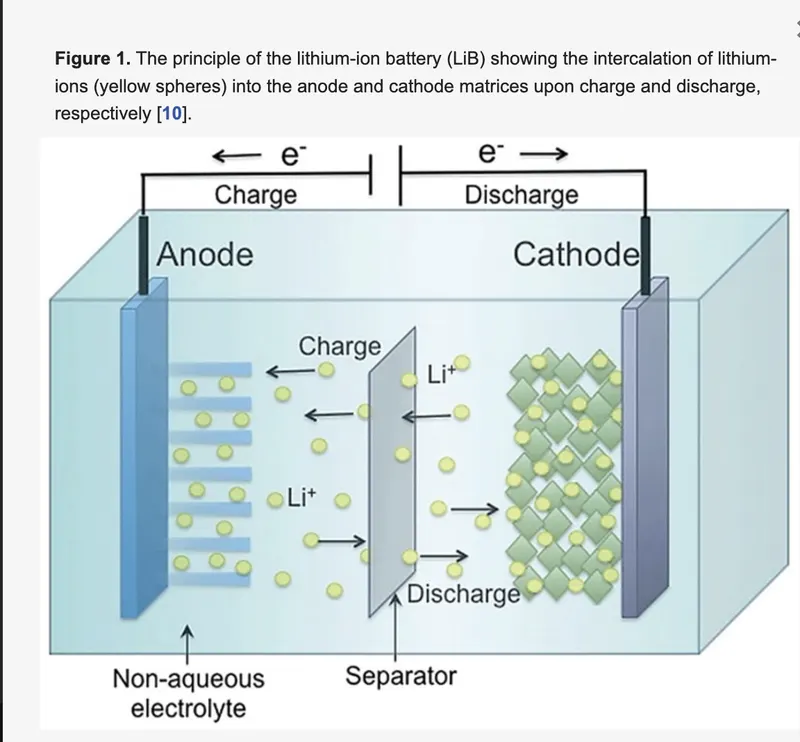
The battery is made up of anode,cathode ,seperator,electrolyte and two current collectors(positive and negative), the anode and cathode store the lithium. the electrolyte carries positively charged lithium ions from the anode to the cathode and from cathode to anode via the seperator. This movement of lithium ions create free electrons in the anode which creates a charge at the positive cureent collector. The electrical current then flows from cureent collector through a device being powered to the negative current collector. The seperator blocks the flow of electrons inside the battery. While the battery is dicharging and providing an electric current, the anode releases lithium ions to the cathode generating a flow of electrons from one side to the other. When charging the opposite happens wehere litium ions are released by the cathode and recieved by the anode. This is the working of lithium ion battery.
OBJECTIVE-1
TYPES OF LITHIUM ION BATTERIES
1) LITHIUM COBALT OXIDE(LiCoO2)-(LCO)
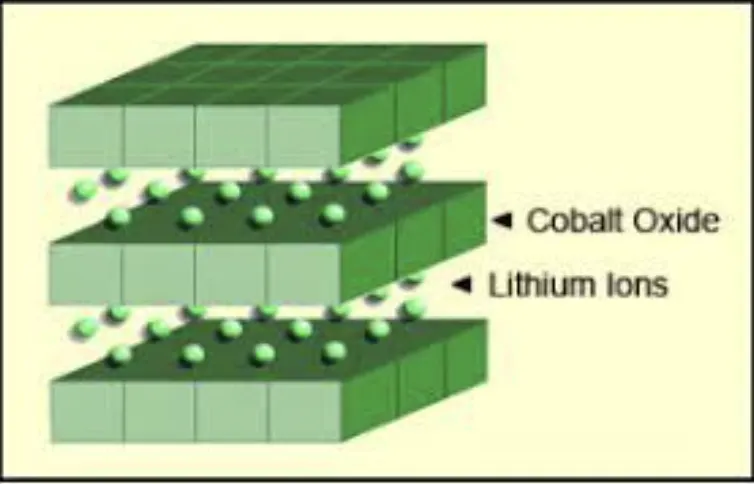
It has highg specific energy but low specific power which means that charging and discharging with current rate above rated values shorten the battery's life. It has a cobalt oxide cathode and graphite anode. the cathode is layered. During disvharge the Li-ions move from anode to cathode. the flow reverses during charging. the graphite anode limits its cycle life hence it has a short life span. It als has a low thermal stability. It is mainly used in mobile phones,laptops ,cameras etc. As the cathode lithium ions are absorbed by the lithium dioxode and the electrode is reduced as it also recieves the electrons from the circuit.
Cathode reaction:
LiCoO2 <-> (Li1 -xCoO2) +(xLi^+) + (xe^-)
At the anode lithium is oxidized.Lithium ions are released from the carbon along with electrons.
Anode reactoin : 6C + (xe^-) +xLi^+ <-> LixC6
Overall reaction : LiCoO2 + 6C <-> LiC6 + CoO2
2)LITHIUM MANGANESE OXIDE(LiMn2O4)-(LMO)
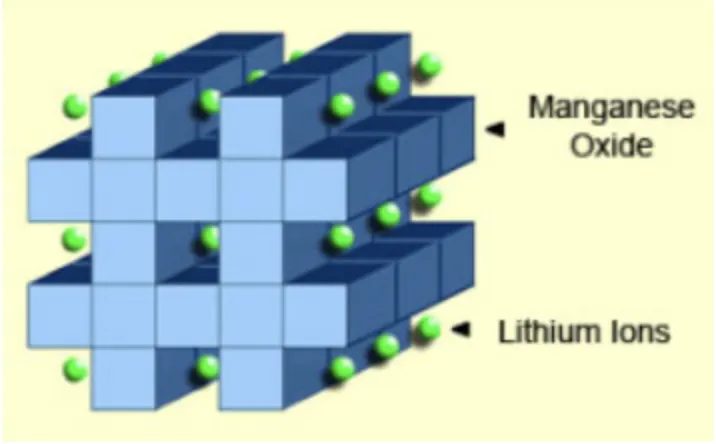
The manganes oxide forms a 3D spinel structure that improves the ion flow on electrode. This resuts inlower internal resistance ,which enables fast charging and high current discharge. The spinel structures also packs extra thermal stability making it safer as compared to LCO.LMO has lower life cycle.
Most Li manganese batteries blend with lithium nickel manganes cobalt oxide (NMC) to enhance precise energy and prolong battery life. this three active metals as well as silicon enhancement can enhance specific energy,speciifc power or longetiivty.LI-manganes has high power and less capacity. It is used for power tools,medical devices as well as in electric vehicle powertrains.
Cathode reaction : LiMnO2 <-> Li1-xMn2O4 + xLi^+ +xe^-
Anode reaction : LiMno2 <-> Li1 = Mn3O4 + xLi^+ =xe^-
Overall reaction : LiMnO2 <->Li1 - xMnO4 + xLi6= + xe^-
(Order of equation :left to right charging and right to left discharging)
3)LITHIUM NICKEL COBALT ALUMINIUM OXIDE(LiNiCoALO2)(NCA)
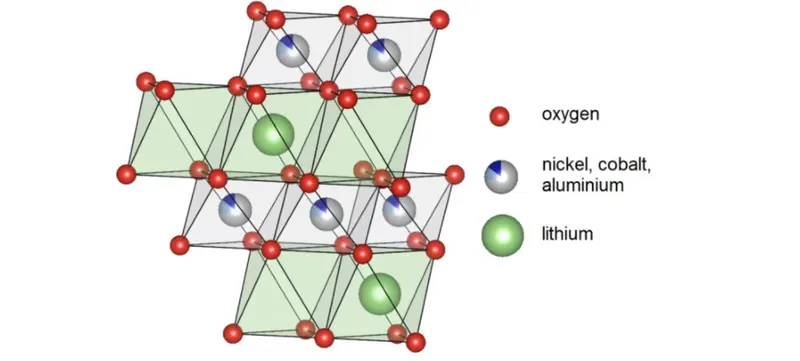
NCA batteries are gaining importance in electric powertrains and grid storage. they are not common in the consumer industry but are good for automotive sector. This technology is is used by famous TESLA. NCA has the highest specific energy, good specific power and a long life span. Here its high cost and marginal safety are the issue of concern.
cathode reaction : LiNiCoAlO2 <-> Li1 -xNiCoAlO2 + xLi^+ +xe6-
anode reaction : xLi^+ + xe6- + 6C <-> LiC6
overall reaction : 6C + LiniCoAlO2 <-> LiC^ + NiCoAlO2
(Order of equation :left to right charging and right to left discharging)
4)LITHIUM NICKEL MANGANESE COBALT OXIDE(LiMnCoO2)-(NMC)
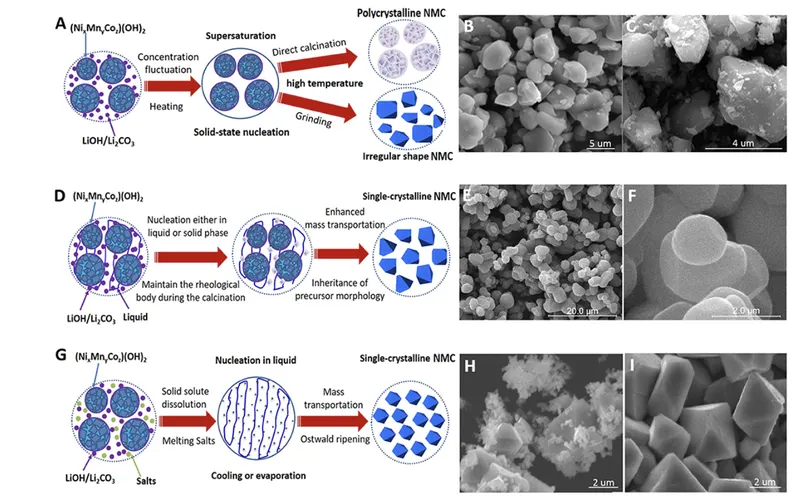
the cathodic combination of nickel manganes cobalt can be tailored to be either energy cells or power cells. NMC has a good performance and excels in specific energy. This Lithium ion battery can deliver a continous dicharge current. The advantage of nicel is its high specifc energy but it has poor stability . Wherras manganese achieves low internal resistance by forming a aspinal structure. unlike nickel , manganes offers low speciif energy.
Cathode reaction: LiMnO2<-> Li1 - xMnO2 + xLi^+ +xe^-
anode reaction: LiMnO2 <->Li1-xMO2 +xLi^+ +xe^-
overall reaction: LiMnO2 <->li1-xMO2 +xLi^+ +xe^-
(Order of equation :left to right charging and right to left discharging)
5)LITHIUM IRON PHOSPATE(LiFePo4)-(LFP)
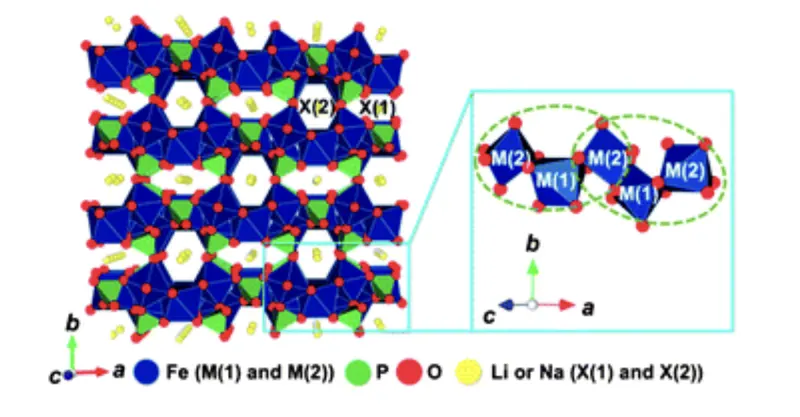
In this type,Li-phospate is used as the cathode since it has good electrochemical performance with low resistance. this is because of the nano scale phospate cathode material. Various advantages of this lithium-ion batter chamistry includes-long life battery life cycle, good thermal stability, high current rating ,enhanced safety and tolerance in case of abuse. Li-phospate is often used to replace lead acid batteries as it has a moderate specific energy and has a very low tolerance for moisture, which reduces its cycle life. At the cathode, lithium ions are absorbed by the lithium dioxide and the electode is reduced as it also recieves the electrons from circuit.
cathode reaction:Life(3)PO4 <-> Li1 -xFe(2) PO4 + xLi^+ +xe^-
at anode lithium is oxidized.Lithium ions are released from the carbon, along with electrons
anode reaction: xLi^+ +xe^- +6C <-> LiC6
Overall reaction : LiFePO4 + ^C <->LiC6 + FePO4
(Order of equation :left to right charging and right to left discharging)
6)LITHIUM TITANIUM OXIDE(LiTiO2)(LTO)
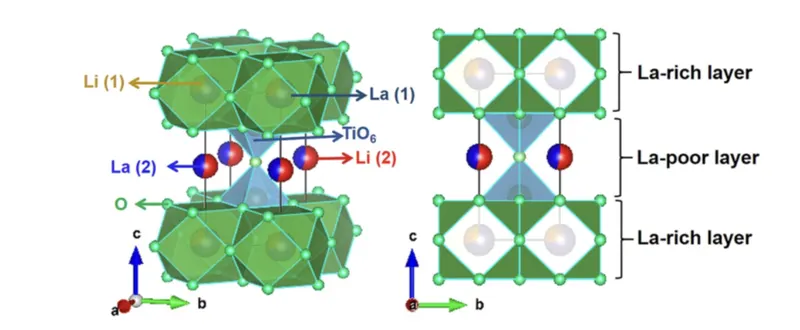
In this technology Li-titranate replaces the graphite in the anode of a typical lithium ion battery and the material forms into a spinel structure. The cathode can be lithium manganes oxide or MNC. li-titranate can be fast charged and delivers a high discharge current 10 times the rated capacity. the cycle count is higher then the regular Li-ion batteries. Li-titrante is very good in safety and has very good low temp discharge and life span.. It is used in electronic powertreains, UPS, solar powered street lihgting.
cathode reaction :4LiMnO4 <-> 4MnO4 + 4li^+ +4e^-
anode reaction : ti5O12 + 4Li^+ + 4e^- <-> Li4tiO12
oveeall reaction : Li4TiO12 + 4MnO4 <->4LiMnO4 + TiO12
(Order of equation :left to right charging and right to left discharging)
COMPARISON TABLE OF MATERIALS:
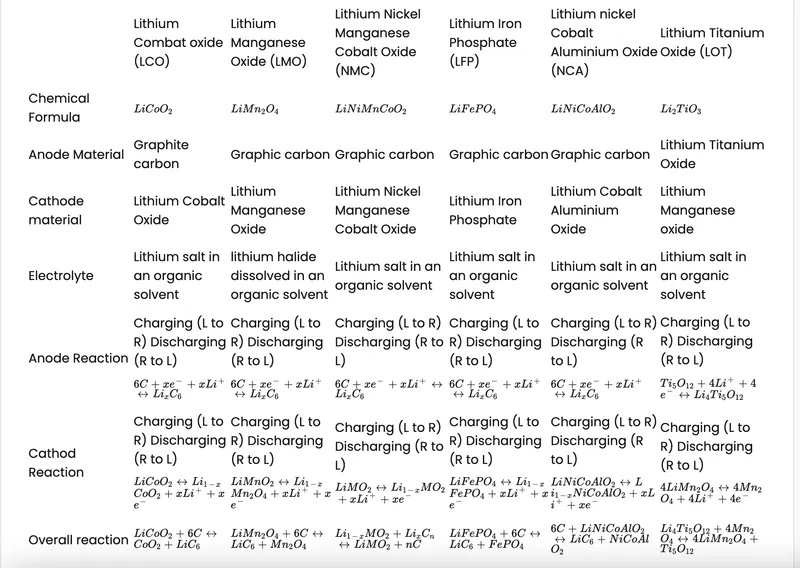
OBJECTIVE 2
Compare the differences between each type of Li+ion batteries based on their characteristics.
*NOMINAL VOLTAGE : it is the system voltage at which the device is deigned to operate. The rated voltage is usually higher then the nominal voltage to ensure the safe operation of the device.
*CYCLE : the charge and dicharge when took place each for a single time, makes a cycle. the higher the cycles csn tske place, the higher is the lifespan.
* THE CURRENT RATE : This is used to determin the fast charging capability and short circuit discharge capability of battery.
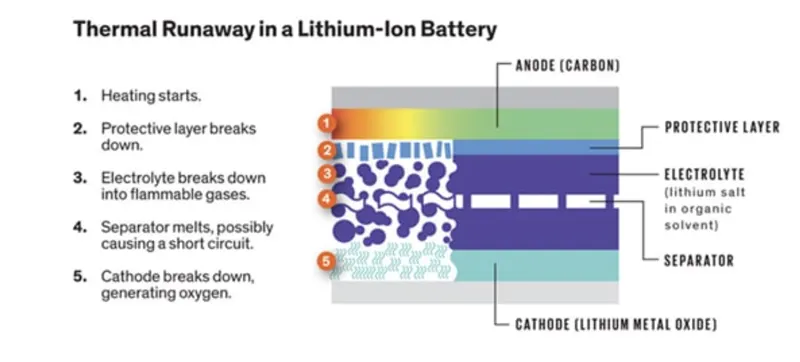
*THERMAL RUNAWAY : Thermal runaway begins when the heat generated within a battery exceeds the amount of heat is disspitated to its surroundings. if the cause of excessive heat creation is not remdied,the condition will go more bad. internal battery temperature will continue to rise, causimg battery current to rise, creating a domino effect. the rise in temperature in single battery will begin to affect other batteries nearby and the pattern will continue this is called as runaway.
*SPECIFIC ENERGY : It is the amount of energy stored per unit mass(Wh/kg) This is a very imp deciding factor that decides how much energy or power we are going to get from different batteries with same amount of weight.
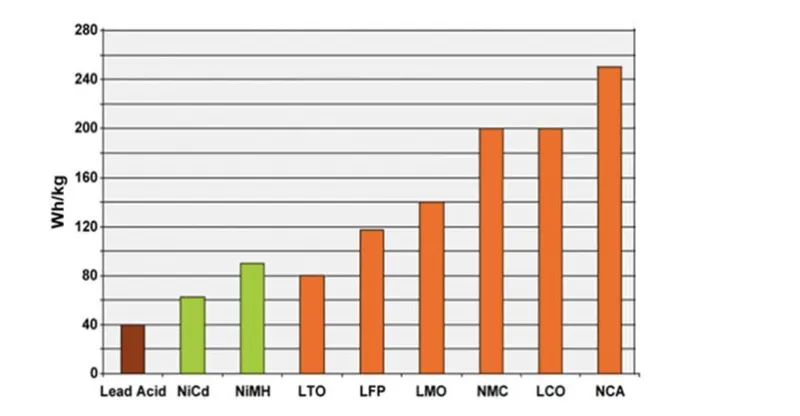
*TYPICAL SPECIFIC ENERGY OF DIFFERENT TYPES OF LITHIUM BASED BATTERIES :
The main difference betyween the 6 types of li+ ion batteries can be differentiated based on the characteristics and a scrreenshot is shown below.
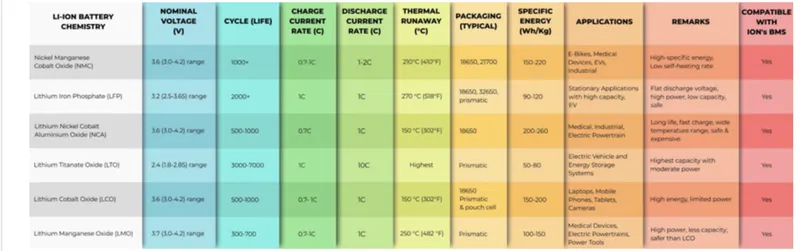
Nominal voltage : Most of them are very close when it comes to this characteristic. LMO has the highest range and LTO has lowest range in volts.
CYCLE LIFE : they differ by a significant amount from each other mostly. LTO batter has the longest life cycle thats why it can last for a longer period of time and it is exactly the opposite for the LMO type batteries.
Charge current rate: Higher the charge current, the less time the battery will take to get fully charged. LFP and LTO are highest, NCA comes close to its contenders but finishes last in this case.
Discharge Current Rates : In severe cases, we can cause an internal short circuit and even an explosion. Most consumer applications require only 1C from their batteries. If we need higher discharge rates and faster charging times, you should definitely choose a high rate battery insteAD. LTO has a discharge rate 10 times higher then the others, that is why it is one of safest batteries.
Thermal Runaway: it we discussed before,a thermal runaway occurs in situations where an increase in temperature changes the conditions in a way that causes a further increase in temperature often leading to a destructive result. It is a kind of uncontrolled positive feedback we know that higher the temperature at which the thermal runaway will occur, the safer the battery will be.LTO has the highest temperature rating in this and NCA and LCO has the lowest.
Specific Energy : The specific energy density can be calculated by integrating from zero to t(cutoff) the expression V(t)*|*A dt then dividing by (3600*Mw). In this way we can obtain the specific energy density in Wh Kg^-1. Lithium ion with cobalt cathodes offers the highest energy densities. Common applications are cellphones,laptops,cameras.Power density indicates how much power a battery can deliver on demand.
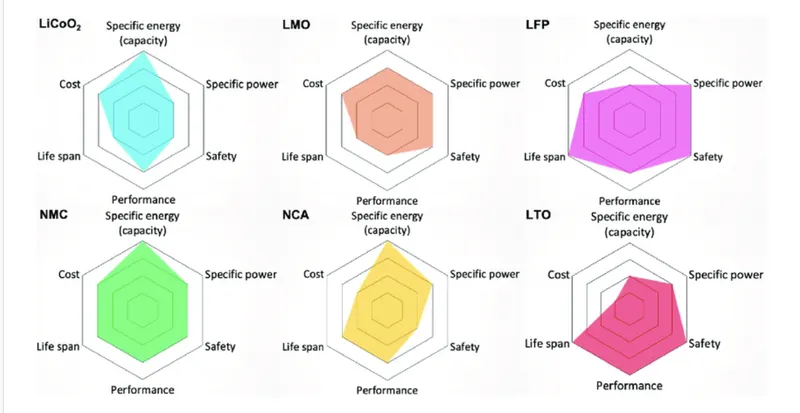
For choosing a proper battery 6 points have to be considered with help of 5 point hexagonal analysis.The 6 factors are as follows.
1)specific energy
2)safety
3)specific power
4)performance
5)life span
6) Cost
RESULTS : We have completed the study of all lithium-ion cells with their reactions,performance and other parameters.