Week-6 Challenge: EV Drivetrain
Aim:
1. Power converter in EV and HEV
2.EV steady state speed when duty cycle is 70 percent for given conditions
3. Mathmatical model of the ω= V/Kϕ -Ra/Kϕ^2 .T using simulink
4.Brief of the Brushless DC motor vs Induction Motor by author's perspective.
Explanation:
1. Power Converters.
- There are mainly two types of power converters used in EV and HEV. One is DC to DC converter and Other One AC to DC converters
- There are many different types of circuits for these.
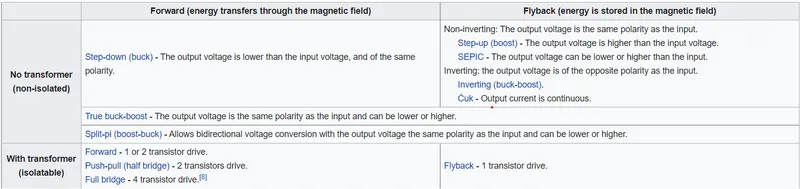
- All DC to DC converters can move power in one direction and also all of these can convey power in both directions.
These converters can be classified in following categories.
Objective 2:
- For given conditions
V= 72volt
A=400Amps
Armature Resistance= 0.5 Ohm
KΦ= 0.7 Volt second
Duty cycle is 70% find steady state speed?
Now
we have equation ω= V/Kϕ-Ra/Kϕ^2 .T where
for duty cycle 70 % voltage is 50.4
value of the above equation will be
ω= 72-1.02 .T
Rearranging the term will get the value
T=70.588-0.98ω .......equation 2
T=24.7+(0.0051)ω ^2 .........equation 1 (Given)
By equating both sides we will get the equation
(0.0051)ω ^2 +0.98ω-45.888=0
solving above equation we get
ω = 38.9353 rad/s
or we can say 371.80 rpm.
Objective 3:
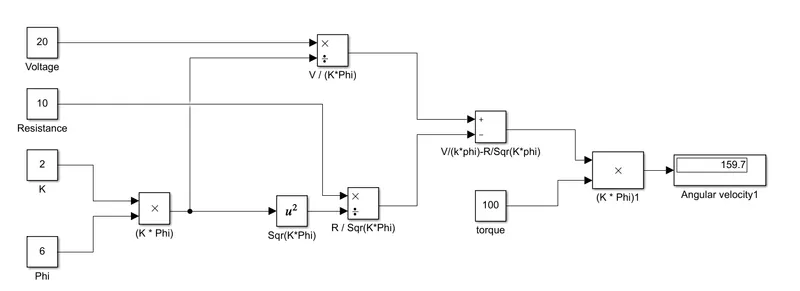
Mathematical model of the equation
ω= (V/Kϕ-Ra/Kϕ^2) .T
Below is the simulink model which represents this equation.
Objective 4:
Article by Wally Rippel
This article is mainly based on the use of DC brushless motors and induction motors in EV and HEV
Author has compared the burshless DC motor and Induction motors. As in todays EV's DC motors and Inducation motors used. There is only basic difference in construction of these two motors is that DC motor has two magnets while the induction motor includes no magnet. DC brushless motor and Induction motor both have almost identical stators. Induction motor operates on the basis of AC while DC motor operates in DC.
DC motors need an inverteer to start under the load while induction motor does not need inverter, without inverter basically DC motors are useless.
Both induction and DC motors have their own advantage such as DC motor can generate more torque than the induction motor as induction motor is good for the constant torque and good for limited torque.
Burshless DC motor has unity power factor while the induction motor attain maximum 0.85 power factor. as DC brushless motors use permanant magnets they are not cheap as PM per kg costs around 50 dollar and also its not easy to control the forces produce by permanant magnets in this case Induction motors wins because they don't need permanant magnets.
But Inducation motors are hard to control as the have varying current control over speed torque is hard and also temperature control is hard.
Both induction and DC motor have their owan pros and cons but both will work good in their field of expertise as DC brushless motor will dominate the Plug in hybrid and HEV while induction motors will work in pure electric vehicles.
Conclusion
1. Power converters used in EV and HEV explained.
2.Successfully calculated the steady state speed in 70% duty cycle.
3. Mathematical model for the given relation is produced.
4.Brief of Brushless DC motor vs induction motor is explained