Project-1: Powertrain for aircraft in runways
Aim :
Powertrain for Aircraft in runways.
Introduction:
Aircrafts does not always work on engines when they are on ground, because engine power for the airplanes can be hazardous on the ground. so when they are moving on the ground are usually with towing with vehicle. But heavy airplanes with carrying capacity more that 200 or so move on the ground with engines with low power level as the towing is not possible with them. Towing of the aircrafts is totally depends upon their weights
There are various aircrafts with different weight range like smallest aircraft can weigh as much as of gross 1630kg and larger on can weigh up to 640000kg.
Aircraft Types:
Turboprop Aircraft
Piston Aircraft
Jets
Light Jets
Mid-Size Jets
Jumbo Jets
Regional Jets
Narrow Body Aircraft
Wide Body Airliners
Commuter liners
Airbus
Reference taken from:
https://lemonbin.com/types-of-airplanes/
As aircrafts travel from the air their speeds are calculated on two different speed, one is ground speed and second is air speed.
So what is difference between two of them
Air speed -
Air speed of the aircraft is relative to the air. That means it depend on speed of the wind and direction.
Airspeed cannot be directly measured from a ground position, but must be computed from the ground speed and the wind speed. Airspeed is the vector difference between the ground speed and the wind speed.
Ground Speed:
Ground speed, on the other hand, is the aircraft’s speed relative to the ground. One thing that should be noted here is that it’s its horizontal rather than vertical speed – an aircraft climbing completely vertically would have a ground speed of zero.
The relationship between airspeed and ground speed is fairly simple. Ground speed is simply the sum of airspeed and wind speed.
If the aircraft is flying in the same direction as the wind is blowing, the aircraft experiences tailwind, and its ground speed is higher than its airspeed. On the other hand, if the wind is blowing against the direction the aircraft is traveling in, the aircraft experiences headwind, and its ground speed is lower than its airspeed.
Aircraft Take off Power
Take Off Power
Take off power = Total Power of Engine.
Total power of engine is depends on the force required to overcome all the forces of the aircraft
That includes - Acceleration, drag, rolling resistance
Now lets assume Boeing 737 -800 aircraft
Specs -
Gross Weight in kg - 79,015kg
Area -125.0 m^2
Drag coefficient for aircrafts - 0.15
Accelerationd due to gravity - 9.81m/s
max speed on runway- 80 m/s
Engine thrust - 107.6 kN
Rolling resistance- 0.02
runway length - 5500m
Lift coefficient - 1.5
Density of air -1.225 kg /m^3
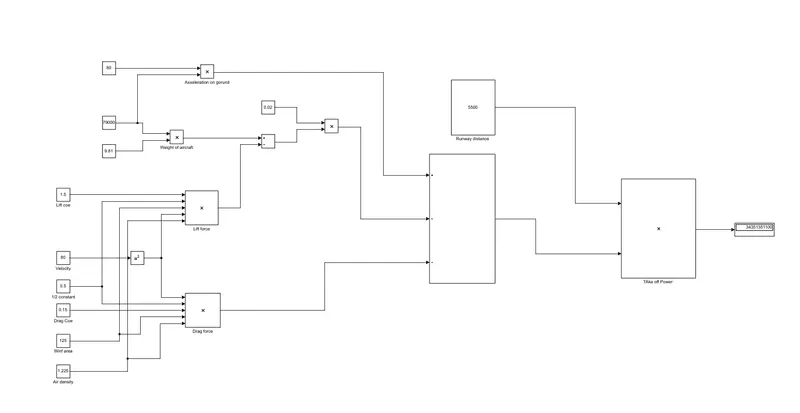
Take off power calculation for aircraft.
For the movement of the aircraft on ground we need a powerful vehicle or powertrain to overcome the weight of aircraft.
Assuming the rolling resistance coefficient other than runway to be 0.3
Now our assumed data is
Mass of aircraft - 79000kg
rolling resistance coefficient - 0.3