Week-6 Challenge: EV Drivetrain
AIM:
1. WHICH TYPE OF POWER CONVERTER CIRCUITS ARE EMPLOYED IN AN ELECTRIC AND HYBRID ELECTRIC VEHICLE?
2. What is EV steady-state speed if the duty cycle is 70%?
3. Explain in brief about author’s perspective.
OBJECTIVE:
1. WHICH TYPE OF POWER CONVERTER CIRCUITS ARE EMPLOYED IN AN ELECTRIC AND HYBRID ELECTRIC VEHICLE?
ANSWER:
- IN POWER ELECTRONIC THERE ARE 4 TYPES OF POWER CONVERTER CIRCUITS,
1. AC-DC POWER CONVERTER (RECTIFIER)
2. DC-AC POWER CONVERTER (INVERTER)
3. DC-DC POWER CONVERTER (CHOPPER)
4. AC-AC POWER CONVERTER (REGULATOR)
- BUT MAINLY 3 TYPES OF POWER CONVERTER CIRCUITS ARE PRESENT IN ELECTRIC AND HYBRID ELECTRIC VEHICLE.
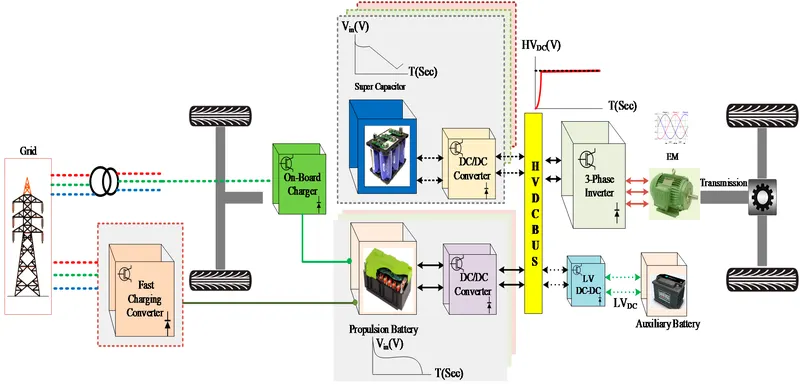
1. AC-DC POWER CONVERTER (RECTIFIER):
- In the electric and hybrid electric vehicle, the power from the AC supply is distributed to the DC brushless motor. The RECTIFIER power converter is used
2. DC-AC POWER CONVERTER (INVERTER):
- In the electric and hybrid electric vehicle, the power from the DC supply is distributed to the AC INDUCTION motor. The INVERTER power converter is used
3. DC-DC POWER CONVERTER (CHOPPER):
- In electric and hybrid electric vehicles, the power from the DC axillary power supply is distributed to different DC components with specified DC voltage. The CHOPPER power converter is used
2. An Electric Vehicle's powertrain with a 72V battery pack is shown in the diagram below. The duty ratio for acceleration operation is 'd1' and for the braking operation the duty ratio is 'd2'.
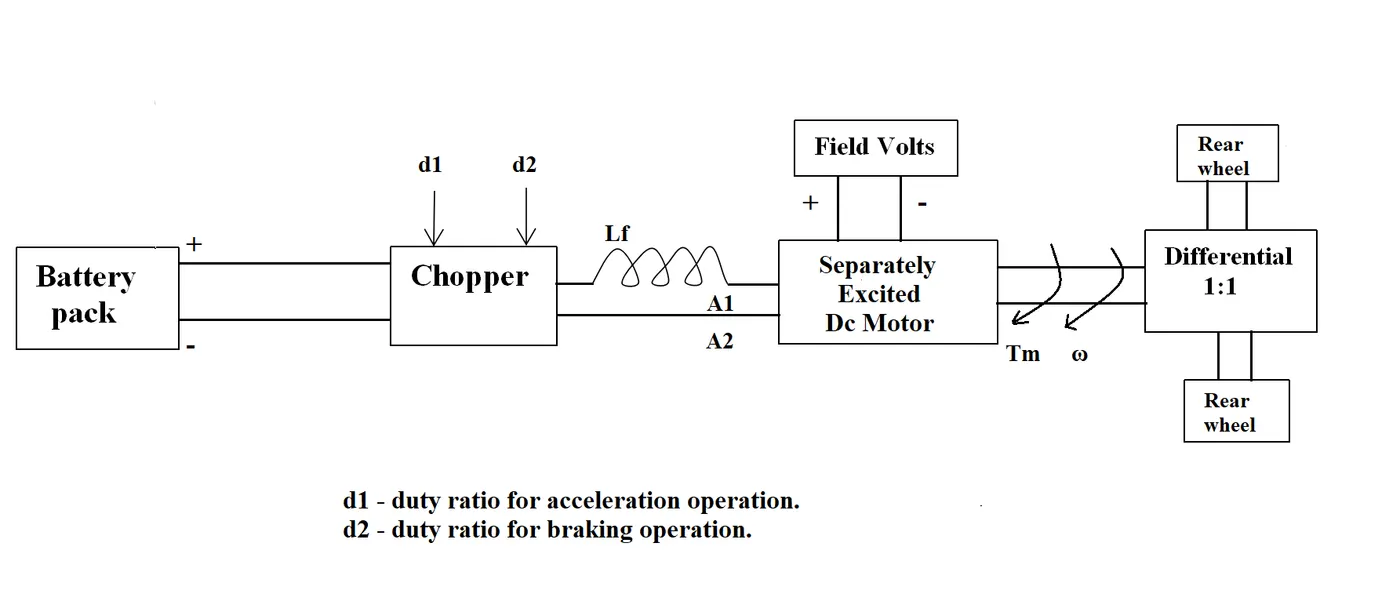
What is EV steady-state speed if the duty cycle is 70%?
ANSWER:
The other parameters of the electric vehicle are given below, Motor and Controller Parameters:
- Rated Armature voltage, `V_a`= 72 V
- Rated Armature current, `I_a`= 400 A
- Rated Armature resistor, `R_a`= 0.5Ω
- Rated Motor constant, `Kphi`= 0.7 Volt second
- Chopper Switching frequency= 400 Hz
- The vehicle speed-torque characteristics are given by the below equation:
- `T_v = 24.7 + (0.0051)omega^2`------Eq 1.
- The duty cycle is `70%`= `0.7`
Now Source Voltage, `V_s = V_a * 0.7`= `72 * 0.7 = 50.4.`
The motor torque is taken as `T prop phiI`, `T_m = KphiI`
where, `I = V_(Total)/R_a`, `V_(Total) = V_s-E_b,``E_b=Kphiomega`
Now, `T_m = Kphi[V_(Total)/R_a]``= Kphi[(V_s-E_b)/R_a]``= Kphi[(V_s-(kphiomega))/R_a] = Kphi[V_s/R_a-((kphi)omega)/R_a]`
`therefore T_m = (KphiV_s)/R_a-((Kphi)^2omega)/R_a=(0.7*50.4)/0.5-((0.7)^2*omega)/0.5`
`T_m = 70.56-0.98omega`-------Eq 2.
- At study state Vehicle Torque, `(T_v)` and Motor Torque, `(T_m)` are equal, where `T_v=T_m`.
Now from equation 1 & 2, we get:
`24.7+(0.0051)omega^2 = 70.56-0.98omega,`
`(0.0051)omega^2+0.98omega-70.56+24.7=0,`
`(0.0051)omega^2+0.98omega-45.86=0,`
so to know the `omega`value we get factorization,
above equation in quadratic form of `ax^2+bx+c =0`
then the values of `a= 0.0051,b=0.98,c=-45.86.`
`omega =(-b+-sqrt(b^2-4ac))/(2*a)`
`omega=(-0.98+-sqrt((0.98)^2-(4)(0.0051)(-45.86)))/(2(0.0051)),`
`omega=(-0.98+-sqrt((0.9604)+0.935544))/(0.0102),`
`omega=(-0.98+-sqrt(1.895944))/(0.0102),`
`omega=(-0.98+-1.37693)/(0.0102),`
`omega=(-0.98+1.37693)/(0.0102),(-0.98-1.37693)/(0.0102).`
`omega=38.91(radian)/(sec),or omega=-231.07(radian)/(sec)`
RESULT:
Here we got two values of angular velocity which are positive and negative, suppose the movement of the vehicle is in a forwarding direction it shows the positive rotation of the wheel and hence it is in study state position no chances of reverse position or negative direction, so we can remove the second value and only consider the positive angular velocity value of `omega=38.91(radian)/(sec)`.
3. Explain in brief about author’s perspective:
ANSWER:
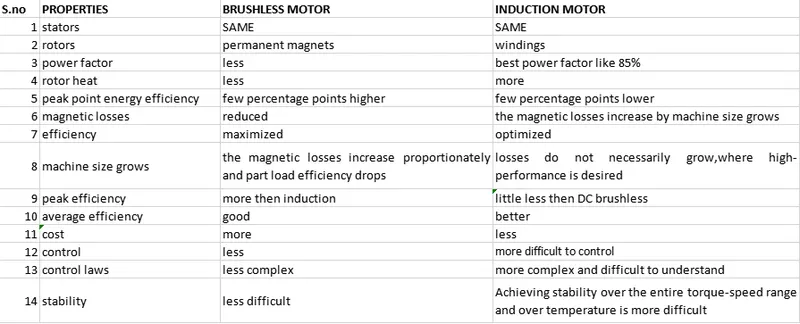
The article deals with INDUCTION MOTOR Vs DC BRUSHLESS MOTOR.
The Author of this Article is WALLY RIPPEL.
Wally Rippel is saying Four main points in this Article about induction motor and dc brushless motor. which are,
- ONE SIZE DOES NOT FIT ALL OR (VEHICLE PERFORMANCE):
- It says that Every vehicle is not the same.
- There is no best engine type but there are different types of engines to suit the personal requirement such as price and performance.
- Previously lead-acid batteries, DC brush motors, and contactor controllers are mainly used and now batteries were replaced by lithium-ion batteries and DC brush motors by either DC brushless or Induction and Contactors have replaced by modulating inverters.
- however, the author says that "we will see both induction and brushless machines “creates a revolution in electric vehicles” for many years to come".
- A CLOSER LOOK OR HOW THE DC BRUSHLESS MOTOR AND INDUCTION MOTOR WORKS?:
- BRUSHLESS MACHINES:
- In brushless machines, the torque remains constant and the conversion of electrical to mechanical energy is optimally efficient.
- The torque remains constant and the conversion of electrical to mechanical energy is optimally efficient.
- the brushless rotor has magnets
- INDUCTION:
- The brushless and induction motor are virtually identical, only the rotatory part of the motor is not the same.
- The frequency of this magnetic field of the rotor is equal to the difference between the applied electrical frequency and the rotational frequency of the rotor itself.
- the induction rotor has no magnets.
- When a 3-phase induction motor is connected to utility type 3-phase power, torque is produced at the outset. The motor has the ability to start under load. No inverter is needed in the Induction motor.
- BRUSHLESS MACHINES:
- BRUSHLESS OR INDUCTION, WHICH ONE TO CHOOSE?:
- STIL NO WINNER:
- DC brushless drives will likely continue to dominate in the hybrid and coming plug-in hybrid markets.
- Induction drives will likely maintain dominance for the high-performance pure electrics.