Week-11 Challenge: Braking
AIM:
- CALCULATE THE ENERGY REQUIRED FOR BREAKING BY DRIVING CYCLE DATA.
- WHY ELECTRIC MOTOR CAN’T DEVELOP BRAKING TORQUE AT HIGH SPEED SIMILAR TO STARTING? HOW ELECTRIC AND MECHANICAL BRAKES ARE COORDINATED?
- MAKE A MATLAB PROGRAM WHICH PLOTS CONTOUR OF GIVEN MOTOR SPEED, TORQUE, AND EFFICIENCY VALUES.
OBJECTIVE:
QUESTION-1:
- CALCULATE THE ENERGY REQUIRED FOR BREAKING BY DRIVING CYCLE DATA.
ANSWER-1:
- THE REQUIRED BREAKING ENERGY IS THE SAME AS ACCLEARATION ENERGY
- THE BREAKING ENERGY IS CALCULATED FROM KINETIC ENERGY LAW WHERE, `1/2 M*V^2`.
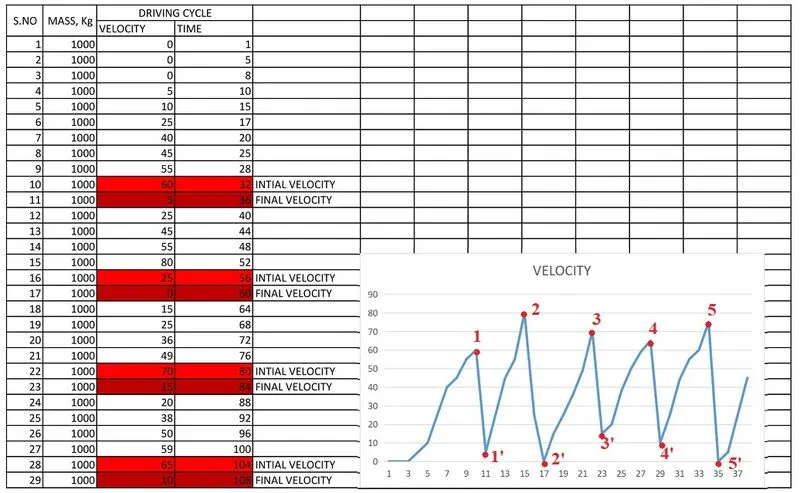
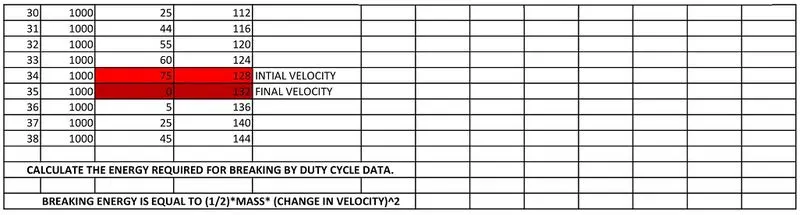
- The Energy required for Breaking is calculated by Kinetic energy as `1/2 *mass*V^2`.
- where,
- m = Mass
- V = velocity
- From the Duty cycle, the Velocity is taken as `DeltaV^2`which is a change in velocity.
- Here, `DeltaV=V_(I)-V_(F)`
- where,
- `V_(I)=` Initial velocity.
- `V_(F)=` Final velocity.
- CALCULATION OF BREAKING ENERGY FROM DRIVING CYCLE DATA.
- From the Driving cycle, There are 5 breaking points in the velocity graph
- From above data the Total breaking energy during cycle is,
- `B_E=1/2(m(Delta(V_(1,1')+V_(2,2')+V_(3,3')+V_(4,4')+V_(5,5'))))`
- From point (1,1')
- `DeltaV_(1,1')= V_1-V_(1')`
- `DeltaV_(1,1')= 60-5=55.`
- From point (2,2')
- `DeltaV_(2,2')= V_2-V_(2')`
- `DeltaV_(2,2')= 80 - 0=80`
- From point (3,3')
- `DeltaV_(3,3')= V_3-V_(3')`
- `DeltaV_(3,3')= 70-15=55`
- From point (4,4')
- `DeltaV_(4,4')= V_4-V_(4')`
- `DeltaV_(4,4')= 65-10=55`
- From point (5,5')
- `DeltaV_(5,5')= V_5-V_(5')`
- `DeltaV_(5,5')= 75-0=75`
- Now we know the values of all the changes in the velocity of breaking energy.
- From point 1,
- `B_(E1)=1/2(m)(DeltaV_(1,1'))^2`
- `B_(E1)=1/2(1000)(55)^2`
- `B_(E1)=1,512,500`, [`becauseK=1000``
- `B_(E1)=1512.5,K_j.`
- From point 2,
- `B_(E2)=1/2(m)(DeltaV_(2,2'))^2`
- `B_(E2)=1/2(1000)(80)^2`
- `B_(E2)=3,200,000`, [`becauseK=1000`]
- `B_(E2)=3200,K_j.`
- From point 2,
- `B_(E3)=1/2(m)(DeltaV_(3,3'))^2`
- `B_(E3)=1/2(1000)(55)^2`
- `B_(E3)=1,512,500`, [`becauseK=1000`]
- `B_(E3)=1512.5,K_j.`
- From point 4,
- `B_(E4)=1/2(m)(DeltaV_(4,4'))^2`
- `B_(E4)=1/2(1000)(55)^2`
- `B_(E4)=1,512,500`, [`becauseK=1000`]
- `B_(E4)=1512.5,K_j.`
- From point 5,
- `B_(E5)=1/2(m)(DeltaV_(5,5'))^2`
- `B_(E5)=1/2(1000)(75)^2`
- `B_(E5)=2,812,500`, [`becauseK=1000`]
- `B_(E5)=2812.5,K_j.`
- From point 1,
- Now the Braking Energy From Over all Cycle is
- `B_E=B_(E1)+B_(E2)+B_(E3)+B_(E4)+B_(E5)`
- `B_E=1512.5+3200+1512.5+1512.5+2812.5`
- `B_E=10,550 K_j`
- RESULT:
- THE OVERALL BRAKING ENERGY FROM ABOVE DATA IS `10,550 K_J`. ENERGY IS REQUIRED TO APPLY THE BREAK FOR ELECTRIC VEHICLE.
QUESTION-2:
- WHY ELECTRIC MOTOR CAN’T DEVELOP BRAKING TORQUE AT HIGH SPEED SIMILAR TO STARTING?
- HOW ELECTRIC AND MECHANICAL BRAKES ARE COORDINATED?
ANSWER-2:
- WHY ELECTRIC MOTOR CAN’T DEVELOP BRAKING TORQUE AT HIGH SPEED SIMILAR TO STARTING?
-
- The electric motor cannot develop braking torque at high speed,
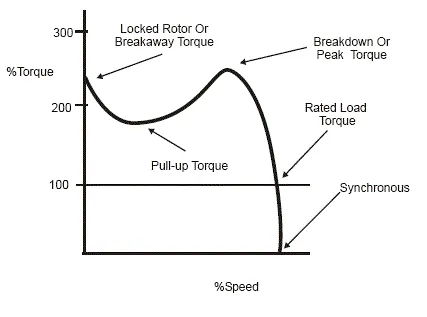
- The electric motor cannot develop the braking torque at high speed. Because The speed of the motor keeps on increases up to Maximum torque and then reduces to the constant speed. which is a breakdown torque or (peak torque).
- In the motor Starting region, the Torque becomes maximum at a small-time to attain the better speed of the motor
- When the motor reaches the breakdown torque and speed keeps on increases then the torque is going to reduce to maintain the speed constant.
- In the electric motor, the braking torque cannot be developed at high speed, because of losses parameters and kinetic energy which has to become zero and forces act on the vehicle. So, The braking torque is developed at low speed in an electric motor.
- The main braking Torque is developed by Regenerative braking or braking.
-
- HOW ELECTRIC AND MECHANICAL BRAKES ARE COORDINATED?
- BRAKING:
- Quickly stopping a motor or any running vehicle is called breaking.
- Quick stopping of a motor is more essential than quick starting.
- Delay in starting up a motor only causes the machinery to stand idle, But a delay in stopping a motor may result in heavy damage to equipment or to the manufactured products and even the loss of human life.
- MECHANICAL BRAKING:
- Mechanical brakes all act by generating frictional forces as two surfaces rub against each other.
- The stopping power or capacity of a brake depends largely on the surface area of frictional surfaces as well as on the actuation force applied.
- The friction and wear encountered by the working surfaces are severe.
- Thus, the durability of a brake or service life between maintenance depends heavily on the type of material used to line the shoe or pad.
- Mechanical brakes are assemblies consisting of mechanical elements for the slowing or stopping of shafts in equipment drives.
- They use levers or linkages to transmit force from one point to another.
- Braking slows or stops the movement of the coupled shafts.
- There are several types of mechanical brakes,
- Band brakes:
- Band brakes are the simplest brake configuration, have a metal band lined with heat and wear resistant friction material.
- Drum brakes:
- Drum brakes, which are commonly used on automobile rear wheels, work when shoes press against a spinning surface called a drum.
- Disc brakes:
- Disc brakes are constructed of brake pads, a caliper, and a rotor. During operation, the brake pads are squeezed against the rotor.
- Cone brakes:
- Cone brakes are made with a cup and a cone, which is lined with heat and wear resistant material. During actuation, the cone is pressed against the mating cup surface.
- Band brakes:
- There are several types of mechanical brakes,
- ELECTRIC BRAKING:
- If the load is removed from an electric motor and supply to it be disconnected, it will continue to run for some time due to inertia. The time elapsing before it stops will be especially long if the motor is massive and has run at high speed.
- However, in many cases that the motor and its driven machine be stopped quickly (in machine tools, cranes, hoists, etc).
- Based on the purpose for which braking is employed, it is of the two types,
- Braking while bringing the drive to rest:
- The device employed for braking absorbs the kinetic energy of the moving parts. Controlling the speed at which the load comes down and limiting it to a safe value.
- Use's,
- Reducing the time taken to stop.
- Stopping exactly at specified points.
- Feeding back, at least a portion of the power to the supply system.
- Braking while lowering loads:
- It absorbs, in addition to the kinetic energy, potential energy, usually gravitational which can drive the system at an excessively high speed.
- Use's:
- Controlling the speed at which the load comes down and limiting it to a safe value.
- Feeding power back to the supply system.
- Braking while bringing the drive to rest:
- Types of electric braking:
- There are three types of electric braking, all of which are applicable to the usual types of electric motors
- Plugging or counter-current braking:
- This is the simplest type of braking when the motor windings are connected for the reverse direction of rotation at a time when the armature is still rotating in the forward direction either under the action of an external torque or due to inertia.
- Plugging involves reconnection of the power supply to the motor so that it tends to drive in the opposite direction.
- During the braking period, the energy is drawn from the supply. The energy is drawn from the supply and stored or kinetic energy of the rotating parts of motor and its driven machines are dissipated in the series current limiting resistor.
- Thus this method is wasteful of energy
- Dynamic or rheostatic braking:
- The motor is disconnected from the supply and operated as a generator driven by the kinetic energy of the rotating parts of the motor and its driven machines.
- Thus the kinetic energy of rotation is converted into electrical energy, which is dissipated in the external resistance connected across the motor at the braking instant.
- This method of braking can be applied to break the direct current motors, synchronous motors, and induction motors
- Regenerative braking:
- In regenerative braking, mechanical energy is converted into electrical energy, part of which is returned to the supply, and the rest of the energy is lost as heat in the windings and the bearings of the electrical machines.
- Regeneration does not generally, involve any switching operation unless it is required to change the speed at which it becomes effective.
- Most of the electrical machines pass smoothly from motoring to generating operation when overdriven by the load.
- Regenerative braking necessary for:
- Supply voltage to drop.
- The motor to be overexcited.
- The motor to be running at a speed higher than no-load speed.
- Regenerative braking necessary for:
- Plugging or counter-current braking:
- There are three types of electric braking, all of which are applicable to the usual types of electric motors
- TWO TYPES OF BASIC CONTROL STRATEGIES FOR MECHANICAL BRAKING AND ELECTRICAL BRAKING:
- SERIES
- In Series Braking, Brake will be applied one after another, so there were in a series connected manner.
- PARALLEL
- In Parallel Braking, Brake is applied on both simultaneously.
- SERIES
- BRAKING:
QUESTION-3:
- MAKE A MATLAB PROGRAM WHICH PLOTS CONTOUR OF GIVEN MOTOR SPEED, TORQUE, AND EFFICIENCY VALUES.
ANSWER-3:
- A MATLAB PROGRAM WHICH PLOTS CONTOUR OF GIVEN MOTOR SPEED, TORQUE, AND EFFICIENCY VALUES.
- The motor Losses are calculated as
- Copper losses:
- The Copper Losses is denoted as `K_c`
- The Copper Loss is directly proportioned to the square of the torque
- `T^2*K_c`
- Iron Losses:
- The Iron Losses is denoted as `K_I`
- The iron Loss is directly Proportioned to Speed.
- `omega*K_I`
- Windage Losses:
- The Windage Losses is denoted as `K_w`
- The Windage Loss is Present across the winding and coil and deals with Magnetic losses.
- `omega^3*K_w`
- Other Constant Losses:
- The other constants are the power losses constant in the Speed of the motors.
- Copper losses:
- The motor Losses are calculated as
MATLAB PROGRAM:
% A MATLAB PROGRAM FOR EFFICIENCY CONTOUR FOR ELECTRIC MOTOR

clear all
close all
clc

% SET THE ARRAY RANGE OF THE SPEED AND TORQUE
X=linspace(1,1000);% SPEED, RAD/SEC
Y=linspace(1,250);% TORQUE OF 0 TO 40 N-M

% ALLOCATE MOTOR CONSTANT LOSS

Kc=0.2; %copper losses
Ki=0.008; % iron losses
Kw=0.00001; %windage losses
CONST=20;  % constant losses

% NOW WE MAKE MESH

[X,Y]= meshgrid(X,Y);

OUTPUT_POWER=(X.*Y);% OUTPUT POWER = SPEED*TORQUE
B=(Y.^2)*Kc;
C=X*Ki;
D=(X.^3)*Kw;
INPUT_POWER=OUTPUT_POWER+B+C+D+CONST;
Z=OUTPUT_POWER./INPUT_POWER;  % efficiency value

% NOW PLOT THE CONTOUR EFFICIENCY OF THE MOTOR
% CONSIDER SOME EFFICIENCY VALUES

V=[0.70,0.80,0.85,0.90,0.91,0.92,0.93,0.95];

box off
grid off
contour(X,Y,Z,V);
xlabel('speed, rad.s^-^1')
ylabel('Torque, N.m')
title('EFFICIENCY OF CONTOUR FOR ELECTRIC MOTOR')
hold on
% NOW PLOT THE CONTOUR OUTPUT POWER OF THE ELECTRIC MOTOR
% WE DRAW THE CONTOUR AT 5 AND 10 KW

V = [5000,10000];
contour(X,Y,OUTPUT_POWER,V);
MATLAB OUTPUT DATA OF CONTOUR EFFICIENCY:
- There are Two Types of Losses in Efficiency Values Like Positive curve and Negative curve.
- We Know That Contour is a 3-d view of Data Where the Values are present.
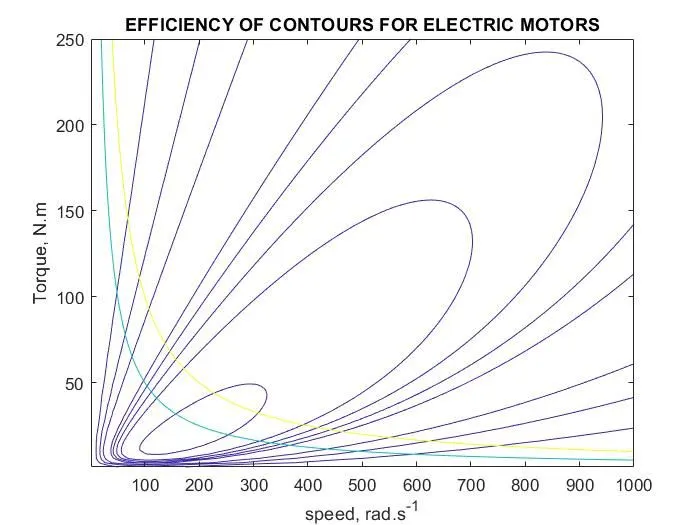
- The Maximum efficiency at Different Velocity at 85%, The Torque is at 249 N_m, and the Speed Of the Motor at 850 Rad/sec.
- The graph shows the Contour Values at Different Efficiency values in 3-d view.