Week 5 - Rayleigh Taylor Instability
AIM:
- To state some practical CFD models that have been based on the mathematical analysis of Rayleigh Taylor waves
- To perform the Rayleigh Taylor instability simulation for 2 different mesh sizes with the base mesh being 0.5 mm(Air and Water).
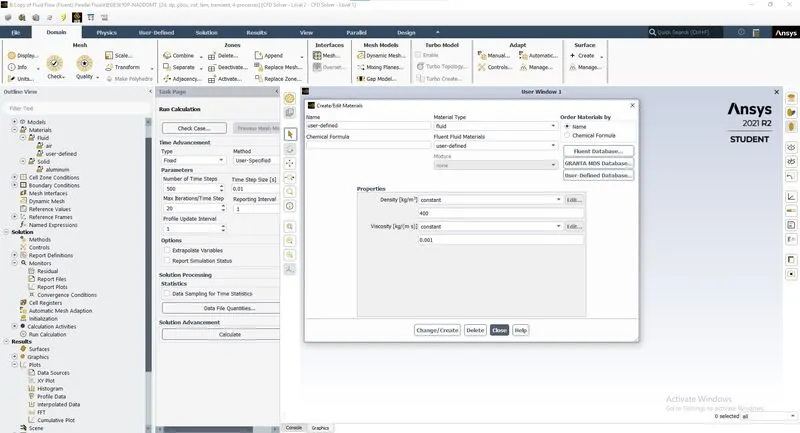
- To run one more simulation with water and user-defined material(density = 400 kg/m3, viscosity = 0.001 kg/m-s) for refined mesh.
- To define the Atwood Number & to find out the Atwood number for both the cases and explain how the variation in Atwood number in the above two cases affects the behavior of the instability.
RAYLEIGH TAYLOR INSTABILITY
The Rayleigh–Taylor instability, or RT instability, is the instability of an interface between two fluids of different densities which occurs when the lighter fluid is pushing the heavier fluid. Examples include the behavior of water suspended above oil in the gravity of earth, mushroom clouds like those from a volcanic eruption and atmospheric nuclear explosion, supernova explosions in which expanding core gas is accelerated into denser shell gas, instabilities in plasma fusion reactors, and inertial confinement fusion.
Water suspended atop oil is an everyday example of Rayleigh–Taylor instability, and it may be modeled by two completely plane-parallel layers of immiscible fluid, the denser on top of the less dense one and both subject to the Earth's gravity. The equilibrium here is unstable to any perturbations or disturbances of the interface: if a parcel of heavier fluid is displaced downward with an equal volume of lighter fluid displaced upwards, the potential energy of the configuration is lower than the initial state. Thus the disturbance will grow and lead to a further release of potential energy, as the more dense material moves down under the (effective) gravitational field, and the less dense material is further displaced upwards. This was the set-up as studied by Lord Rayleigh. The important insight by G. I. Taylor was his realization that this situation is equivalent to the situation when the fluids are accelerated, with the less dense fluid accelerating into the more dense fluid. This occurs deep underwater on the surface of an expanding bubble and in a nuclear explosion
Types of Instability and some practical CFD models that have been based on the mathematical analysis of Rayleigh Taylor waves:
Ritchmyer-Meshkov instability:
The Richtmyer-Meshkov instability arises when a shock wave interacts with an interface separating two different fluids. It combines compressible phenomena, such as shock interaction and refraction, with hydrodynamic instability, including nonlinear growth and subsequent transition to turbulence, across a wide range of Mach numbers.
Plateau–Rayleigh instability:
The Plateau–Rayleigh instability, often just called the Rayleigh instability, explains why and how a falling stream of fluid breaks up into smaller packets with the same volume but less surface area. This fluid instability is exploited in the design of a particular type of inkjet technology whereby a jet of liquid is perturbed into a steady stream of droplets.
Kelvin–Helmholtz instability:
Kelvin–Helmholtz instability can occur when there is velocity shear in a single continuous fluid, or where there is a velocity difference across the interface between two fluids. An example is a wind blowing over water: The instability manifests in waves on the water surface. More generally, clouds, the ocean, Saturn's bands, and the sun's corona show this instability.
PROCEDURE:-
*The geometry is created as mentioned dimensions in the space claim.The geometry is converted into a surface by the pull option and the geometry.
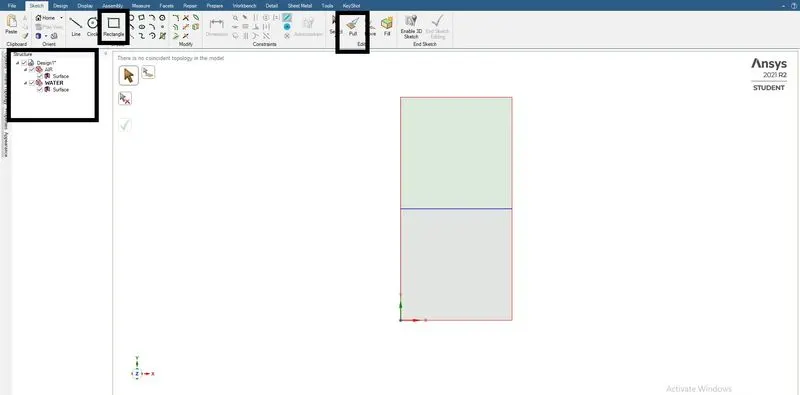
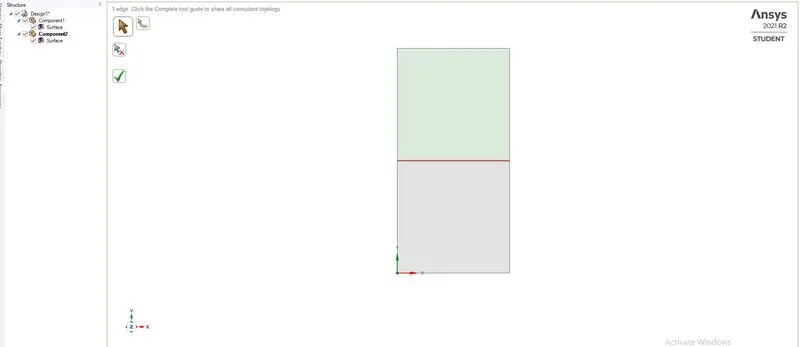
*The surfaces are been checked share so mesh inflation can be done to interconnect the surfaces.
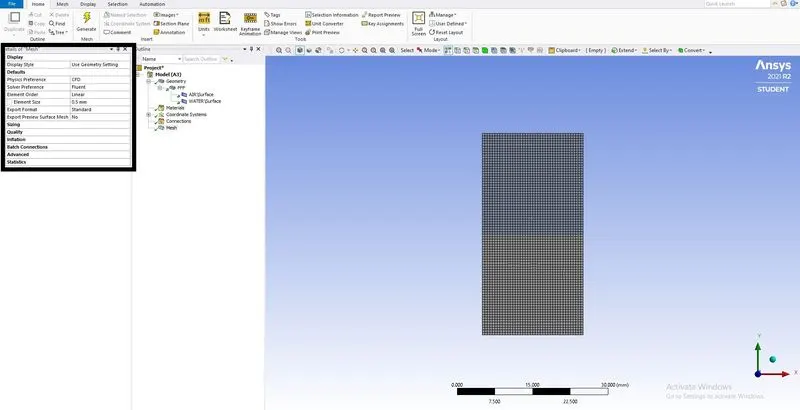
*The mesh is created for an element size of 0.5 mm and the quality of the elements we more than 40%.
*The Setup workbench is started and given recommended parameters.
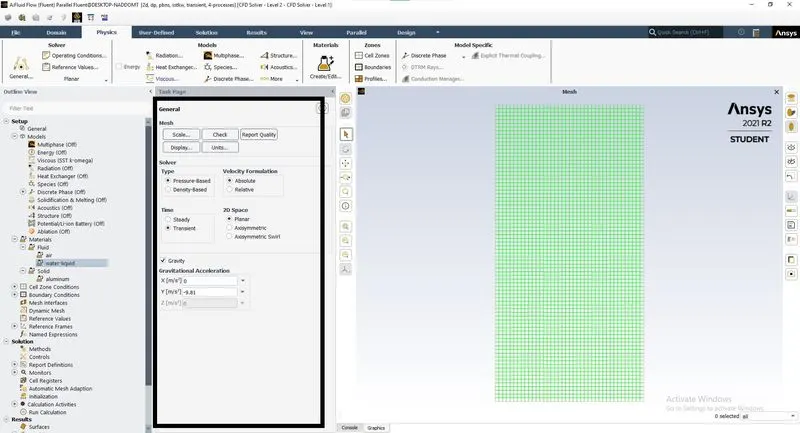
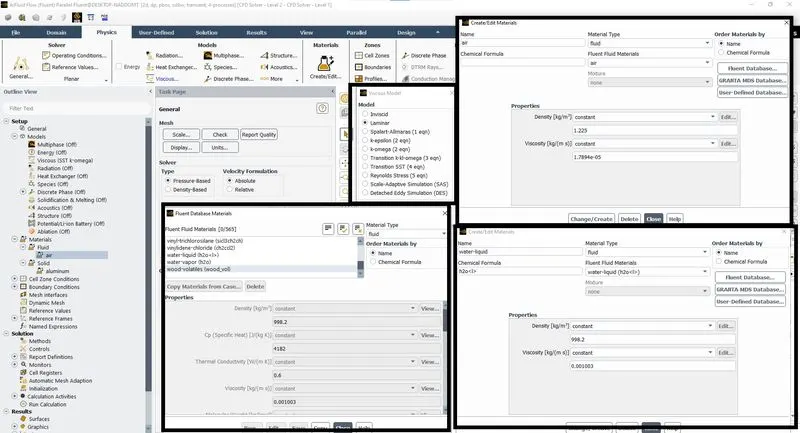
*The material is been added, the air is been initiated with specific values at one surface and water on the other.
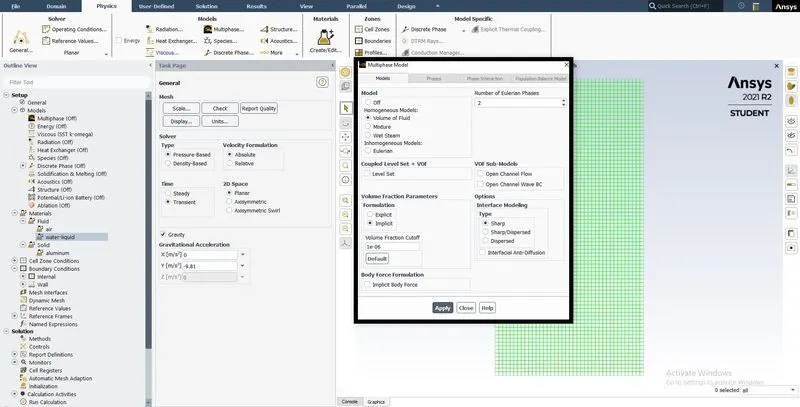
*The multiphase is been initialed for volumes of fluid with two euclidean phase.
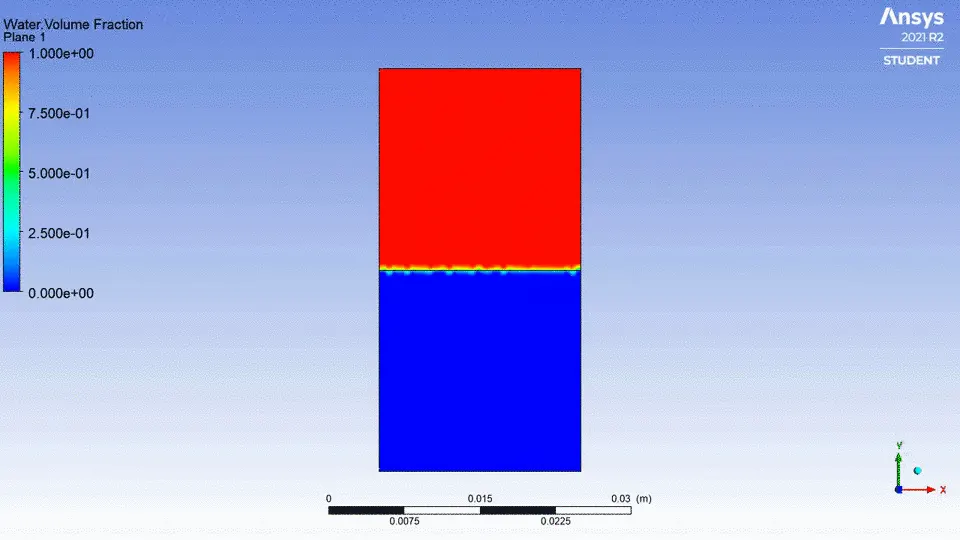
The animation has been visualized for Rayleigh Taylor Instability between air and water.
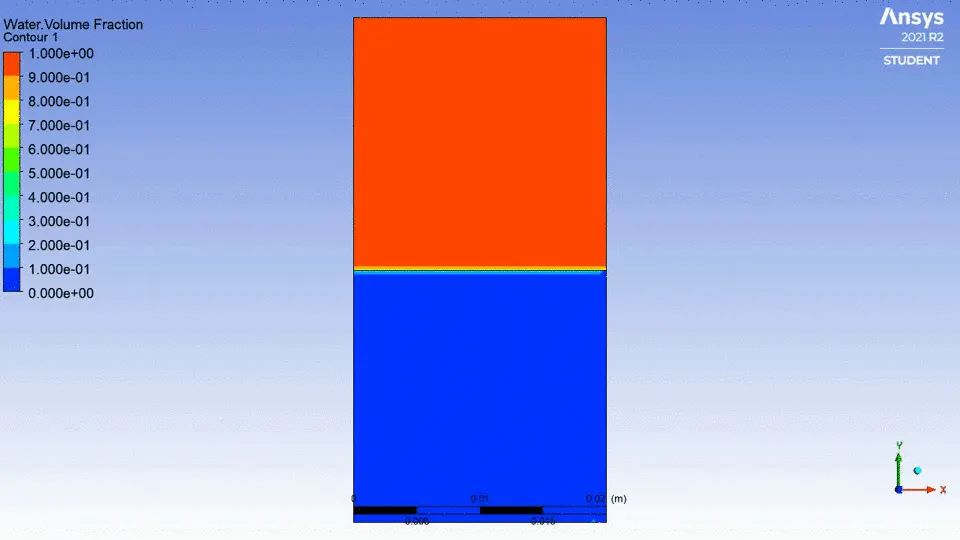
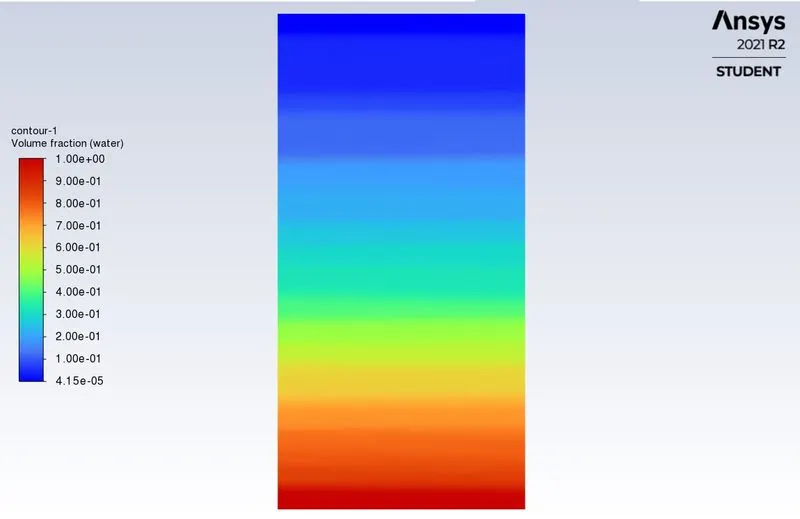
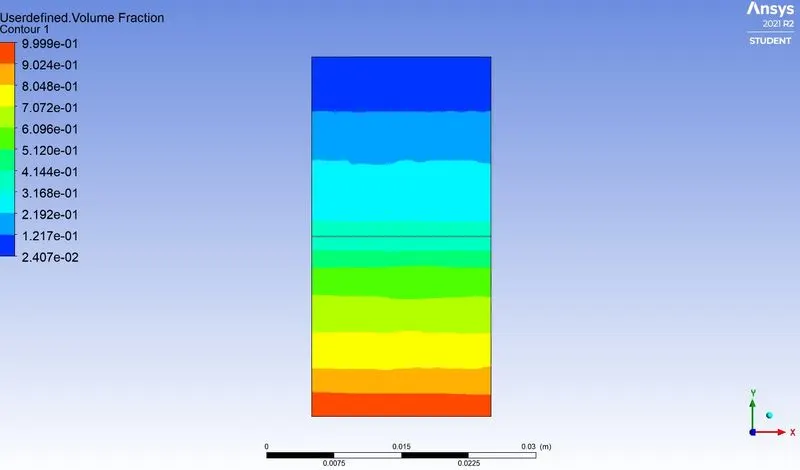
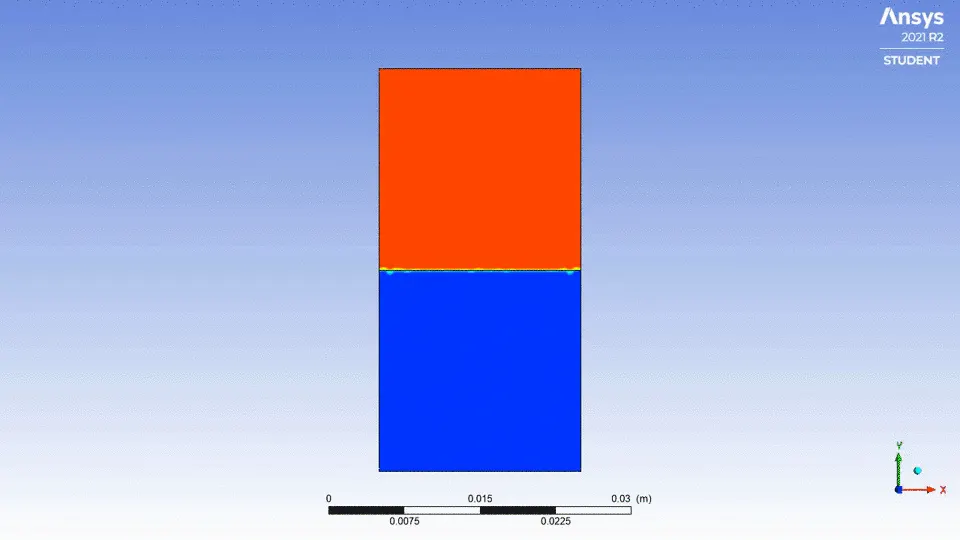
CASE 1 (mesh size 0.3mm)
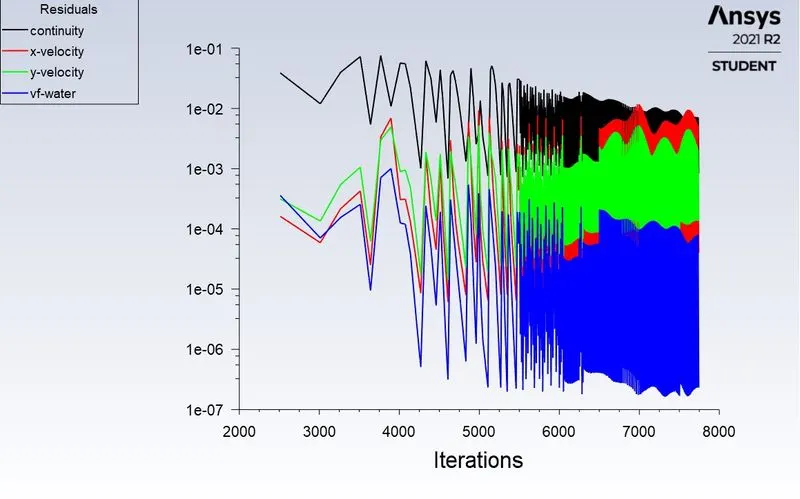
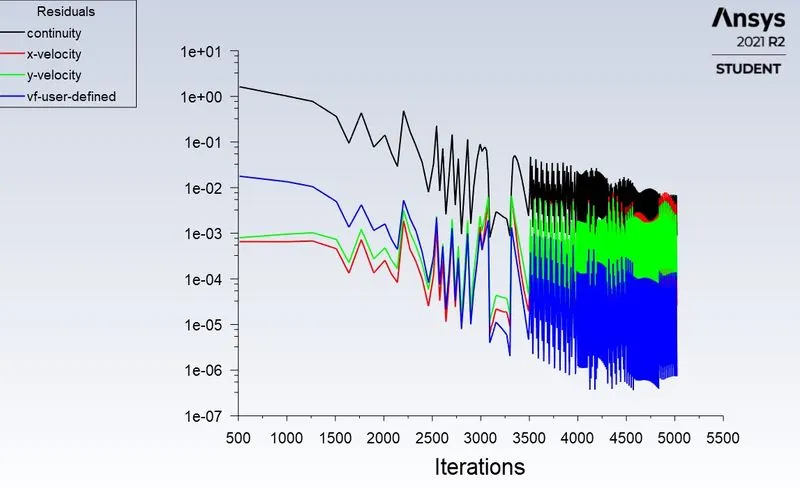
CASE 2 (mesh size 0.3mm with user-defined fluid)
Atwood number (A)
The Atwood number (A) is a dimensionless number in fluid dynamics used in the study of hydrodynamic instabilities in density stratified flows. It is a dimensionless density ratio defined as

where
 = density of the heavier fluid
 = density of the lighter fluid
Case 1:For fluid materials air and water
ρ1">ρ1=density of water=998.2kg/m^3
ρ2">ρ2=density of air=1.225kg/m^3
`A=998.2−1.225998.2+1.225`
A=0.9975
Case 2:For fluid materials user defined and water
ρ1">ρ1=density of water=998.2kg/m^3
ρ2">ρ2=density of user defined=400kg/m^3
`A=998.2−400998.2+400`
A=0.427
The difference in the fluid densities divided by their sum is defined as the Atwood number A.
For A close to 0, RT instability flows take the form of symmetric "fingers" of fluid; for A close to 1, the much lighter fluid "below" the heavier fluid takes the form of a larger bubble.
Conclusions:
- In the above challenge, the simulation starts with the state of hydrostatic equilibrium, and the Rayleigh Taylor instability is observed at the interference when a lower density fluid pushes a higher density fluid due to which formation of shock waves at the interface takes place. Formation of air bubbles starts taking place, which compresses the heavy fluid around it, due to which shock waves of multidimensional fashion generates and it gets stronger as it moves upward.
- It is observed that the more we refine the mesh, the more the simulation results get smoother about the irregularities that take place at the interface of the two fluids. As higher density fluid replaces lower density fluid, the formation of air bubbles and vortex takes place, which travels towards the upward region with time.
- we can see more detailed results about the formation of waves and the formation of some air bubbles that get trapped at the lower region during the initial stage and then they travel towards the upper region, generating shock waves. At the end of the simulation, it is to be observed that the two phases get separated from each other though, we can see some diffusivity between them which is a volume fraction of air and water.
- In the Rayleigh- Taylor Instability, due to a sudden collapse in the layer between the denser and lighter fluid spike generation takes place which is obviously time-dependent, hence using a steady-state solver will not work as we are interested in the flow parameters with respect to time.