Week-3 Challenge: ADVISOR Tool
ADvanced VehIcle SimulatOR (ADVISOR):
- An advanced vehicle simulator model called ADVISOR has been developed at the National Renewable Energy Laboratory to allow system-level analysis and trade-off studies of advanced vehicles.
- Because of ADVISOR's fast execution speed and the open programming environment of MATLAB/Simulink, the simulator is ideally suited for doing parametric studies to map out the design space of potential high fuel economy vehicles (3X) consistent with the goals of the Partnership for New Generation of Vehicles (PNGV).
Qn. 1)For EV_defaults_in file, if cargo mass is 500 kg with all other default conditions, can the vehicle travel for 45 km with FTP drive cycle? Conclude your observations.
As a first step, the advisor tool is downloaded. The Matlab 'pwd' is changed to the path where "advisor.m" file is available.
Now the tool can be launched by typing "advisor" in the command window.
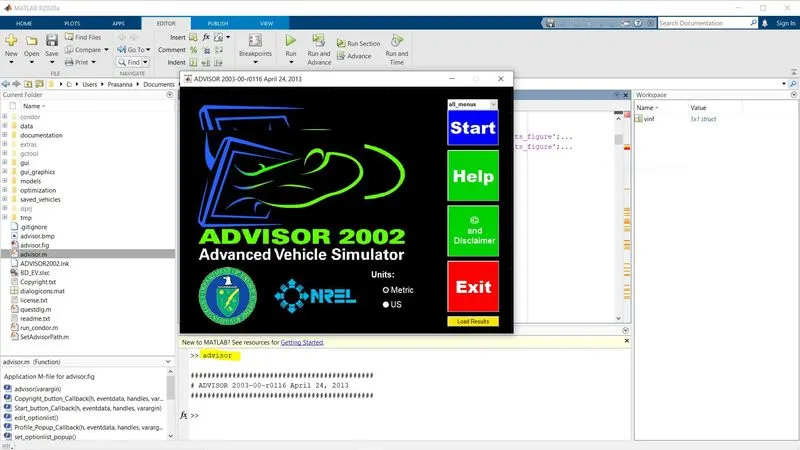
It lauches a window as shown above and the "Units" are set to "Metric" standards. Once the advisor is launched, the "EV_defaults_in file" is loaded and also the cargo mass is changed to 500kg. Since, in the given question, It is said that all other has to be considered as default condition, no other parameter is changed.
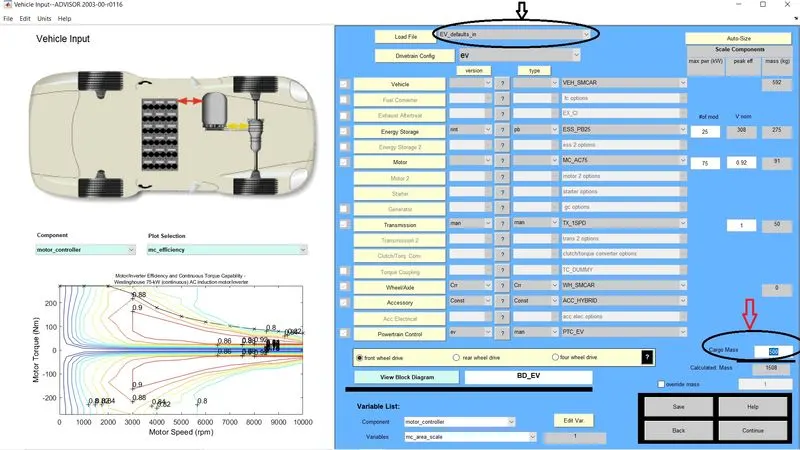
Once these two changes are made, the "Continue" button is clicked. In the next window, we have to load the FTP drive cycle and do the simulation.
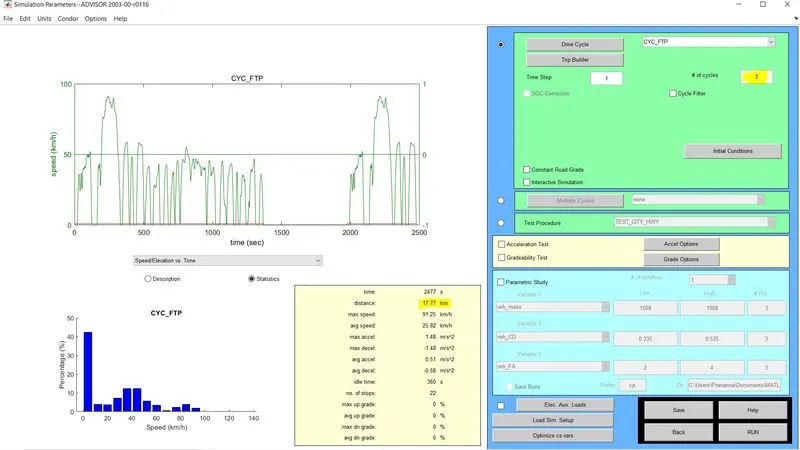
One FTP cycle constitutes for 17.77 km. Hence, To check for a distance of 45km , three FTP cycles are given for simulation. The "RUN" button is then clicked.
RESULT:
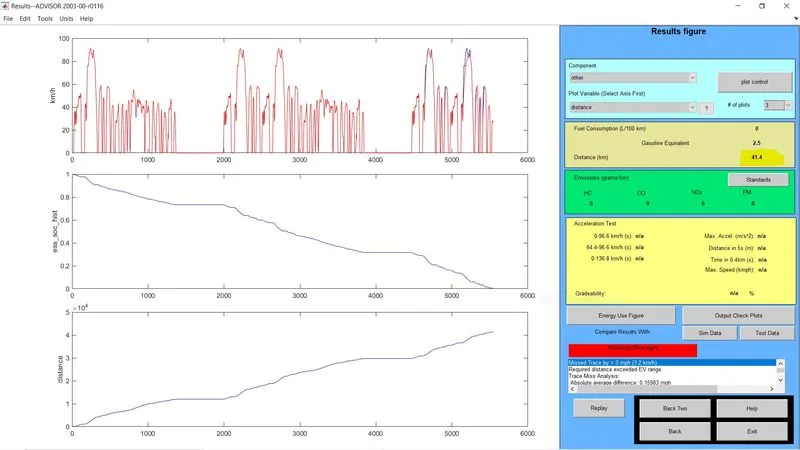
Hence it can be seen the graph that the State of Charge of battery is zero at 5500s (approx) and the max. distance that the vehicle could travel is 41.4 km
Hence, with the present battery capacity and three cycles of FTP driving cycle, the vehicle CANNOT travel 45 km.
Qn. 2)Changing the battery capacity and repeating the simulation.
Here, instead of 25 modules of battery, 30 modules are fed and the simulation is run for 3 cycles of FTP
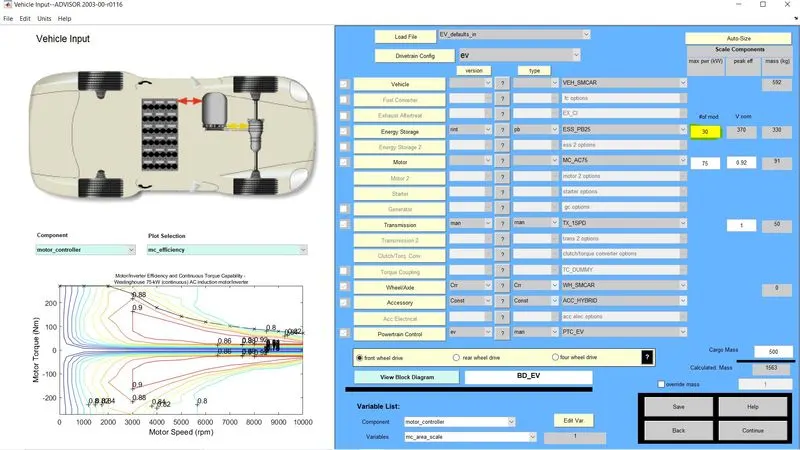
RESULT:
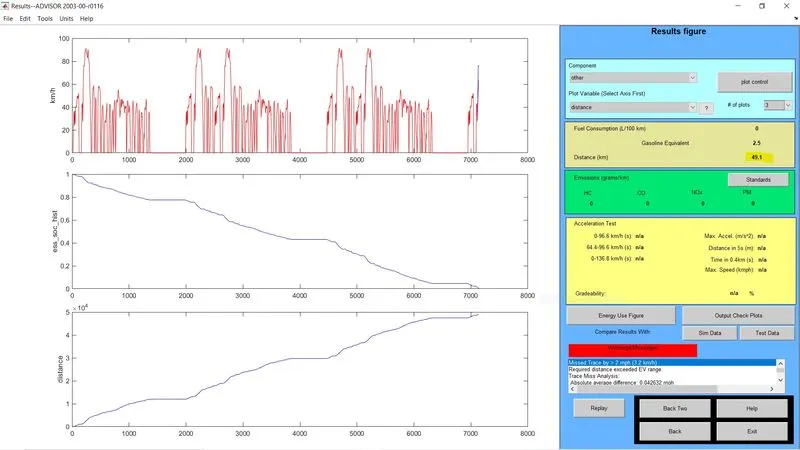
Hence, with 30 no. of battery module(370V), though the vehicle cannot travel three cycles fully, it could travel a distance of 49.1 km which is above 45 km.
Let us analyse when no. of battery modules are 35 in number.
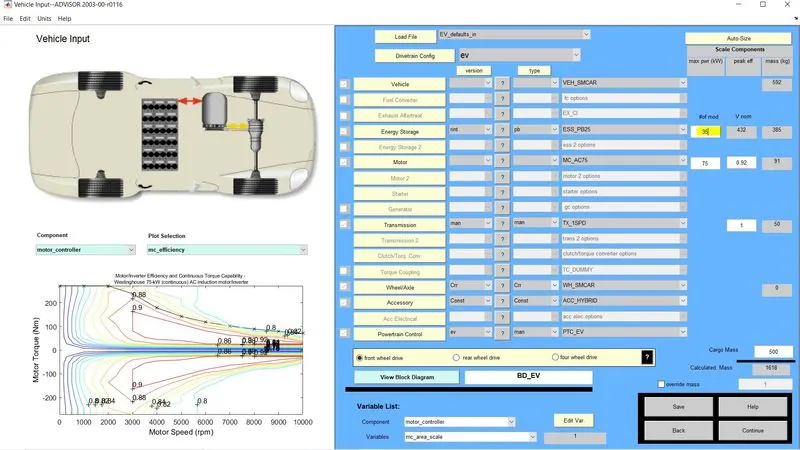
We could see that the number of modules are changed to 35 and the total voltage of the battery stands at 432V.
NOTE: When this configuration is run for 3 cycles, we could not visualise the total drain of SOC. Hence, 4 cycles are selected to know about the total range when the battery module is 35 in number.
RESULT:
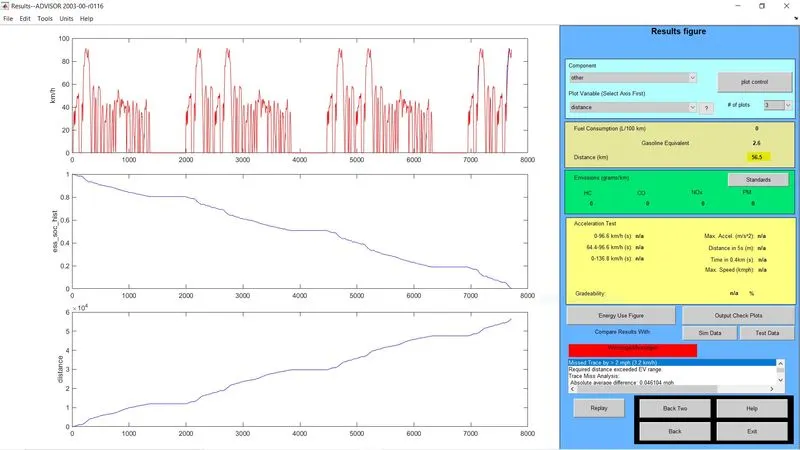
Hence when the no. of battery module is increased to 35, the range of the vehicle is 56.5 km and the SOC becomes zero almost near 7800 seconds which is higher than the previous case.
Qn. 3)To Perform gradeability test with PRIUS_Jpn_defaults_in file and compare results in table
Steps:
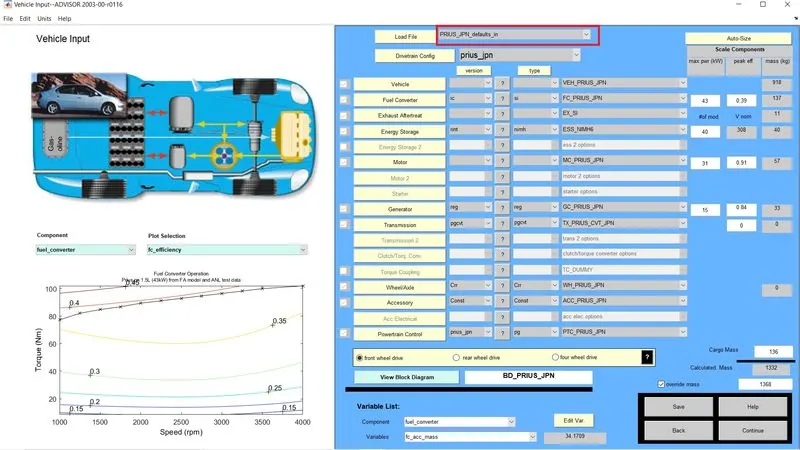
- The PRIUS_Jpn_defaults_in file is loaded
- All the other parameters are set as default and the continue button is clicked.
- The simulation parameters window opens up and the UDDS drive cycle is selected.
To perform gradeability test, the "Gradeability Test" check box is checked and the "Grade options" button is clicked which pops up a window.
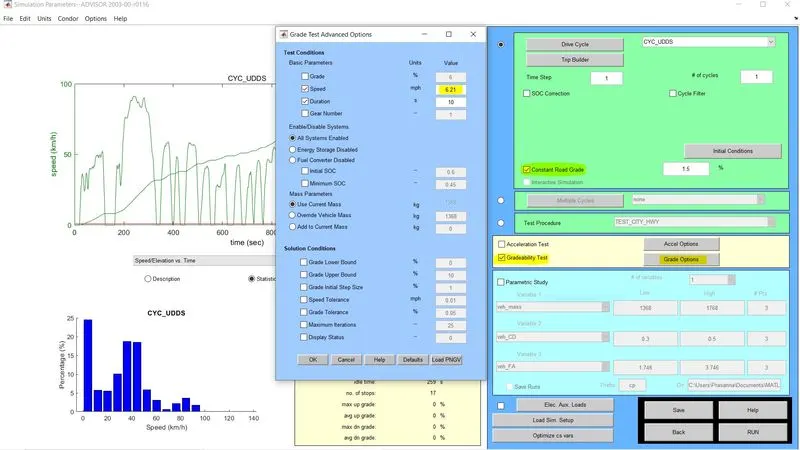
Under the test conditions, The speed and the duration are given. "All system Enabled" option is also selected to propel both from IC engine and the battery power.
Also, a constant road grade of 1.5% is given. Let us analyse the results for different speeds and same duration of 10 seconds.
1.) Speed= 10km/hr (6.21 mph) for 10s
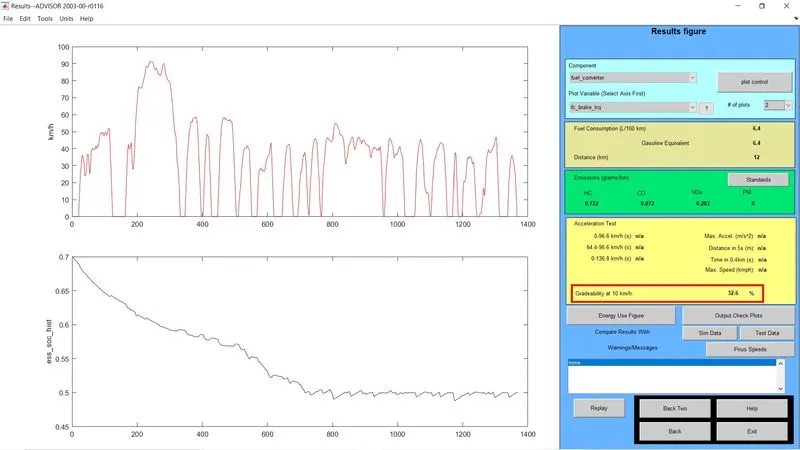
Hence we could see that the Gradeability at 10km/hr is 32.6%.
2.) Speed= 20km/hr (12.42 mph) for 10s
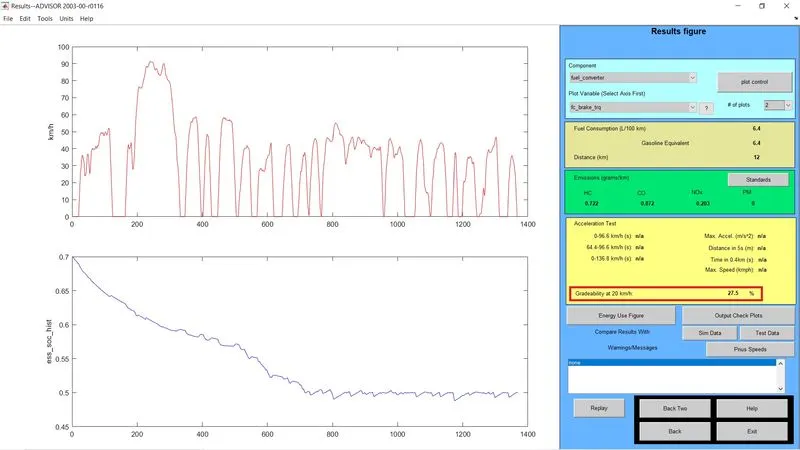
Hence we could see that the Gradeability at 20km/hr is 27.5%.
3.) Speed= 35km/hr (21.75 mph) for 10s
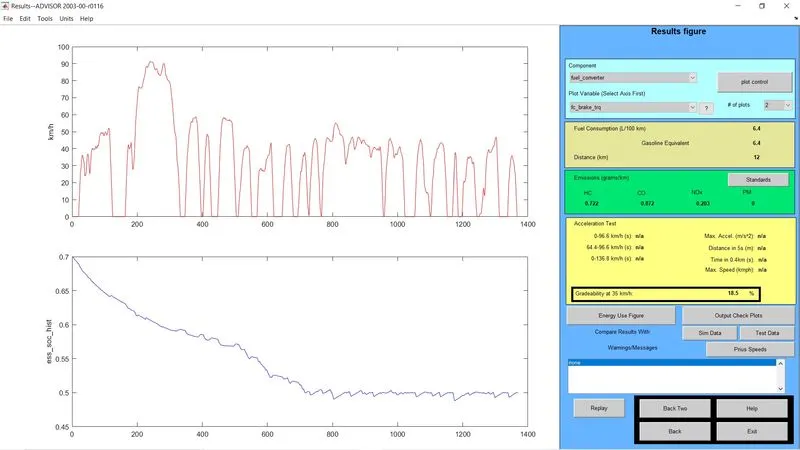
Hence we could see that the Gradeability at 35km/hr is 18.5%.
4.) Speed= 60km/hr (37.28mph) for 10s
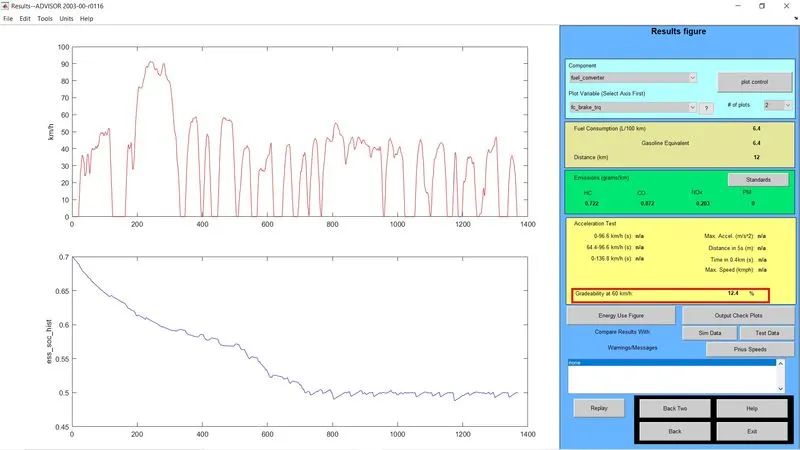
Hence we could see that the Gradeability at 60km/hr is 12.4%.
Hence, for a constant road grade of 1.5% and a duration of 10s, the Speed vs Gradeability is as follows:
| Speed (kmph) | Gradeability (%) |
| 10 | 32.6 |
| 20 | 27.5 |
| 35 | 18.5 |
| 60 | 12.4 |
CONCLUSION: Hence, as speed increases, the gradeability(%) decreases which tells us that the vehicle cannot climb steep places at a very high speed.