Week-4 Challenge WOT Condition Part-2
Qn. 1)What is the difference between mapped and dynamic model of engine, motor and generator? How can you change model type?
Mapped and dynamic models are options that are available in the Power Train blockset.
Powertrain Blockset provides fully assembled reference application models of automotive powertrains, including gasoline, diesel, hybrid, and electric systems. It includes a component library for simulating engine subsystems, transmission assemblies, traction motors, battery packs, and controller models.
Powertrain Blockset provides two types of combustion engine models: mapped and dynamic.
Mapped model: These are the most basic types of blocks. They use lookup tables or maps and run the simulation with the available data. They work faster compared to the dynamic model. Here, the tables provide overall engine, motor and generator characteristics.
Dynamic model: It represents the actual components. It decomposes engine, motor and generator into lower level subsystems. They are used to analyse the impact of individual components on the overall performance.
For example, In the EV reference application in the Matlab documentation, we have both mapped and dynamic motor models.
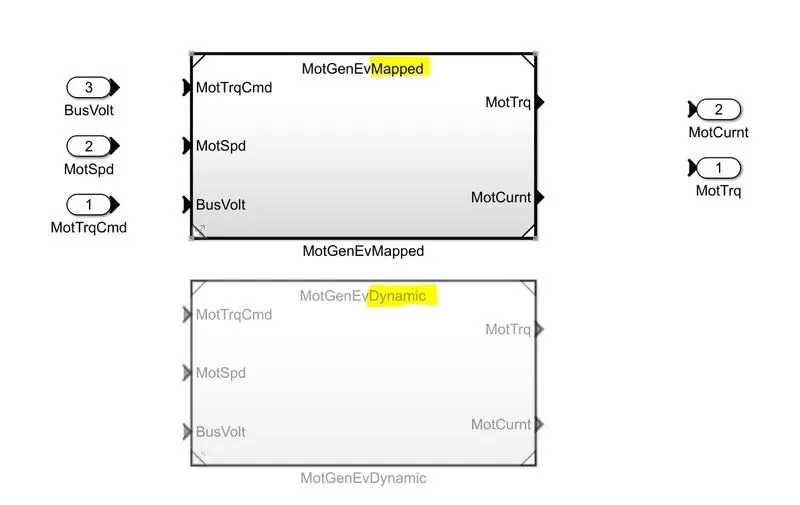
Here since mapped model is used, the dynamic model is disabled.
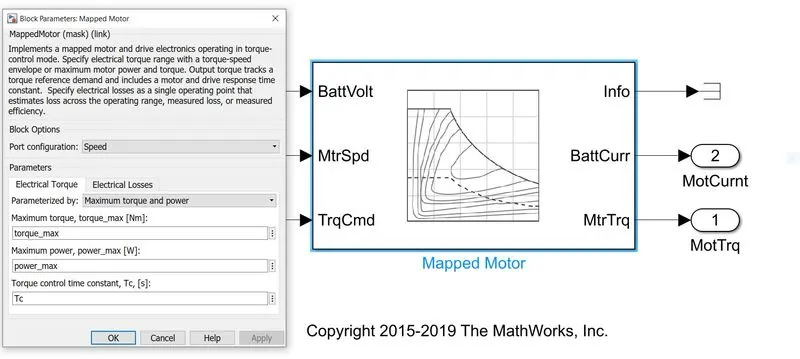
The above figure shows the mapped model of the motor.
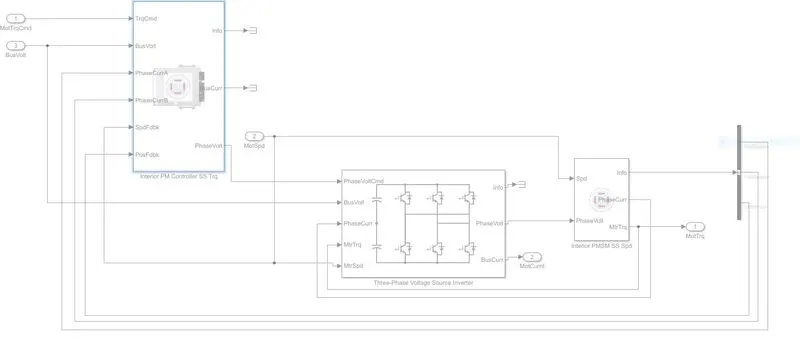
This model shows the dynamic model where the individual components such as controller, motor, three phase voltage source inverter are shown.
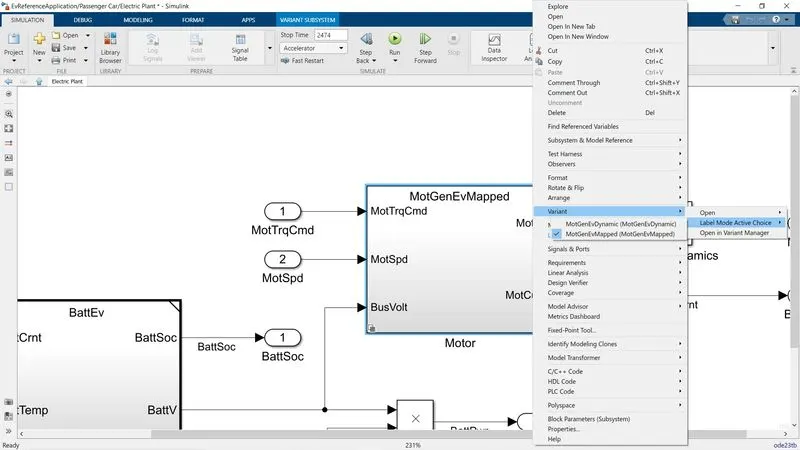
Changing the model type:
- In the overall model, click the "Passenger Car" blockset.
- Go to "Electric Plant" subsystem.
- In the electric plant subsystem, there will be a block called "Motor".
- Right click on it and choose Variant>>Label Model active Choice>>Mapped or Dynamic
Qn. 2)How does the model calculate miles per gallon? Which factors are considered to model fuel flow?
Miles per gallon: It refers to the number of miles that the vehicle could run for one gallon of fuel which could be petrol or diesel.
The model that calculates miles per gallon can be seen in "Performance calculation" subsystem under "Visualisation" block.
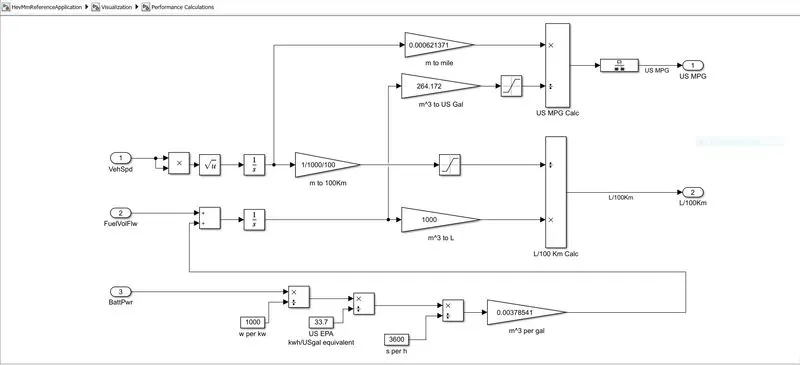
In Hybrid EV, the battery power is converted to its fuel equivalent by converting its power(W) to kWh using necessary conversion factors. This kWh is then converted to fuel equivalent(m^3 per gallon) and then added to the actual Fuel volume flow. It is then converted to US gallons and then acts a divisor with distance(miles) to finally get miles per gallon.
The two necessary factors to model a fuel flow from the block diagram are Vehicle Speed and the Battery power
Qn. 3)Run the HEV Reference Application with WOT drive cycle. Change the grade and wind velocity in the environment block. Comment on the results.
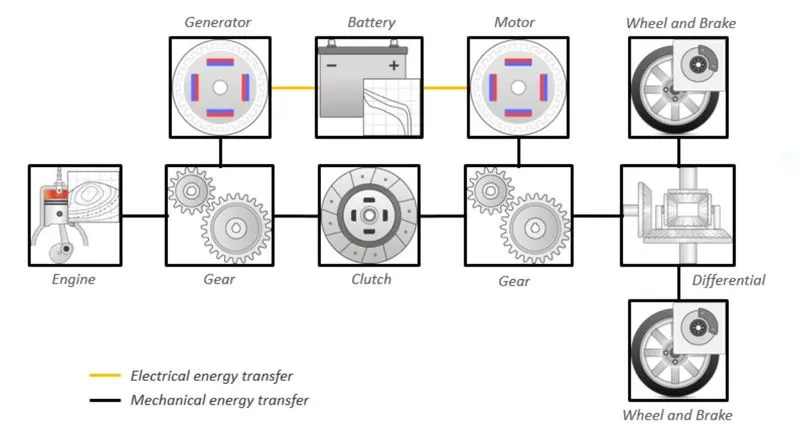
The hybrid electric vehicle reference application represents a full multimode hybrid electric vehicle (HEV) model with an internal combustion engine, transmission, battery, motor, generator, and associated powertrain control algorithms.
This diagram shows the powertrain configuration.
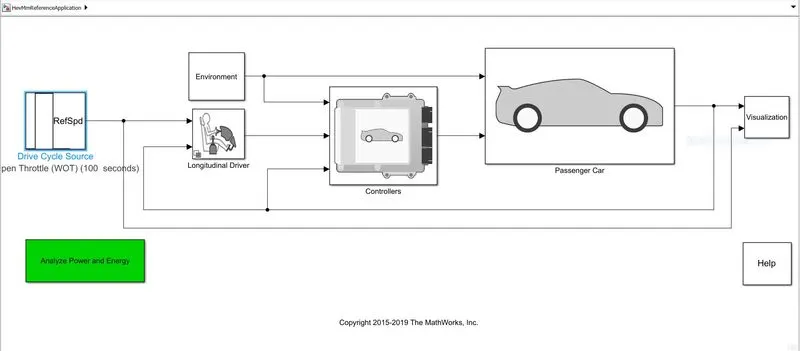
The simulink model is as follows:
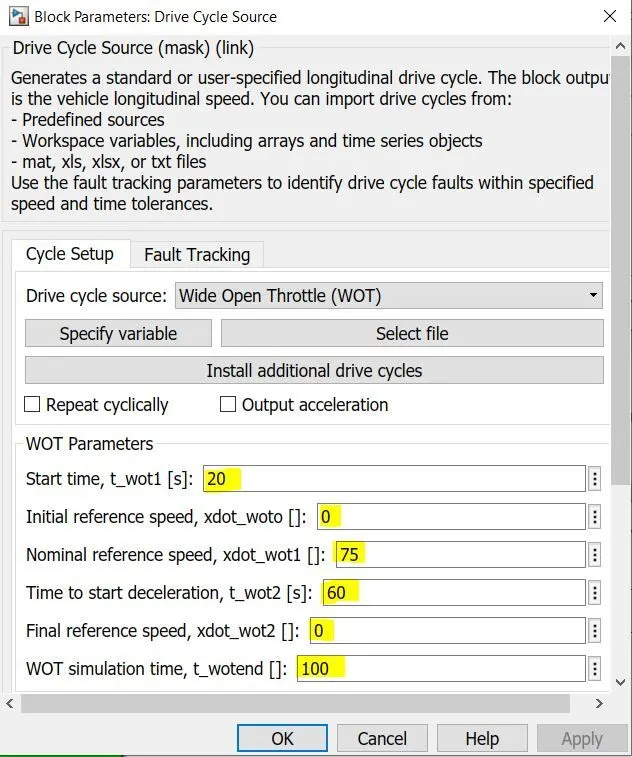
The drive cycle is changed to simulate the open throttle condition.
The parameters are given as follows:
Simulation results when grade=0 and wind velocity=0 is as follows:
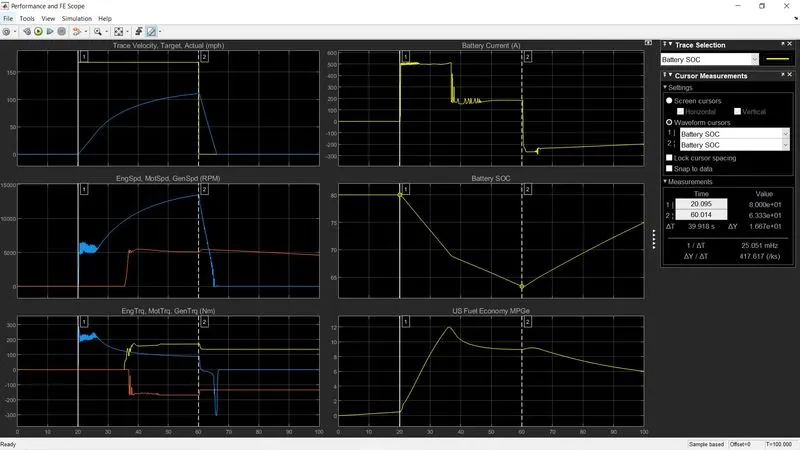
Now grade and wind velocity are fed to the model by giving the values in the environment subsystem
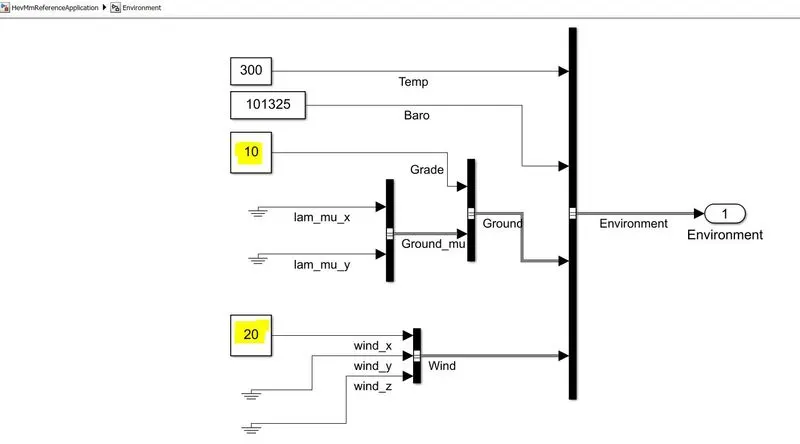
Simulation results when grade and wind velocity are given: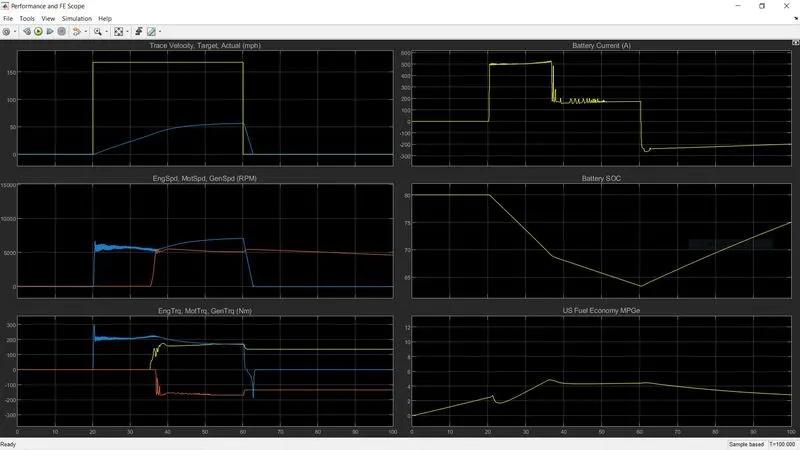
Comparison of two cases:(i.e With and without the effect of grade and wind)
- Clearly there is a dip in max speed reached when wind and grade are considered(i.e from mph to 56mph)
- The max. engine speed also decreases.
- The MPG also decreases.
Qn. 4)Keeping all other parameters same, compare the simulated results of hybrid and pure electric powertrains.
The electric vehicle reference application represents a full electric vehicle model with a motor-generator, battery, direct-drive transmission, and associated powertrain control algorithms.
The electric vehicle reference application is configured with a mapped motor and battery. The below diagram shows the powertrain configuration.
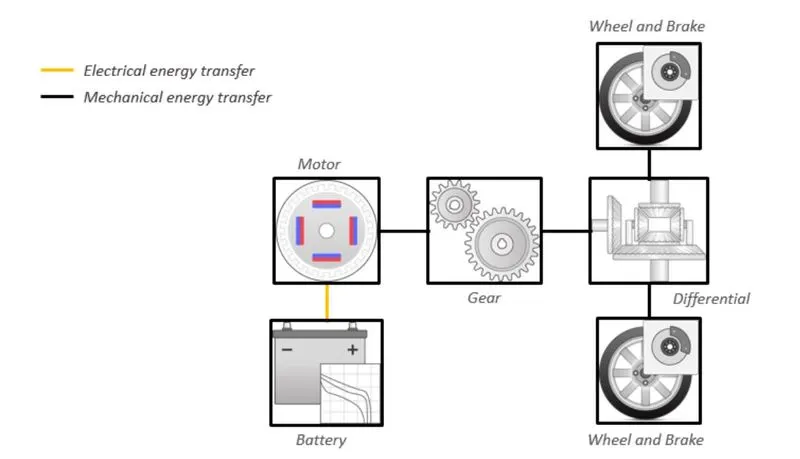
The EV power train is less complex in nature compared to the hybrid.
Simulation results for same WOT and enviromental conditions:
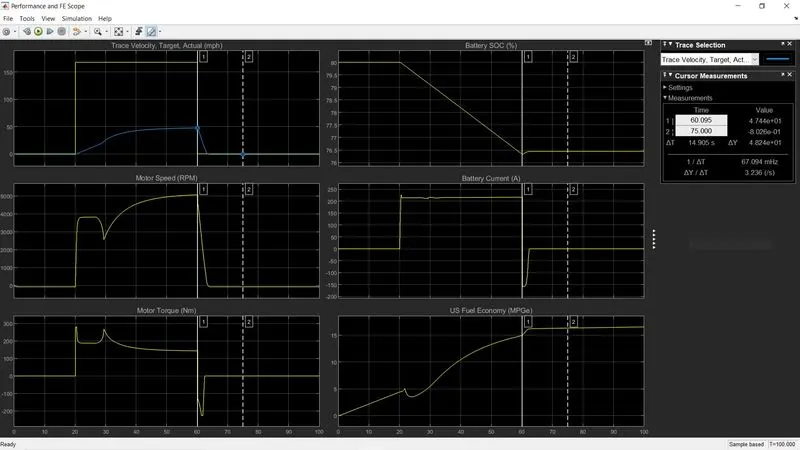
Comparison between Pure EV and Hybrid:
| Hybrid | Pure EV | |
| Grade | 10 | 10 |
| Wind | 20 | 20 |
| Maximum Speed(mph) | 56 mph | 47 mph |
| Max engine/motor speed(RPM) | 7054 | 5061 |
| SOC(%) (from 0 to 100s) | 80% to 75% (majorly due to regenerative braking recovery) | 80% to 76% |
| US Fuel Economy(MPGe) | 28 | 16.5 |