Week-11 Challenge: Braking
EV LIVE SESSION BATCH 16
AIM :
- For a defined driving cycle, calculate the energy required for braking.
- Why electric motor can’t develop braking torque at high speed similar to starting? How electric and mechanical brakes are coordinated?
- Make a MATLAB program which plots contour of given motor speed, torque and efficiency values. Attach the code as a .m file attach a screenshot of all the plots.
OBJECTIVE (1) - For a defined driving cycle, calculate the energy required for braking.
Drive Cycle :
Drive cycle is a test cycle for a vehicle which various improve conditions which will be done for all the newly produced and about to launch vehicles.
This drive cycle is done to test the emission or fuel efficiency with various input of throttle and various hillclimbing angles in case of an IC engine.
Images of an electric vehicle the test is done with various inputs of throttle and various hillclimbing angles to analyse power efficiency, range of vehicle and the state of charge is left after running the test in the battery.
There are many define Drive cycles and in this part we have taken the highway fuel economy driving schedule as a reference drive cycle.
Braking Energy :
To accelerate a vehicle we need some energy to accelerated like the same to brake the vehicle we need some energy to brake.
In acceleration the velocity changes from initial to final velocity value while breaking the velocity changes from final value to initial value of 0.
So in this case of braking the kinetic energy will be given by,
Braking energy = 0.5* M * (Vf - Vi) ^2
Where ,
M = mass of vehicle
Vi = initial velocity
Vf = final velocity
Lets consider,
Mass of vehicle = 1000kg
For first 10 seconds
Top speed after accelerationn ,v2 = 25m/s
Lowest speed after deceleration, v1 = 5m/s
Braking energy required
BE1 = 0.5 * m * (v2-v1)^2
BE1 = 0.5 * 1000* (6.94-1.38)^2
BE1 = 15.5KW
For the next 20 seconds
BE2 = 0.5 * m * (v2-v1)^2
BE2 = 0.5 * 1000(20.83-4.16)^2
BE2 = 138.9KW
BE3 = 0.5 * m * (v2-v1)^2
BE3 = 0.5 * 1000 * (19.44-2.77)^2
BE3 = 138.9KW
Total braking energy required,’
BE total = BE1 + BE2 + BE3
BEtotal = 15.5 + 138.9 + 138.9
BEtotal = 293.3KW
Results : For this driving cycle, the braking energy is 293.3KW
OBJECTIVE (2) - Why electric motor can’t develop braking torque at high speed similar to starting? How electric and mechanical brakes are coordinated?
Lets consider a torque speed characteristic :
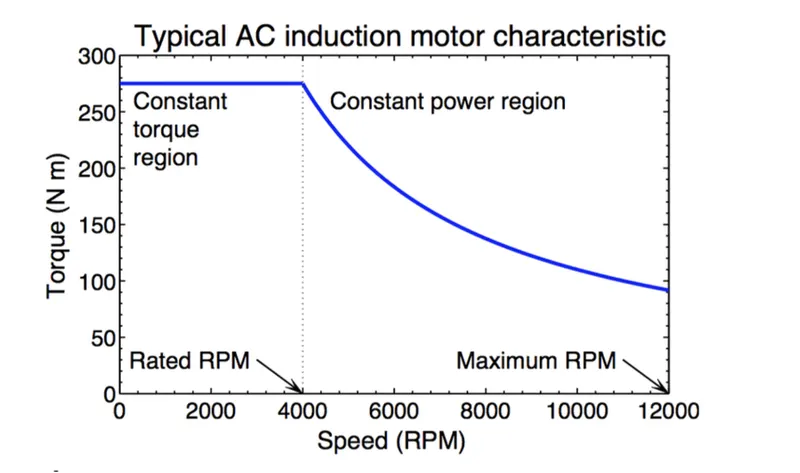
From this curve we have 2 region Constant torque and constant power region. At the start the motor achieves peak torque till it reaches a certain motor speed range from where it will drop rapidly.
• The reason due to the drop in torque is due to the motors after reaching critical speed in the area where the peak torque is constant is known as the constant torque region of the motor.
• The region where the torque decreases is known as the constant power region as the power generated by the motor will be at its peak.
• Since the torque produced at the constant power region is very low it is not possible to develop enough breaking torque in this region, the breaking down produced increases as the speed decreases.
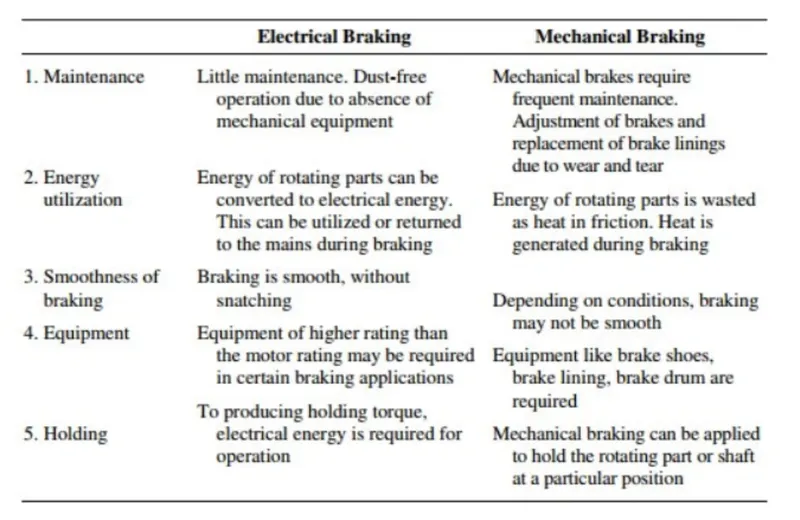
How are electrical and mechanical brakes co ordinated ?
Electric Braking System :
• In this type of braking , the winding of the motor to produce a braking torque. A braking torque is developed during the braking operation.
• This braking torque opposes the motion of the rotating member of shaft. This is achieved by suitably changing the electrical connections of motor. The motor operates on a speed torque characteristic depending upon the method of braking employed.
Mechanical braking system :
• In mechanical braking, the frictional force between the rotating parts and the brake drums produces the required braking. To achieve this, the mechanical equipment , such as brake linings and brake drums are required.
• Whether electrical or mechanical the braking of drive should stop the motor at the point of time & position.
•The electric braking system used in electric vehicles and hybrid electric vehicles is regenerative braking.
•This method uses the motor as a generated during break in developing a retarding and torque which acts on the running motor and halts it.
• The kE and PE minus the loss of motor are returned to the mains and the motor runs at a constant speed . Thus regenerative braking eliminates the tendency of the load to accelerate the motor.
•Mechanical braking systems used can be either disc or drum brake system.
•Where in case of a disc brake system friction pads rub against a disc when the brake pedal is applied and kinetic energy is converted to heat and slows down the vehicle.
• In a drum System a set of brake shoes which are friction materials press against a drum. Since the breaking torque is very less at high speeds mechanical brakes are applied to slow down the vehicle .
• As the motor which is the constant torque region to region are to braking system takes effect in the motor at as a generator and the negative torque produces charges the battery pack.
QUESTION (3) - Make a MATLAB program which plots contour of given motor speed, torque and efficiency values. Attach the code as a .m file attach a screenshot of all the plots.
Matlab Code :
clear all
close all
clc

%Torque and velocity range of motor
torque = linspace(0,250);
velocity = linspace(0,1000);

%copper loss constant
kc = 0.2;

%IRON LOSS CONSTANT
ki = 0.008;

%%WINDAGE LOSS CONSTANT
kw = 0.00001;

%CONSTANT MOTOR LOSS
c = 20;

%CREATING 2 ARRAY
[W,T] = meshgrid(velocity,torque);
output_power = (W.*T);

%LOSS CALCULATIONS
copper_losses = kc*(T.^2);
iron_losses = (W).*ki;
windage_losses = (W.^3)*kw;

%POWER % EFFICICNECY CALCULATIONS
input_power = output_power + copper_losses + windage_losses +c;
Efficiency = output_power./input_power;

%EFFICIENCY CURVES VALUES RANGE
V = [0.70 0.75 0.80 0.85 0.875 0.90 0.91 0.92 0.93];

%PLOTTING CONTOUR FOR SPEED,TORQUE & EFFICIENCY
box off
grid off
contour(W,T,Efficiency,V);
contourf(W,T,Efficiency,V);
colorbar
xlabel('Motor speed (RPM)')
ylabel('Efficiency')
title('EFFICIENCY OF MOTOR')
OUTPUT :