Week-11 Challenge: Braking
Aim:
- For a defined driving cycle, calculate the energy required for braking.
- Why electric motor can’t develop braking torque at high speed similar to starting? How electric and mechanical brakes are coordinated?
- Make a MATLAB program which plots contour of given motor speed, torque and efficiency values.
Governing Equations:
i. Energy required for braking (E):
`E= 1/2*m*(V_i-V_f)`
Where,
`m =` mass `(kg)`
`V_i =` Initial Velocity `(kmph) | m/s^2`
`V_f =`Final Velocity `(kmph) | m/s^2`
ii. Force required for braking `(F):`
`F= m*d`
where,
`d =` (V_i-V_f/t) deceleration of a vehicle `(m/s^2)`
`t=` Time (Sec)
iii. Power required for braking `(P):`
`P = F*(V_i-V_f)` `(kW)`
1. For a defined driving cycle, calculate the energy required for braking.
Drive Cycle:
- From the defined drive cycle, calculating the energy required for braking:
Case 1:
- Considering the velocity of a vehicle from 63 sec to 74 sec
- Kerb Weight = 800 kg
- Pay load = 400 kg
- Total weight = 1200 kg
- Initial Velocity (V_i) = 80 kmph = 22.22 m/sec
- Final Velocity (V_f) = 0 kmph
- Time taken to decelerate the vehicle = 11 sec
- Energy required for braking `(E):`
`E= 1/2*m*(V_i-V_f)`
`= 1/2*1200*(22.2-0)`
`= 13320 kg-m/s^2`
`E= 13.320 kJ`
- Force required for braking `(F):`
`F= m*d` `(N)`
`F= 1200* (22.2-0)/11`
`F= 2.42 kN`
- Power required for braking `(P):`
`P = F*(V_i-V_f)` `(kW)`
`P= 2.42*22.2`
`P = 53.72 kW`
Case 2:
- Considering the velocity of a vehicle from 31 sec to 41 sec
- Kerb Weight = 800 kg
- Pay load = 400 kg
- Total weight = 1200 kg
- Initial Velocity (V_i) = 59 kmph = 16.38 m/sec
- Final Velocity (V_f) = 30 kmph = 8.3 m/sec
- Time taken to decelerate the vehicle = 10 sec
- Energy required for braking `(E):`
`E= 1/2*m*(V_i-V_f)`
`= 1/2*1200*(16.38-8.3)`
`= 4848 kg-m/s^2`
`E= 4.848 kJ`
- Force required for braking `(F):`
`F= m*d` `(N)`
`F= 1200* (16.38-8.3)/11`
`F= 0.881 kN`
- Power required for braking `(P):`
`P = F*(V_i-V_f)` `(kW)`
`P= 0.881*22.2`
`P = 7.1 kW`
2. Why electric motor can’t develop braking torque at high speed similar to starting? How electric and mechanical brakes are coordinated?
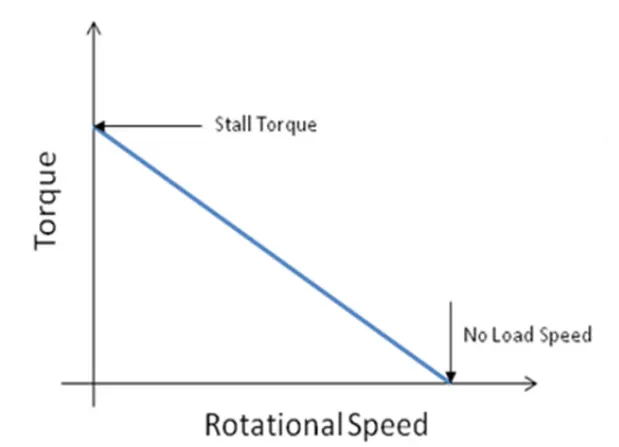
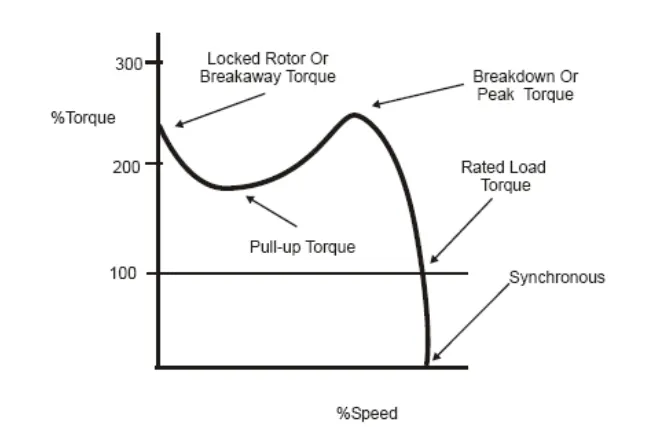
Fig: DC Motor Torque Vs Speed characteristic Fig: AC Motor Torque Vs Speed characteristic
- Here in the both cases of AC and DC there is no torque at maxium speed, gradually the torque decreases at high speed as the speed tends to be maxium speed.
- This situation does not occurs at the begining of the acceleration because most of the torque is used to increase the kinetic energy of the load. But when the speed is already high and no extra load is applied, it is not posible to increase the torque as well as to develop the braking torque. The braking operation happens in the motion which is been distributed as per propertion in the brake Energy and the regenerative braking.
- Coordination of Mechanical and electrical brakes in EV/HEV:
Mainly there are two ways of braking in EV, they are:
- Series: Regenerative braking and Mechanical braking applied one after another.
- Parallel: Both Regenerative braking and Mechanical braking applied simultaniously.
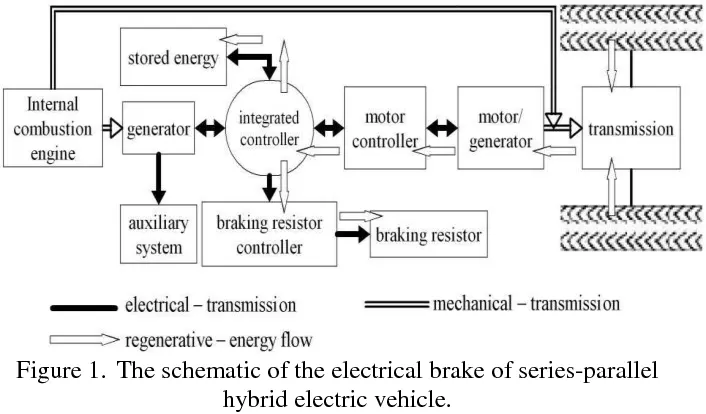
- When the brake pedal is pressed the hydraulic fluid reaches the brake piston and created the braking presure on the wheels and the same kinetic energy is been used by the regerative braking for the generating more power using the Bi-diractional motor which operates as a generator while braking.
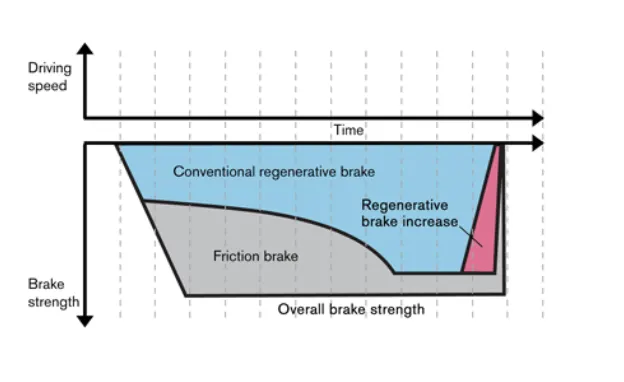
- In the Nissan Leaf there is EDIB (Electric Driven intelligent Brake), where both mechanical & Regenerative braking took place in the more efficient way.
- The Torque and speed characteristics of this braking system is as follows:
3. Make a MATLAB program which plots contour of given motor speed, torque and efficiency values.
MATLAB Code:
% Contour of given motor speed, torque and efficiency values
clear all
close all
clc

%Inputs
%Speed array (W)
W= linspace(0,1000,250);
%Torque array (T)
T= linspace(0,250,250);

%Loss coefficients
%Copper losses (Kc)
Kc= 0.18;
%Iron losses
Ki= 0.006;
%Windage losses
Kw= 0.000015;

%Meshgrid
[x,y] = meshgrid(W,T);
copper_loss= (y.^2)*Kc;
Iron_loss= x.*Ki;
Windage_loss= (x.^3)*Kw;
C= 20;

%Output Power (P_o)
P_o= x.*y;
%Input Power (P_in)
P_in= P_o+(copper_loss + Iron_loss + Windage_loss + C);

%Efficiency (E)
E= (P_o./P_in);
n= linspace(0.7,0.95,10);
contour(x,y,E,n)
xlim(0,1000)
ylim(0,250)
xlabel('Speed (rad/sec)')
ylabel('Tprque (N_m)')
Procedure:
- Initially provide the input parameters, Motor Speed, Torque and loss coefficients.
- Next, calculate the losses by meshgrid of motor speed and Torque using meshgrid() command.
- Next, calculate the output power, input power and Efficiency.
- Next, plot the contour of motor speed, torque and efficiency.
Results:
- Contour of given motor parameters:
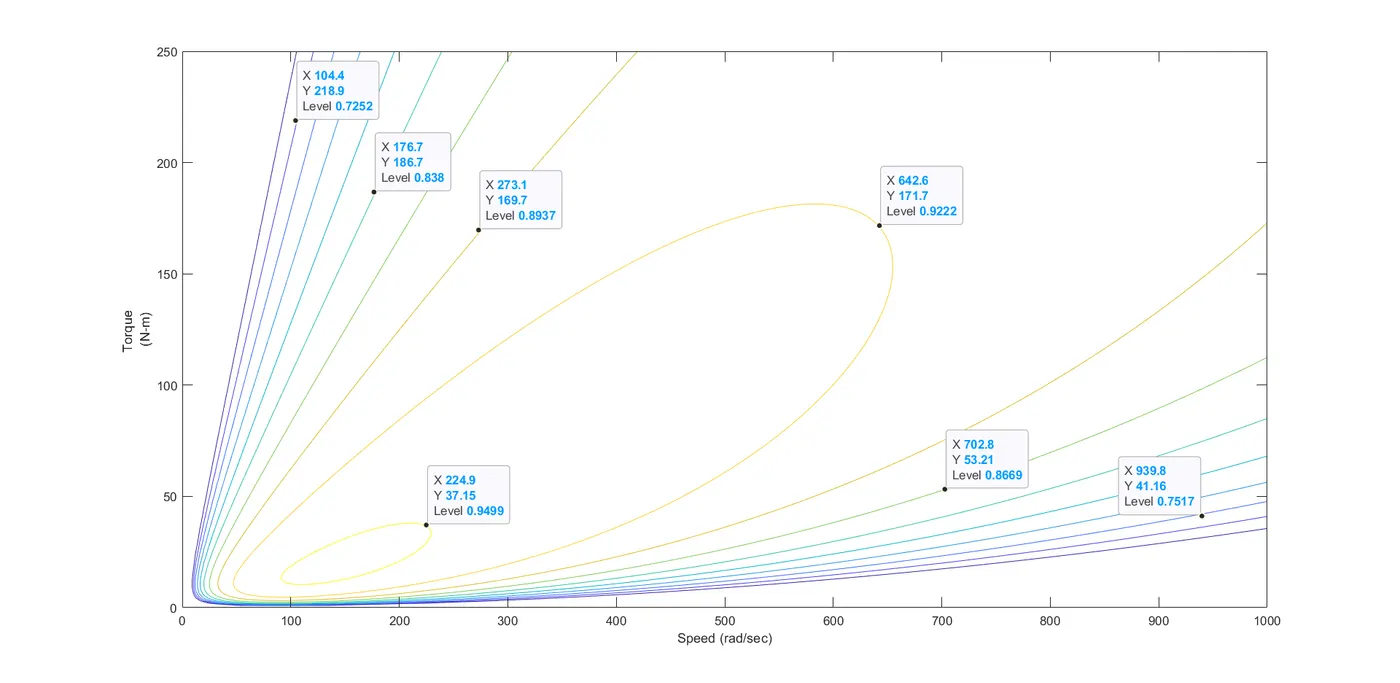
- From the contour graph we can see the 94.9% efficiency at speed 224.9 rad/sec and torque 37.15 N-m.
- As the speed increases the Efficiecny is reduces.
Conclusion:
Hence,
- For a defined driving cycle, calculated the energy required for braking.
- Explained the Coordination of Mechanical and electrical brakes in EV/HEV
- Created a MATLAB program which plots contour of given motor speed, torque and efficiency values.