Week 1 Understanding Different Battery Chemistry
1).
LITHIUM ION BATTERIES:=
- The most popular technology of the battery sector currently is the lithium ion battery. Relative to other types of batteries,
- Lithium ion batteries have better energy, power density and higher cycling ability.
- These qualities are extremely important in the use in modern applications like electrical and hybrid vehicles and most importantly energy storage systems which are used in the renewable energy applications.
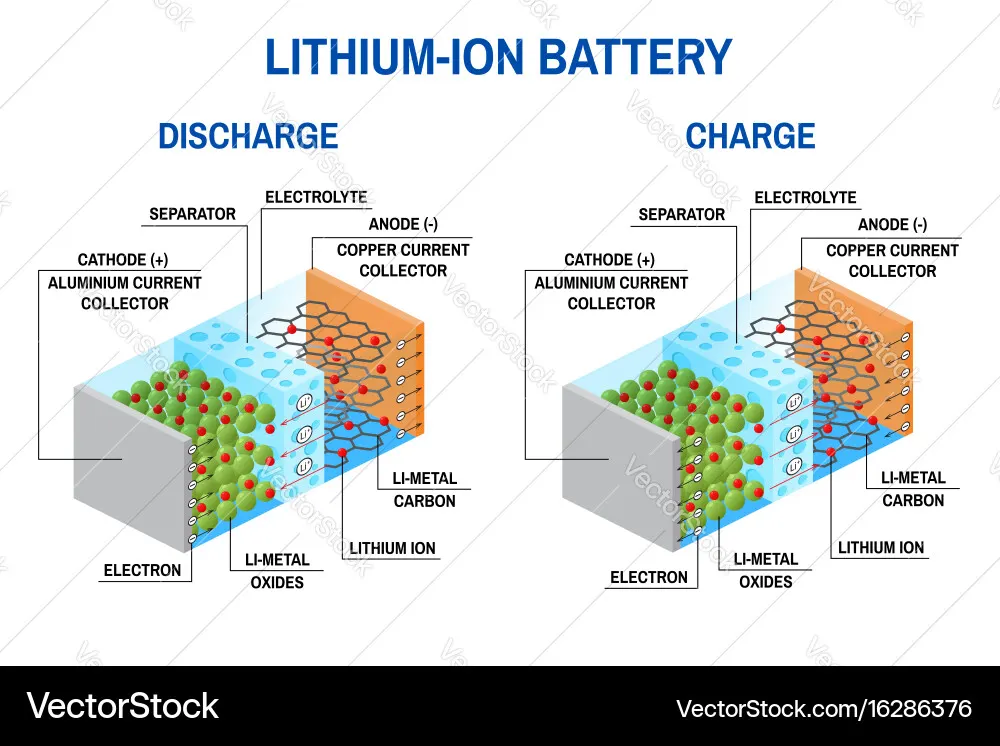
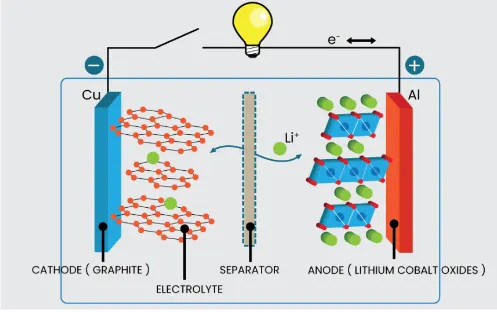
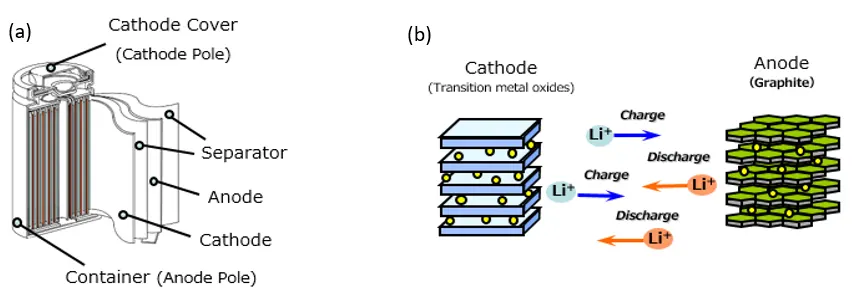
- The lithium ion batteries chemistry is the same across the different Lithium-ion Battery types; during discharge, Lithium-ions are moved to the positive cathode from the negative anode through the organic electrolyte. The anodes in all various technologies of lithium ion are all made from graphite.
- The differences are the cathode which contains changing cobalt, nickel or manganese concentrations. All various cathode types allow high lithium insertion and intercalation levels which result in large energy storage quantities.
| LCO (LiCoO2) = LITHIUM COBALT OXIDE | ||||
|
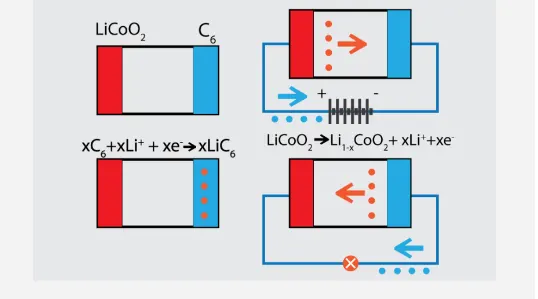
CHEMICAL REACTIONS: Li1-xCoO2(s) + x Li+ + x e- = LiCoO2(s)
|
- How they work
During discharge, lithium is oxidized from Li to Li+
(0 to +1 oxidation state) in the
lithium-graphite anode through the following reaction:C6Li=6C+LI+O
- These lithium ions migrate through the electrolyte medium to the cathode, where
they are incorporated into lithium cobalt oxide through the following reaction,
which reduces cobalt from a +4 to a +3 oxidation state :
Li1-xCoO2(s) + x Li+ + x e- = LiCoO2(s)
2.
| LMO (Lithium magnesium oxide) | ||||
| CHEMICAL REACTIONS:
|

| ANODE | CATHODE |
|
|
- It is used in different applications like power tools and electric cars.
- LMO batteries have the ability to deliver a lot of energy in a short period of time, which makes them extremely useful for use in power tools like drills.
- In 1996, lithium manganese oxide was first used as a cathode material.
- A three dimensional spinel structure was formed by this structure, this improves the flow of ions between the electrodes.
- The high flow decreases the internal resistance and increases loading capability.
- LMO batteries are usually used in medical devices and equipment, power tools, electric bikes and more. Because of their thermal resistance and higher safety. LMO batteries can also be used for laptops and electrical cars.
3.
| NCA (Nickel-Cobalt-Aluminum) | ||||
|
CHEMICAL REACTIONS:
NCA battery technology and applications
|

4.
| NMC(LiNi0.8Mn0.1Co0.1O2) = Lithium Nickel Manganese Cobalt Oxide |
||||
|
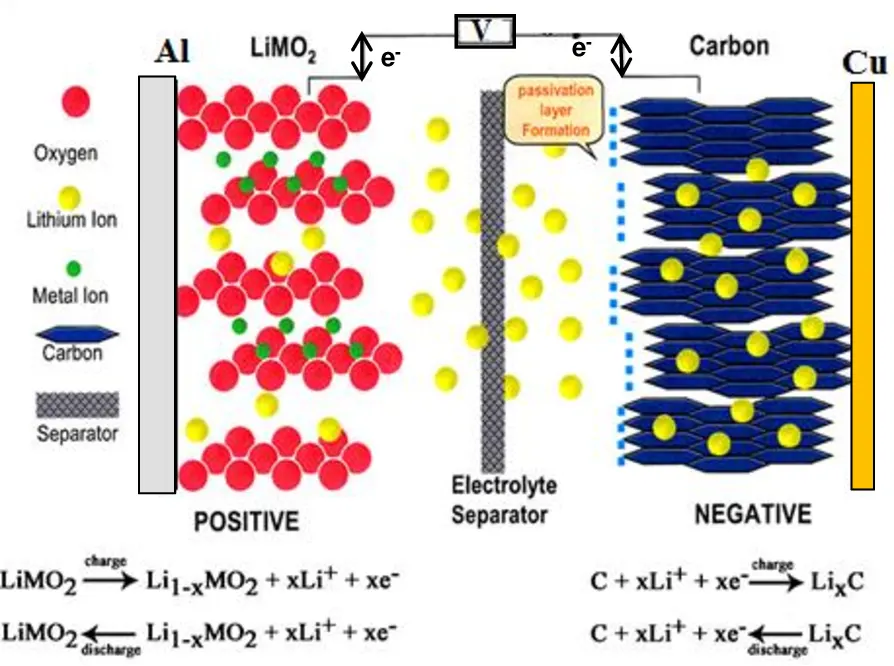
CHEMICAL REACTIONS: overall reaction of NMC 811 leaching by hydrochloric acid can be written as: 2LiMO2,(s) + 8HCl(l) ⇌ 2LiCl(l) + 2MCl2,(l) + 4H2O(l) + Cl2,(g).
NMC battery technology and applications
|
5.
|
LFP (LiFePO4) = Lithium iron phosphate or lithium ferro-phosphate |
||||
|
CHEMICAL REACTIONS:
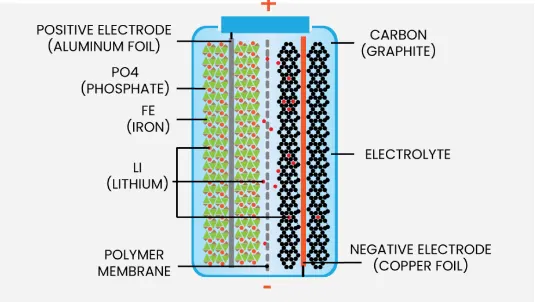
LFP batteries technology and applications
|
6.
|
LTO=lithium titanate (Li2TiO3) |
||||
|
CHEMICAL REACTIONS: Li7Ti5O12 + 2Li+ + 2e-= Li9Ti5O12.
LTO batteries technology and applications
|
2).
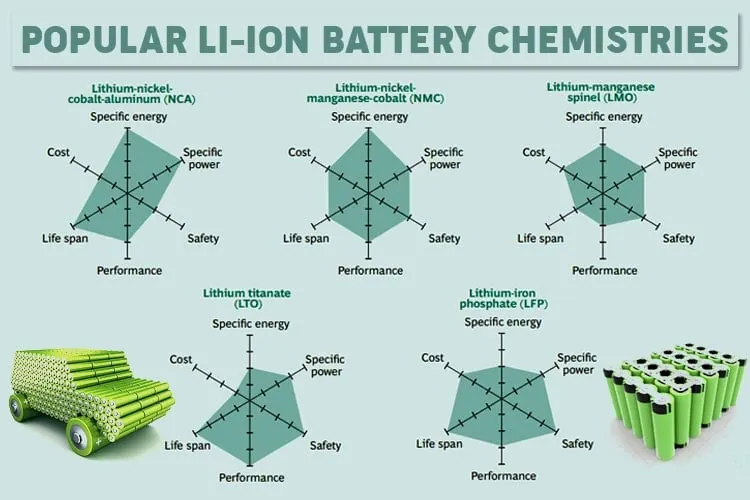
| Lithium-ion battery Types | SP | SE | SF | LS | CS | PF |
|---|---|---|---|---|---|---|
|
Lithium Cobalt Oxide |
L |
H |
L |
L |
L |
M |
|
Lithium Manganese Oxide |
M |
M |
M |
L |
L |
L |
|
Lithium Nickel Manganese Cobalt Oxide |
M |
H |
M |
M |
L |
M |
|
Lithium Iron Phosphate |
H |
L |
H |
H |
L |
M |
|
Lithium Nickel Cobalt Aluminum Oxide |
M |
H |
L |
M |
M |
M |
|
Lithium Titanate |
M |
L |
H |
H |
H |
H |
WHERE:
- SP stands for specific power
- SE stands for specific energy
- SF stands for safety
- LS stands for lifespan
- CS stands for cost
- PF stands for performance
- L stands for low
- M stands for moderate
- H stands for high