Week 1 Understanding Different Battery Chemistry
Lithium-ion Batteries:
Lithium-ion batteries power the lives of millions of people each day. From laptops and cell phones to Hybrids and Electric cars, this technology is growing in popularity due to its light weight, high energy density and ability to recharge.
Construction:
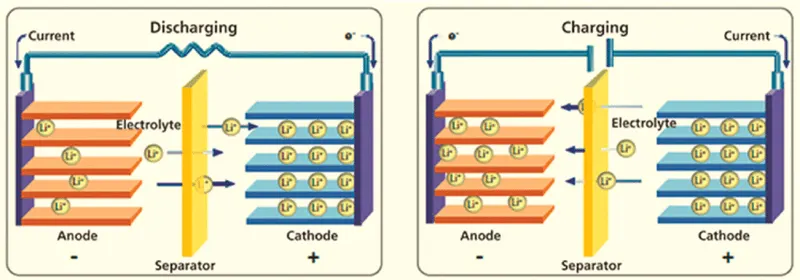
A Battery is made up of an anode, cathode, separator and two current collectors (positive and negative). The anode and cathode store the lithium. The electrolyte carries positively charged lithium ions from the anode to the cathode and vice versa through the separator. The movement of the lithium ions creates free electrons in the anode which creates a charge at the positive current collector. The electrical current then flows from the current collector through a device being powered (cell phone, computer, etc) to the negative current collector. The separator blocks the flow of electrons inside the battery.
Charging and Discharging:
While the battery is discharging and providing an electric current, the anode releases lithium ions to the cathode, generating a flow of electrons from one side to the other. When plugging in the device, the opposite happens: Lithium ions are released by the cathode and received by the anode.
Advantages:
- Generally, they are much lighter than other types of rechargeable batteries of the same size.
- They hold their charge. A lithium-ion battery pack loses only about 5 percent of its charge per month.
- High specific energy and high load capabilities with Power cells.
- Long cycle and extended shelf life, maintenance free. They can handle hundreds of charge / discharge cycles.
- High capacity, low internal resistance, good coulombic efficiency.
- Simple charge algorithm and reasonably short charge times.
- Low self-discharge (less than half that of NiCd and NiMH).
Limitations:
- Requires protection circuit to prevent thermal runaway if stressed.
- Degrades at high temperature and when stored at high voltage.
- No rapid charge possible at freezing temperatures (<0oC, <32oF)
- Transportation regulations required when shipping in large quantities.
- They are extremely sensitive to high temperatures. Heat causes lithium-ion battery packs to degrade much faster than they normally would.
Compare the differences between each type of Li-Ion batteries based on their characteristics:
|
Types of Lithium-ion Battery |
Anode |
Cathode |
Electrolyte |
Chemical Reaction |
Applications |
|
Lithium Cobalt Oxide (LCO) |
C6 (Graphite) |
LiCoO2 |
Ethylene Carbonate |
C6 + LiCoO2 LiC6 + CoO2 |
Mobile phones, Tablets, Laptops, Cameras |
|
Lithium Manganese Oxide (LMO) |
C6 (Graphite) |
LiMn2O4 |
Ethylene Carbonate |
C6 + LiMn2O4 LiC6 + Mn2O4 |
Power tools, Medical devices, Electric Powertrains |
|
Lithium Nickel Cobalt Aluminium Oxide (NCA) |
C6 (Graphite) |
LiNiCoAlO2 |
Ethylene Carbonate |
C6 + LiNiCoAlO2 LiC6 + NiCoAlO2 |
Medical devices, Industrial purposes, Electric powertrain (Tesla) |
|
Lithium Nickel Manganese Cobalt Oxide (NMC) |
C6 (Graphite) |
LiNiMnCoO2 |
Ethylene Carbonate |
C6 + LiNiMnCoO2 LiC6 + NiMnCoO2 |
E-bikes, Medical devices, EVs, Industrial purpose |
|
Lithium Iron Phosphate (LFP) |
C6 (Graphite) |
LiFePO4 |
Ethylene Carbonate |
C6 + LiFePO4 LiC6 + FePO4 |
Portable and stationary needing high load currents and endurance |
|
Lithium Titanium Oxide (LTO) |
Li2TiO3 |
LiMnO4 |
Ethylene Carbonate |
Li4Ti5O12 + 4Mn2O4 4LiMn2O4 + Ti5O12 |
UPS, Electric powertrain, Solar-powered street lighting |
|
Types of Lithium-ion Battery |
Nominal Voltage (V) |
Specific Energy (Wh/Kg) |
Charge (C-Rate) |
Discharge (C-Rate) |
Performance |
Lifespan (Related to depth of discharge, load, Temperature) |
Safety |
Thermal Runaway ( 0C ) |
Cost |
|
Lithium Cobalt Oxide (LCO) |
3.60 |
150-200 |
0.7 to 1 |
1 |
Medium |
500-100 |
Low |
150 |
Low |
|
Lithium Manganese Oxide (LMO) |
3.70 |
100-150 |
0.7 to 1 |
1 |
Low |
300-700 |
Medium |
250 |
Low |
|
Lithium Nickel Cobalt Aluminium Oxide (NCA) |
3.60 |
200-260 |
0.7 |
1 |
Medium |
500 |
Low |
150 |
Medium |
|
Lithium Nickel Manganese Cobalt Oxide (NMC) |
3.60, 3.70 |
150-220 |
0.7 to 1.0 |
1 |
Medium |
1000-2000 |
Medium |
210 |
Low |
|
Lithium Iron Phosphate (LFP) |
3.20, 3.30 |
90-120 |
1 |
1 |
Medium |
2000 and above |
High |
270 |
Low |
|
Lithium Titanium Oxide (LTO) |
2.40 |
50-80 |
1 |
10 |
High |
3000-7000 |
High |
-30 |
High |