Week 1 Understanding Different Battery Chemistry
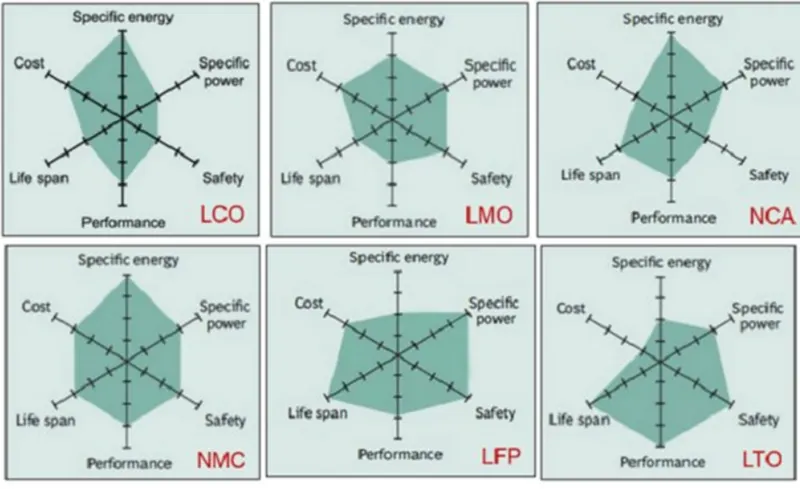
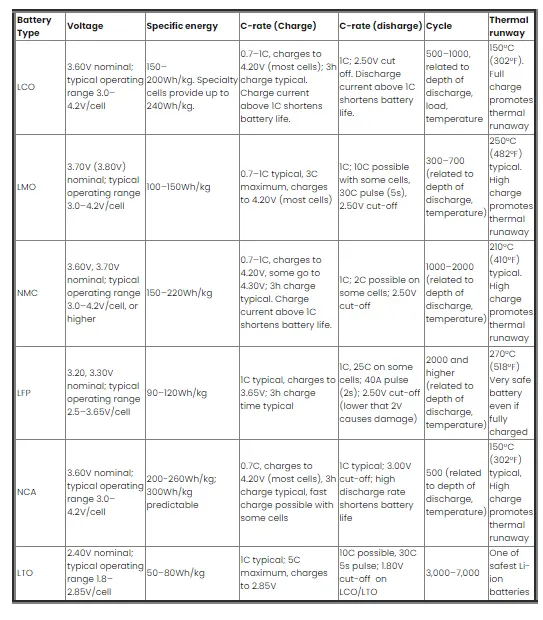
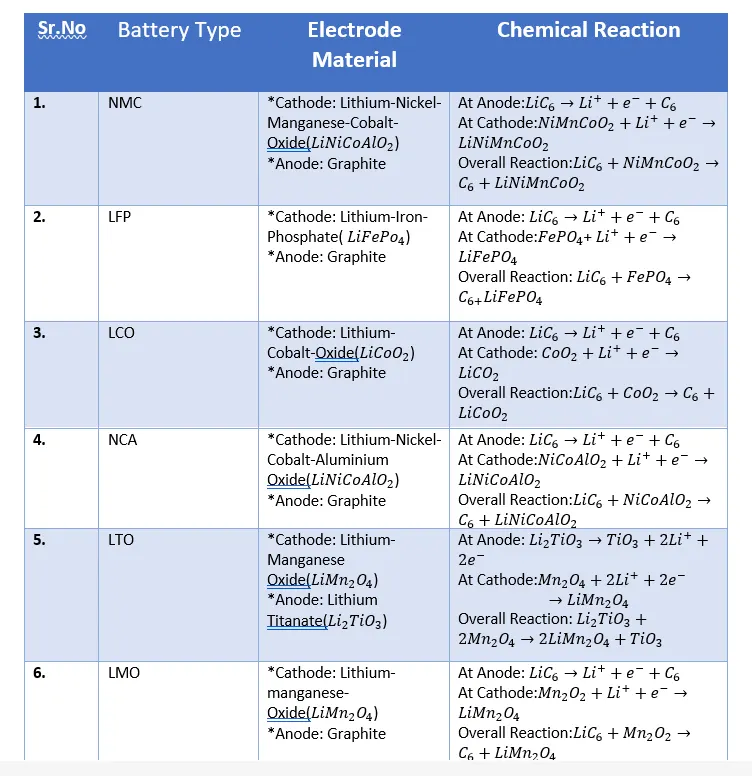
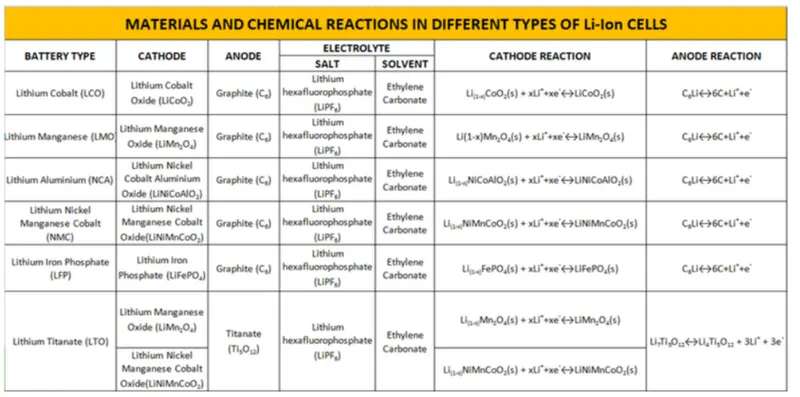
Q 1.Prepare a table which includes materials & chemical reactions occurring at the anode and cathode of LCO, LMO, NCA, NMC, LFP and LTO type of lithium ion cells.Give your detailed explanation on it.
# Lithium ion battery :
Introduction:
lithium-ion battery or Li-ion battery is a type of rechargeable battery composed of cells in which lithium ions move from the negative electrode through an electrolyte to the positive electrode during discharge and back when charging. Li-ion cells use an intercalated lithium compound as the material at the positive electrode and typically graphite at the negative electrode. Li-ion batteries have a high energy density, no memory effect (other than LFP cells) and low self-discharge. Cells can be manufactured to either prioritize energy or power density They can however be a safety hazard since they contain flammable electrolytes and if damaged or incorrectly charged can lead to explosions and fires.
A prototype Li-ion battery was developed by Akira Yoshino in 1985, based on earlier research by John Goodenough, M. Stanley Whittingham, Rachid Yazami and Koichi Mizushima during the 1970s–1980s,]and then a commercial Li-ion battery was developed by a Sony and Asahi Kasei team led by Yoshio Nishi in 1991.Lithium-ion batteries are commonly used for portable electronics and electric vehicles and are growing in popularity for military and aerospace applications.
Chemistry, performance, cost and safety characteristics vary across types of lithium-ion batteries. Handheld electronics mostly use lithium polymer batteries (with a polymer gel as electrolyte), a lithium cobalt oxide (LiCoO2) cathode material, and a graphite anode, which together offer a high energy density. Lithium iron phosphate (LiFePO4), lithium manganese oxide (LiMn2O4 spinel, or Li2MnO3-based lithium rich layered materials, LMR-NMC), and lithium nickel manganese cobalt oxide (LiNiMnCoO2 or NMC) may offer longer lives and may have better rate capability. Such batteries are widely used for electric tools, medical equipment, and other roles.
NMC and its derivatives are widely used in the electrification of transport, one of the main technologies (combined with renewable energy) for reducing greenhouse gas emissions from vehicles. Improperly recycled batteries can create toxic waste, especially from toxic metals and are at risk of fire. Moreover, both lithium and other key strategic minerals used in batteries have significant issues at extraction, with Lithium being water intensive in often arid regions and other minerals often being conflict minerals such as cobalt. Both environmental issues have encouraged some researchers to improve mineral efficiency and alternatives such as iron-air batteries.
Research areas for lithium-ion batteries include extending lifetime, increasing energy density, improving safety, reducing cost, and increasing charging speed, among others. Research has been under way in the area of non-flammable electrolytes as a pathway to increased safety based on the flammability and volatility of the organic solvents used in the typical electrolyte. Strategies include aqueous lithium-ion batteries, ceramic solid electrolytes, polymer electrolytes, ionic liquids, and heavily fluorinated systems.
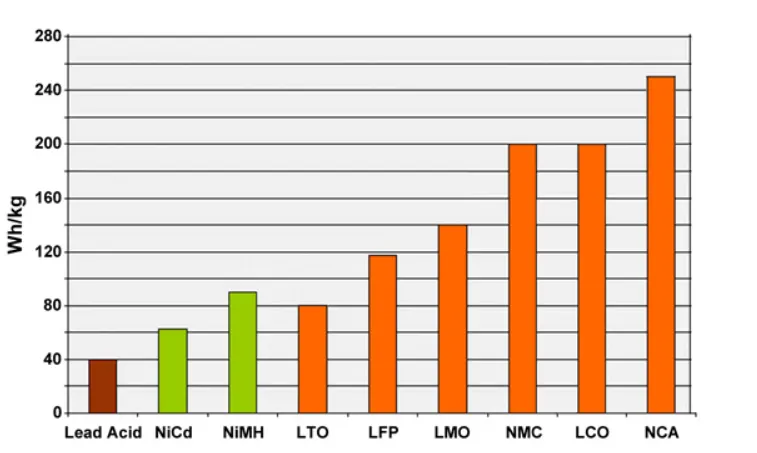
#Table
# Construction and Working Of Lithiumn ion battery:
Mainly It consist of
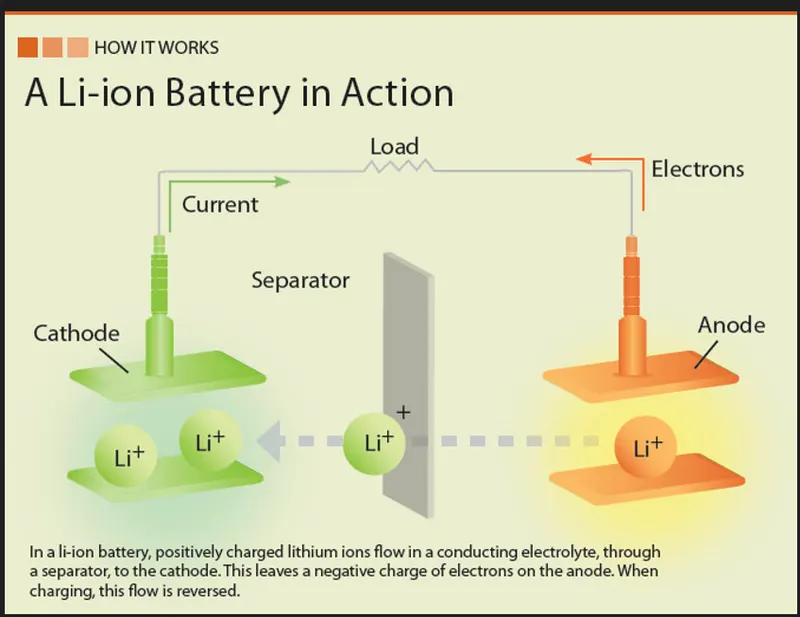
- cathode
- Anode
- Seperator
- Electrolyte
1.Cathode:
There are multiple cathode materials to choose from within the Li-ion battery space. Originally, the primary active component of the cathode was cobalt. Today, cobalt is frequently being substituted out partially with nickel (NMC, NCA). Cathode materials require extremely high purity levels and must be almost entire free of unwanted metal impurities – notably iron, vanadium and sulfur.
High-performance, high-capacity cathode materials which have been used to achieve unprecedented battery performance. These include Nickel Cobalt Aluminum (NCA), Core Shell Gradient (CSG), Spinel-based lithium-ion (LMO), Cobalt-based lithium-ion (LCO) and Nickel Cobalt Manganese (NCM or NMC).
Cathode Binders
Our portfolio of binder materials includes Styrene Butadiene Copolymer (SBR), and Polyvinylidene Fluoride (PVDF), used in the cathode and anode electrode slurry making process for Lithium-ion batteries. Binders such as SBR and PVDF hold the active material particles together and in contact with the current collectors i.e. the Aluminum Foil (Al foil) or the Copper Foil (Cu foil).
Aluminum Foils
A rolled foil (RA-type), made from wrought Cu is generally used for high-energy, high-power applications. Aluminum foils are used as the cathode current collector of secondary Li-ion batteries. Currently, the anode is comprised of a Graphite mixture, while the cathode combines Lithium and other choice metals, and all materials in a battery have a theoretical energy density. With Lithium-ion, the anode is well optimized, and design changes will yield little to no significant improvements in performance. On the other hand, the cathode material is wide open to enhancements, and explains why today’s battery research is so heavily focused on this area.
Cathode Active Materials
Cathode Active Materials are the main elements dictating the differences in composition while building positive electrodes for battery cells. The cathode materials are comprised of cobalt, nickel and manganese in the crystal structure forming a multi-metal oxide material to which lithium is added. This family of batteries includes a variety of products that cater to different user needs for high energy density and/or high load capacity.
2.Anode
The vast majority of lithium-ion batteries use graphite powder as an anode material. Graphite materials are either synthetically-produced (artificial graphite) or mined from the ground (natural graphite), then heavily processed before being baked onto a copper foil to serve as anodes. Graphite anodes meet the voltage requirements of most common Li-ion cathodes, are relatively affordable, extremely light, porous and durable.
Anode Material Requirements
In order to be suitable for lithium-ion battery manufacturing, anode materials should meet the following requirements:
- Excellent porosity and conductivity.
- Good durability and light weight.
- Low Cost.
- Voltage match with preferred cathode.
3.Electrolyte
The Role of Electrolyte in Lithium-ion Batteries
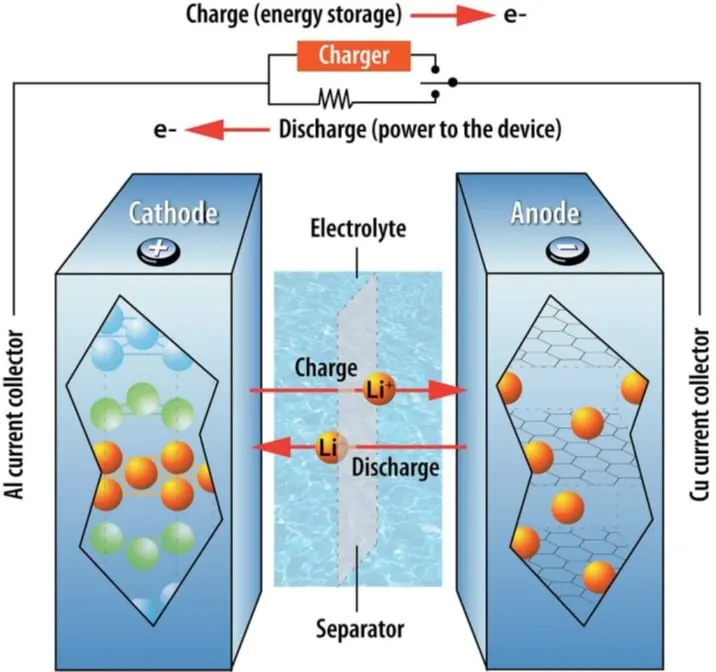
Electrolyte plays a key role in transporting the positive lithium ions between the cathode and anode. The most commonly used electrolyte is comprised of lithium salt, such as LiPF6 in an organic solution.
4.Seperator
-What is the function of lithium-ion battery separator?
The separator membrane is moistened with electrolyte and it forms a catalyst that speeds up the movement of ions from the cathode to anode on charging and in reverse direction in case of discharge. The separator acts as an insulator with poor electrical conductivity.
-What is separator breakdown in lithium-ion batteries?
-What is the function of the separator membrane in a battery?