STRESS ANALYSIS ON PLATES WITH HOLE USING SOLIDWORKS
AIM: Perform a static analysis on two models of plate with holes
MATERIAL PROPERTIES:
The material of both the plates is chosen to be Alloy steel, the properties of which are given in the below table.
Name: Alloy Steel
Model type: Linear Elastic Isotropic
Default failure criterion: Max von Mises Stress N Yield strength: 6.20422e+08 `N/m^2`
Tensile strength: 7.23826e+08 `N/m^2`
Elastic modulus: 2.1e+11 `N/m^2`
Poisson's ratio: 0.28
Mass density: 7700g `(kg)/m^3`
Shear modulus: 7.9e+10 `N/m^2`
Thermal expansion coeficient: 1.3e-05 /Kelvin
PROCEDURE:
The entire process of performing a Solidworks simulation can be divided into four parts.
1. Part design Includes making the part file of the model to be analyzed and material assigned to the components.
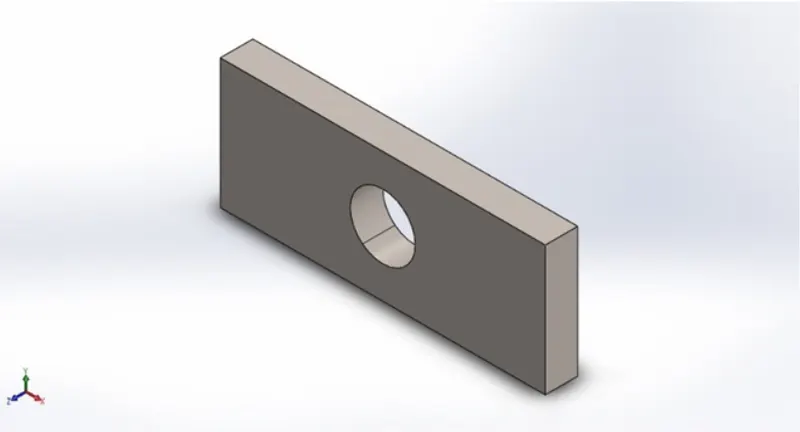
CASE1 :Create a rectangular block with a hole in the middle with 60mm. The dimensions of the block are 300 x 120 x300mm
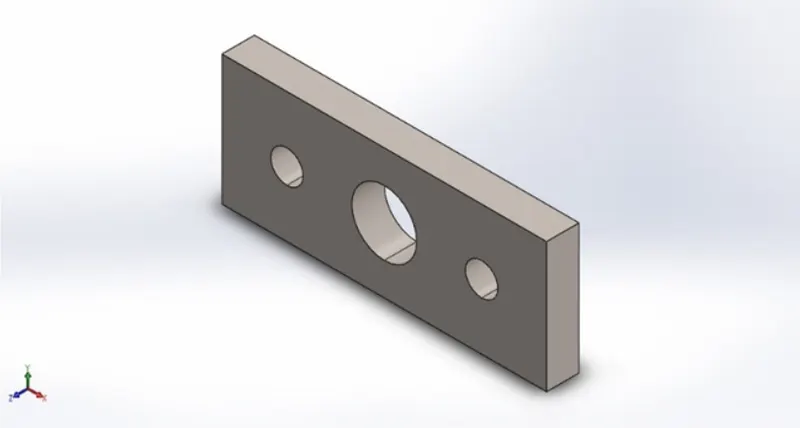
CASE 2: Create two additional holes in the rectangular block of diameter 30mm on either side with a distance of 90mm from the centre
2. Setting up of boundary conditions Includes setting up the fixed supports, reactions and external loads.
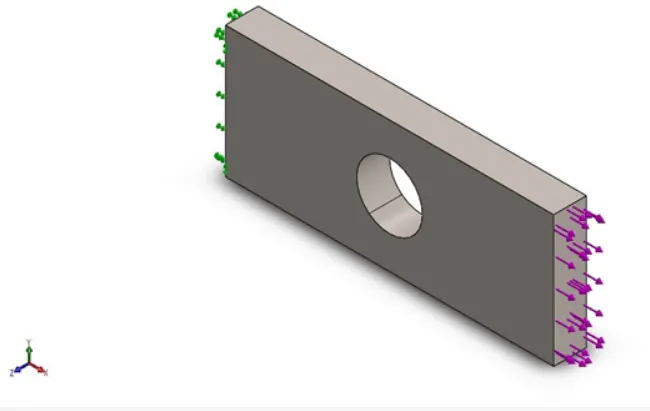
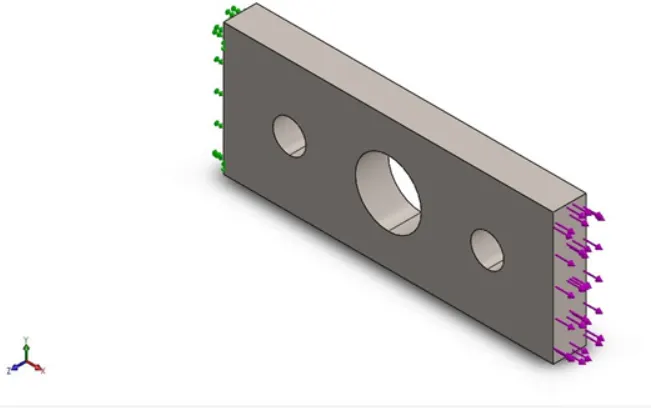
Here we have to establish the loads and supports.The boundary conditions imposed on the plates are a fixture on one side and a load of 1000N on the other side -120 X 30 mm surface.
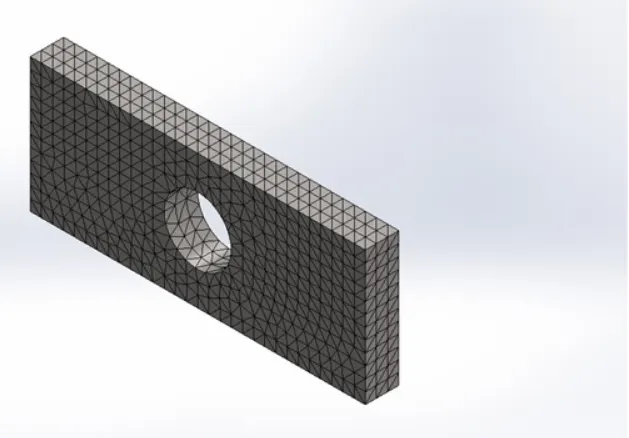
3. Meshing the component was using default mesh size, and various other mesh parameters are setup.
MESH INFORMATION:
Mesh type Solid Mesh Mesher Used: Standard mesh
Automatic Transition: Off Include
Mesh Auto Loops: Off
Jacobian points 4 Points
Element Size 0.0099862 m
Tolerance 0.00049931 m
Mesh Quality Plot High
Total Nodes 11535
Total Elements 7121
Maximum Aspect Ratio 2.949
% of elements with Aspect Ratio < 3 100
% of elements with Aspect Ratio > 10 0
% of distorted elements(Jacobian) 0
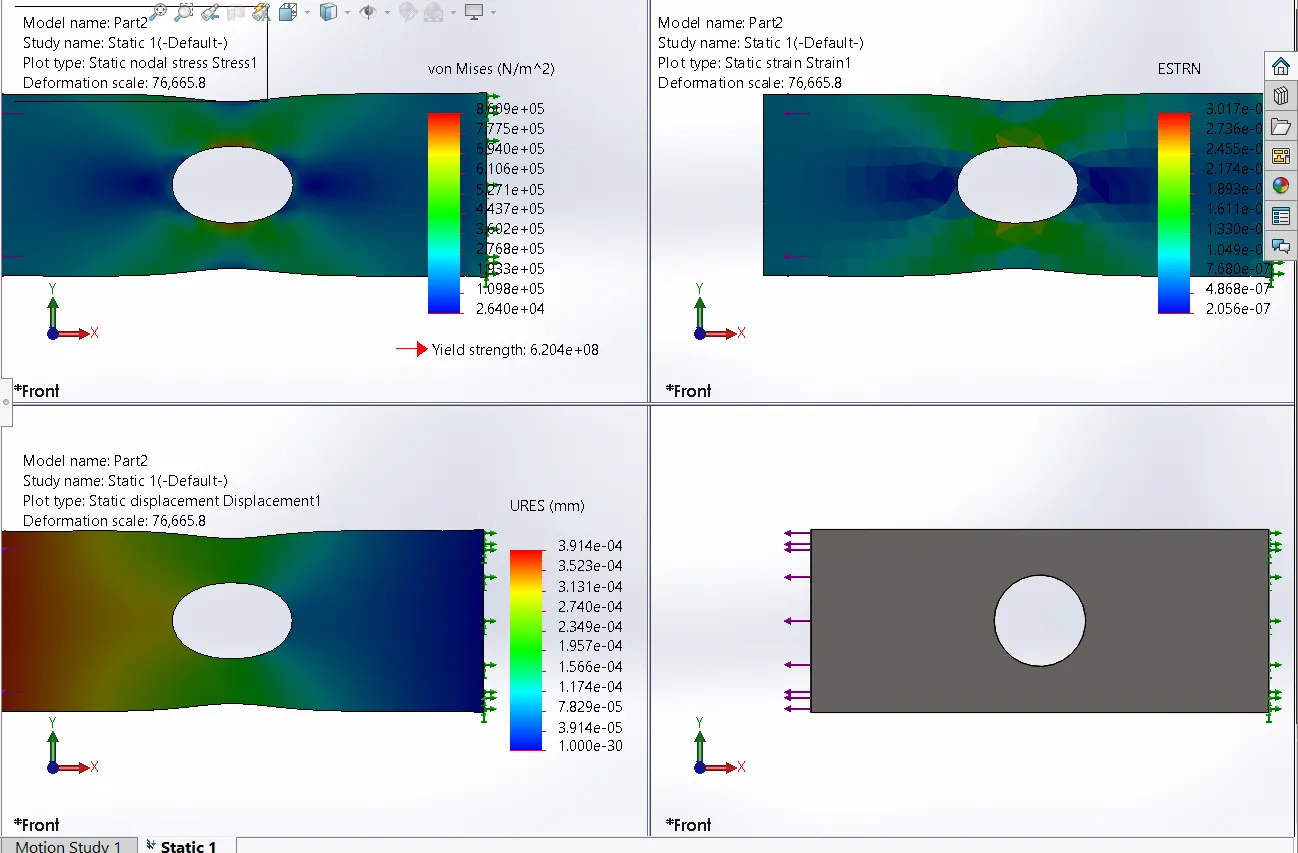
4. Solver Analysis The solver is run giving out the results for Von mises stresses, strains and displacements at all the nodes and identifying the minimum and maximum values of those to determine the critical regions.
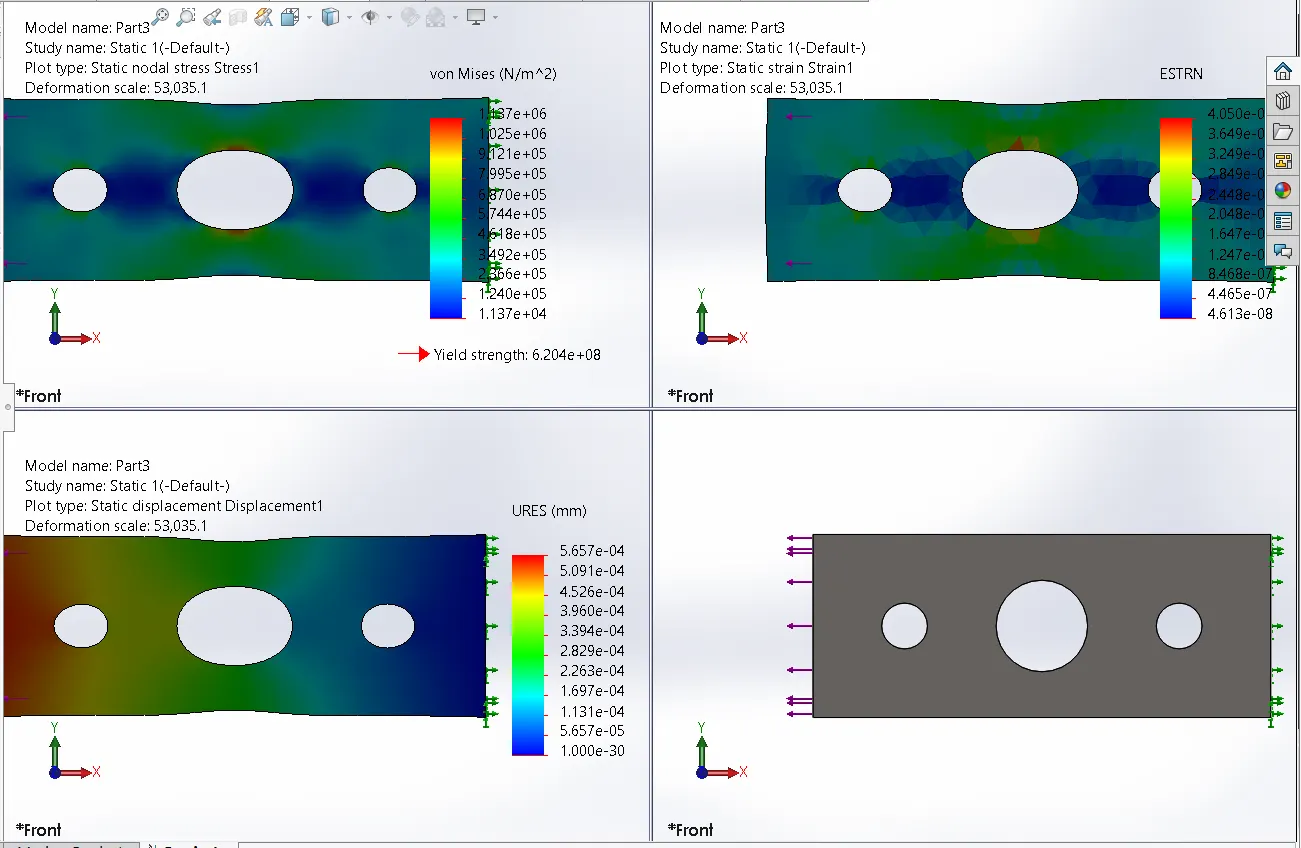
A similar procedure is followed for case 2
RESULTS:
1st CASE:
CASE II:Plate with three holes
CONCLUSION:
| Case No | Von mises Stress | Equivalent Strain |
| 1 | 8.609e+05 `N/m^2` | 3.017e-07 |
| 2 | 1.137e+06 `N/m^2` | 4.050e-07 |
The plate with a single central hole experiences higher maximum stress than the plate with three holes. This seems counter-intuitive at first since the plate in the second case has a higher number of stress concentration regions and hence expected to experience higher maximum stress. But in reality what is happening is that the additional two holes in the second case, due to their geometrical positioning, are acting as stress relief features reducing the effect of stress concentration at the central hole. This is the reason for the lesser value of maximum Von mises stresses in case of the plate with three holes.
The maximum displacement, on the other hand, is higher in case of a plate with three holes since the extra holes reduce the load-bearing capacity of the plate due to the reduction in the load-bearing material volume. Hence more deformation occurs in the plate with three holes than in the plate with a single hole for the same applied load.