Section Modulus calculation and optimization
Aim - Calculate section modulus o automotive hood and optimise for higher strength.
Objectives -
- Calculate section modulus of automotive hood.
- Optimise section modulus by comparing with improved section.
Moment of Inertia -
when a body is free to rotate around an axisis, torque must be applied to change its angular momentum. The amount of
torque needed to cause any given angular acceleration (the rate of change in angular velocity ) is proportional to the
moment of inertia of the body.Moment of inertia may be expressed in units of kilogram meter squared (kg-m^2) in SI
units Mathemaically,
`I = M* r^2`
where,
M = Mass of body
r = Distance from the axis of rotation
Section Modulus -
Section modulus is a geometric property for a given cross-section used in the design of beams or flexural members. other geometric properties used in design include area for tension and shear, radius of gyration for compression, and moment of inertia and polar moment of inetia for stiffness. Any relationship between these properties is highly dependent on the shape in question. Equation for the section moduli of common shapes are given below. There are two types of section moduli, the elastic section modulus and the plastic section modulus.
Mathemetically,
`S = I/Y`
Where,
S = Section modulus
I = Moment of Inertia
Y = Distance from the nuetral axis to the outer fiber
Lets calculate the section modulus of Automotive hood in nx-cad
Procedure -
Open NX-Cad and load the Hood assembly
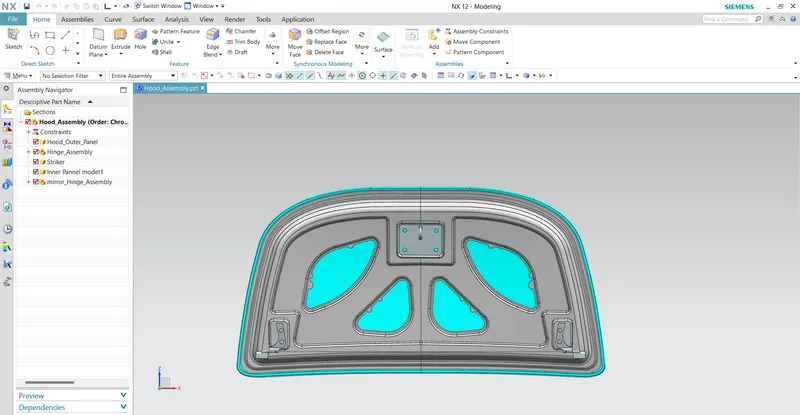
We taken Hood inner pane and Outer panel for stress calculation
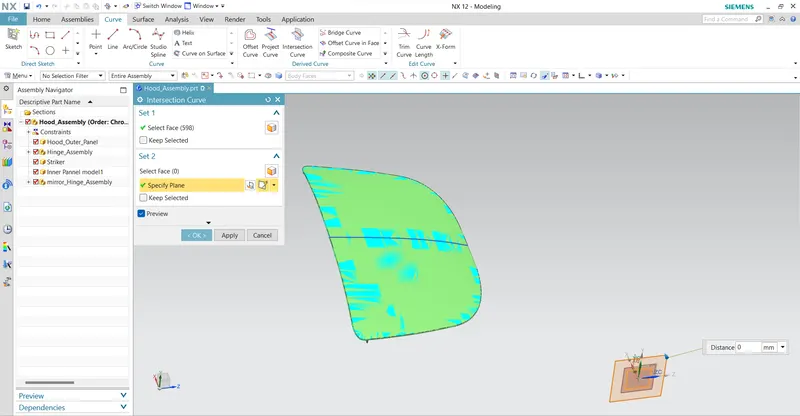
Go to Intersection curve - select entire assembly - select hood inner panel - select hood outer panel using body face option - Select mirror plane - Ok
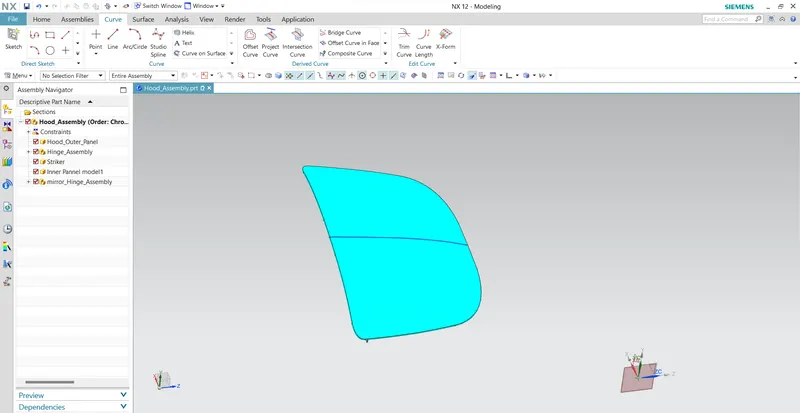
Hide Outer panel - Hide inner panel - Hide striker - Hide Hinge assembly - Hide Mirror Hinge assembly
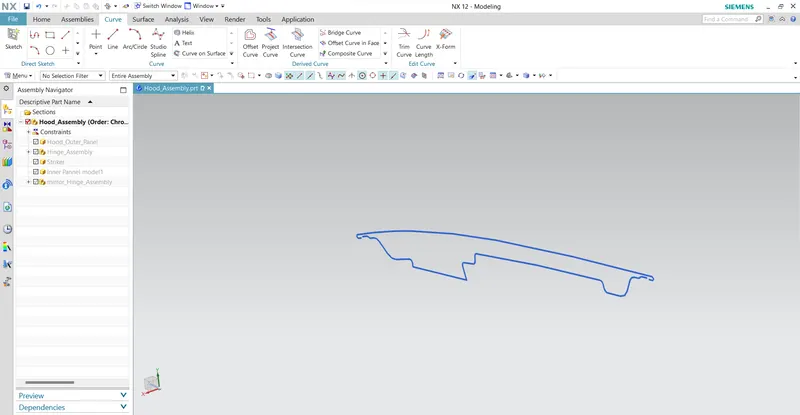
We can see o opening between inner panel and outer panel we have to join this opening but it difficult to join so try project to other plane and do on it.
creating a datum plane parallel to mirror plane at 100 offset mm
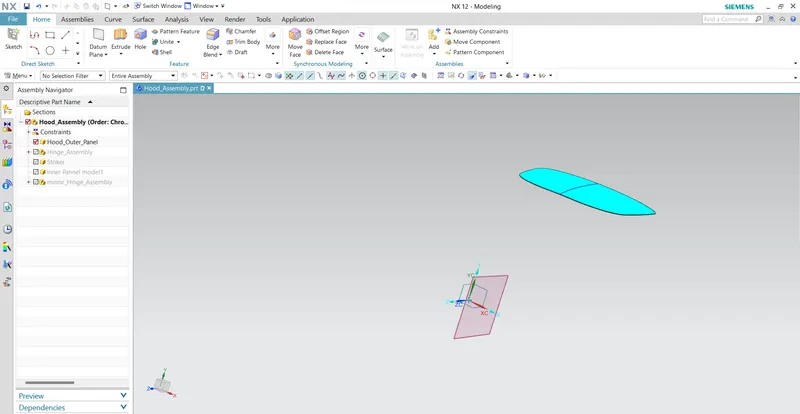
Project the intersection curve on Plane
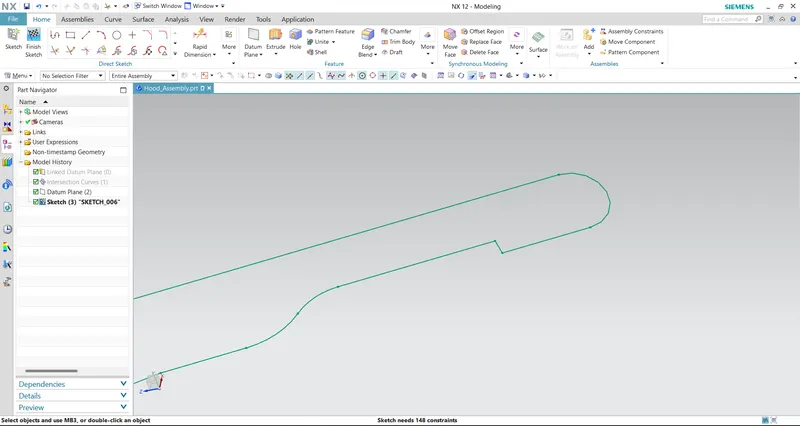
Now we can edit the curve for and join together
Use quick trim and delete inner curves and use extend curve to join curves then we get a close curve
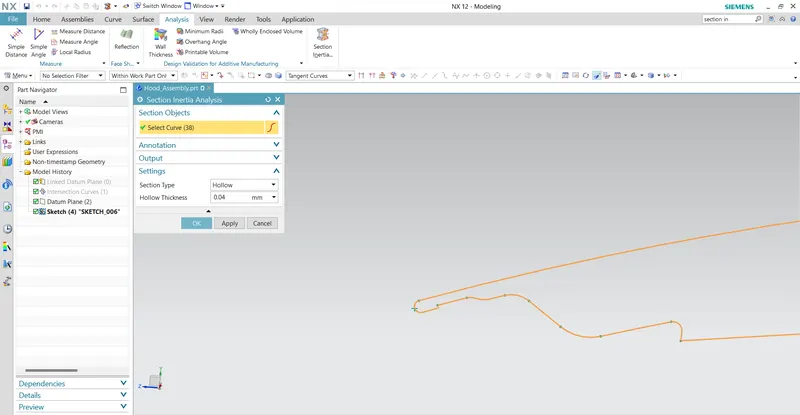
Now go to Section inertia analysis and select curve - hollow - ok
Improving section
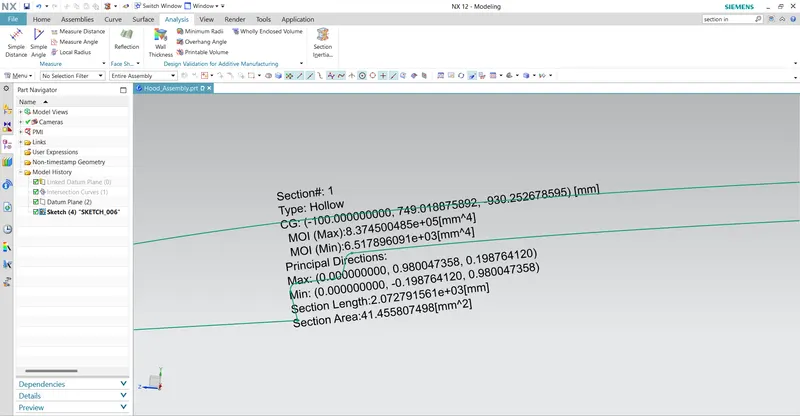
Keep in mind that we have max and min moment of inertia, We need higher value in minimum moment of inertia.
Now we get the value of I ( moment of inertia) Now we need value of Y ( distance from nutral axis )
For this we have measure the distance by creating points
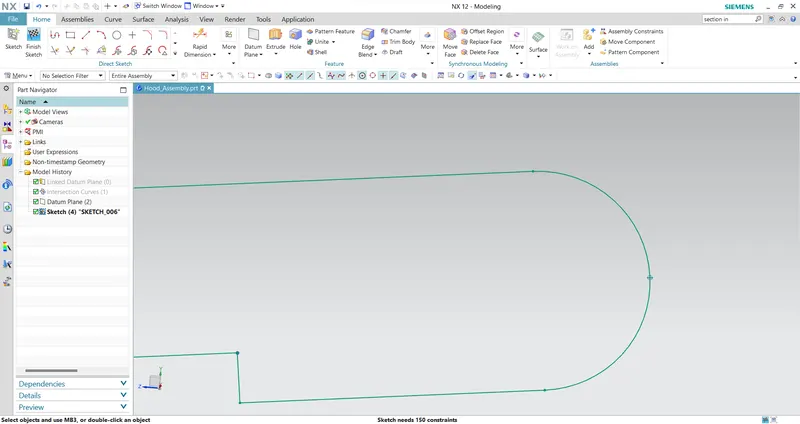
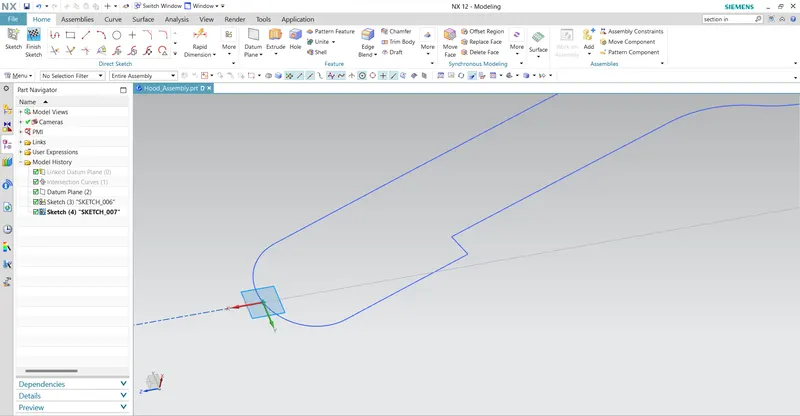
Now measure the distance between points
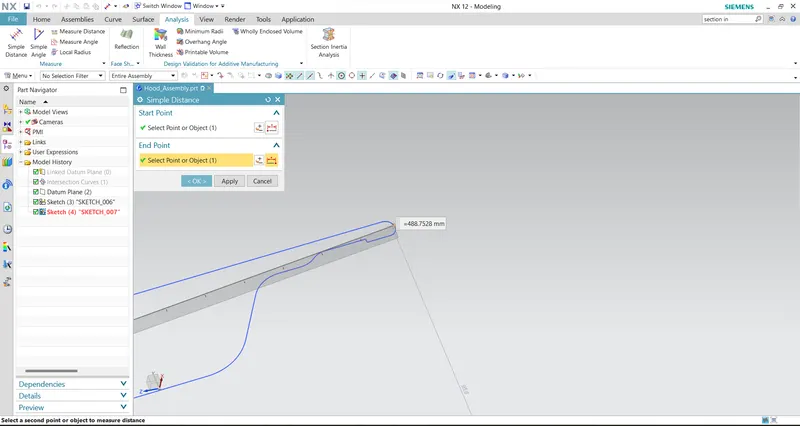
Now we hav to optimise the section modulus for this we have to edit the sketch
Offset the curve and make higher strength curve
We make 5 mm offset some surface now do the section modulus on this sketch lets compare with previous results
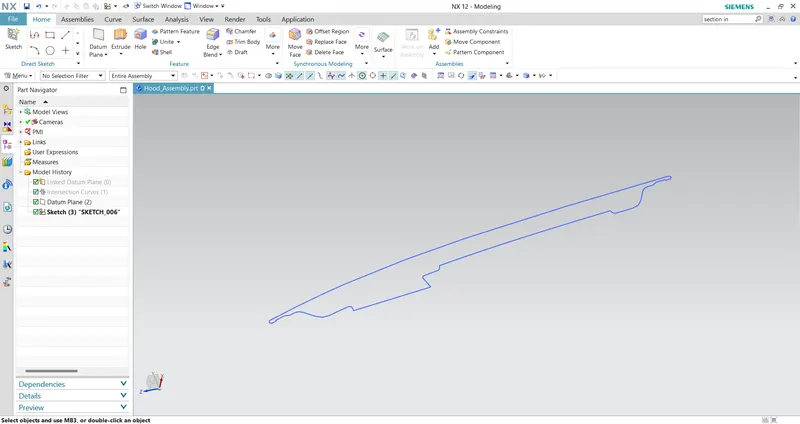
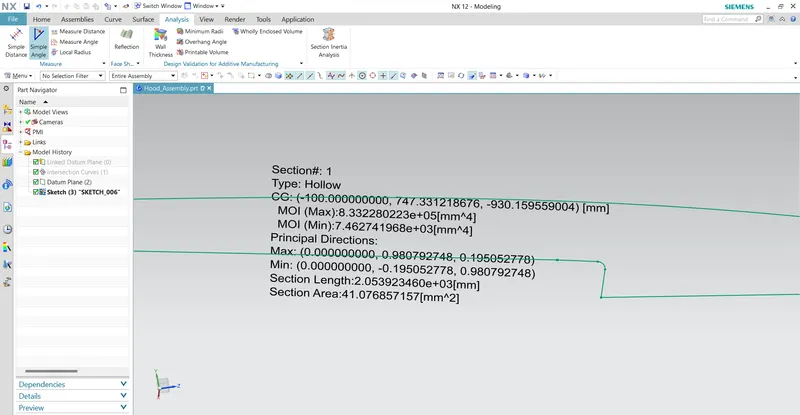
We can see that MOI is incresed here lets compare both results
| Sections | Section 1 | Section 2 (Improved section) |
| Max MOI | `8.3322*10^5 mm^4` | `8.3322*10^5 mm^4` |
| Min MOI | `6.5145*10^3 mm^4` | `7.46274*10^3 mm^4` |
| Section Area | 41.45 mm^2 |
41.076 mm^4 |
Calculations
Section 1
Moment of inertia (max) = 8.3322*10^5 mm^4
Moment of inertia (min) = 6.5145*10^3 mm^4
Distance between both end = 488.75 mm
Lets consider 488 mm
So Y = 488/2 = 244 mm
Section Modulus = MOI / Y
so Smax = (8.3322*10^5) / 244
Maximum Section modulus Smax = 3414 mm^3 mm^3
Smin = (6.5145*10^3) / 244
Minimum section modulus Smin = 26.69 mm^3 mm^3
Section 2
Moment of inertia (max) = 8.3322*10^5 mm^4
Moment of inertia (min) = 7.46274*10^3 mm^4
Distance between both end = 484.75 mm
Lets consider 486 mm
So Y = 486/2 = 243 mm
Section Modulus = MOI / Y
so Smax = (8.3322*10^5) / 243
Maximum Section modulus Smax = 3414.83 mm^3
Smin = (7.46274*10^3) / 243
Minimum section modulus Smin = 30.71 mm^3
Results -
- By improving the cross section we can get higher minimum moment of inertia
- Higher area gives high strength