Project - Design a Hospital Management system
PROJECT- "Design a Hospital Management system for better patient care"
Healthcare management system (HMS)
cite:-https://otakoyi.software/blog/healthcare-management-system-features-and-benefits
- Over the last few decades, the need to digitize the healthcare services industry has increased immensely.
- Having a system in place that will not only allow but also enhance administrative as well as clinical operations in the medical field is a must.
- Healthcare Management System is an all-in-one software system that provides expert solutions, automates daily operations, manages documentation, inventory, and bills, and overall lifts the heavy weight off the clinicians’ shoulders.
- Healthcare management system is a cloud-based web medical management framework that registers and incorporates the data from every single department to make all the internal activities automated.
- A healthcare management system software seeks to cover a wide range of tasks: from streamlining the workflow for medics to providing superior patient experience and everything in between, such as downsizing administrative costs and reducing errors.
- HMS consolidates clinicians, patients, medical supplies, laboratory results data, insurance, medical bills, doctor appointments, and reports.
HMS does many works like:
- Maintain the medical records of the patient
- Maintain the contact details of the patient
- Keep track of the appointment dates
- Save the insurance information for later reference
- Tracking the bill payments.
HMS ARCHITECTURE
- Identify processes to be automated with hospital management solutions (patient relations, appointment scheduling, inventory management, etc.)
- Finalize the list of features required by your hospital management system (see examples of HMS features below.)
- Identify the specific technologies that will be used.
- Identify the platforms to be implemented (web, mobile, cloud, etc.)
- Make sure a highly skilled medical software engineer or project manager has delivered a full roadmap of the solution.
- Plan your client-server HMS application relations across a range of components.
- Make sure your solutions for databases, API integrations, and other sources of information are prepared, and their interactions are well-planned.
- Plan the tasks necessary to build the project, including the software development and solutions necessary to carry out tasks (front-end/back-end languages and frameworks.)
- Hire a team of developers and medical QA professionals.
- Make sure your project plan is adapted to the existing IT infrastructure of the hospital facility.
- Make sure all requirements from the medical staff members are collected, documented, and systematized.
- Design interfaces and everything else affecting user experience.
WORKFLOW
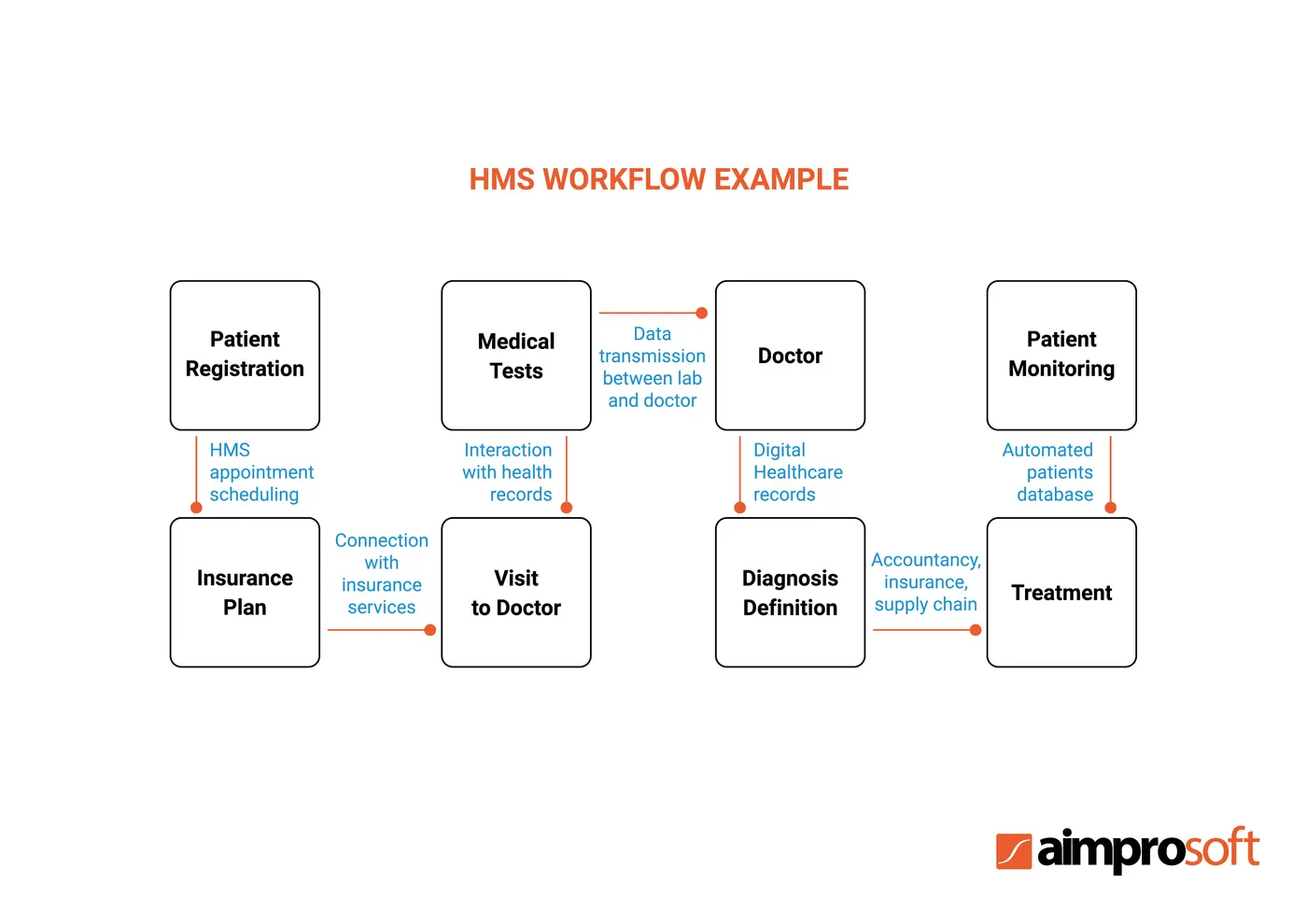
cite:-https://www.aimprosoft.com/blog/how-to-develop-a-hospital-management-system/
Health Processes that can be managed within HMS
The most important medical administration processes traditionally consolidated and managed with hospital management software include:
- Medical staff records (hospital workforce management)
- Patient records (personal profiles, medication plans, etc.)
- Physician activities (patient appointment schedules and more)
- Dispensary management
- Medical inventory management
- Pharmacy, radiology, and laboratory records/inventory
- Claims, billing, and payment processes
- Workflows of different medical departments
- Hospital inventory (medical drugs, syringes, instruments, and so on).
WEB technologies used
Most popularly used web programming languages are:-
PYTHON
- Python is an interpreted, object-oriented, high-level programming language with dynamic semantics.
- Its high-level built in data structures, combined with dynamic typing and dynamic binding, make it very attractive for Rapid Application Development, as well as for use as a scripting or glue language to connect existing components together.
- Python's simple, easy to learn syntax emphasizes readability and therefore reduces the cost of program maintenance.
- Python supports modules and packages, which encourages program modularity and code reuse.
- The Python interpreter and the extensive standard library are available in source or binary form without charge for all major platforms, and can be freely distributed.
HTML
- HTML is an acronym which stands for Hyper Text Markup Language which is used for creating web pages and web applications.
- HTML is the standard markup language for creating Web pages
- HTML describes the structure of a Web page
- HTML consists of a series of elements
- HTML elements tell the browser how to display the content
- HTML elements label pieces of content such as "this is a heading", "this is a paragraph", "this is a link", etc.
- Hypertext defines the link between web pages. A markup language is used to define the text document within the tag which defines the structure of web pages.
- This language is used to annotate (make notes for the computer) text so that a machine can understand it and manipulate text accordingly. Most markup languages (e.g. HTML) are human-readable.
JAVASCRIPT
- JavaScript is the world most popular lightweight, interpreted compiled programming language.
- It is also known as scripting language for web pages.
- It is well-known for the development of web pages, many non-browser environments also use it.
- JavaScript can be used for Client side developments as well as Server side developments.
- JavaScript is an easy to learn and also powerful scripting language, widely used for controlling web page behavior.
- You can validate user input before sending the page off to the server. This saves server traffic, which means less load on your server.
- They don't have to wait for a page reload to see if they have forgotten to enter something.
- You can create interfaces that react when the user hovers over them with a mouse or activates them via the keyboard.
DATABASE
- The medical practice management system: forms an integral part of the healthcare system. It takes care of different administrative and clinical aspects of your practice. It is geared towards a facility’s clerical work, such as managing various documents, scheduling appointments, and more. It automates and streamlines multiple activities, which makes it easy to run the facility smoothly.
- Electronic health records: are another type of hospital management information system that is basically concerned about the patient’s medical information. doctors can simply fill out all the information on the EHR system. The best part is that it can be accessed instantly using a mobile or computer. It also enables doctors to easily share data across different departments, allowing them to provide quick and accurate treatment. It deals with data management, which generally contains information on patients'
- E-prescribing software: is a beneficial technology as it enables doctors to generate prescriptions electronically. It allows them to directly send prescriptions to the pharmacy in just a few clicks, and when the patient gets there, the store is already ready with their supplements. The system eliminates the need to create handwritten notes, which are generally hard to decipher, and instead generates an understandable prescription. medical history, allergies, laboratory charges, and more.
- New technologies like AR: are considered by healthcare companies to make the process more visually clear. AR has firmly created an area for itself as an outstanding market within the operational world, and it is already transforming the work methodology forever. It allows the professionals to strengthen the tactic they work on an everyday basis, with a bunch of the newest choices being supplemental to the workplace.
- The Master patient index: is a crucial part of the hospital management system as it aims at connecting patient records from more than one database. MPI creates an index of all medical records for a specific patient, which is easily accessible by all departments. The main purpose of MPI is to reduce duplication of patient records and also to avoid inaccuracy of information that can result in wrong treatment.
- Billing software: makes it easy by automatically generating medical bills and handling the entire workflow. Besides patient billing, the software also takes care of insurance claims and verification, payment tracking, and processing. It sends out alerts for late payments or if there is any pending bill from the hospital’s end.
FEATURES PROVIDED
Outpatient department management system
- Scheduling and profiling of patients who seek specific types of medical help at the hospital, but do not require a bed or to be admitted for overnight care.
- Allows optimization of peak hours, decreases incidences of appointment cancellation, and provides additional tools, such as email or SMS notifications for doctors and patients alike.
Patient management system
- Patient health profiles are powered up by multifaceted data pulled from a range of HMS modules and systems.
- Allows migration of valuable patient data such as health condition statistics plus associated tests and documents to other modules and systems.
- Helps to accumulate and share patient information. Hospital patient management system features include patient experience management and patient journey mapping.
Physician management system
- Physician profiles, medical appointment schedules, and other matters related to senior medical personnel. Helps to keep professional profiles and workloads of medical specialists under precise control.
- Can also be called a physician services reporting system, as it allows doctors to generate activity reports and bills.
Hospital administration system
- An all-in-one powerful solution for hospital managers that allows them a helicopter view over all hospital processes.
- The best hospital management system should be equipped with a variety of data-analyzing tools (e.g. charts, etc.).
- This type of system provides tremendous opportunities for healthcare business optimization.
EXAMPLES-Messages
1- HL7 BAR-Admit, Discharge and Transfer
- An HL7 Billing Account Record (BAR) message is used to make changes to a patient’s billing account information, or to add new patient accounts.
- This message type is typically used when data is sent from an ADT or registration system to a patient accounting system in order to create or add to a patient’s account receivable/billing record.
EXAMPLE:-
MSH|^~\&|MESA_OP|XYZ_HOSPITAL|iFW|ABC_HOSPITAL|040112043835||BAR^P01|0000000001|T|2.3|
EVN||20200420134725||
PID|||3000222452||DOE^JOHN^E||19931114|M||||||||||1546740|666381774|
PV1||I|BRACKENRIDGE|||||023434|||||||||023434|||||||||||||||||||||||||||20031121||
GT1|0||DOE^JOHN^E||756 E FANNIN ST^^LAGRANGE^TX^789450000|9799660489|||||M|||||CARE INN|457 NMAIN^^LAGRANGE^TX^78945|
IN1|1|T71|||MEDICAID
2-HL7 ORM-Order entry
- The HL7 Order Entry (ORM) message is a commonly used message type that holds information about a request for materials or services.
- ORM messages are most commonly used to facilitate orders and results-based workflows within Radiology and Laboratory departments.
EXAMPLE:-
MSH|^~\&|MESA_OP|XYZ_HOSPITAL|iFW|ABC_RADIOLOGY|||ORM^O01|101104|P|2.3||||||||
PID|1||20891312^^^^EPI||APPLESEED^JOHN^A^^MR.^||19661201|M||AfrAm|505 S. HAMILTON AVE^^MADISON^WI^53505^US^^^DN |DN|(608)123-4567|(608)123-5678||S|| 11480003|123-45-7890||||^^^WI^^
PD1|||FACILITY(EAST)^^12345|1173^MATTHEWS^JAMES^A^^^
PV1|||^^^CARE HEALTH SYSTEMS^^^^^||| |1173^MATTHEWS^JAMES^A^^^||||||||||||610613||||||||||||||||||||||||||||||||V
ORC|NW|987654^EPIC|76543^EPC||Final||^^^20140418170014^^^^||20140418173314|1148^PATTERSON^JAMES^^^^||1173^MATTHEWS^JAMES^A^^^|1133^^^222^^^^^|(618)222-1122||
OBR|1|363463^EPC|1858^EPC|73610^X-RAY ANKLE 3+ VW^^^X-RAY ANKLE ||||||||||||1173^MATTHEWS^JAMES^A^^^|(608)258-
8866||||||||Final||^^^20140418170014^^^^|||||6064^MANSFIELD^JEREMY^^^^||1148010^1A^EAST^X-RAY^^^|^|
DG1||I10|S82^ANKLE FRACTURE^I10|ANKLE FRACTURE||
HMS REQUIREMENTS
- Hospital employees must be well-trained and qualified to use the clinic management system.
- HMS interfaces must be sustainable and easy-to-use based on real-life hospital processes. They must be documented and approved by hospital staff.
- All necessary data should be displayed exactly when medical professionals need it, so every UI component, button, form layout, and piece of the information agrees with the data provided by healthcare providers.
- Role-based access for each medical staff member should be organized according to level of authority and job responsibility. A hierarchical system of access rights and protective measures should be designed beforehand.
- Each staff member should be provided with a convenient, secure data entry format/interface that meets the scope of their tasks while remaining limited in its ability to retrieve information beyond competency level.
- It’s necessary to ensure the best possible security settings and practices for patient data protection.
- HMS architecture should provide potential for scalability and have room for further functionality development and/or process automation.
Hospital management system modules
- Operational/tactical data management modules. Responsible for classification and management of essential hospital information, these modules are used for financial administration, patient healthcare plans, engineering issues, distribution of medication, equipment inventory, and much more.
- Patient relations management modules. This administrative system is similar to that of a CRM in regular business companies. It allows healthcare providers to manage interactions with patients to enhance the patient experience and journey.
- Profile-based healthcare modules, such as Electronic Health Records (EHR) or Electronic Medical Records (EMR), contain personal patient data.
- Ticket-based healthcare activity-management modules. This category includes medical appointment-scheduling software and other systems associated with specific hospital workflows: planning and execution of daily tasks, for example, like hospital admissions and discharges.
- Billing and claim management modules. These solutions work as gateways that allow interaction with third-party systems like secure banking systems and claims-management systems operated by U.S. insurance providers.
The exact cost of the project on the hospital management system depends on the following factors:
- Location of your development team;
- Contract type;
- Complexity of the project.
So the cost starts from $170K and may reach $200K with an admin panel for managing patients and doctors.
Let’s imagine a situation. You hire a team from Eastern Europe like Uptech with an hourly rate of $50 (for North America and Western Europe, an hourly rate is usually 3-6 times higher), the cost of building the medium complexity hospital management application (Android and iOS) would be about $210K. The price includes discovery, UX&UI design, and development.
If you want to start with MVP, the price will be around $173K.
TOP 3 HOSPITAL MANAGEMENT SYSTEMS
eHospital
Since 2008, the American company Adroit Infosystems has been proposing eHospital — a complete SaaS product for medical organizations. Over 12 years, the campaign has done a great job of studying user feedback to exceed customers’ expectations.
eHospital is considered one of the best HMS on the market among hospitals. The product is known for its high degree of customization, stable operation, reputation, and a wide list of features:
-
-
- Inpatient and outpatient management;
- Online appointment scheduling;
- Portal for doctors;
- Portal for patients;
- Billing system;
- Accounting;
- Inventory control;
- Security management.
-
SoftClinic
SoftClinik was established in 2002 as EHR and HMS by the Indian company JVS Group. It includes the Hospital Information System (HIS), EHR, and a portal for patients where they can store medical records. SoftClinic is available for PC, web, and mobile platforms, but for the latter, there is no official support, which is a significant drawback.
The main SoftClinic features include:
-
-
- Appointment Scheduling;
- Bed Management;
- Claims Management;
- Inpatient and outpatient management;
- Inventory Management;
- Medical Billing;
- Patient Records Management;
- Physician Management;
- Policy Management.
-
Medstar HIS
The third one from the HMS list, which came out of the digital workshop of Pinaacle Technologies, Medstar HIS, offers customers more than 50 premium modules and features that many other competitors don’t have:
-
- EMR module allows storing any information on the online portal — from laboratory tests to doctors recommendations;
- keeps billing records in compliance with industry standards;
- advanced storage and backup facilities protect against any data loss.