Project 2
Design a robotic surgery procedure to remove a healthy kidney from the donor using an AI guided Robot
KIDNEY TRANSPLANT
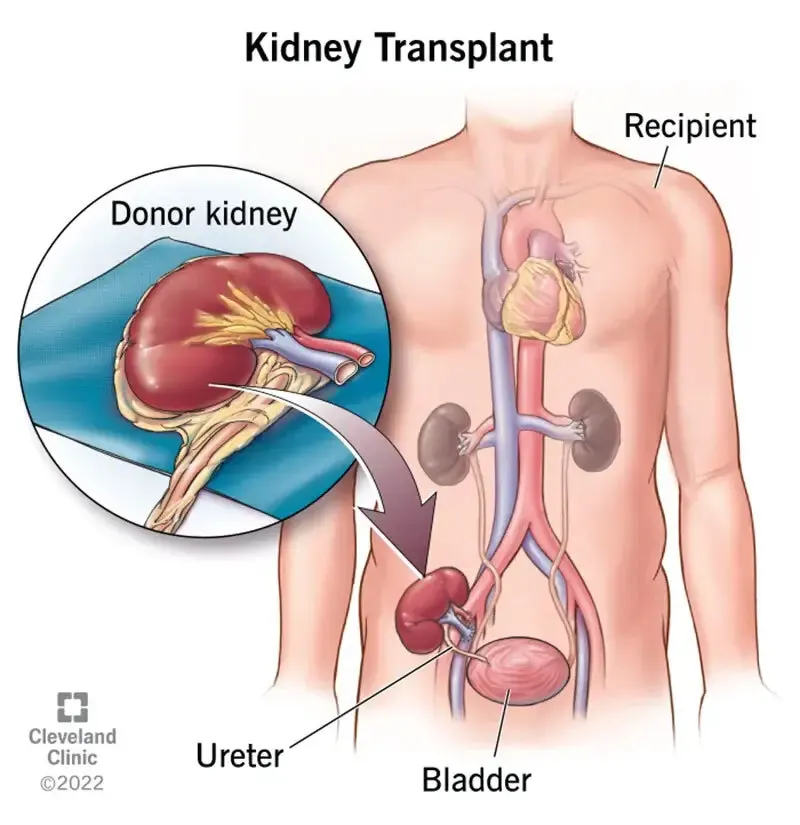
- A kidney transplant is a procedure where a new donor kidney is placed in your body.
- This is typically done to treat kidney failure.
- Once attached, your new kidney will start to do the job of the failing organ.
- Kidney transplants are done to help people with chronic kidney disease or end-stage renal failure. When your kidneys can no longer filter waste properly, you’ll need either dialysis(which uses a machine to remove waste from your bloodstream) or a kidney transplant.
ROBOTIC SURGERY
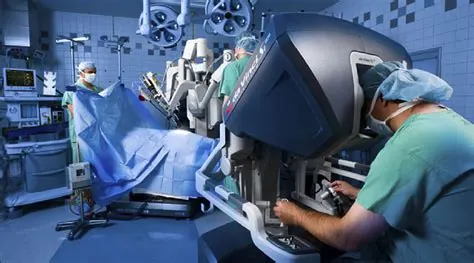
- Robotic surgery, also called robot-assisted surgery, allows doctors to perform many types of complex procedures with more precision, flexibility and control than is possible with conventional techniques.
- Robotic surgery is usually associated with minimally invasive surgery — procedures performed through tiny incisions.
- It is also sometimes used in certain traditional open surgical procedures.
1) Methods used for the Robotic assisted kidney transplantation surgery.
- Kidney Transplantation (KT) is the most preferred standard care of treatment for patients with end stage renal disease.
- Traditionally, kidney transplantation has been carried out by open surgery i.e by making large incisions. However, in the recent times, the procedure is being done with minimally invasive surgical procedures.
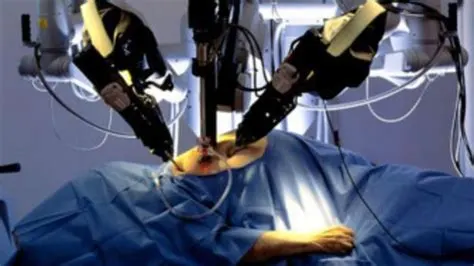
- Robot Assisted Kidney Transplantation (RAKT) is a minimally invasive technique that uses a robotic support to perform the KT.
- As a high level of expertise is required in KT and robotic surgery, RAKT is performed by transplant surgeons with extensive training and experience in robotics and transplant surgery.
TECHNIQUE/METHODS
- To date, several techniques are described for living donor nephrectomy, including open surgery, pure laparoscopy, hand-assisted laparoscopy, and robot-assisted surgery .
- The most commonly used technique is the minimally invasive transperitoneal laparoscopic approach.
- According to the literature, laparoscopic surgery for living donor nephrectomy achieves similar functional results compared to open and robot-assisted living donor nephrectomy, being equally safe for the donor.
- Robot-assisted surgery offers clear advantages over conventional laparoscopy like three-dimensional view, enhanced visualization of the operative field (12x), and, possibly, a shorter learning curve.
Robot-assisted living donor kidney transplantation
- When using the da Vinci System, the patient is positioned in lithotomy position according to the Vattikuti-Medanta technique .
- When the da Vinci system is used, the patient is positioned in dorsal decubitus. A 20–30° Trendelenburg position is recommended.
- The required robotic instruments are monopolar scissors, Potts scissors, bipolar forceps, prograsp forceps, large needle driver, black diamond micro-forceps, and bulldog clamps.
- A 12 mm camera port is inserted in the supra-umbilical area, and a pneumoperitoneum is created.
- Veress needle puncture, optical trocar access, or the Hasson technique can also be used for access to the abdomen and creation of a pneumoperitoneum.
- The open approach (Hasson technique) has been reported to result in fewer complications.
- Three extra robotic 8 mm ports are placed under vision, and the robot is docked.
- Minimal changes in port placement are related according to the robotic system used.
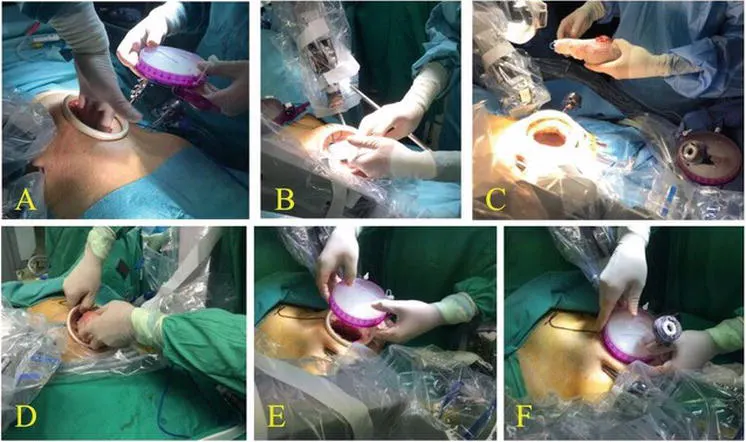
- A GelPOINT device replaces the camera trocar through a 6–8 cm (four fingers) periumbilical incision once the transplant bed preparation has been performed.
- Alternatively, the GelPOINT device can be introduced from the beginning through a 6–8 cm periumbilical incision, containing the camera and an assistant port.
- This GelPOINT device is used to introduce the graft in the abdominal cavity and allows for insertion of slushed ice (± 200 ml) via modified Toomey syringes into the abdominal cavity, surrounding the graft surface with the intent to achieve regional hypothermia (i.e., low constant temperature (<20°C) of the graft).
- Additionally, GelPOINT® is a useful device for fast hand introduction if needed (i.e., in case of massive bleeding).
- In selected cases, the graft can be introduced transvaginal as described by few authors .
- The AirSeal (Conmed, Utica, NY, USA) system might be used in order to maintain a stable and low-pressure pneumoperitoneum at 8 mmHg.
INFO/RESULTS FROM-University of Florence
- The University of Florence group very recently published their results on their first 17 RAKTs from deceased donors .
- They now performed 19 cases, all successfully completed without need of open conversion. Overall, 32 RAKTs have been performed at the University of Florence from January 2017 (22.4% of all KT in this period). The first RAKT from a deceased donor was performed in August 2017.
2) What are the specific requirements where kidney transplantation employs surgical robots.
- As a high level of expertise is required in kidney transplant and robotic surgery, RAKT is performed by transplant surgeons who have obtained extensive training and experience in robotics and transplant surgery.
- A specially trained surgeon controls the robotic arms from a viewing screen, which is usually situated in the same room as the operating table.
- But the viewing screen could be located far away, allowing surgeons to perform telesurgery from remote locations.
- The screen is part of what is referred to as a console, which allows surgical procedures to be performed from a seated position, while the surgeon views a magnified three-dimensional view of the patient’s surgical site.
- camera and the use of very small surgical tools attached to robotic arms.
- The robotic instruments employed for RAKT included the following:
(a) large needle driver
(b) black diamond micro-forceps
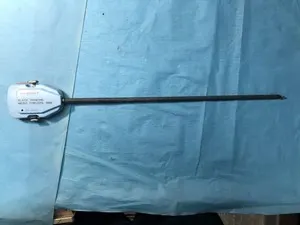
(c) monopolar curved scissors
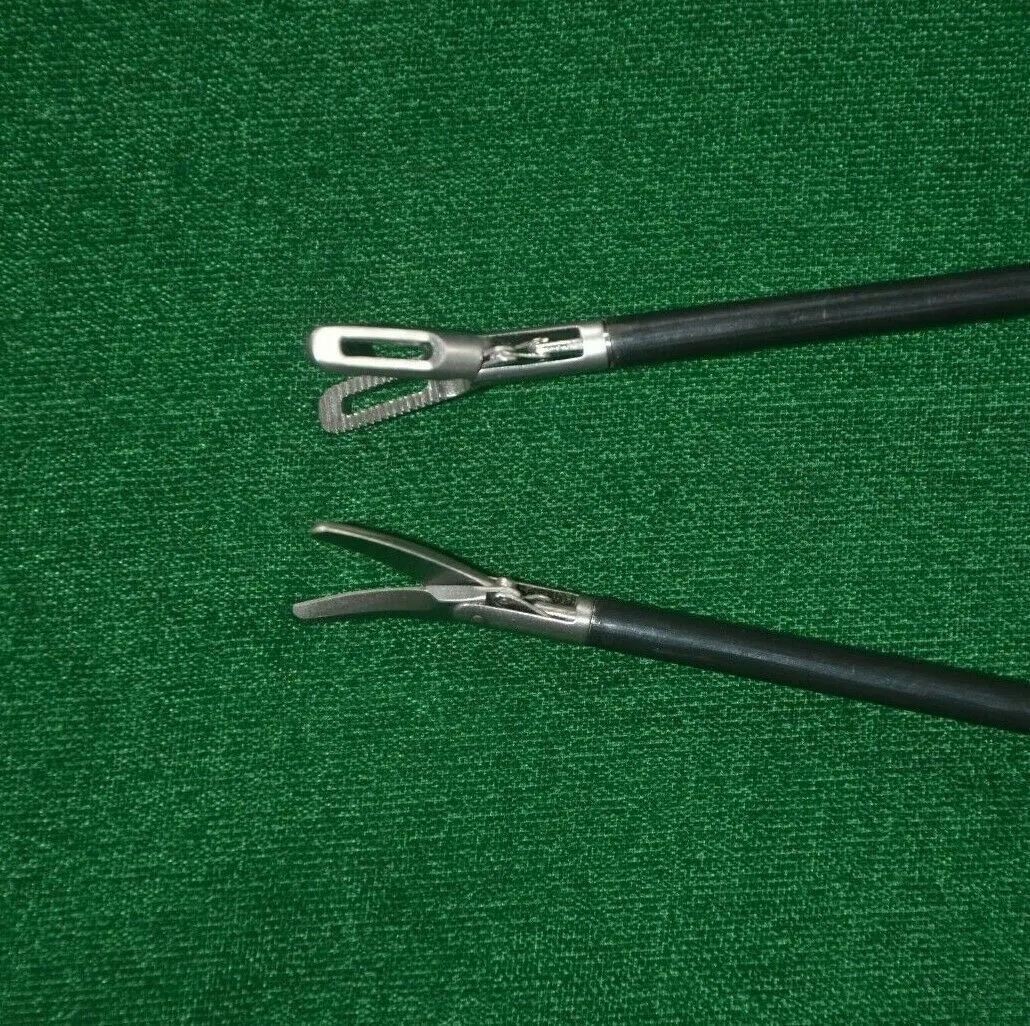
(d) Maryland bipolar forceps
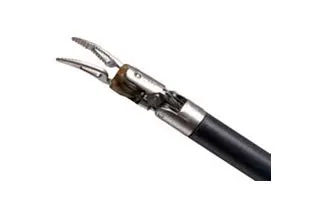
(e) prograsp forceps
(f) robotic bulldog clamps
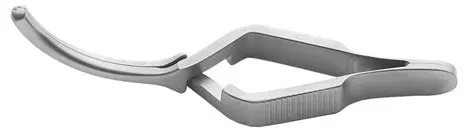
3) Describe the surgical robot used for the procedure and its features. Draw a block diagram.
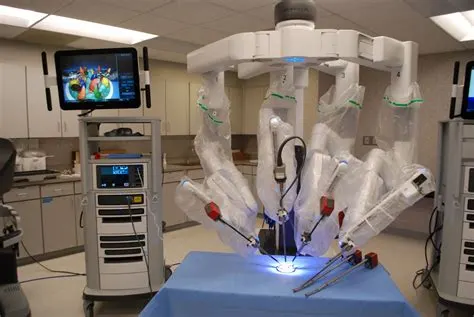
- Robot-assisted surgery is used to allow doctors to perform complex surgeries with greater precision, flexibility and control.
- Robots are used most frequently to perform keyhole surgery – procedures that are performed through tiny incisions.
- The instruments on the robot are miniaturised so they can fit through the incision.
- Robots do not make decisions or perform surgeries alone. The surgeon gives the instructions and the robot performs the action, with the robot having higher precision than the human hand.
Features
- The most common types of surgical robots have :-
- one or more mechanical arms, with miniaturised surgical instruments attached to them.
- camera arm:-The camera is a magnified high-definition camera that provides a 3D image of the inside of the body.
- three arms: the middle arm and the left and right arms.
- The middle arm was used to hold the laparoscope and provide a visual display of the surgical site. This arm consisted of one linear joint, three positioning joints, and an RCM mechanism. The linear joint adjusted the height of the robotic arm relative to the operating bed, while the positioning joints enabled the laparoscope to reach the incision port.
- The RCM mechanism, which served as the end effector of the middle arm, held the laparoscope and facilitated its position change without causing pain at the incision port.
- The left and right arms were used to hold surgical instruments to accomplish auxiliary work.
- Therefore, the key points of the robot development lay in the flexible design of the surgical instrument and the RCM mechanism.
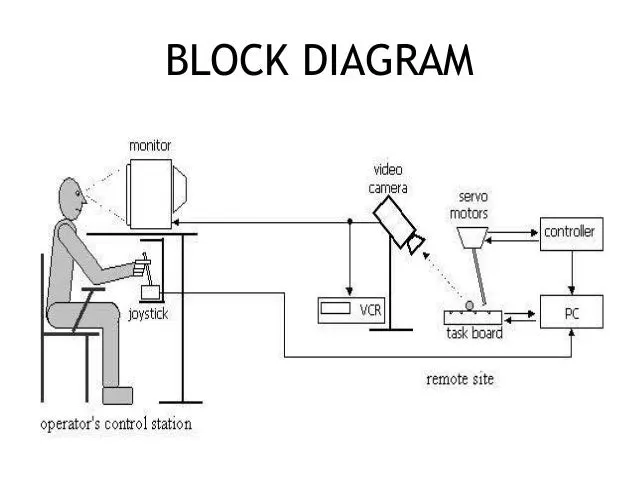
- The surgeon sits at a computer console positioned next to the operating table and operates the robot.
Block diagram
4) Draw a detailed flow chart of the entire procedure labelling all the steps in as much detail as possible.
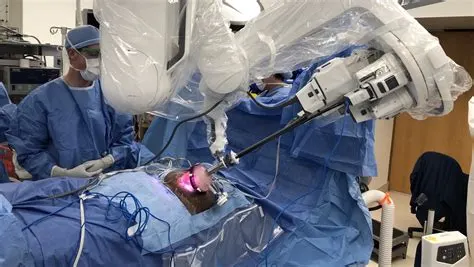
The steps for receiving robotic assisted surgery include:
- You will be given general anesthesia to induce sleep and eliminate any sensation to pain.
- Small incisions (approximately 1 to 2 centimeters or 0.393 to 0.787 inches in length) are made by the surgeon to allow for placement of the instruments into the body (note, this is the reason robotic surgery is usually referred to as minimally invasive surgery).
- A small, flexible tube with a lighted camera is used to allow the surgeon to have an enlarged 3D view of the surgical site.
- Your surgeon inserts miniature robotic instruments and the powerful camera into your body.
- Your surgeon then sits at a nearby console (a large computer) to direct the procedure.
- At the console, the area of operation can be seen highly magnified, with excellent resolution.
- Sitting at the console, your surgeon manipulates the de Vinci’s robotic arms (attached to the surgical instruments) with the use of hand and foot controls; another surgeon serves as an assistant who is positioned at the operating table to confirm the placement of the surgical instruments.
- The instruments respond to these movements and translate them into precise, real-time movements inside your body.
- The robotic devices, which have greater dexterity and range of motion than a human, allow your surgeon to successfully perform delicate surgeries in hard-to-reach places.
- Organs that need to be removed and replcaed will be removed through one of the small incisions.
- After the procedure is complete, the incisions are closed and covered with a small dressing.`arrow`
5)What are the tasks performed by the AI used in robotic kidney transplantation?


- AI was introduced into surgery more recently, with a strong root in imaging and navigation and early techniques focusing on feature detection and computer-assisted intervention for both pre-operative planning and intra-operative guidance.
AI for preoperative planning
- Pre-operative planning where surgeons plan the surgical procedure on the basis of existing medical records and imaging is essential for the success of a surgery.
- Our researchers highlighted four routine tasks based on medical imaging that involve AI techniques: (1) anatomical classification, (2) detection, (3) segmentation, and (4) registration.
AI for intraoperative guidance
- Surgical trauma is reduced through minimally invasive surgery (MIS), which is now progressively combined with robotic assistance. Computer-aided intra-operative guidance has always been a cornerstone of MIS.
- In light of this, learning strategies have been extensively integrated into the development of intra-operative guidance to provide enhanced visualisation and localisation in surgery.
- AI techniques for computer-aided intraoperative guidance in MIS.
- There are four main areas of computer-aided intra-operative guidance in MIS that involve AI techniques: (1) shape instantiation, (2) endoscopic navigation, (3) tissue tracking, and (4) Augmented Reality (AR).
AI for surgical robotics
- By virtue of the development of AI techniques, surgical robots can achieve superhuman performance during MIS.
- The objective of AI is to boost the capability of surgical robotic systems in perceiving complex in vivo environments, conducting decision-making, and performing the desired tasks with increased precision, safety, and efficiency.
- AI techniques for surgical robotics.
- The common AI techniques used for robotic and autonomous systems (RAS) can be summarised in four aspects: (1) perception, (2) localisation and mapping, (3) system modelling and control, and (4) human–robot interaction.
6) What are the preoperative, perioperative, and postoperative steps taken to ensure a successful surgery
Preoperative
- Gather information about the procedure
- Discuss the risk and benefits of robotic-assisted surgery with your surgeon
- Follow your surgeon’s pre-operative instructions regarding what medications to eat, and what to eat and drink before surgery (usually foods and fluids are to be avoided for at least eight hours before surgery).
- Some procedures (such as colon procedures) require that you use an enema or laxatives to cleanse the bowel before surgery.
- Remember to mention any over-the-counter medications as well as natural herbs or supplements you are taking, in addition to prescription medications, and follow the healthcare provider’s instructions on what to take and when.
- Be aware that any type of medication that could result in decreased clotting time may cause bleeding during the surgery, such as aspirin, Coumadin, or Plavix; these medications should be withheld for 10 days before the surgery.
Perioperative
- One surgeon will remove the kidney from the donor, while another prepares you to receive the donated kidney.
- Your surgeon then sits at a nearby console (a large computer) to direct the procedure. At the console, the area of operation can be seen highly magnified, with excellent resolution.
- After the procedure is complete, the incisions are closed and covered with a small dressing.
- You may be instructed by your surgeon to abstain from heavy lifting or straining until your healthcare provider approves resuming normal activities.
- Your surgeon may advise you to abstain from driving for at least one week.
Follow your surgeon’s instructions on pain medication or other post-operative instructions after surgery. - Instructions to contact your healthcare provider if your pain worsens (particularly if it is not relieved by pain medication) you experience nausea and vomiting, bleeding,
- Instructions to contact your healthcare provider if you have redness or pus at one of the surgical sites (this may indicate an infection has started.
7) Ethical concerns and regulations of a kidney transplantation procedure.Find out and list the machine classifications and IEC 60601 standards applied to the equipment.
Ethical concerns and regulations
- The ethical criteria that need to be considered by departments and individual surgeons seeking to introduce RAKT is whether robot-assisted transplantation provides a similar or better technical vascular anastomosis than an open approach and if incision-related morbidity is less than with an open procedure.
- These ethical considerations are similar to Knight's assessment of innovations in cardiothoracic surgery, including minimally invasive cardiac surgery.
- Based on these, any surgeon carrying out a RAKT should ask, ‘Can I, with my skill set, in my demographic practice, provide as good or better transplant graft and patient outcomes, when compared with an open implant, with a similar tariff?’ The variables addressed in such self-reflection should be openly discussed with the patient during the consent process, alongside the overall effectiveness of robotic procedures relative to other approaches.
- Regular appraisal of surgical ability and outcomes, combined with institutional support for pioneering intervention, will allow safe and efficient progress. With every new approach that evolves, it is essential to continually assess the goals and outcomes that must be achieved, ensuring the procedure is held to the correct standard and patient safety preserved.
- The cost must also be borne in mind, ensuring a fair distribution of funding, particularly when transplant patients comprise a relatively small proportion of the wider populations that healthcare services treat.
- Ultimately it is of the utmost importance that patients chose the right procedure for them, with the support of their team and careful explanation of appropriate literature, alongside honest conversations about risk, local expertise, and the LC involved—true evidence-based medicine.
- IEC 60601 is a series of technical standards for the safety and essential performance of medical electrical equipment, published by the International Electrochemical Commssion.
- First published in 1977 and regularly updated and restructured, as of 2011 it consists of a general standard, about 10 collateral standards, and about 80 particular standards.
- DOI: 10.5772/intechopen.90276
- DOI: 10.1097/TP.0000000000003881
- https://doi.org/10.1093/ckj/sfab214
- doi: 10.5500/wjt.v12.i7.163
- doi: 10.3791/62220
- https://www.springwise.com/tech-explained/surgical-robots
- https://my.clevelandclinic.org/health/treatments/22178-robotic-surgery
- https://www.imperial.ac.uk/news/200673/application-artificial-intelligence-ai-surgery/
- https://www.verywellhealth.com/robotic-surgery-4843262