Project 1 - Design and Develop a IOT based Wireless Wearable Health Monitoring System or a Home Healthcare System to monitor the physiological parameters of ECG, Heart Rate, Pulse Oximetry, Cuffless Blood Pressure and Body Temperature.
Design and Develop a IOT based Wireless Wearable Health Monitoring System or a Home Healthcare System to monitor the physiological parameters of ECG, Heart Rate, Pulse Oximetry, Cuffless Blood Pressure and Body Temperature.
i-Product Name :- "All you need is THE RING"
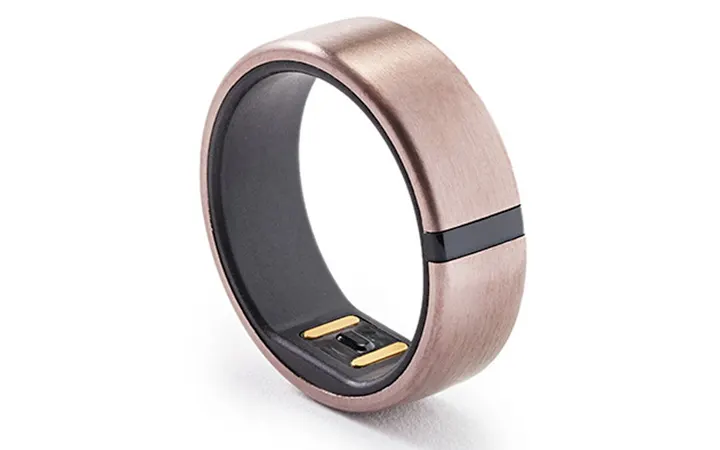
cite:-https://www.smartringnews.com/posts/what-are-smart-rings-how-do-they-work
- Remote health monitoring of patients is required importantly for elderly people, who require 24/7 monitoring, mainly because of their ageing problems and weak immune system and also there is an increase in the number of people who are insured, shrinking the supply of doctors in face of a larger demand. People find it much more difficult to access healthcare. wearable health monitoring systems deals with this problem by increasing the capacity of physicians to treat their patients, expanding access to care.
- The quality of care improves with this patient monitoring.
- The product is light weight, comfortable, portable,can be worn,works when the wearer is moving/working.
Specifications
- Wearable device: Ring
- Weight: 15g
- Dimension: 1.5'' x 1.2'' x 1.5''
- Recorded Parameters: Electrocardiogram(ECG), Heart Rate(HR), Pulse Oximetry, Cuffless Blood Pressure,Body Temperature.
- Alert Type:Vibration and beeps
- Battery:6-7 days battery life
Physiological parameters choosen to be monitored
- Electrocardiogram(ECG)
- Heart Rate(HR)
- Pulse Oximetry
- Cuffless Blood Pressure
- Body Temperature
ii-Specifications of the parameters
A-Electrocardiogram (ECG)
Specifications:-
- Frequency: 0.5-100 Hz
- Amplitude: 0.25 – 1mV
Sensor:-
- heart or pulse monitor ( infrared or optical)
B-Heart Rate (HR)
Specifications:-
- 40 – 220 Beats per minute
Sensor:-
- Measured from ECG Signal
C-Pulse Oximetry
Specifications:-
- Frequency: 400-900 Hz
- one red 660 nm LED and one infrared (IR) 940 nm LED
Sensor:-
- SpO2 sensor
D-Cuffless Blood Pressure
Specifications:-
- Frequency: 100Hz
Sensor:-
- Blood pressure sensor/arterial blood pressure sensor
E-Body temperature
Specifications:-
- 0oC – 40oC
Sensors:-
- Thermistor Sensor with accuracy of ±0.1oC
iii-Schematic Block diagram of IoT device to acquire physiological parameters

Cite:-https://www.etechnog.com/2021/05/iot-block-diagram-architecture.html
Sensor and Actuator
- They work in the opposite principle to each other.
- A sensor senses the physical changes in its environment and produces an electrical or electronic signal. For example, a temperature sensor senses the temperature across its environment.
- An actuator makes physical changes when it gets electrical or electronic signals. For example, a solenoid valve opens when it gets an electrical power supply and allows the flow of any liquid or gas through it.
Controller
- An IoT system in a home or production plant has so many sensors or actuators.
- So all the actuators and sensors are connected to a controller.
- The controller control all those sensors and actuators.
- Sensors and actuators are analog devices but IoT system works with digital data, so the controller also helps to analog to digital and digital to analog conversion.
Processor
- It collects data from all sensors through the controller in the form of digital signals and processes them.
- The main function of the processor to collect all data, arrange them and process them. The processor also removes the unwanted data to reduce the size of big data.
Gateways
- They are responsible to transmit data of an IoT system through the internet.
- They modulate and demodulate the data for transmission.
- Gateways help to transmit the data from the processor of the IoT system to the server for storing.
- The example of Gateway devices is ZigBee, WiFI, etc.
Cloud Server
- It is the space for storing data.
- Cloud server stores all the data of an IoT system and it serves with the users when they requested. This cloud server only helps to control devices over the internet.
- They serve the data with users located anywhere in the world.
User Device
- It is the device actually where the data are used to observe the status, analytics, and control the devices of the IoT system.
- Based on the data acquired, the doctor takes necessary actions
iv-Design factors considered
Always ON
- low power consumption
- instant wake
Hands free
- minimal key inputs
- voive/gesture recognition
Environment aware
- gyroscope
- accelometer
- compass
- camera
- GPS
Communications
- RF Cellular
- Zigbee
Attention getting
- less distraction
- short interactions
Development platform supported
- available API
- accessories
v-Noises added to the signals and how are they proposed to be overcome.
Baseline wander(BW)
- Baseline wander (BW) is a low-frequency artefact in electrocardiogram (ECG) signal recordings.
- BW makes interpretation of ECG recordings difficult.
- Solution:The simplest method of baseline wander (drift) removal is the use of a high-pass filter that blocks the drift and passes all main components of ECG though the filter.
Power Disturbance
- Power disturbances occurs when the battery dies or leak.
- is one of the most disturbing noise sources in biopotential recordings that hampers the analysis of the electrical signals generated by the human body.
- Solution: use a quality product with long lasting battery life.
Thermal Noise
- Thermal noise occurs in all transmission media and communication equipment, including passive devices.
- Every equipment element and the transmission medium itself contribute thermal noise to a communication system if the temperature of that element or medium is above absolute zero.
- Solution: to reduce the thermal noise contribution is the choice of material with a high quality factor and low-temperature operation.
Movement Disturbances
- Sometimes movement of patients causes disturbances while acquiring signals
- Solution: Make sure the device is attached to the body tightly, so that movement cannot be noticed much.
vi-Communication protocols
Here we see the top 5 IoT communication protocols to transmit the data.
A-Radio frequency identification(RFID)
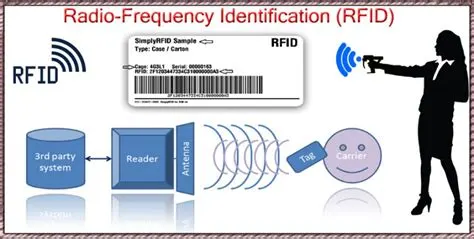
- RFID incorporates the use of electromagnetic or electrostatic coupling in the radio frequency portion of the electromagnetic spectrum to uniquely identify an object,person etc.
- used for short range communication(10cm-200cm).
- consists of tag and reader.
- tag is developed using a micro chip and antenna.
- used for unique identification of device.
- reader transmits or recieves from objevt/tag using RF waves.
- Data is in the form of electronic product code(EPC).
B- Bluetooth
- uses UHF RF waves to communicate (ISM bands)
- 2.4 GHz is commonly used frequency
- communication range is upto 100m
- star configuration, two or more device can be connected
- Data protection in the form of authentication
- low cost and energy efficiency
- Bluetooth topologies:- 1) point to point 2) point to multipoint.
C-ZigBee
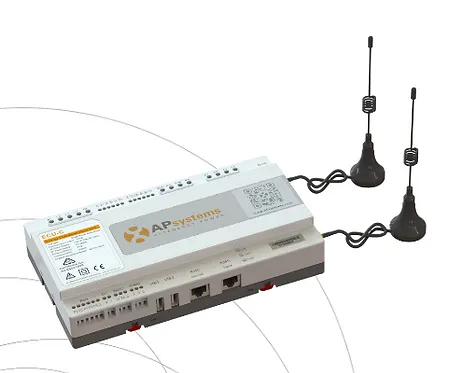
- Uses UHF RF waves to communicate (ISM bands)
- 2.4 GHz is commonly used frequency
- Communication range is upto 100m or greater
- Mesh type of topology( nodes, router and processing)
- mesh network ensures uninterrupted connection among devices
- low cost, high data rates, high network capacity
- it consists of coordinator, end device, router, ZigBee trust centre, ZigBee gateway
D- Wireless Fidelity(WiFi)
- Wireless LAN (WLAN) follows IEEE 802.11 standards
- 2.4/5 GHz is commonly used frequency
- higher transmission ranges
- network supports quick connectivity,higher data rates, secure, flexible network configuration, reliable and compatible with devices.
- WIfI is very commonly used and suitable for Iot in healthcare.
E-Satellite
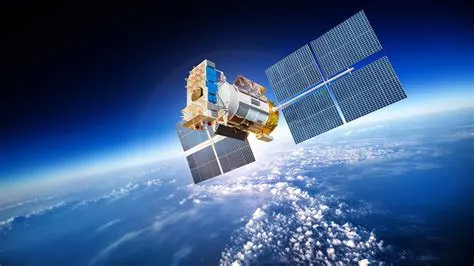
- Efficient and beneficial for remote and widely seperated geographical areas.
- commonly used where other modes are not available
- ground and space segment
- Uplink and downlink frequency
- high data rates, different types of braodcast, instant access, highly compatible with devices and technologies
- 3 satelites seperated at 120 degree globally can cover entire earth
vii-How the data acquisition is proposed and how the data will be transmitted wireless.
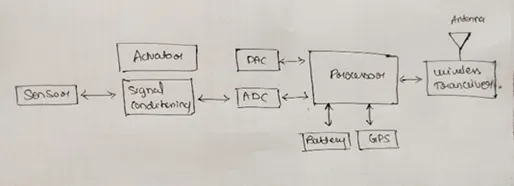
Data acquisition
- Sensor’s nodes forms very important bud, it is place where data is sensed and collected.
- It has got sensors and transducer interface, where all these are exposed to various types of weathers, and they will pickup lot of noise along with the signals.
- So, we need to condition these signals, it forms first part after the sensor.
- The conditioned signals are now going to be digitized.
- They are then minimally processed and take into account all the power requirements, processing capabilities, computational requirements, and longevity of sensor, the cooling requirements all are going to be taken care.
- Incase there is going to be an actuation to be done to sensor, then there is DAC.
- It has got a battery, GPS to locate where the sensor is going to be placed.
- All these are going to be in a single unit.
- There is wireless transceiver, that transmits the data to next node or to the co-ordinator.
- Data is going to be bidirectional because nodes receive data from the coordinator or remote monitoring site also.
Data Transmission
- Wireless IoT systems use antennas to transmit or receive information and usually operate in association with wireless routers to improve the signal to and from the device they are connected to.
- They connect to a processor which can then, depending on how it has been programmed, perform an action with any need for user input.
- WIfI is very commonly used and suitable for Iot in healthcare for wireless transmission.
- Wireless LAN (WLAN) follows IEEE 802.11 standards, 2.4/5 GHz is commonly used frequency.
viii-Cloud Computing approach to build in Intelligence in the data being received from the IoT sensors.
- Some architectures in IOT requires the data processing to be carried out centrally on a large volume of data on the cloud.
- Here, the cloud is in between the smart devices and the application, it is a centralized computing place, where all data is commonly computed and the responses are generated and communicated via app to the smart devices.
Features to be included here are:-
cite:-https://www.javatpoint.com/cloud-computing-architecture
1. Client Infrastructure
Client Infrastructure is a Front end component. It provides GUI (Graphical User Interface) to interact with the cloud.
2. Application
The application may be any software or platform that a client wants to access.
3. Service
A Cloud Services manages that which type of service you access according to the client’s requirement.
4. Runtime Cloud
Runtime Cloud provides the execution and runtime environment to the virtual machines.
5. Storage
Storage is one of the most important components of cloud computing. It provides a huge amount of storage capacity in the cloud to store and manage data.
6. Infrastructure
It provides services on the host level, application level, and network level. Cloud infrastructure includes hardware and software components such as servers, storage, network devices, virtualization software, and other storage resources that are needed to support the cloud computing model.
7. Management
Management is used to manage components such as application, service, runtime cloud, storage, infrastructure, and other security issues in the backend and establish coordination between them.
8. Security
Security is an in-built back end component of cloud computing. It implements a security mechanism in the back end.
9. Internet
The Internet is medium through which front end and back end can interact and communicate with each other.
ix-How an emergency situation will be handled and flow of events, when there are abnormal values acquired. How will a false alarm will be handled.
SCENARIO
- Consider a situation, where an elderly person wearing the smart ring is resting on his bed. Suddenly his oxygen saturation levels starts decreasing and as it reaches 90 percent and keeps on decresing, the ring starts alerting the patient by producing beeps and vibration and at the same time it sends the data immediately to the nursing stations nearby via wireless communication and cloud.
- The doctors in nursing station will be monitoring the data 24/7, when they recieve the emergency signals, doctors analyse the data and take immediate actions.
- The emergency team and ambulance will reach the place and treat the patient on site or take him to the hospital depending on the severity of the condition.
How to handle false alarms
- False alarms can be sometimes due to weak battery, when equipment is dirty, or when you are cooking because there the temperature will be high or sometimes when the vitals are not slightly within the range.
- so these false alarms can be handled by keeping the device clean, changing the batteries.
- we can create a button in the ring, in order to stop the alarm and send message to stations that there is no emergency.
- Doctors if they find the situation not critical, they may contact the patient through mobile and check the patients condition.
x-Method for storing the data in a centralized database
- a centralized database, all data is stored and maintained in one place. The central location is a computer or database. All the data is stored in a single location for an example mainframe computer.
- This database mostly maintains and modifies using internet connection like LAN and WAN.
- In a centralized database system one computer act as a server for storing whole data.
- In a centralized database system, client-server architecture is used it is the very simplest form of a database system in which one client sent a request to the server. The server will receive a request and will be a response.
- by entering the unique ID or Name or Code given we can retrive the data.
xi-Method for automatic detection of abnormal conditions in the parameters and generation of alarms.
- The values given by the sensors are measured and compared with the nominal value predefined in the program in the comparators.
- If the measured value varies, the system will send an alert to the concerned person with the help of Wi-fi module, and as an physical indication the buzzer gives beep sound and also LED bulb glows.
- The programmed output is displayed through a local display LCD screen/ mobile.
- The same output is also transmitted through the Wi-fi module to the nursing stations.
- The Doctors, analyse the situations and take actions immediately.
- The emergency team and ambulance will reach the place and treat the patient on site or take him to the hospital depending on the severity of the condition.
xii-Security aspects proposed to build-in this system
- Develop a security mindset
- Network security
- Adding authentication features
- Using encrytion technology
- Establishing right hardware
- Privacy of the wearer
- NO data is hacked,manipulated.
xiii-To launch the product in the market, procedure to be followed.
Validation
- Equipment qualification is a necessary and critical step in ensuring that a product or service is provided accurately and consistently with requirements aligned with medical device manufacturing and testing.
Prerequisites in an Equipment Qualification Protocol
Setting up equipment in a medical device manufacturing facility includes ensuring that the equipment will safely and consistently work as intended. To do this, it is necessary to verify the following actions:
- That the equipment is installed according to the manufacturer's instructions.
- That the equipment is operated properly and consistently.
- That the equipment performs within the requirements determined by the facility.
To cover all of the necessary criteria, equipment qualifications are typically organized by separating the protocol into three sections: installation qualification (IQ), operational qualification (OQ), and performance qualification (PQ).
Installation qualification (IQ)
- The Installation Qualification Procedure applies to the installation of new equipment, moving or relocating equipment, or after equipment modifications.
- The Installation Qualification (IQ) Procedure ensures equipment is installed with appropriate utilities, is entered into the calibration and preventive maintenance systems, is installed in accordance with manufacturers requirements, and is installed with consideration to operator space requirements and safety.
EXAMPLE:-
- Cross-checking the contents of a package against the packing list
- Checking for damage to the device
- Making sure each piece of equipment is installed in the proper location
- Checking connections to other devices or equipment
- Verifying the installation of any ancillary equipment
- Verifying power supply to the device
Operational qualification (OQ)
- Once the IQ has been conducted, the next stage in process validation—operational qualification—ensures that the equipment is operating in accordance with the user’s requirements and within the operating range specified by the device manufacturer.
EXAMPLE:-
- Displays and operational signals, such as LEDs
- Temperature fluctuation controls
- Humidity measurement and control systems
- Fan or motor RPM
- Servo motors and air-flap controllers
- Card access and reader
Performance qualification (PQ)
- performance qualification is used to verify that the equipment consistently produces the correct results under real-world conditions.
- That means PQ should be conducted in the actual facility with trained personnel, using the utilities, equipment, control procedures and manufacturing process that will be used to produce commercial batches of the product.
EXAMPLE:-
- The manufacturing conditions, operational parameters, and raw materials used.
- The data you will collect and the plan for evaluating it
- The tests you will conduct on the equipment and the acceptance criteria for each
- An extensive sampling plan that provides confidence of the quality within batches and between batches
- The criteria for making science- and risk-based decisions about the efficacy of the process.
xiv-10 number of users connected to a hospital.
- In this situation we can create seperate profiles for each device, so they can be identified effortlessly. These profiles will help doctors to prevent misdiagnosis.
- a multi-tier architecture can be used. In this architecture, there is a middle layer within the client and the server. It clarifies the difficulty of waiting time by clients. It maintains a queue of requests by different clients, and the client can do their work; meanwhile, the server is busy processing other client’s request. The middle layer forwards the request, and the server, in turn, replies to the client.