Project
Aim:
To observe and create a report for the simulation of BAJA All-Terrain vehicle(ATV) model with Continuously Variable Transmission (CVT).
Overview:
In this report we are discussing a simulation model of Continuously Variable Transmission (CVT) with basic simulink/simscape model, CVT with dashboard models and finally CVT with look up table.
Requirements:
The below blocks are required to simulate the BAJA ATV model using CVT transmission system:
- Signal builder - This block provides the input signals like Brake input and Throttle input to engine.
- Generic Engine - This block is the system level model of spark ignition and diesel engine.
- Ideal rotational motion sensor - This block is used to sense the rpm of the engine shaft.
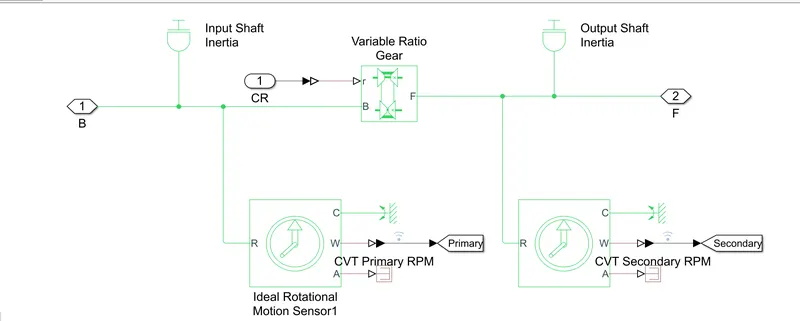
- CVT block - This CVT block has a sub system which includes Inertia blocks, Variable ratio transmission, Ideal roatational motion sensor.
- Simple Gear - This block provides the fixed gear ratio.
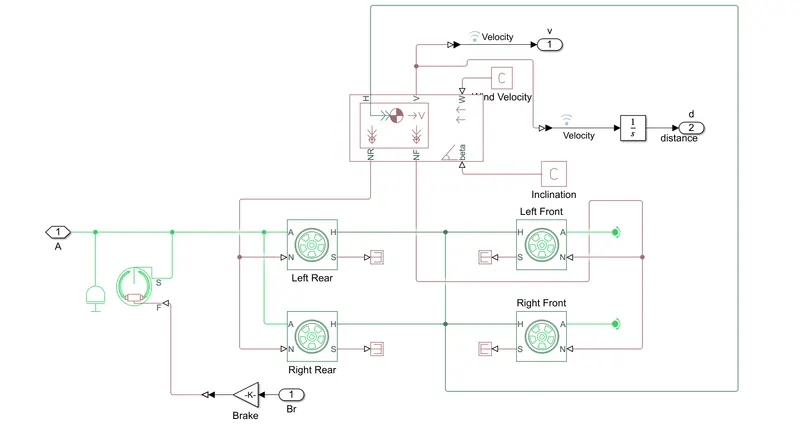
- Vehicle body - This block has a sub system in which the blocks like Tire, Vehicle body, Double-Shoe brake are used to create Vehicle body model.
- Scope - This block is used to view the results.
- Look up table - This block provides the output values depending upon the input values.
Case 1: Simulation of BAJA All-Terrain vehicle(ATV) model with Continuously Variable Transmision using simscape blocks.
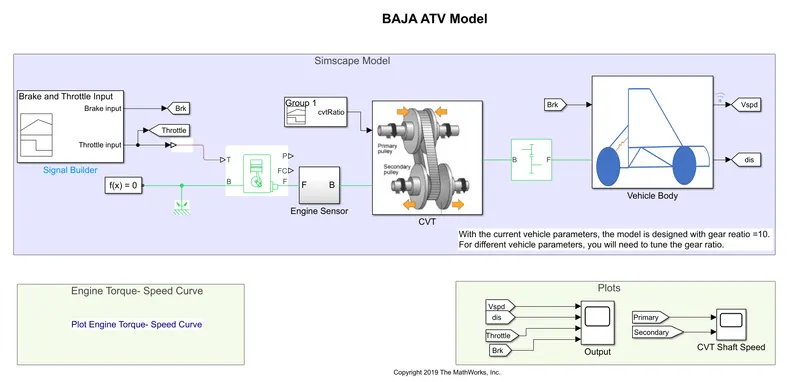
The above figure shows the simulation of BAJA ATV model with CVT transmission using simscape blocks.
Procedure:
- First we need to generate input signals like Brake input and Throttle input using signal builder block.
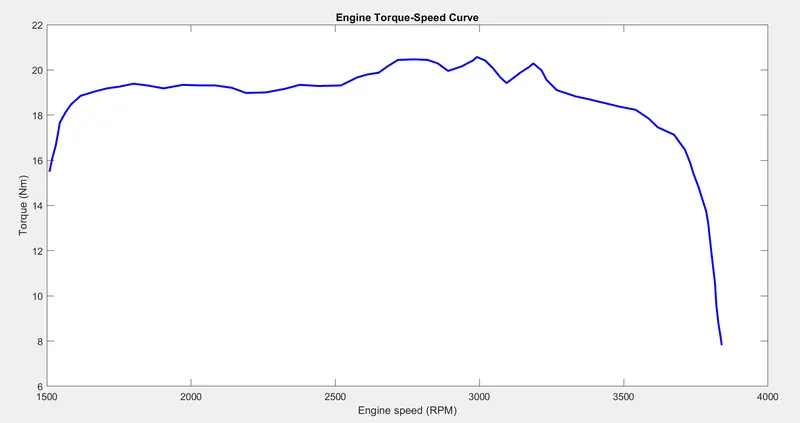
- The above inputs is connected to generic engine block and the data points are extracted from Engine Torque-Speed curve which is provided as values to generic engine.
- The output of the engine is sensed using the Engine sensor block.
- The Engine sensor block has sub system in which Ideal rotational motion sensor is used to sense the RPM of the Engine shaft.
- The ouput of the Engine sensor block is connected to CVT block. CVT is a Continuously Variable Transmission which consists of Primary pulley, Secondary pulley, Variator and Belt.
- Generally Primary pulley and secondary pulley is connected through belt. The pulleys are connected to variator which is designed like a V shaped material.
- These pulleys are compressed and decompressed through a hydraulic liquids and the gear ratio will vary according to the movement of primary and secondary pulley.
- When the primary pulley is moved inwards and on the otherhand secondary pulley is moved outwards then overdrive condition occurs in vehicle and viceversa for speed reduction condition.
- These CVT blocks are made of sub systems like Inertia block, Variable Gear block and Ideal rotational motion sensors.
- The CVT ratio is given to CVT block through signal builder.
- The primary pulley is connected to engine and secondary pulley is connected to vehicle body.
- The simple gear box block is used for speed reduction and output of gear is connected to vehicle body block.
- This Vehicle body block has sub systems like vehicle body, Tire, Double-Shoe Brake blocks and these blocks forms a typical vehicle body model for simulation.
- The scope blocks are used to view the input values like Brake, Throttle and output values like Velocity, distance and CVT ratio of primary and secondary pulley.
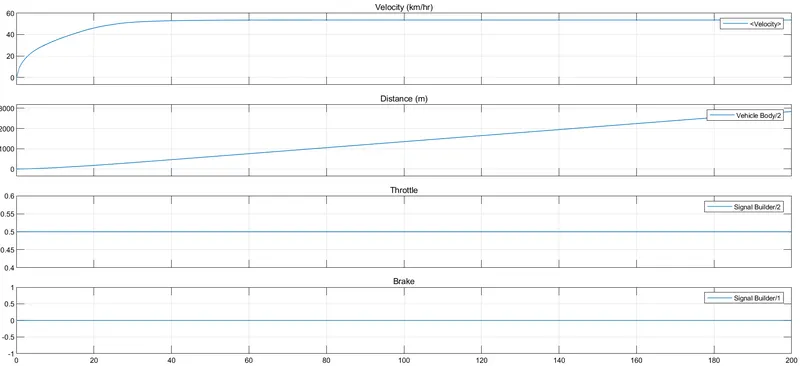
The graph shows the velocity of the vehicle and distance travelled by vehicle when input throttle is provided.
CVT Block:
Vehicle Body:
Torque-Speed Curve:
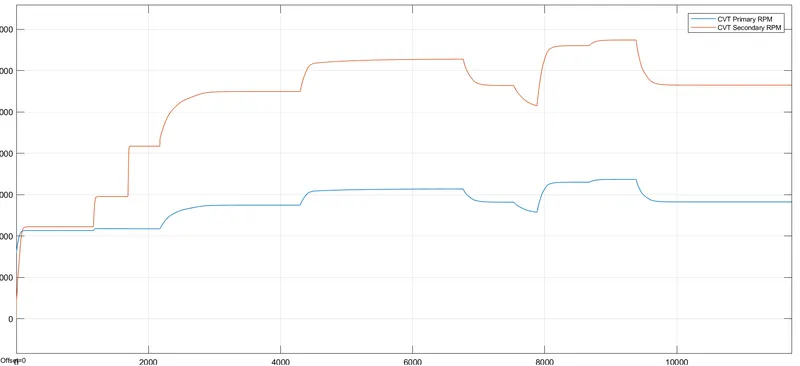
RPM of Primary and Secondary pulley:
Case 2: Simulation of BAJA All-Terrain vehicle(ATV) model with Continuously Variable Transmision using Dashboard Blocks.
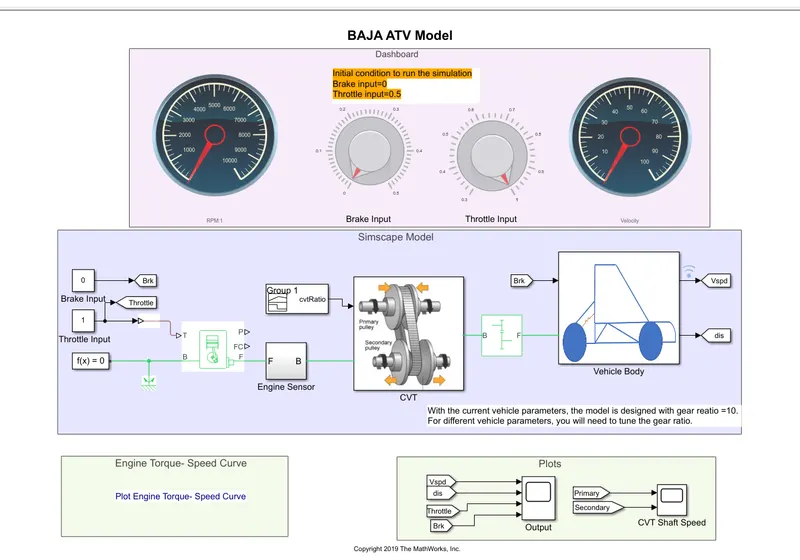
The above figure shows the simulation of BAJA ATV model with CVT transmission using dashboard blocks.
The procedure is similar to the case 1 model in addition to that we have dashboard models like Knob and Circular Gauge. The input values like Throttle and brake is provided while running the simulation through the Knob block. The output values like Velocity of vehicle and Engine RPM is viewed through circular gauge block.
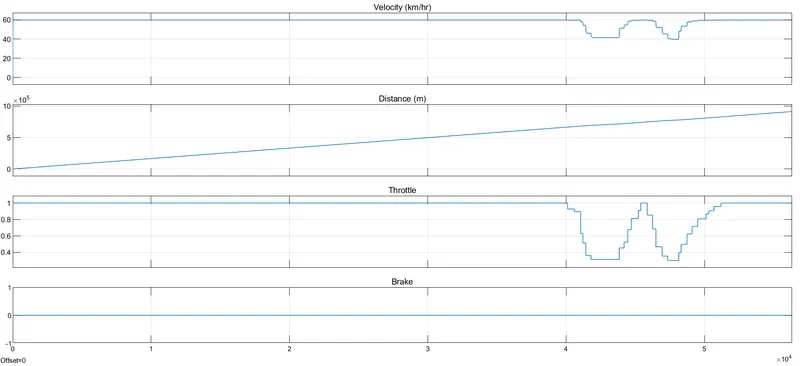
The above graph shows the velocity variation for the corresponding input Throttle variation.
Case 3: Simulation of BAJA All-Terrain vehicle(ATV) model with Continuously Variable Transmision using Lookup Table.
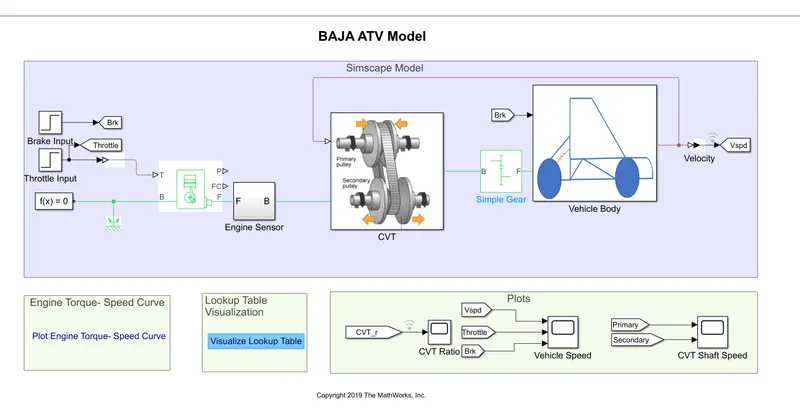
The above drawing shows the BAJA All-Terrain Vehicl(ATV) model with CVT using lookup table.
This model is similar to case 1 mentioned above in addition to that lookup table is used as a CVT gear ratio input. The velocity from the vehicle body is feed back to the CVT block through lookup table.
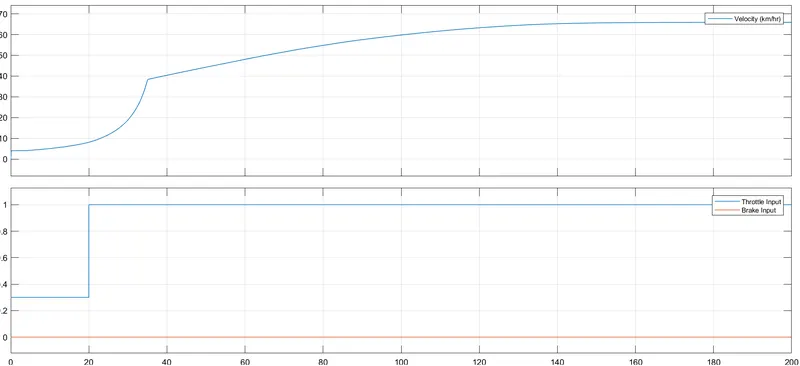
The graph shows the velocity of vehicle when throttle input is provided to engine.
Visualization of Lookup Table:
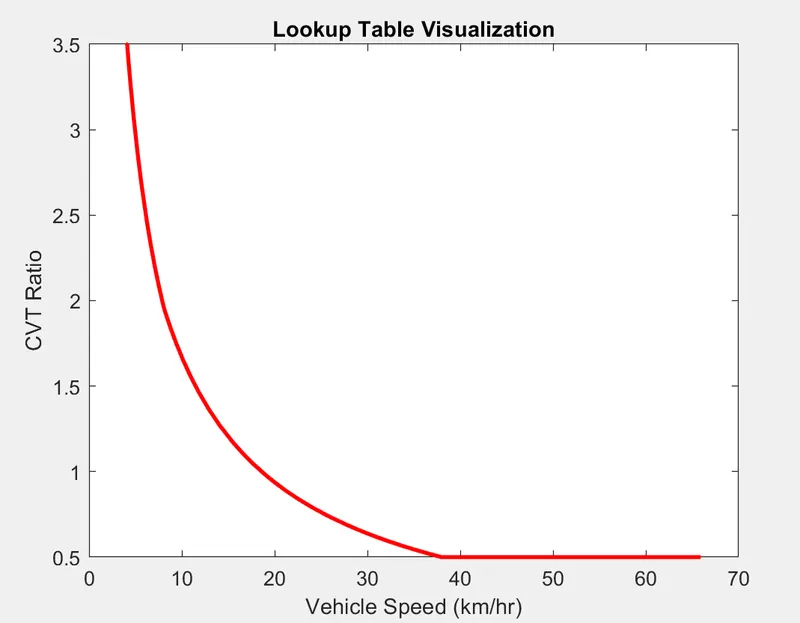
The above graph shows the input of the lookup table.
Case 4: Simulation of BAJA All-Terrain vehicle(ATV) model with Continuously Variable Transmision using both Lookup table and Dashboard blocks.
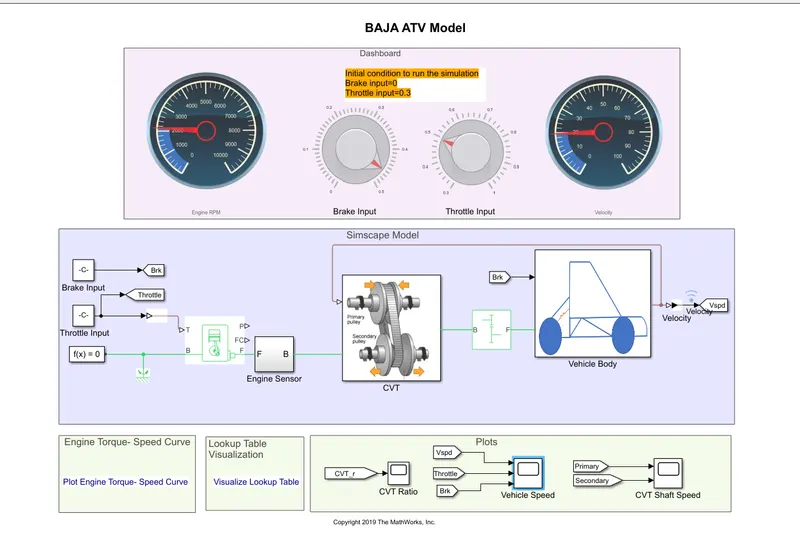
The above model shows the ATV model with CVT system with both Lookup table and Dashboard blocks.
The procedure is similar to case 3 model in addition to that dashboard blocks are used to provide the real time values to blocks.
We have used Knob as a input block and Circular Guage as output block. The input Throttle and Brake values can be provided to model while running the simulation and the velocity and Engine RPM are viewed in gauge.
CVT ratio:
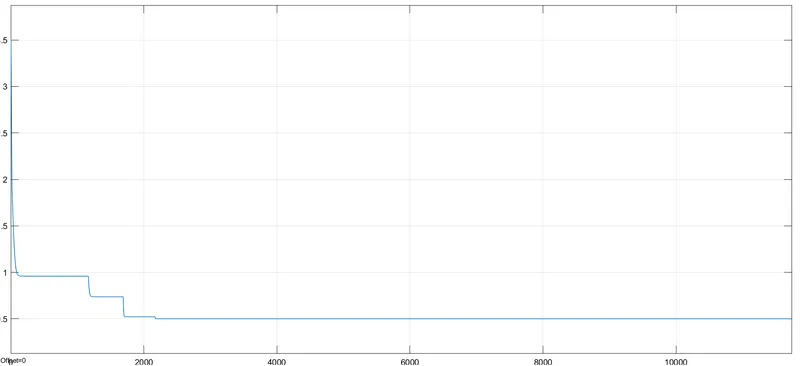
The above graph shows the CVT ratio obtained based on the real time velocity feedback via lookup table.
Output:
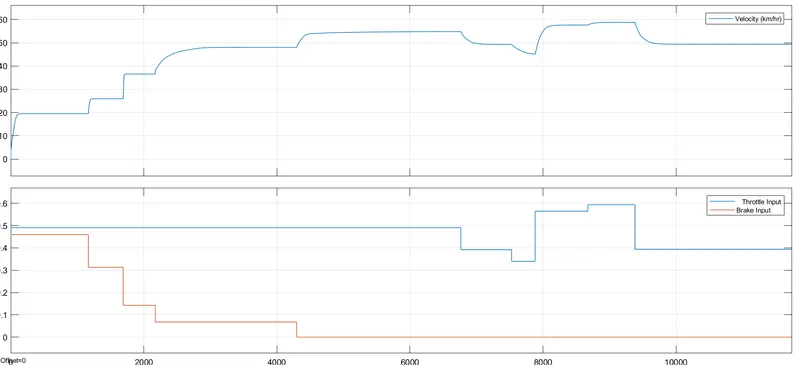
The above graph shows the velocity values according to the given Throttle and Brake input values. The velocity is reduced while increasing the brake value using knob.
Result:
Thus the BAJA All-Terrain Vehicle(ATV) model with Continuously Variable Transmission is achieved and detailed report is created.