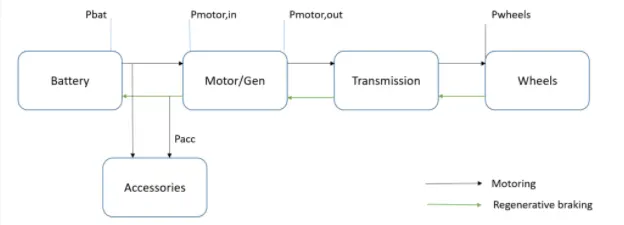
Project-1: Powertrain for aircraft in runways
1)weight terminologies-
- Standard empty weight -The weight of an empty airplane including unusable fuel, full operating fluids (hydraulic fluids) and full engine oil.
- Basic empty weight - Standard Empty Weight plus optional equipment. This is the starting point of weight and balance calculations.
- Useful load- Useful load is total usable fuel, cargo, passengers, and drainable fuel. Equation: Maximum Ramp Weight - Basic Empty Weight = Useful Load
- Payload- It is what's "paying" for the flight: passengers, bags, and cargo. It's how much weight you can carry besides basic empty weight and fuel.
- Maximum ramp weight - This is the maximum allowable weight mass for ground operations. MRW assures acceptable ground maneuverability and includes fuel for taxi, run-up and start.
- Maximum Takeoff weight (MTOW)-Maximum allowable mass for the initiation of a takeoff roll. Depending on how big your airplane is, you may have a variety of MTOWs limited by: structural limitations, runway distance, climb performance, or landing weight limits.
- Minimum flight weight (MFW)-Minimum certificated weight for flight as limited by aircraft strength and airworthiness requirements. This weight has a lot to do with the balance of weight considering fuel/payload distribution.
-
Maximum Landing weight (MLW) -Maximum landing weight is usually a structural limit, but may include calculations based on missed approach climb performance.
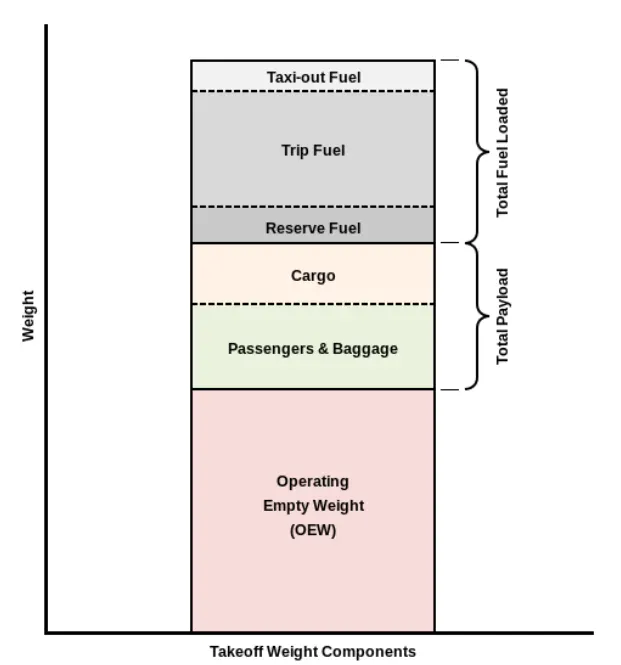
, MLW = Maximum landing weight, TOR = Take-off run , LR = Landing run
| Type | MTOW [kg] | MLW [tonnes] | TOR [m] | LR [m] | ICAO category | FAA category |
|---|---|---|---|---|---|---|
| Vickers Viscount 800 | 30,400 | Medium | Large | |||
| Vickers VC10 | 152,000 | 151.9 | Heavy | Heavy | ||
| Tupolev Tu-204SM | 104,000 | 87.5 | 2250 | Medium | Large | |
| Tupolev Tu-154M | 104,000 | 80 | Medium | Large | ||
| Scaled Composites Model 351 Stratolaunch | 589,670 | 3660 | Heavy | Super | ||
| Saab 2000 | 22,800 | 21.5 | 1300 | Medium | Large | |
| Saab 340 | 13,150 | 12.930 | 1300 | 1030 | Medium | Small |
| Pilatus PC-24[24] | 8,300 | 7.665 | 893 | 724 | Medium | Small |
| McDonnell-Douglas MD-90-30 | 71,000 | 64.41 | 2165 | 1520 | Medium | Large |
| McDonnell-Douglas MD-83 | 73,000 | 63.28 | Medium | Large | ||
| McDonnell Douglas MD-11 | 273,300 | 185 | 2990 | 1890 | Heavy | Heavy |
| McDonnell Douglas DC-10 | 256,280 | 183 | 2990 | 1890 | Heavy | Heavy |
| Lockheed L-1011-500 | 231,300 | 166.92 | 2636 | Heavy | Heavy | |
| Lockheed L-1011-200 | 211,400 | Heavy | Heavy | |||
| Lockheed C-5 Galaxy[4][5][6] | 381,000 | 288.417 | 2530 | 1494 | Heavy | Heavy |
| Learjet 75[23] | 9,752 | 8.709 | 1353 | 811 | Medium | Small |
| Ilyushin Il-96M | 270,000 | 195.04 | 3115 | 2118 | Heavy | Heavy |
| Ilyushin IL-96-300 | 250,000 | 175 | 2600 | 1980 | Heavy | Heavy |
| Ilyushin IL-86 | 208,000 | 175 | Heavy | Heavy | ||
| Hawker Siddeley Trident 2E | 65,000 | Medium | Large | |||
| Handley Page Hermes | 39,000 | Medium | Large | |||
| Fokker 100 | 46,000 | 39.95 | 1621 | 1350 | Medium | Large |
| Embraer Phenom 300[25] | 8,150 | 7.65 | 956 | 677 | Medium | Small |
| Embraer Phenom 100 | 4,800 | 4.43 | 975 | 741 | Light | Small |
| Embraer ERJ 145 | 22,000 | 19.3 | 2270 | 1380 | Medium | Large |
| Embraer 190[19] | 48,000 | 43 | 2056 | 1323 | Medium | Large |
| Embraer 175[20] | 37,500 | 32.8 | 2244 | 1304 | Medium | Large |
| Embraer 170[22] | 36,000 | 32.8 | 1644 | 1274 | Medium | Large |
| Embraer 120 Brasilia | 11,500 | 11.25 | 1560 | 1380 | Medium | Small |
| Douglas DC-8-61 | 147,000 | Heavy | Heavy | |||
| Douglas DC-8-51 | 125,000 | Medium | Large | |||
| Douglas DC-8-32 | 140,000 | Heavy | Heavy | |||
| Douglas DC-7 | 55,000 | Medium | Large | |||
| Douglas DC-6B | 48,500 | Medium | Large | |||
| Douglas DC-6A | 48,600 | Medium | Large | |||
| Douglas DC-6 | 44,000 | Medium | Large | |||
| Douglas DC-4 | 33,000 | Medium | Large | |||
| de Havilland Hercules | 7,000 | Medium | Small | |||
| de Havilland Comet 4 | 70,700 | Medium | Large | |||
| de Havilland Comet 3 | 68,000 | Medium | Large | |||
| de Havilland Comet 2 | 54,000 | Medium | Large | |||
| de Havilland Comet 1 | 50,000 | Medium | Large | |||
| Convair 880 | 87,500 | Medium | Large | |||
| Concorde | 185,000 | 111.1 | 3440 | 2220 | Heavy | Heavy |
| Cessna Citation CJ4[26] | 7,761 | 7.103 | 1039 | 896 | Medium | Small |
| Caravelle III | 46,000 | Medium | Large | |||
| Bombardier Q400 | 28,000 | 28.01 | 1219 | 1295 | Medium | Large |
| Bombardier CRJ900[21] | 36,500 | 33.345 | 1778 | 1596 | Medium | Large |
| Bombardier CRJ700 | 33,000 | 30.39 | 1564 | 1478 | Medium | Large |
| Bombardier CRJ200 | 23,000 | 21.319 | 1918 | 1479 | Medium | Large |
| Boeing 787-10[10] | 254,000 | 201.849 | Heavy | Heavy | ||
| Boeing 787-9[10] | 254,000 | 192.777 | 2900 | Heavy | Heavy | |
| Boeing 787-8[10] | 228,000 | 172.365 | 3300 | 1695 | Heavy | Heavy |
| Boeing 777F | 347,800 | 260.816 | 2830 | Heavy | Heavy | |
| Boeing 777-300ER | 351,800 | 251.29 | 3100 | Heavy | Heavy | |
| Boeing 777-300 | 299,370 | 237.683 | 3380 | Heavy | Heavy | |
| Boeing 777-200LR | 347,450 | 223.168 | 3000 | Heavy | Heavy | |
| Boeing 777-200ER | 297,550 | 213.00 | 3380 | 1550 | Heavy | Heavy |
| Boeing 767-400ER | 204,000 | 158.758 | 3414 | Heavy | Heavy | |
| Boeing 767-300ER | 187,000 | 136.08 | 2713 | 1676 | Heavy | Heavy |
| Boeing 767-300 | 159,000 | 136.078 | 2713 | 1676 | Heavy | Heavy |
| Boeing 757-300 | 124,000 | 101.6 | 2550 | 1750 | Medium | Large |
| Boeing 757-200 | 116,000 | 89.9 | 2347 | 1555 | Medium | Large |
| Boeing 747-400ER | 412,770 | 295.742 | 3090 | Heavy | Heavy | |
| Boeing 747-400 | 396,900 | 295.742 | 3018 | 2179 | Heavy | Heavy |
| Boeing 747-300[7] | 377,840 | 260.320 | 3222 | 1905 | Heavy | Heavy |
| Boeing 747-200[7] | 377,840 | 285.700 | 3338 | 2109 | Heavy | Heavy |
| Boeing 747-100[7] | 340,200 | 265.300 | Heavy | Heavy | ||
| Boeing 747-8F | 447,700 | 346.091 | 3100 | 1800 | Heavy | Heavy |
| Boeing 747-8 | 443,613 | 306.175 | 3100 | Heavy | Heavy | |
| Boeing 737-900ER | 85,000 | 71.35 | 2804 | 1829 | Medium | Large |
| Boeing 737-900 | 85,000 | 66.36 | 2500 | 1704 | Medium | Large |
| Boeing 737-800 | 79,000 | 65.32 | 2308 | 1634 | Medium | Large |
| Boeing 737-700 | 70,000 | 58.06 | 1921 | 1415 | Medium | Large |
| Boeing 737-600 | 66,000 | 54.66 | 1796 | 1340 | Medium | Large |
| Boeing 737-500 | 60,000 | 49.9 | 1832 | 1360 | Medium | Large |
| Boeing 737-400 | 68,000 | 54.9 | 2540 | 1540 | Medium | Large |
| Boeing 737-300 | 63,000 | 51.7 | 1939 | 1396 | Medium | Large |
| Boeing 727-200 Advanced[17] | 84,000 | 70.1 | Medium | Large | ||
| Boeing 727-200[17] | 78,000 | 68.1 | Medium | Large | ||
| Boeing 727-100C[17] | 72,500 | 62.4 | Medium | Large | ||
| Boeing 727-100[17] | 72,500 | 62.4 | Medium | Large | ||
| Boeing 720B[16] | 106,000 | 79.5 | Medium | Large | ||
| Boeing 720[16] | 104,000 | 79.5 | Medium | Large | ||
| Boeing 717-200HGW | 55,000 | 47.174 | 1950 | Medium | Large | |
| Boeing 717-200BGW | 50,000 | 46.265 | 1950 | Medium | Large | |
| Boeing 707-320C[15] | 151,000 | 112.1 | Heavy | Heavy | ||
| Boeing 707-320B[15] | 151,000 | 97.5 | Heavy | Heavy | ||
| Boeing 707-120B[15] | 117,000 | 86.3 | Medium | Large | ||
| Boeing 377 | 67,000 | Medium | Large | |||
| Beechcraft 1900D | 7,765 | 7.605 | 1036 | 853 | Medium | Small |
| BAe Jetstream 41 | 10,890 | 10.570 | 1493 | 826 | Medium | Small |
| Avro RJ-85 | 42,000 | 36.74 | Medium | Large | ||
| ATR 72-600 | 22,800 | 22.35 | 1333 | 914 | Medium | Large |
| ATR 42-500 | 18,600 | 18.3 | 1165 | 1126 | Medium | Small |
| Antonov An-225 | 640,000 | 591.7 | 3500 | Heavy | Super | |
| Antonov An-124-100M | 405,060 | 330 | 2520 | 900 | Heavy | Heavy |
| Airbus A400M | 141,000 | 122 | 980 | 770 | Heavy | Heavy |
| Airbus A380-800[1][2][3] | 575,000 | 394 | 3100 | 1930 | Super | Super |
| Airbus A350-1000 | 308,000 | 233.5 | Heavy | Heavy | ||
| Airbus A350-900 | 270,000 | 175 | 2670 | 1860 | Heavy | Heavy |
| Airbus A340-600[8] | 367,400 | 256 | 3100 | 2100 | Heavy | Heavy |
| Airbus A340-500[8] | 371,950 | 240 | 3050 | 2010 | Heavy | Heavy |
| Airbus A340-300[8][9] | 276,700 | 190 | 3000 | 1926 | Heavy | Heavy |
| Airbus A340-200[8][11] | 253,500 | 181 | 2990 | Heavy | Heavy | |
| Airbus A330-300[12][13] | 242,000 | 185 | 2500 | 1750 | Heavy | Heavy |
| Airbus A330-200[12][13] | 242,000 | 180 | 2220 | 1750 | Heavy | Heavy |
| Airbus A321-100[18] | 83,000 | 77.8 | 2200 | 1540 | Medium | Large |
| Airbus A320-100[18] | 68,000 | 66 | 1955 | 1490 | Medium | Large |
| Airbus A319[18] | 64,000 | 62.5 | 1850 | 1470 | Medium | Large |
| Airbus A318[18] | 59,000 | 57.5 | 1375 | 1340 | Medium | Large |
| Airbus A310-300[14] | 157,000 | 124 | 2290 | 1490 | Heavy | Heavy |
| Airbus A310-200[14] | 142,000 | 123 | 1860 | 1480 | Heavy | Heavy |
| Airbus A300-600R[14] | 192,000 | 140 | 2385 | 1555 | Heavy | Heavy |
| Airbus A300-600[14] | 163,000 | 138 | 2324 | 1536 | Heavy | Heavy |
| Airbus A220-300 | 65,000 | 57.61 | 1890 | 1494 | Medium | Large |
| Airbus A220-100 | 59,000 | 50.80 | 1463 | 1356 | Medium | Large |
----------------------------------------------------------------------
2) Difference between airspeed and ground speed
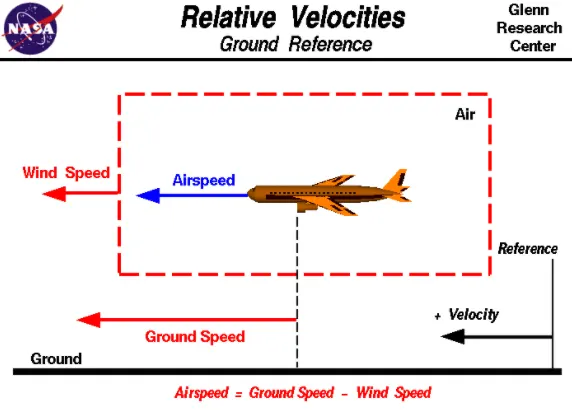
Firstly, ground speed is how fast the aircraft is travelling relative to a fixed point on the ground.
Air speed is the vector difference between the ground speed and wind speed. It is how fast an airplaen is really flying strictly under its own power.
---------------------------------------------------------------------
3) Aircraft engine power is not used to move it on the ground at the airport-
The aircraft gets its thrust from a jet blast where the gases from the engine are expelled with high energy. This causes the movement of aircraft when in air. Now for the movement of aircraft on the ground, if same method is used this wastes fuel stored for the flight and the engine exhaust might damage the nearby infrastructure. The engine might expell debris and dust onto the places surrounding the aircraft. Also, using the engine for this purpose poduces a lot of noise that is very uncomfortable to the crew and the passengers.
For the above mentioned reasons, a towing vehicle is used to maneuver the aircraft when on ground, until it reaches the runway, where it takes off.
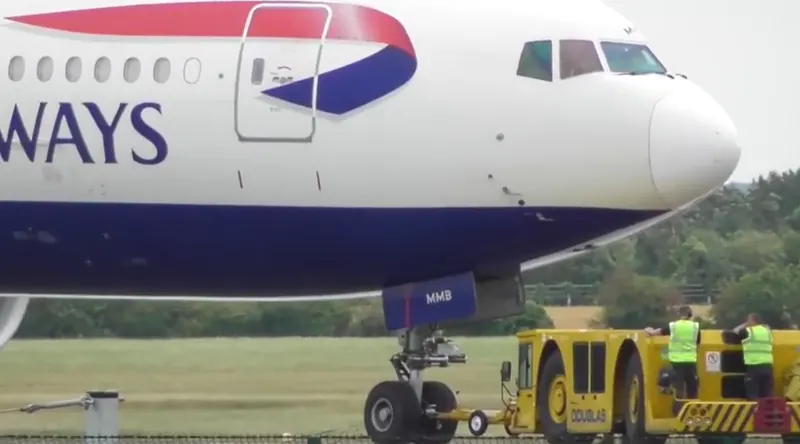
Towing with a taxibot saves on fuel and prevents engine wear and maintenance. Besides the controlling of the maneuvering is easier as the aircraft's sysrtems are not used for this purpose and the movement of the aircrafts get easier outside the boarding gates.
----------------------------------------------------------------------
4) Movement of aircraft to the runway when it is ready to take off-
The area on which aircraft move on the airfield can broadly be separated into three separate categories. The ramp, or apron, is where the stands are located for aircraft to park. The runways are what the aircraft use to takeoff and land. And the taxiways, which they use to get between the two.
A specialised vehicle called tug is used for the movement of aircraft from the apron to the runway. These vehicles push the aircraft backwards by using their power until they reach the taxiways. in this region, the aircraft taxes itself from one place to another.
----------------------------------------------------------------------
5) Take off power- Power developed by the aircraft to take off and become airborne. This power is usually very high although might not be the maximum of engine power that can be used. This helps aircraft achieve a safe altitude of flight before stabilizing.
Tyre Design - modern Aircraft tyres are usually tubeless, although they can be tubed as well. They are the point of contact of aircraft with the ground and support the vessel's weight while on ground. They are used for the movement on ground. They also are a part of suspension unit and absorb shock of landing by cushioning the impact even when the aircraft is moving on the ground. They have wide range of operating conditions and thus are properly maintained.
The number of wheels required for aircraft increases with the weight of the aircraft, as the weight of the aeroplane needs to be distributed more evenly.
- Design and construction of aircraft tyre.
Carcass plies are used to form the tire. They are sometimes called casing plies. An aircraft tyre is constructed for the purpose it serves.
- They support the weight of an aircraft while it is on the ground.
- It also provides the necessary traction for braking and stopping of an aeroplane.
- Tyre also helps to absorb the shock of landing and provide cushioning the roughness of takeoff, roll-out, and taxi operations.
Unlike an automobile or truck tyre, it does not have to carry a load for a long period of continuous operation. However, an aircraft tyre absorbs the high impact loads of landing, and also it’s operating at high speeds for a short time when required.
Load Rating – Load rating is the maximum permissible load at a specified inflation pressure.
Ply Rating – Ply Rating is used to identify the maximum recommended load rating and inflation pressure for a specified tyre. It is an index of tyre strength.
Speed Rating – The speed rating is the maximum takeoff speed to which the tyre has been tested.
Skid Depth – Skid depth is the distance between the tread surface and the deepest groove as measured in the mould.
Aircraft tyres must have an approved speed and load rating and have sufficient clearance when retracted through landing gear to allow for tyre growth. Tyre growth is the increase in the size of the tyre due to centrifugal forces at high speed.
Each tyre manufacturer produces their own designs of the tyre with different tread patterns, wear patterns, wear limits etc, and in some cases, different names for the same part of the tyre.
Rolling resistance- THis is the force that resists the motion of an objet rolling on a surface.
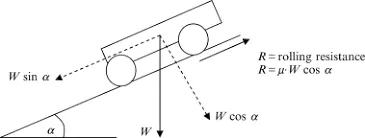
The term u in the formula is called rolling resistance coefficient.
The tyre's rolling resistance depends on tire inflation, pressure and the velocity of the flight when it ismoving on the wheels.
Tyre Pressure - The gas typically nitrogen inside the tyres pressurizes the tyre and inflates it. Aircraft tyre generally operates at high pressures upto 14 bar and even higher for business jets. Tyre pressure has to be maintained as per guidelines as they form one of the most important aspects of flight safety. Proper tyre pressure upon landing is needed to decrease the tyre skid and thereby preventing degradation fo the tyre.
Brake forces when landing - An aircraft that moves at speeds over 250 km/hr has to have robust braking system to stop it on touch down. An aircraft uses a mix of braking systems assisted by the engine, tyre braking and wing drag increment with the help of flaps and mechanical spoilers
The braking force required can be calculated considering the velocity of touch down, the distance in which the flight has to come to a stop or to some lower velocity value.
--------------------------------------------------------------------
6) Force and power required to push/pill an aircraft by a towin vehicle-
forces acting-
Rolling resistance - Fr = µ*W
µ- rolling resistance
W - normal force = mg
Aerodynamic drag force - Since the taxibot pulls and pushes the aircraft, the drag coefficient parameters of aircraft has to be accounted for the calucation of power requirement.
Fd = 0.5 * rho * v^2 * Cd * A
rho - density of air
v = velocity
cd - drag coeffcient
A= cross sectional area
Hill climbing forces are usually 0 as the airport is leveled during construction.
towing vehicle specifications -
Lets assume the aircraft to be Boein 737-500.
mass = 60000 kg
frontal area = 321.43 m2
coeff of rolling resistance - 0.012
towing boat weight - 12000 kg
tyre radius = 0.5175
velocity of towing vehicle -17 km /hr =4.7 m/s
calculations -
Rolling resistance, Fr = 0.012*(60000+12000)*9.8 = 8475.8 N
Drag force Fd = 0.5* 1.225 * 0.02* *321.43*4.7^2 = 88.75 N
Total force is the summation of above forces = 8564.59 N
Torque = Ftotal * tyre radius = 8564.59 * 0.5175 = 4893.66 Nm
Power = Ftotoal * V =8564.59 * 4.7 = 40.253 kw
----------------------------------------------------------------
7) Lets assume the towing operation is carried for 15 mins = 900 secs= 0.25 hr. Energy required to tow the aircraft is
E = 40.253*0.25 = 10.063 kWh
A brushless DC motor can be used with voltage 480 V and current 110 A.
The duty cycle can be calculated by dividing the power required by power of motor.
D=p/pin = 40.253/ (480*110) = 0.7623