Project 1 Mechanical design of battery pack
Aim:
To prepare a Battery pack of capacity 18 kWh with ANR26650M1-B cell
Mechanical design of Battery pack:
Our objective is to prepare a ANR26650M1-B cell Battery pack of capacity 18kWh.
ANR26650M1-B cell is a Lithium Iron phosphate (LPF), it's chemical name is`(LiFePO_4)`.
Cell production:
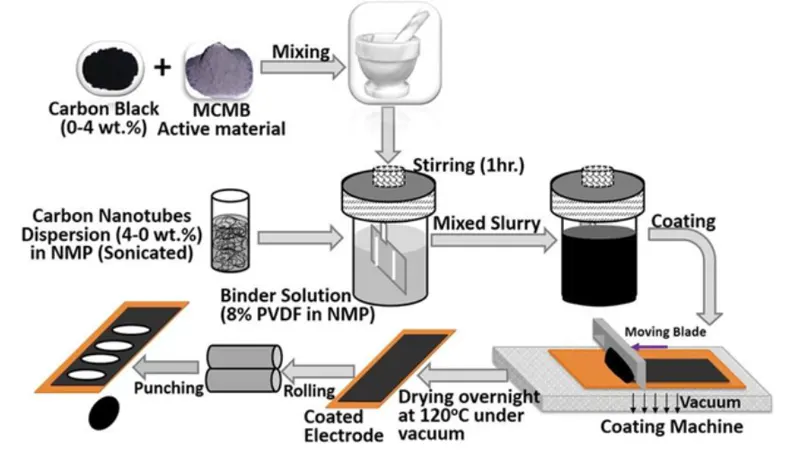
Lithium-ion cylindrical cells are made by rolling long strips of cathode foil, separator and anode foil together and inserting into a rigid stainless steel or aluminium cell housing. The housing is filled with liquid electrolyte, safety disks are inserted into the top and the electrodes are welded to the outer battery terminals. The cell is hermetically sealed by crimping the top disk assembly closed.
Characteristics of Lithium Iron phosphate (LPF):
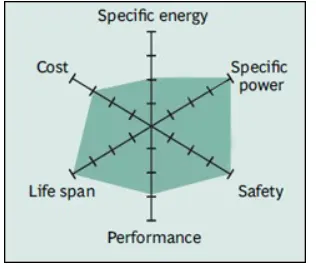
(LiFePO_4) batteries exhibit qualities that make them ideally suited for off-grid products where cost, safety, stability and cycle life are primary requirements. They have lower energy density than competing Li-ion chemistries and a lower output voltage of 3.2V, but this is a acceptable for most off-grid applications. Many successfull off-grid products use LiPO_4 batteries.
Cell: ANR26650M1-B is given form the formation and dimension of the cell, it is it's identification; thus a cyclindrical with a diameter of 26mm and the height of 65mm.
The given capacity for the required battery is 18kWh. Assuming 18kWh is the capacity includes the margin of 15-20%, the actual battery capacity required is around 15kWh. In order to desing for safety conditons we can have a capacity between 15-18kWh.
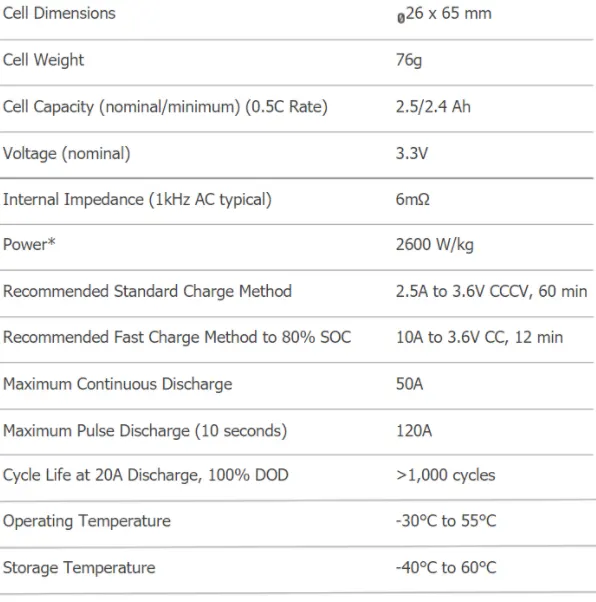
ANR26650M1-B Technical Data:
Let us assumed the Specifications of the Cell,
Battery pack calculation:
`En ergy``/Capacity = Power (P) * time (t)` `(kWh)`
`i.e;` Energy`/Capacity = Vo l ta g e (V) * Current (i) * time (t)`
`implies` `En ergy``/Capacity = Vo l t a g e (V) * Nom i n a l Capacity`
Let us assume that for 18kWh battery pack we need supply voltage of 200V and Capacity of 90Ah.
`i.e;` `18kWh = 200V * 90 Ah`
Cell parameters,
Nominal Voltage = 3.3V
Current capacity = 2.5Ah
Voltage calculation:
`200V = 3.3 * X`
where, `X=` No.of cell in series
`implies``X approx 60`
`therefore`To generate the 200V Voltage, 60 cell are to be connected in series (60S)
Capacity calculation:
`90Ah = 2.5 * Y`
where, `Y=` No.of cells in Parallel
`implies Y= 36`
`therefore`To generate the 90Ah Capacity, 36 cell are to be connected in parallel (36P)
The require battery pack cell combination is `'60S36P'`
The total no.of cells for `'60S36P'`` are `60*36= 2160 cells`
Cell Dimensions:
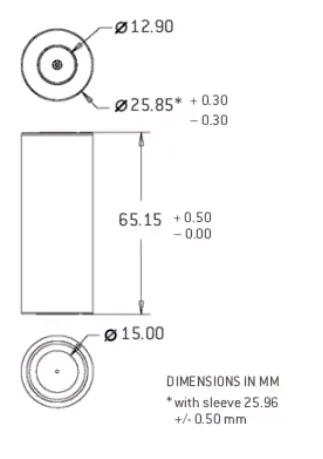
`Height = 65 mm`
`Diameter = 26 mm`
`Weight = 76 grams`
Cell Holder Dimensions:
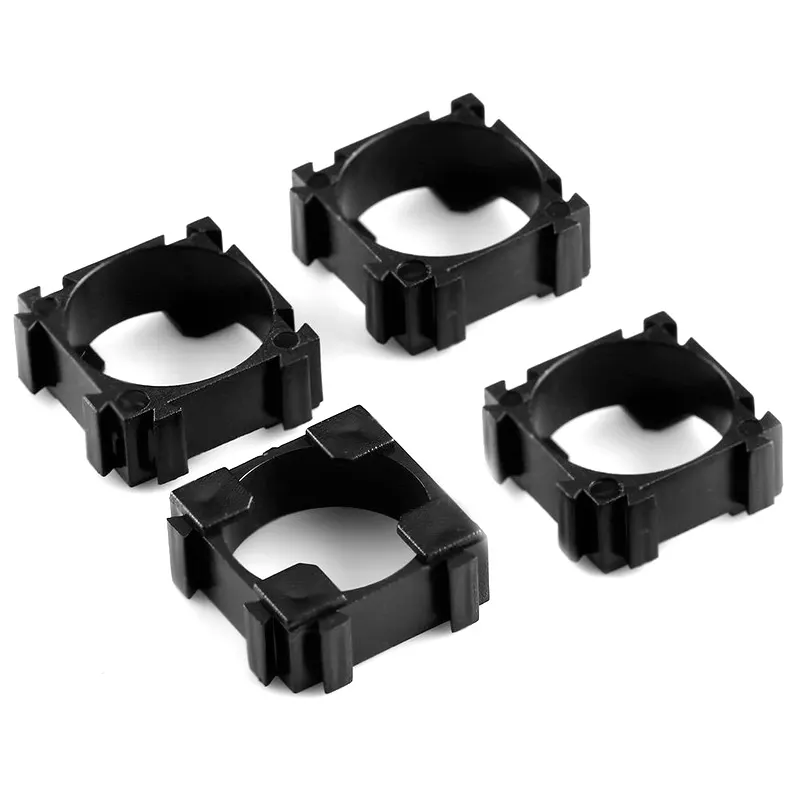
`Height = 10 mm`
`Diameter = 26 mm`
`Leng th = 29 mm`
`Width = 29 mm`
`Weight=5g`
Battery pack Assembly:
Arrangement of the cell in 60S36P together will not be the best arrangement. It will take 29*60 x 29*36 mm (1740 x 1044 mm) of space. And all the cells in a single matrix will lead to very poor thermal management. The ventilators will not be able to cool the inner cells properly. If this battery pack is assumed to the Electric Vehicle ( Electric rickshaw), .74 x 1.04 meter area is taken by the battery only.
A solution to the thermal and space challenge is to divide the battey into some modules. If we make a module of 10S6P (60 cells), this will create 33V 15Ah in each module. Like wise if we built 36 such modules will create a 60S36P array which results in 198V 90Ah.
Battery Module Dimensions:
`Leng th = 290 mm`
`Width = 174 mm`
Step 1:
Assemble cell holders in a 10S6P manner as below,
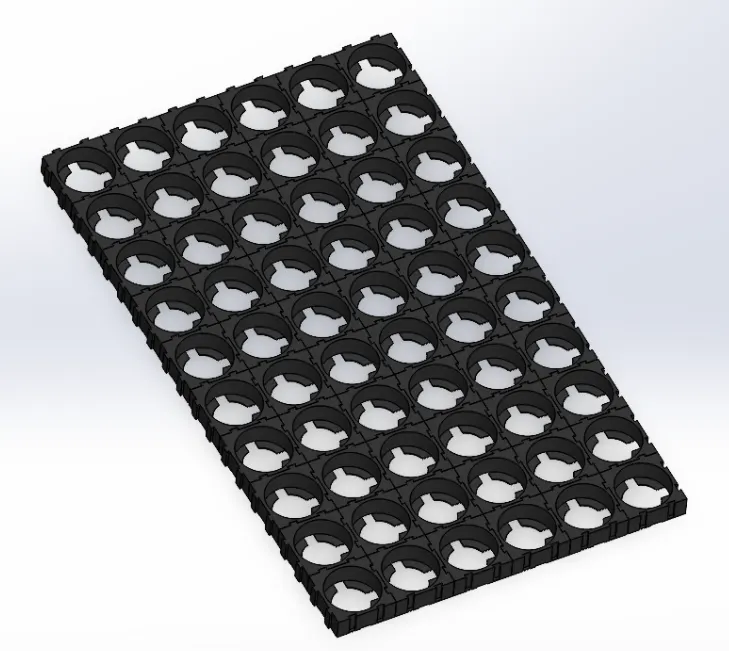
Step 2:
Assemble cells in the cell cell holders as below,
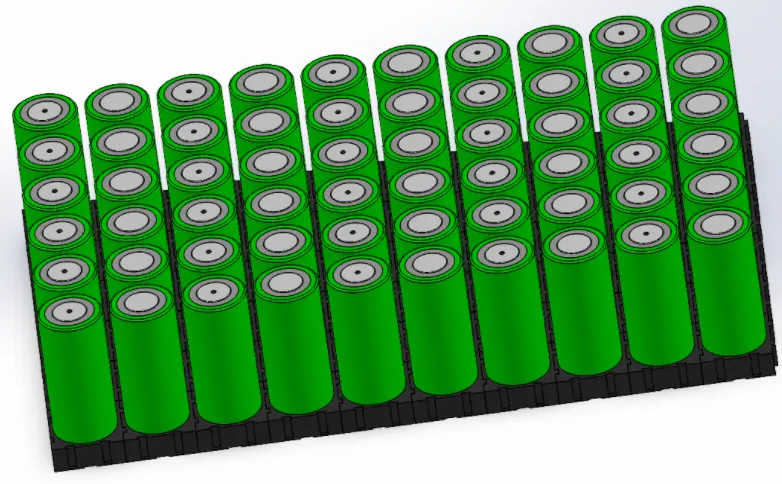
As it is a air cooling system, we should provide the proper gap between the cells for cooling.
Step 3:
Add cell holders on the upper side aswell.
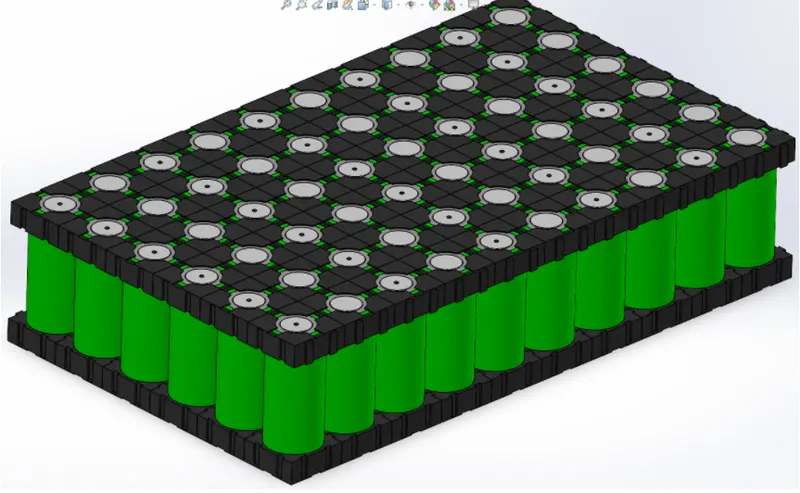
Step 4:
Connect the cells in the series and parelle connection withthe nickel strips.
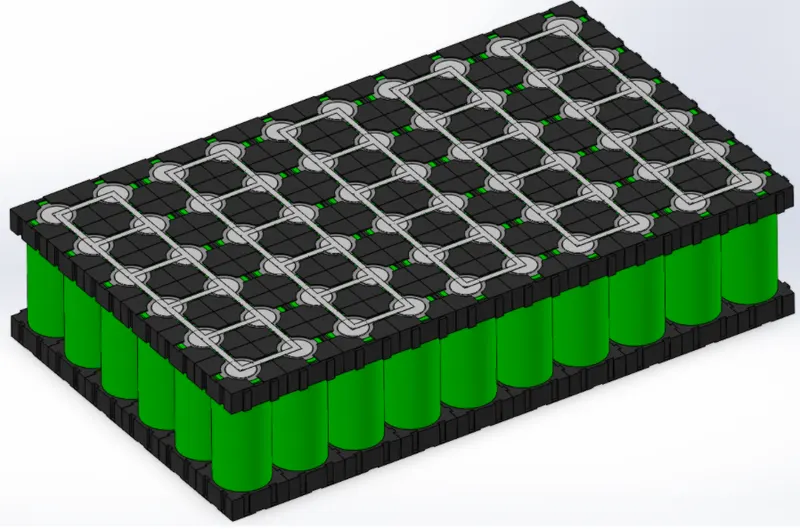
One module is completed.
Like wise prepare the 36 modules in 10S6P manner connection. The position of the module doesn't matter but the connection should be made in the proper manner.
Step 4:
Arrange the 36 modules as one battery pack.
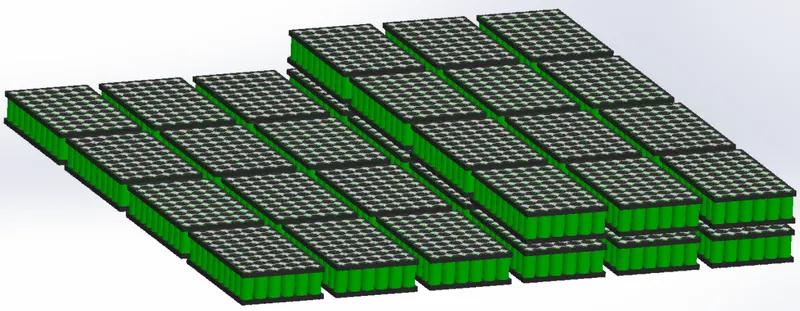
Step 5:
The complete battery pack incorporated with the Battery management system
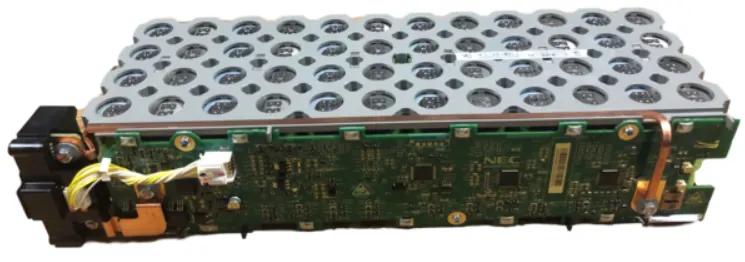
The functions of the BMS consists of monitoring the status of the battery cells (Vlotage, current and temperature), monitoring state of charge (SOC) and state of health (SOH) to estimate the states of the battery cells, performing diagnostics and communicating with diagnostic tools. Cell balancing is another important task carried out by the BMS, as we know multiple cells will be combined in seriies or parallel ot form a battery pack. The cell voltage of all the cells should always be equal.
Weight of the Battery pack = (Cell weight*2160)+ (Holder weight *2016*2)
= [(76*2160)+ (5*2*2160)]
= 185.76kg (Excludes BMS)
Safety:
Lithium-ion cells should be charged according to the battery manufacturer's specifications. Under no circumstances should cells be subject to over-charge, over-discharge or short circuit.
cells should not be subjected to mechanical abuse or stress.
Cells should not be subject to hightemperature charging `(>45^0C)` or low temperaturing charging.
Cells should be stored in a practically discharge state, typically between 20-40%
Cells used in a battery packs should be individually monitored and controlled by a BMS to prevent electrical stress.
Battery should be designed to allow passive cooling of individual cells and cell spacing should be designed to prevent thermal runaway from spreading cell to cell.
Conclusion:
This ANR36650M1-B Battery pack will generate 17.82kWh of capacity by arranging arranging 60S36P manner.
The total weight of the battery pack is 185.76kg.